Download the App & Start Learning
- Expert Faculty Guidance
- Updated Study Material
- Mock Tests & Practice Quiz
- Live Doubt Solving Sessions
- Exam-Oriented Preparation
- Motivation & Success Strategy
Katara Academy

Loading blogs…


Army Clerk Time Table 2026 helps candidates organise their daily preparation for the Agniveer Clerk / Store Keeper Technical (SKT) Common Entrance Examination (CEE). A fixed timetable makes it easier to cover General English, Mathematics, General Knowledge, General Science and Computer Science without leaving important topics for the final days.
The ideal timetable depends on the candidate's available study hours, current preparation level and weak subjects. Instead of following an unrealistic schedule, candidates should create a routine that includes concept study, question practice, revision, previous year papers and mock tests.
Important: Use the latest Indian Army recruitment notification as the final reference for the applicable CEE syllabus, exam pattern and recruitment instructions.
| Particular | Details |
|---|---|
| Post | Agniveer Clerk / Store Keeper Technical |
| Exam | Common Entrance Examination (CEE) |
| Questions | 50 |
| Maximum Marks | 200 |
| Exam Duration | 2 Hours |
| Main Subjects | General Knowledge, General Science, Mathematics, Computer Science and General English |
The Clerk/SKT preparation pattern contains five major subjects. General English represents a large portion of the written examination, while Mathematics also requires regular problem-solving practice. The remaining subjects should be revised consistently throughout the preparation.
| Subject | Questions | Marks | Study Priority |
|---|---|---|---|
| General Knowledge | 5 | 20 | Daily revision |
| General Science | 5 | 20 | Regular concept practice |
| Mathematics | 10 | 40 | Daily problem solving |
| Computer Science | 5 | 20 | Regular revision |
| General English | 25 | 100 | Daily practice |
| Total | 50 | 200 | Complete Preparation |
Candidates who can study for around 6 hours a day can divide their preparation into focused sessions. Breaks should be included between study sessions to maintain concentration.
| Time | Subject / Activity | Focus |
|---|---|---|
| 6:00 AM – 7:00 AM | General English | Grammar and vocabulary |
| 7:15 AM – 8:15 AM | Mathematics | Concepts and calculations |
| 10:00 AM – 11:00 AM | General Knowledge | Static GK and current affairs |
| 2:00 PM – 3:00 PM | Science | Concepts and MCQs |
| 5:00 PM – 6:00 PM | Computer Science | Computer fundamentals and MCQs |
| 8:00 PM – 9:00 PM | Revision / Test | Previous questions, mock test or error analysis |
The timings above are an example. Candidates with college, work or other responsibilities can shift the sessions to different hours while keeping the same subject distribution.
Candidates with only four hours available each day can use a compact timetable. The key is to study consistently and avoid completely skipping any subject for several days.
| Duration | Activity |
|---|---|
| 60 Minutes | General English |
| 60 Minutes | Mathematics |
| 45 Minutes | GK + Current Affairs |
| 45 Minutes | Science + Computer |
| 30 Minutes | Revision / Practice Questions |
Candidates with limited time can still maintain a daily routine by rotating subjects. Use the first hour for a high-priority subject and the remaining time for revision and mixed practice.
| Time | Activity |
|---|---|
| 60 Minutes | English / Mathematics |
| 30 Minutes | GK / Science / Computer rotation |
| 30 Minutes | Previous questions / Revision |
A weekly schedule can prevent candidates from repeatedly studying only their favourite subjects. Rotate the subjects throughout the week and reserve one day for a complete test and revision.
| Day | Main Subjects | Extra Activity |
|---|---|---|
| Monday | English + Mathematics | Vocabulary and formulas |
| Tuesday | GK + Science | Current affairs |
| Wednesday | English + Computer | Grammar and computer MCQs |
| Thursday | Mathematics + GK | Calculation and GK revision |
| Friday | Science + English | Science MCQs and vocabulary |
| Saturday | Mixed Practice | Previous year questions |
| Sunday | Mock Test + Revision | Analyse mistakes and weak topics |
Candidates who prefer morning study can use the first hours of the day for subjects requiring higher concentration. English and Mathematics can be placed in the morning, followed by GK and revision later in the day.
Candidates who have college, work or other daily responsibilities can divide preparation into shorter sessions. One subject can be studied before the day's activities and another during the evening. Weekend time can be used for longer revision and mock tests.
| Available Time | Suggested Routine |
|---|---|
| Morning 45 Minutes | English or Mathematics |
| Evening 60 Minutes | GK, Science or Computer |
| Night 30 Minutes | Revision and practice questions |
| Weekend | Full mock test + detailed analysis |
Previous year papers should be added after completing the relevant concepts. They help candidates practise earlier question styles and identify topics that require additional revision.
Mock tests are useful for improving time management and measuring preparation. Begin with subject-wise tests and gradually move towards full-length tests.
During the final week, focus on revision and practice instead of collecting new study material. Revise important formulas, grammar rules, vocabulary, GK facts, Science concepts, Computer terminology and previously incorrect questions.
| Day | Main Focus |
|---|---|
| Day 1 | English grammar and vocabulary revision |
| Day 2 | Mathematics formulas and practice |
| Day 3 | GK and current affairs revision |
| Day 4 | Science and Computer revision |
| Day 5 | Full-length mock test and analysis |
| Day 6 | Weak-topic revision and previous questions |
| Day 7 | Light revision and exam preparation |
There is no fixed number of hours suitable for every candidate. A consistent timetable based on available time, syllabus coverage and weak areas is more useful than simply counting study hours.
Candidates can begin with English or Mathematics during their highest-concentration period and rotate GK, Science and Computer throughout the day or week.
Yes, a two-hour routine can be used when time is limited. Focus on English or Mathematics, rotate GK, Science and Computer, and use the remaining time for revision and practice questions.
Subject-wise tests can be included during regular preparation. Full-length mock tests can be scheduled periodically, especially after completing a substantial portion of the syllabus.
Not necessarily. English and Mathematics benefit from frequent practice, while GK, Science and Computer can be rotated through the weekly timetable with regular revision.
Set realistic daily targets, track completed topics, keep an error notebook and review your progress every week. Adjust the schedule when a subject requires additional practice.
Army Clerk Time Table 2026 should provide a balanced combination of English, Mathematics, GK, Science and Computer Science preparation. Include daily practice, regular revision, previous year papers and periodic mock tests in your routine. Whether you have two, four or six hours available, a realistic and consistent timetable can help you organise your CEE preparation and monitor your progress.

Army Clerk Study Plan 2026 is designed to help candidates prepare systematically for the Agniveer Clerk / Store Keeper Technical (SKT) Common Entrance Examination (CEE). A proper timetable helps candidates divide their preparation time between General English, Mathematics, General Knowledge, General Science and Computer Science.
Instead of studying randomly, candidates should follow a fixed routine that includes concept learning, question practice, previous year papers, mock tests and revision. The study plan can be adjusted according to the candidate's available time, current preparation level and weak subjects.
Important: Check the latest Indian Army recruitment notification for the applicable examination pattern, syllabus, qualifying requirements and other recruitment instructions before following the final preparation schedule.
| Particular | Details |
|---|---|
| Post | Agniveer Clerk / Store Keeper Technical |
| Exam | Common Entrance Examination (CEE) |
| Questions | 50 |
| Maximum Marks | 200 |
| Exam Duration | 2 Hours |
| Main Subjects | General Knowledge, General Science, Mathematics, Computer Science and General English |
| Subject | Questions | Marks | Study Focus |
|---|---|---|---|
| General Knowledge | 5 | 20 | Static GK, defence, history, geography and current affairs |
| General Science | 5 | 20 | Physics, Chemistry and Biology basics |
| Mathematics | 10 | 40 | Arithmetic, algebra, geometry, mensuration and calculation practice |
| Computer Science | 5 | 20 | Computer fundamentals, hardware, software, MS Office and internet |
| General English | 25 | 100 | Grammar, vocabulary, comprehension and sentence correction |
| Total | 50 | 200 | Complete CEE Preparation |
A daily timetable should provide regular time to every subject. Since General English carries a large portion of the examination, it should receive consistent attention. Mathematics should also be practised regularly because speed and accuracy improve through repeated problem-solving.
| Session | Study Activity | Suggested Focus |
|---|---|---|
| Morning Session | General English | Grammar, vocabulary and practice questions |
| Session 2 | Mathematics | Concepts, formulas and problem solving |
| Session 3 | General Knowledge | Static GK and current affairs |
| Session 4 | Science + Computer | Concept revision and objective questions |
| Final Session | Revision / Test | Previous questions, mock test or error analysis |
The first month should focus on understanding the syllabus and building basic concepts. Start with General English grammar, basic Mathematics, fundamental Science, Computer basics and important GK topics.
The second month should focus on increasing question-solving practice. Start solving previous year papers and subject-wise tests after completing the related topics.
The final month should focus on revision, full-length mock tests and improving speed. Avoid continuously adding new study material. Concentrate on topics that are already part of your preparation.
Use the study plan as a framework, not as a rigid schedule. If Mathematics is your weak subject, increase its practice time. If English is already strong, use some of that time for revision and weaker areas.
| Day | Main Focus | Additional Practice |
|---|---|---|
| Monday | English + Mathematics | Vocabulary and formulas |
| Tuesday | GK + Science | Current affairs |
| Wednesday | English + Computer | Grammar and computer MCQs |
| Thursday | Mathematics + GK | Calculation and GK revision |
| Friday | Science + English | Science MCQs and vocabulary |
| Saturday | Mixed Practice | Previous year questions |
| Sunday | Mock Test + Revision | Analyse mistakes and revise weak topics |
Give English regular practice because it represents a major portion of the Clerk CEE. Divide your study sessions between grammar, vocabulary and objective questions.
Mathematics should be practised consistently rather than only during the final preparation period. Begin with basic arithmetic and gradually move towards more difficult topics.
These subjects can be prepared through short daily revision sessions. Avoid leaving them entirely for the last week. Use concise notes, objective questions and regular revision.
GK: Revise static GK and current affairs regularly.
Science: Focus on basic Physics, Chemistry and Biology concepts.
Computer: Revise fundamentals, hardware, software, memory, operating systems, MS Office and internet-related concepts.
Previous year papers and mock tests should become an important part of the study plan after basic concepts are covered. Previous papers help candidates understand earlier question styles, while mock tests provide repeated timed practice.
Maintaining a simple preparation record can make the study plan more effective. Record the topics completed, test scores, incorrect questions and areas requiring revision.
| Track | What to Record |
|---|---|
| Syllabus | Completed and pending topics |
| Mock Tests | Score, accuracy and time taken |
| Mistakes | Wrong and doubtful questions |
| Revision | Topics that need repeated revision |
During the final week, focus on revision rather than starting large new topics. Revise your short notes, formulas, vocabulary, GK facts, Computer concepts and previously made mistakes.
| Day | Focus |
|---|---|
| Day 1 | English grammar and vocabulary revision |
| Day 2 | Mathematics formulas and practice |
| Day 3 | GK and current affairs revision |
| Day 4 | Science and Computer revision |
| Day 5 | Full-length mock test and analysis |
| Day 6 | Weak-topic revision and previous questions |
| Day 7 | Light revision and exam preparation |
Start with the latest syllabus and divide the subjects into daily study sessions. Include concept learning, objective practice, previous year papers, mock tests and revision in your weekly schedule.
There is no fixed number of hours suitable for every candidate. The study duration should depend on your available time, current preparation level and remaining syllabus. Consistency is more important than simply counting study hours.
General English carries a significant portion of the CEE pattern, while Mathematics also requires regular problem-solving practice. However, candidates should allocate additional time to their weaker subjects.
A 30-day plan can provide a structured revision and practice schedule, but the required preparation time varies according to the candidate's existing knowledge, syllabus coverage and practice level.
Start with subject-wise tests after completing individual topics and gradually move to full-length mock tests as more of the syllabus is completed.
Yes. Previous year papers can help you practise earlier question styles and identify topics that require additional preparation.
Army Clerk Study Plan 2026 should balance concept learning, subject-wise practice, previous year papers, mock tests and revision. Follow a realistic daily timetable, give regular attention to General English and Mathematics, revise GK, Science and Computer Science consistently, and track your mistakes after every test. Adjust the schedule according to your preparation level and use the latest official recruitment information as the basis for your final exam preparation.

Army Clerk Preparation Strategy 2026 is important for candidates preparing for the Agniveer Clerk / Store Keeper Technical (SKT) Common Entrance Examination (CEE). A structured preparation plan helps candidates cover General Knowledge, General Science, Mathematics, Computer Science and General English while improving speed, accuracy and time management.
The best approach is to divide the syllabus into smaller topics, study concepts first, practise objective questions, solve previous year papers and regularly attempt mock tests. Candidates should also keep track of their mistakes and revise weak areas throughout the preparation period.
Important: Always compare your preparation with the latest Indian Army recruitment notification, syllabus and examination instructions because recruitment rules and examination details can change between cycles.
| Particular | Details |
|---|---|
| Post | Agniveer Clerk / Store Keeper Technical |
| Exam | Common Entrance Examination (CEE) |
| Questions | 50 |
| Maximum Marks | 200 |
| Subjects | General Knowledge, General Science, Mathematics, Computer Science and General English |
| Preparation Method | Concepts + Practice + Previous Papers + Mock Tests + Revision |
Before starting preparation, candidates should understand the distribution of questions and marks. The Clerk/SKT preparation pattern consists of five major subjects, with General English carrying the largest share of the written examination.
| Subject | Questions | Marks |
|---|---|---|
| General Knowledge | 5 | 20 |
| General Science | 5 | 20 |
| Mathematics | 10 | 40 |
| Computer Science | 5 | 20 |
| General English | 25 | 100 |
| Total | 50 | 200 |
General English is an important part of the Clerk CEE. Candidates should give regular time to grammar, vocabulary and comprehension-based practice.
Important areas include:
Read English questions carefully and maintain a vocabulary notebook. Revise difficult words regularly rather than trying to memorise a large number of words in one day.
Mathematics requires consistent problem-solving practice. Candidates should first understand the basic formula and method for each topic and then solve objective questions.
Important areas include:
Keep a separate formula notebook and practise calculations regularly. After solving a question, check whether the mistake was caused by a wrong formula, calculation error or misunderstanding of the question.
General Knowledge should be prepared through a combination of static GK and current awareness. Candidates should revise important facts regularly instead of trying to complete the entire subject in a short period.
Important areas include:
Prepare short notes for facts that are difficult to remember and revise them at regular intervals.
General Science preparation should focus on basic concepts from Physics, Chemistry and Biology. Candidates should understand the concept first and then practise objective questions.
School-level science concepts can be useful for building the foundation. After completing a topic, solve multiple-choice questions to check your understanding.
Computer Science is particularly relevant for Clerk/SKT candidates. Preparation should cover basic computer knowledge and common terminology.
A daily study plan should distribute time according to the syllabus and the candidate's weak areas. The following is an example that can be adjusted according to individual availability.
| Study Session | Activity |
|---|---|
| Session 1 | General English – Grammar and Vocabulary |
| Session 2 | Mathematics – Concepts and Questions |
| Session 3 | GK and Current Affairs |
| Session 4 | Science and Computer Science |
| Session 5 | Previous Year Questions / Mock Test |
| Final Revision | Review mistakes and revise short notes |
Candidates with limited preparation time can divide a 30-day plan into four stages. The exact number of hours should depend on the candidate's current preparation level.
Complete basic concepts from English, Mathematics, GK, Science and Computer Science. Prepare short notes for formulas, facts, vocabulary and difficult concepts.
Start solving topic-wise objective questions and previous year papers. Record every incorrect answer and revise the related topic.
Attempt mixed-subject tests and practise switching between different subjects. Focus on improving accuracy while maintaining speed.
Attempt full-length mock tests under timed conditions. Analyse each test and revise weak areas instead of simply moving to another test.
Previous year papers are an important part of preparation because they provide practice with earlier question styles. Candidates should solve papers after completing the relevant concepts and analyse every incorrect answer.
Mock tests should be used to measure preparation rather than simply to increase the number of attempts. Attempt tests under exam-like conditions and maintain a record of scores, time taken and mistakes.
During the final revision period, avoid starting too many new books or resources. Focus on your short notes, previously attempted questions, formulas, vocabulary, GK facts, computer terminology and mistakes from mock tests.
Keep your preparation organised and revise the topics that repeatedly cause mistakes. A calm and consistent revision routine can help you use the final preparation period efficiently.
Start by understanding the latest syllabus and exam pattern. Then divide the syllabus into subjects and topics, study concepts, practise objective questions and gradually add previous year papers and mock tests.
There is no compulsory order. Candidates can begin with their weaker subject while maintaining regular practice of General English, Mathematics, GK, Science and Computer Science.
Yes. Previous year papers provide useful practice with earlier question styles and can help candidates identify recurring concepts and weak areas.
There is no fixed number of hours suitable for every candidate. The important factors are consistency, syllabus coverage, practice, revision and the quality of study sessions.
Build basic concepts, memorise important formulas, solve topic-wise questions and practise calculations regularly. Analyse every wrong answer to identify the reason for the mistake.
Study grammar systematically, build vocabulary, practise sentence correction and comprehension questions and solve objective questions regularly.
Daily full-length tests are not necessary for every candidate. Use subject-wise tests during learning and gradually increase full-length mock-test practice as the examination approaches.
Army Clerk Preparation Strategy 2026 should combine syllabus-based study, subject-wise practice, previous year papers, mock tests and regular revision. Give special attention to General English, Mathematics and the remaining Clerk/SKT subjects according to the examination pattern. Track your mistakes, revise weak topics and follow the latest official recruitment information throughout the preparation process. A consistent and organised study routine can make your Army Clerk CEE preparation more systematic and measurable.

Army Clerk Books 2026 are useful for candidates preparing for the Agniveer Clerk / Store Keeper Technical (SKT) Common Entrance Examination (CEE). The right study material can help candidates understand concepts, practise objective questions, revise important topics and prepare according to the examination syllabus.
The Clerk/SKT CEE covers General Knowledge, General Science, Mathematics, Computer Science and General English. Candidates should select books according to the latest syllabus instead of collecting too many study materials. Subject-wise books, previous year papers and mock tests can be combined for structured preparation.
Important: Before purchasing any Army Clerk book, check its latest edition, syllabus coverage and question pattern. The current Indian Army recruitment notification should remain the primary reference for examination requirements.
| Particular | Details |
|---|---|
| Post | Agniveer Clerk / Store Keeper Technical |
| Exam | Common Entrance Examination (CEE) |
| Main Subjects | GK, General Science, Mathematics, Computer Science and General English |
| Question Type | Objective-type questions |
| Useful Resources | Subject books, previous year papers, mock tests and revision notes |
There is no single book that is compulsory for every candidate. Different preparation resources recommend different books for the same subject. The following books are commonly listed for Army Clerk and Agniveer CEE preparation and can be selected according to the candidate's level and study requirements.
| Subject | Book / Resource | Useful For |
|---|---|---|
| General Knowledge | Lucent's General Knowledge | Static GK and general awareness revision |
| General Knowledge | Advanced Objective General Knowledge – S. Chand | Objective GK practice |
| General Science | Encyclopedia of General Science – Arihant | Science concepts and revision |
| General Science | General Science for Competitive Exams | Objective science practice |
| Mathematics | Fast Track Objective Arithmetic – Rajesh Verma | Arithmetic concepts and practice |
| Mathematics | Objective Maths for Army Soldier GD, Clerk, Technical | Army-focused Mathematics practice |
| Computer Science | Objective Computer Awareness | Computer fundamentals and objective questions |
| Computer Science | Computer Awareness – Arihant | Basic computer concepts and revision |
| English | Objective General English – S.P. Bakshi | Grammar and objective English practice |
| English | General English for All Competitive Examinations – S.C. Gupta | Grammar, vocabulary and practice |
General Knowledge preparation requires a combination of static information and current awareness. A standard GK book can be used for history, geography, polity, economics, sports, awards, important personalities and other general topics.
Lucent's General Knowledge is widely used for competitive examination preparation. It can be used for building a basic static GK foundation and revising important facts.
An objective GK resource can be useful after completing basic concepts. Practising multiple-choice questions helps candidates become familiar with competitive-exam question formats.
Preparation Tip: Do not depend on an old GK book for current affairs. Use updated current-affairs material separately.
General Science preparation generally includes basic concepts from Physics, Chemistry and Biology. Candidates should select a book that explains concepts clearly and provides objective questions for practice.
This type of reference book can be used for broader General Science coverage and revision of competitive-examination concepts.
A competitive-exam science book can provide topic-wise explanations and practice questions. Candidates who need stronger conceptual foundations can also revise relevant school-level science textbooks.
Mathematics requires regular problem-solving practice. Candidates should select a book containing explanations, solved examples and a sufficient number of objective questions.
This resource is useful for arithmetic-based preparation and repeated practice. Candidates can use it to improve calculation speed after understanding the basic concepts.
An Army-focused Mathematics book can be useful for candidates who prefer questions and practice material aligned with Army recruitment examinations.
Preparation Tip: Maintain a formula notebook and revise important formulas regularly instead of repeatedly reading complete chapters.
Computer Science is an important part of Clerk/SKT preparation. Candidates should cover computer fundamentals, hardware, software, memory, operating systems, MS Office, internet, networking and common computer terminology according to the syllabus.
A dedicated Computer Awareness book can help candidates revise fundamental computer concepts and practise objective questions.
Objective computer resources are useful for practising terminology, abbreviations, basic hardware and software questions and other common competitive-exam topics.
English has a major role in the Clerk/SKT CEE pattern. Candidates should practise grammar, vocabulary, sentence correction, synonyms, antonyms, idioms, spelling, comprehension and other syllabus-based topics.
This book can be used for systematic grammar study and objective-question practice for competitive examinations.
This type of comprehensive English resource can help candidates revise grammar rules and practise competitive-exam questions.
Candidates who prefer studying from a single comprehensive resource can consider an Army Clerk-specific guide that combines multiple subjects. Current preparation resources list books specifically designed for Army Clerk/SKT preparation, along with separate subject-wise books.
A combined guide can be useful for revision, but it should not necessarily replace detailed subject books when a candidate has difficulty with a particular subject. Use the latest edition and compare the contents with the current syllabus before starting preparation.
No. A focused combination of one comprehensive Army Clerk guide, selected subject-wise books, previous year papers and mock tests can be enough for organised preparation. The quality of practice and revision is more important than collecting a large number of books.
| Resource | Main Purpose |
|---|---|
| Subject Books | Concept building and detailed study |
| Previous Year Papers | Understanding previous question styles |
| Mock Tests | Timed practice and performance analysis |
| Current Affairs | Recent events and general awareness revision |
| Short Notes | Quick revision before tests and examination |
Start by completing the syllabus topic by topic. Read the concept from the selected book and solve the practice questions immediately after studying the topic. Mark questions that you find difficult and revise them later.
After completing a subject, begin solving previous year papers and subject-wise tests. Once most of the syllabus is covered, move towards full-length mock tests. This approach connects concept learning with actual exam practice.
Useful resources include Army Clerk-specific guides and subject-wise books for General Knowledge, General Science, Mathematics, Computer Science and General English. Candidates should select books according to the latest syllabus and their preparation level.
Objective General English by S.P. Bakshi and General English for All Competitive Examinations by S.C. Gupta are commonly listed resources for competitive English preparation.
Candidates can use resources such as Fast Track Objective Arithmetic by Rajesh Verma or an Army-focused objective Mathematics book covering Clerk-level topics and practice questions.
Computer Awareness and Objective Computer Awareness resources can be used for computer fundamentals, terminology and objective-question practice.
Books are useful for learning and revision, but candidates should also practise previous year papers and mock tests. Current affairs should be prepared from an updated source.
Not necessarily. Candidates can begin with a comprehensive guide and add subject-specific books only where additional explanation or practice is required.
Army Clerk Books 2026 can provide the foundation for systematic CEE preparation. Select study material according to the latest syllabus, focus on concept clarity and solve enough objective questions after each topic. Combine your selected books with previous year papers, mock tests, current-affairs revision and regular practice. A focused study-material strategy can make Army Clerk preparation more organised and easier to track.

Army Clerk Mock Test 2026 is a useful practice resource for candidates preparing for the Indian Army Agniveer Clerk / Store Keeper Technical (SKT) Common Entrance Examination (CEE). A mock test helps candidates understand the exam structure, practise questions from different subjects, improve time management and identify topics that need more revision.
For effective preparation, candidates should combine mock tests with the latest Army Clerk syllabus, previous year papers, regular revision and timed practice. Mock tests should be attempted seriously so that the result reflects the candidate's actual preparation level.
Important: The actual examination pattern and qualifying requirements should always be checked against the latest Indian Army recruitment notification before the exam.
| Particular | Details |
|---|---|
| Post | Agniveer Clerk / Store Keeper Technical |
| Exam | Common Entrance Examination (CEE) |
| Questions | 50 |
| Maximum Marks | 200 |
| Major Subjects | General Knowledge, General Science, Mathematics, Computer Science and General English |
| Practice Mode | Full-length and subject-wise mock tests |
The Clerk/SKT CEE preparation pattern consists of five major subject areas. A full-length mock test should cover these subjects in proportions similar to the examination pattern.
| Subject | Questions | Marks |
|---|---|---|
| General Knowledge | 5 | 20 |
| General Science | 5 | 20 |
| Mathematics | 10 | 40 |
| Computer Science | 5 | 20 |
| General English | 25 | 100 |
| Total | 50 | 200 |
Mock tests provide a practice environment similar to a real examination. Candidates can practise answering questions continuously without depending on books or notes.
Time management is important in a competitive examination. Regular timed tests help candidates decide how much time to spend on easy, moderate and difficult questions.
After completing a mock test, candidates can analyse their performance subject by subject. Low scores can indicate areas that require additional revision.
A mock test is not only about attempting a large number of questions. Candidates should focus on reducing incorrect answers and avoiding careless mistakes.
Recording scores from every mock test allows candidates to compare their performance over time and identify whether their accuracy and speed are improving.
Do not stop after checking your score. Divide your mistakes into three categories: concept mistakes, calculation mistakes and careless mistakes. This makes your next revision more focused.
Practise grammar, vocabulary, sentence correction, synonyms, antonyms, idioms, spelling, comprehension and other syllabus-based questions. English forms a major portion of the Clerk CEE pattern, so regular practice is useful.
Practise arithmetic, number system, algebra, geometry, mensuration and other prescribed topics. Focus on calculation speed and accuracy while solving timed questions.
Use mock tests to revise history, geography, Indian Constitution, culture, defence-related information, sports, awards, important personalities and current affairs according to the syllabus.
Practise basic Physics, Chemistry and Biology questions. Analyse incorrect answers and revise the underlying concepts instead of memorising only the final answer.
Practise questions related to computer fundamentals, hardware, software, memory, operating systems, MS Word, MS Excel, PowerPoint, internet and common computer terminology.
| Mock Test | Previous Year Paper |
|---|---|
| Designed for current practice | Based on a previous examination or memory-based reconstruction |
| Can be attempted repeatedly | Useful for understanding earlier question styles |
| Useful for speed and accuracy practice | Useful for analysing previous questions and recurring concepts |
| Can include newly created questions | Reflects questions from an earlier recruitment cycle |
There is no fixed number of mock tests required for every candidate. The focus should be on quality, regular practice and detailed analysis. Candidates can start with subject-wise tests and gradually move towards full-length tests as the syllabus is completed.
| Preparation Stage | Practice Approach |
|---|---|
| Syllabus Learning | Subject-wise quizzes |
| Revision | Mixed-subject practice tests |
| Exam Practice | Full-length timed mock tests |
| Final Revision | Timed tests with detailed mistake analysis |
Start with topic-wise practice and gradually increase the difficulty. Once the basic syllabus is covered, attempt mixed-subject tests. Later, solve full-length mock tests under exam-like conditions. Maintain a performance record containing your score, time taken, incorrect answers and weak topics.
Candidates should also continue solving Army Clerk previous year papers because mock tests and previous papers serve different purposes. Previous papers help understand earlier question patterns, while mock tests provide additional timed practice.
It is a practice test designed around the Agniveer Clerk/SKT CEE syllabus and examination structure. It helps candidates practise questions, manage time and analyse preparation.
A full-length mock test based on the current Clerk/SKT CEE preparation pattern contains 50 questions for 200 marks.
The major subjects are General Knowledge, General Science, Mathematics, Computer Science and General English.
Yes. Mock tests provide timed practice and help candidates identify weak areas, improve accuracy and become familiar with answering questions under exam conditions.
Yes. Previous year papers and mock tests have different purposes. Using both can provide question-pattern practice as well as repeated timed practice.
Analyse every incorrect answer, identify weak topics, revise them and retake practice tests. Focus on both accuracy and time management rather than only increasing the number of attempts.
Army Clerk Mock Test 2026 can help candidates build exam familiarity, improve speed, increase accuracy and identify preparation gaps. For better results in practice, attempt tests under timed conditions, analyse mistakes carefully and revise weak subjects regularly. Combine mock tests with the latest syllabus and previous year papers to maintain a structured Army Clerk CEE preparation routine.

Preparing for the Indian Army Clerk or Store Keeper Technical (SKT) CEE becomes easier when candidates practice previous year question papers. Army Clerk previous year papers help aspirants understand the type of questions, subject distribution, difficulty level, time pressure and frequently tested concepts.
For Clerk/SKT preparation, previous papers can be used along with the latest syllabus and exam pattern. Available preparation resources include papers from different recruitment years, including memory-based papers and older official papers. For example, preparation platforms currently list Clerk/SKT papers from 2024, 2023, 2021 and 2020. :contentReference[oaicite:0]{index=0}
Important: Previous year papers are useful for practice, but candidates should follow the latest Indian Army notification, syllabus and CEE pattern for the current recruitment cycle.
| Particular | Details |
|---|---|
| Post | Agniveer Clerk / Store Keeper Technical |
| Exam | Common Entrance Examination (CEE) |
| Questions | 50 |
| Maximum Marks | 200 |
| Major Subjects | General Knowledge, General Science, Mathematics, Computer Science and General English |
| Practice Material | Previous papers, memory-based papers and mock tests |
Different preparation resources list Army Clerk/SKT papers from previous recruitment years. Candidates can use these papers to compare question types and identify recurring topics.
| Year | Paper Type | Use for Preparation |
|---|---|---|
| 2024 | Clerk/SKT memory-based paper | Recent question practice and pattern understanding |
| 2023 | Clerk/SKT memory-based paper | Topic and question-type practice |
| 2021 | Army Clerk paper | Additional full-paper practice |
| 2020 | Older Army Clerk papers | Concept revision and extra practice |
The availability and classification of papers can differ between sources. Some are identified as official papers, while others are memory-based papers reconstructed from candidates' recollection. Therefore, candidates should check the paper type before treating it as an official question paper. :contentReference[oaicite:1]{index=1}
The Clerk/SKT CEE includes five major subject areas. The current preparation pattern commonly used for Army Clerk includes General Knowledge, General Science, Mathematics, Computer Science and General English. Previous Clerk/SKT papers listed by preparation platforms also follow this broad subject structure. :contentReference[oaicite:2]{index=2}
| Subject | Questions | Marks |
|---|---|---|
| General Knowledge | 5 | 20 |
| General Science | 5 | 20 |
| Mathematics | 10 | 40 |
| Computer Science | 5 | 20 |
| General English | 25 | 100 |
| Total | 50 | 200 |
Previous papers show how questions can be framed from English, Mathematics, GK, Science and Computer Science. This helps candidates become familiar with different question formats.
When several papers are analysed together, candidates can identify topics that appear repeatedly or require additional revision.
Solving complete papers under a fixed time limit helps candidates practise quick calculation, reading and decision-making.
Candidates can record incorrect answers after every paper and revise the related concepts. This creates a systematic error-reduction process.
A previous paper can be used as a self-assessment test. The score can help candidates decide which subjects require more attention.
Do not simply count how many questions you answered correctly. Maintain an error notebook containing wrong answers, calculation mistakes, vocabulary errors, GK facts and computer concepts that need revision.
English carries a significant share of the Clerk CEE. Use previous papers to practise grammar, vocabulary, sentence correction, synonyms, antonyms, comprehension and other commonly tested areas.
Practise arithmetic, number system, algebra, geometry, mensuration and other syllabus topics. Focus on solving questions accurately within a limited time.
Previous questions can help you understand the type of static GK and general awareness topics used in preparation material. Revise important facts regularly.
Use previous papers to revise basic concepts from Physics, Chemistry and Biology. Focus on understanding concepts instead of memorising isolated answers.
Practise questions related to computer fundamentals, hardware, software, operating systems, MS Office, memory, internet and common computer terminology.
| Previous Year Paper | Mock Test |
|---|---|
| Based on a past examination or memory-based reconstruction | Created for current practice |
| Useful for understanding previous question styles | Useful for repeated timed practice |
| Helps identify recurring concepts | Helps measure current preparation |
Army Clerk/SKT previous papers are available through various exam-preparation platforms and study resources. Candidates should verify whether a paper is an official paper or a memory-based paper before using it as a reference.
The Clerk/SKT CEE pattern covered in current preparation material contains 50 questions for a total of 200 marks.
Practise General Knowledge, General Science, Mathematics, Computer Science and General English according to the latest syllabus and examination pattern.
Yes. Memory-based papers can provide additional practice and help candidates understand question styles. However, they should not be treated as identical to an official question paper unless their status is clearly verified.
There is no fixed number. Candidates should solve enough papers to understand the pattern, identify weak areas and consistently complete full papers within the required time.
A practical approach is to understand the syllabus first, practise previous papers, analyse mistakes and then use mock tests for regular timed practice.
Army Clerk Previous Year Papers are an important practice resource for candidates preparing for the Agniveer Clerk/Store Keeper Technical CEE. They can help you understand question patterns, improve speed, identify weak subjects and build exam familiarity. Use papers from multiple years, analyse every mistake and combine previous-paper practice with the latest syllabus, mock tests and regular revision for a structured preparation plan.

Army Clerk Previous Year Cut Off is useful for candidates preparing for the Agniveer Clerk / Store Keeper Technical (Clerk/SKT) Common Entrance Examination (CEE). Previous cut-off trends can help candidates understand the level of competition and set a practical target score for the examination.
The Army Clerk/SKT examination is conducted through the Common Entrance Examination. The written paper carries 200 marks, with Section A covering General Knowledge, General Science, Mathematics and Computer Science, while Section B consists of General English.
| Particular | Details |
|---|---|
| Post | Agniveer Clerk / Store Keeper Technical |
| Exam | Common Entrance Examination (CEE) |
| Total Marks | 200 Marks |
| Section A | 100 Marks |
| Section B – English | 100 Marks |
| Minimum Section A | 32 Marks |
| Minimum Section B | 32 Marks |
| Minimum Overall | 80 Marks |
Trade-wise Army Clerk/SKT cut-off figures available online are generally based on previous recruitment trends and reported merit levels rather than a single consolidated official cut-off published by the Indian Army. One recent analysis reports the Clerk/SKT cut-off trend at around 60%–65% for both 2025 and 2024. Since the CEE carries 200 marks, this corresponds to approximately 120–130 marks as a reported historical range.
| Recruitment Year | Reported Clerk/SKT Trend | Approx. Marks / 200 | Status |
|---|---|---|---|
| 2025 | 60%–65% | 120–130 | Reported previous-year trend |
| 2024 | 60%–65% | 120–130 | Reported previous-year trend |
| 2023 | Reported around 110–130 marks | 110–130 | Unofficial trend estimate |
For the 2025 recruitment cycle, recruitment-analysis sources have reported the Clerk/SKT cut-off around the 60%–65% range. On a 200-mark paper, this represents approximately 120–130 marks.
Candidates should use this range only as a reference for preparation. The minimum qualifying requirement remains different from the marks that may be needed for shortlisting or merit.
Available previous-year analysis also places the 2024 Clerk/SKT cut-off trend around 60%–65%, equivalent to approximately 120–130 marks out of 200.
The exact selection level can vary because Army recruitment is organised through different recruiting offices and vacancies can differ between recruitment areas.
Some previous-year analyses report a Clerk/SKT trend of approximately 110–130 marks for 2023. This range should be treated as an unofficial historical reference rather than an official consolidated cut-off.
Comparing several years is more useful than depending on one year's number because examination difficulty, competition and vacancies can change from one recruitment cycle to another.
One of the most important points for Army Clerk candidates is understanding the difference between minimum qualifying marks and the selection cut-off.
| Criteria | Marks | Meaning |
|---|---|---|
| Section A Qualifying | 32 | Minimum marks required in Section A |
| Section B Qualifying | 32 | Minimum marks required in English |
| Overall Qualifying | 80 | Minimum overall qualifying score |
| Previous-Year Trend | Varies | Used to understand competition and merit trends |
A candidate who scores 80 marks may meet the minimum qualifying requirement but should not assume that this score will be sufficient for selection. The actual merit level can be considerably different from the minimum qualifying score.
The number of candidates appearing for the Clerk/SKT examination can influence competition. A larger candidate pool can affect the merit level.
Available vacancies and recruitment requirements can vary by cycle and recruitment area. This can influence the number of candidates shortlisted.
The difficulty level of the question paper can affect the marks obtained by candidates. A comparatively difficult paper may produce a different score distribution from an easier paper.
The performance of candidates in a particular recruitment cycle also affects the merit level. Therefore, previous-year cut-offs cannot be treated as guaranteed marks for the next examination.
Army recruitment is organised through different recruiting offices. Vacancies and competition can vary between areas, which is why candidates should also check the applicable regional recruitment information.
The Clerk/SKT CEE contains two major sections. Section A covers four subjects, while Section B consists entirely of General English.
| Subject | Questions | Marks |
|---|---|---|
| General Knowledge | 5 | 20 |
| General Science | 5 | 20 |
| Mathematics | 10 | 40 |
| Computer Science | 5 | 20 |
| General English | 25 | 100 |
| Total | 50 | 200 |
Recent recruitment analyses have reported the Clerk/SKT trend around 60%–65% for 2024 and 2025, equivalent to approximately 120–130 marks out of 200. These figures are reference trends rather than a single official national cut-off.
Available analysis reports a Clerk/SKT trend of around 60%–65%, or approximately 120–130 marks out of 200. Candidates should treat this as an unofficial historical range.
Available previous-year analysis places the Clerk/SKT trend around 60%–65%, which corresponds to approximately 120–130 marks out of 200.
Some recruitment analyses report a Clerk/SKT trend of approximately 110–130 marks for 2023. This should be treated as an unofficial historical reference.
The Indian Army Clerk/SKT sample paper specifies 32 marks in Section A, 32 marks in Section B and 80 marks overall as the minimum qualifying requirements.
Not necessarily. Recruitment-area conditions, vacancies, competition and the applicable merit process can affect the marks associated with selection.
80 marks is the stated overall minimum qualifying requirement. Meeting the minimum does not guarantee selection because the merit or shortlisting level can be higher.
Previous cut-off trends can help candidates understand competition and set a preparation target. Candidates should aim to score comfortably above the minimum qualifying marks rather than preparing only to reach the minimum.
The Army Clerk Previous Year Cut Off provides a useful reference for candidates preparing for the Clerk/SKT CEE. Recent analyses report Clerk/SKT trends around 60%–65% for 2024 and 2025, while some 2023 analyses report approximately 110–130 marks. However, these figures are not a substitute for an official consolidated cut-off. Candidates should focus on achieving a strong score in the 200-mark CEE, clearing the sectional qualifying requirements and preparing for the typing and subsequent recruitment stages.

Army Clerk Cut Off 2026 is an important topic for candidates appearing for the Agniveer Clerk / Store Keeper Technical (Clerk/SKT) Common Entrance Examination (CEE). The Clerk/SKT CEE carries a total of 200 marks and candidates must satisfy the prescribed minimum qualifying requirements in both sections as well as the overall examination.
| Particular | Details |
|---|---|
| Exam | Indian Army Agniveer CEE 2026 |
| Category | Agniveer Clerk / Store Keeper Technical |
| Total Marks | 200 Marks |
| Section A | 100 Marks |
| Section B – English | 100 Marks |
| Minimum Section A | 32 Marks |
| Minimum Section B | 32 Marks |
| Minimum Overall | 80 Marks |
The official Indian Army Clerk/SKT practice paper states that candidates must score at least 32 marks in Section A and 32 marks in Section B separately. The candidate must also obtain at least 80 marks in total to qualify the written examination. :contentReference[oaicite:1]{index=1}
| Section | Maximum Marks | Minimum Qualifying Marks |
|---|---|---|
| Section A | 100 | 32 |
| Section B – General English | 100 | 32 |
| Total | 200 | 80 |
Scoring only 80 marks should therefore be understood as meeting the stated minimum qualifying requirement, not as a guarantee of selection. The actual shortlisting and merit position can depend on the applicable recruitment process, vacancies and candidate performance.
There is an important difference between qualifying marks and the selection cut-off. Qualifying marks are the minimum marks required to pass the examination according to the prescribed rules. The selection cut-off refers to the level of marks associated with shortlisting or merit for a particular recruitment process.
For the 2026 Agniveer CEE, several education and recruitment sources have reported that the Indian Army does not provide a single publicly applicable Clerk cut-off figure for all candidates. Instead, selection is handled through the applicable regional/ARO-wise recruitment process and merit lists. The Indian Express also reported that the Army releases regional, ARO-wise merit lists rather than a single public cut-off list. :contentReference[oaicite:2]{index=2}
Therefore, candidates should be careful with websites that present one number as the guaranteed official Army Clerk Cut Off 2026. Expected cut-off figures published by coaching or recruitment websites are estimates and can differ from the actual selection level.
Various recruitment websites have published different expected ranges for Clerk/SKT based on previous trends, examination difficulty and competition. For example, one 2026 analysis estimated the Clerk/SKT cut-off around 120–130 marks out of 200, while another analysis gave a different range. These figures are unofficial estimates and should not be presented as an official Indian Army cut-off. :contentReference[oaicite:3]{index=3}
The Clerk/SKT CEE consists of two sections. Section A includes General Knowledge, General Science, Mathematics and Computer Science. Section B consists of General English. The official Army sample paper provides the following structure. :contentReference[oaicite:4]{index=4}
| Subject | Questions | Marks |
|---|---|---|
| General Knowledge | 5 | 20 |
| General Science | 5 | 20 |
| Mathematics | 10 | 40 |
| Computer Science | 5 | 20 |
| General English | 25 | 100 |
| Total | 50 | 200 |
The selection level can change from one recruitment cycle to another. Candidates should understand the major factors that can influence the marks required for shortlisting.
A higher number of candidates competing for available opportunities can affect the level of competition.
The number of vacancies available for a particular trade and recruitment area can affect the merit position required for selection.
If a particular examination is comparatively difficult or easier, the overall marks obtained by candidates can vary.
The overall performance of candidates appearing for the CEE is another factor that can influence the merit level.
Army recruitment is organised through different recruiting offices and zones. Competition and vacancies can vary by recruitment area, so candidates should check the applicable ARO or ZRO information.
The Clerk/SKT recruitment process also includes a typing test during the online CEE. The official Indian Army sample paper states that 30 words per minute in English is desirable. Only candidates who qualify the typing test are eligible for the call-up for the Phase-II recruitment process. :contentReference[oaicite:5]{index=5}
Therefore, candidates should not focus only on written marks. English typing practice should also be included in the preparation plan.
The exact selection cut-off should not be confused with the minimum qualifying marks. The official Clerk/SKT practice paper specifies 32 marks in each section and 80 marks overall as minimum qualifying requirements. The actual merit level can vary according to the applicable recruitment process.
Candidates must score at least 32 marks in Section A, 32 marks in Section B and 80 marks overall according to the official Indian Army Clerk/SKT sample paper.
80 marks is the stated minimum overall qualifying requirement. Meeting the minimum does not guarantee selection because the subsequent shortlisting and merit process can depend on the applicable recruitment conditions.
The Clerk/SKT CEE is conducted for a total of 200 marks, with 100 marks in Section A and 100 marks in General English.
Yes. The official Clerk/SKT practice paper specifies a minimum of 32 marks separately in Section A and Section B, along with 80 marks overall.
The recruitment process uses applicable regional and ARO-wise merit arrangements, and a single cut-off number should not be assumed for every candidate or recruitment area.
Candidates should aim substantially above the minimum qualifying marks rather than preparing only for 80 marks. Since unofficial expected cut-offs vary, candidates should focus on maximising their score and meeting all other selection requirements.
The Army Clerk Cut Off 2026 should be understood in two parts: the official minimum qualifying requirement and the actual merit level used for shortlisting. For Clerk/SKT CEE, the official Indian Army practice paper specifies 32 marks in each section and 80 marks overall. However, these marks do not guarantee selection. Candidates should aim for a strong overall score, prepare General English carefully, practise all Section A subjects and work on the Clerk/SKT typing test to improve their chances of progressing to the next recruitment stage.

Army Clerk Promotion 2026 is an important topic for candidates planning a career in the Indian Army as an Agniveer Clerk / Store Keeper Technical (Clerk/SKT). Under the current Agnipath system, an Agniveer is initially engaged for four years. During this period, the individual serves in a distinct Agniveer rank. After completion of four years, eligible Agniveers may be considered for enrolment in the regular cadre according to organisational requirements, applicable policies and objective selection criteria.
| Career Stage | Details |
|---|---|
| Initial Entry | Agniveer Clerk / Store Keeper Technical |
| Initial Engagement | Four years under the Agnipath scheme |
| During Agniveer Service | Military training and assigned duties as an Agniveer |
| After Four Years | Opportunity to apply for regular enrolment |
| Regular Cadre | Up to 25% of each specific batch may be enrolled, subject to applicable criteria |
| Further Career | Regular Army service and career progression are governed by applicable service rules |
The Agnipath scheme provides a four-year engagement for Agniveers. During this period, Agniveers form a distinct rank in the Armed Forces. Therefore, candidates should not assume that joining as an Agniveer Clerk automatically leads to the conventional Army promotion hierarchy during those four years.
The major career progression point comes at the end of the four-year engagement. Agniveers can be offered an opportunity to apply for permanent enrolment in the Indian Army. Applications are considered centrally on the basis of objective criteria, including performance during the four-year engagement.
After completing four years, an Agniveer Clerk may be considered for regular enrolment. The Government's Agnipath framework states that applications for permanent enrolment are considered in a centralised manner using objective criteria, including performance during the four-year engagement period.
Up to 25% of each specific batch of Agniveers may be enrolled in the regular cadre. Selection is therefore not automatic and an Agniveer does not have a guaranteed right to permanent enrolment.
For candidates who are selected into the regular cadre, the subsequent service is governed by the applicable regular service conditions and policies of the Indian Army.
The career path can be understood in two broad stages: the initial Agniveer period and, for those selected, subsequent regular Army service.
The candidate joins the Indian Army as an Agniveer Clerk / Store Keeper Technical after completing the prescribed recruitment process. The individual undergoes military training and performs duties assigned to the category and unit.
Clerk-related work can include administration, documentation, computer operations, records, correspondence and other office responsibilities. Store Keeper Technical duties can involve stores, inventory and related records.
At the end of the four-year engagement, the Agniveer may have the opportunity to apply for regular enrolment. Selection is based on the criteria and policies applicable at that time.
Agniveers selected for regular enrolment continue their careers under the applicable regular Army service conditions. Their future career progression and promotions are then governed by the rules applicable to regular personnel of the Indian Army.
Candidates often search for a fixed hierarchy such as Clerk → Lance Naik → Naik → Havildar. However, the exact career progression for a regular Army individual depends on the applicable service rules, trade, appointment, vacancies, performance and other conditions. It is therefore not appropriate to treat a fixed promotion timeline as guaranteed for every Army Clerk.
For an Agniveer Clerk, the more important distinction is between the initial four-year Agniveer engagement and subsequent regular cadre service if selected.
| Period | Career Position | Promotion Status |
|---|---|---|
| Year 1 | Agniveer Clerk | Agniveer engagement |
| Year 2 | Agniveer Clerk | Agniveer engagement |
| Year 3 | Agniveer Clerk | Agniveer engagement |
| Year 4 | Agniveer Clerk | Consideration for regular enrolment |
| After 4 Years | Regular cadre, if selected | Future progression under regular service rules |
Selection for regular enrolment is not based simply on completing four years. The Government has stated that applications are considered centrally using objective criteria, including performance during the four-year engagement period.
Organisational requirements and the policies issued by the Armed Forces also form part of the framework. Consequently, candidates should focus on maintaining good performance and meeting all applicable service requirements during their engagement.
Although regular enrolment is not guaranteed, candidates can focus on performing their assigned responsibilities properly and maintaining professional standards throughout their service.
The Agnipath scheme provides an initial four-year service opportunity along with the prescribed financial and service benefits. Agniveers receive a customised monthly package, applicable Risk and Hardship allowances and other benefits according to the scheme and service rules.
On completion of four years, Agniveers who are not selected for regular enrolment receive the applicable Seva Nidhi package. Those selected for regular cadre continue under the applicable regular service conditions.
According to the original Agnipath framework, individuals selected for regular enrolment are required to serve for a further engagement period of at least 15 years and are governed by the existing terms and conditions applicable to Junior Commissioned Officers/Other Ranks in the Indian Army, as amended from time to time.
This means that regular cadre service is different from the initial Agniveer engagement. Once selected for regular enrolment, the individual's future career progression is handled under the applicable regular Army service framework.
Agniveers form a distinct rank during their four-year engagement. Candidates should not assume the conventional regular Army promotion hierarchy applies automatically during this period.
After four years, an Agniveer may be given an opportunity to apply for regular enrolment. Selection is based on applicable objective criteria, performance and organisational requirements.
Yes, an Agniveer can be considered for regular enrolment after the four-year engagement. However, permanent enrolment is not guaranteed.
Up to 25% of each specific batch of Agniveers may be enrolled in the regular cadre, subject to the applicable selection process and requirements.
No. Completion of four years does not guarantee regular enrolment. The Army considers applications according to organisational requirements, policies and objective selection criteria.
The selected individual continues in the regular Army under the applicable terms and conditions of service. Future career progression is then governed by the relevant regular service rules.
An Agniveer should focus on performance, discipline, military training, physical fitness, professional skills and compliance with applicable service requirements. Final selection remains subject to the Army's prescribed criteria and organisational requirements.
The Army Clerk Promotion 2026 pathway is different from the traditional promotion system because candidates initially join as Agniveers under the Agnipath scheme. The initial engagement is for four years, after which eligible Agniveers may apply for regular enrolment. Up to 25% of each specific batch may be selected for the regular cadre based on objective criteria, performance and organisational requirements. Candidates who enter regular service then follow the applicable Army service rules for their future career progression.

The Army Clerk Posts List 2026 is useful for candidates who want to understand the different roles available under the Agniveer Clerk / Store Keeper Technical category. In the Indian Army recruitment notification, the category is generally mentioned as Agniveer Clerk / Store Keeper Technical (Clerk/SKT).
| Post / Role | Main Work | Work Area |
|---|---|---|
| Agniveer Clerk | Office administration, documentation and records | Army offices and units |
| Store Keeper Technical (SKT) | Store, inventory and supply-related records | Army stores and units |
These are the two main roles associated with the Clerk / Store Keeper Technical recruitment category. Candidates should carefully read the recruitment notification for the particular recruiting year because vacancies, eligibility conditions and allocation can vary.
The Agniveer Clerk role focuses mainly on administrative and clerical responsibilities within the Army. Clerks help maintain official records, prepare documents and support the routine administrative functioning of their assigned unit.
Store Keeper Technical (SKT) is the store and inventory-oriented role within the Clerk/SKT category. The work is associated with maintaining records of stores, equipment, supplies and other authorised items.
The exact nature of SKT duties depends on the unit, appointment and responsibilities assigned by the Army.
| Feature | Army Clerk | Store Keeper Technical |
|---|---|---|
| Primary Focus | Administration and clerical work | Stores and inventory management |
| Records | Personnel, office and administrative records | Stock, equipment and store records |
| Computer Work | High importance | Used for records and inventory-related work |
| Typing | Important for clerical work | Useful for documentation and records |
| Main Work Environment | Office / administrative section | Store / logistics section |
Clerk and Store Keeper Technical are commonly grouped together in Army recruitment as Agniveer Clerk / Store Keeper Technical. They share the same recruitment category and eligibility framework, while the actual duties can differ after appointment.
A candidate should therefore not assume that Clerk and SKT are completely separate recruitment categories. The recruitment notification determines the category, eligibility, selection process and applicable requirements for the particular cycle.
For the Clerk / Store Keeper Technical category, candidates generally need to have passed 10+2 / Intermediate in any stream, such as Arts, Commerce or Science, with the marks requirements specified in the recruitment notification.
The current recruitment information specifies 60% aggregate marks and a minimum of 50% in each subject. Candidates must also have at least 50% marks in English and in Mathematics/Accounts/Book Keeping in Class XII.
Typing is particularly relevant to the Clerk/SKT recruitment process. The Army's Clerk/SKT recruitment information specifies an English typing speed of around 30 words per minute as desirable for the typing test.
Candidates preparing for Army Clerk should therefore practise English typing regularly. Both speed and accuracy are important because clerical work involves preparing and maintaining official records.
Candidates applying for Clerk/SKT have to appear for the Online Common Entrance Examination (CEE) as part of the recruitment process. The Clerk/SKT examination covers areas such as General Knowledge, General Science, Mathematics, Computer Science and General English.
The CEE is followed by the subsequent recruitment stages according to the Army's notified selection procedure.
| Skill | Use in Clerk/SKT Work |
|---|---|
| Typing | Document preparation and computer-based work |
| Computer Knowledge | Digital records, documents and office applications |
| Mathematics | CEE preparation and numerical record work |
| English | Communication, documentation and CEE preparation |
| Accuracy | Important for official records and inventory information |
| Organisation | Helps manage files, registers and stores |
Clerk/SKT personnel gain experience in administration, documentation, computer operations, record management and store-related work. These skills can also be useful for administrative and inventory-related responsibilities outside the military.
Under the Agniveer system, the initial engagement is for four years. After the four-year period, up to 25% of a batch may be considered for enrolment in the regular cadre, subject to performance, organisational requirements and applicable selection criteria.
The main roles under the Clerk/SKT category are Agniveer Clerk and Store Keeper Technical (SKT).
They are grouped under the same Clerk/Store Keeper Technical recruitment category, but their duties can differ according to the appointment and unit.
An Army Clerk mainly handles administrative work, documentation, records, computer operations, correspondence and other office responsibilities.
A Store Keeper Technical handles store and inventory-related records, stock documentation, receipt and issue records and other duties related to stores and supplies.
The Clerk/SKT category generally requires 10+2 in any stream with the marks and subject-wise conditions specified in the recruitment notification.
Yes. English typing is an important part of the Clerk/SKT recruitment process, and around 30 words per minute is specified as desirable for the typing test.
Yes. The Clerk/SKT educational qualification allows 10+2 candidates from Arts, Commerce and Science streams, subject to the prescribed aggregate, subject-wise and English/Mathematics or Accounts/Book Keeping requirements.
The Army Clerk Posts List 2026 mainly covers the Agniveer Clerk and Store Keeper Technical (SKT) roles under the Clerk/SKT category. Clerk responsibilities focus more on administration, documentation and records, while SKT responsibilities are more closely connected with stores, inventory and supply records. Candidates should check the latest Indian Army notification for the applicable recruitment year before applying and prepare for the CEE, typing test, physical, medical and document verification stages.

Army Clerk, officially recruited under the Agniveer Clerk / Store Keeper Technical (Clerk) category, is an important administrative role in the Indian Army. The job mainly involves office administration, record management, documentation, computer operations, correspondence and other clerical responsibilities. Depending on the posting and duties assigned, personnel may also work with stores, inventory and related records.
An Army Clerk is responsible for supporting the administrative functioning of an Army unit. Clerks work with official files, records, correspondence, data and office documentation. They may also assist senior personnel with routine administrative work and maintain information required for the smooth functioning of the unit.
The post requires accuracy, discipline, confidentiality, computer knowledge and good communication skills. Since the Army operates through a structured administrative system, correct documentation and timely record maintenance are important parts of the job.
| Particular | Details |
|---|---|
| Post | Agniveer Clerk / Store Keeper Technical (Clerk) |
| Nature of Work | Administrative, Clerical, Computer and Record Management |
| Main Workplace | Army offices, units and other assigned establishments |
| Important Skills | Computer knowledge, typing, accuracy, communication and organisation |
| Typing Requirement | English typing at around 30 words per minute is desirable during the CEE typing test |
| Selection Route | CEE, Typing Test, Physical Tests, Medical and other notified stages |
One of the important responsibilities of an Army Clerk is maintaining official records and files. The clerk may update documents, arrange files and ensure that required information is properly recorded and accessible to authorised personnel.
Accuracy is especially important because administrative records can contain important information relating to personnel, office activities and unit administration.
Army Clerks assist with preparing and maintaining different types of office documents. This may include letters, reports, statements, notices, registers and other official paperwork assigned by the unit.
The work requires careful checking of names, numbers, dates and other details before documents are processed or forwarded.
Computer knowledge is an important part of the Army Clerk profile. Clerks may use computers and office applications for data entry, document preparation, record maintenance and other administrative tasks.
Typing speed and accuracy are also important. The Indian Army's Clerk/SKT sample paper information states that an English typing speed of 30 words per minute is desirable during the typing test. Candidates who qualify the typing test can proceed to the next stage as per the recruitment process.
Army offices require regular updating of records and information. Clerks may enter data into computer systems, update existing records and prepare information required by authorised officials.
This work demands concentration because even a small data-entry mistake can create problems in official records.
Clerks can assist with official correspondence within the unit. This may involve preparing, receiving, recording, organising and forwarding official communications according to established procedures.
Proper handling of correspondence helps ensure that instructions and administrative information reach the concerned personnel on time.
An Army Clerk may assist in routine office management and administrative activities. This can include maintaining registers, organising documents, preparing statements and supporting senior personnel with assigned office work.
The specific duties depend on the unit, office and responsibilities assigned to the individual.
Depending on the appointment and work assigned, clerical duties can include basic bookkeeping and handling financial or accounting-related records. Candidates with good numerical ability and attention to detail can find these tasks easier to manage.
Since official records may involve financial information, accuracy and proper documentation are important.
The Clerk/SKT category also covers store-related responsibilities. A Store Keeper Technical may be involved in maintaining records of stores, equipment and supplies and supporting the accounting and distribution of authorised items.
There is no single fixed daily routine for every Army Clerk because work depends on the unit and current administrative requirements. A typical working day may include checking assigned tasks, updating records, preparing documents, handling computer work, maintaining files and completing office responsibilities.
| Skill | Why It Matters |
|---|---|
| Computer Knowledge | Useful for digital records, documents and office applications. |
| Typing | Helps in preparing documents and completing computer-based work efficiently. |
| Accuracy | Important for records, data entry and official documents. |
| Communication | Useful for handling official correspondence and office coordination. |
| Organisation | Helps maintain files, records, registers and inventory information. |
| Discipline | Essential for working within the Army's structured environment. |
Army Clerk work includes a significant amount of office and administrative work, but candidates should not assume that it is a civilian-style desk job. An Agniveer is part of the Indian Army and must follow military discipline, training, physical standards and service requirements.
The job profile may therefore combine administrative responsibilities with military training and duties assigned by the Army.
After selection, candidates undergo military training as prescribed by the Indian Army. Training is designed to develop discipline, physical fitness, military skills and the knowledge required for the assigned category.
For Clerk/SKT personnel, the role-specific work can involve computer operations, documentation, record management and store-related procedures in addition to military training.
Army Clerk is recruited under the Agniveer system. The Agniveer engagement is for four years. During the service period, personnel receive military training, perform their assigned duties and gain experience in administration, documentation, computer operations and related areas.
As per the Agniveer scheme, up to 25% of a batch may be considered for enrolment in the regular cadre of the Armed Forces, subject to performance, organisational requirements and the applicable selection criteria.
An Army Clerk mainly handles administrative work such as maintaining records, preparing documents, data entry, correspondence, computer operations and other office duties assigned by the unit.
Agniveer Clerk is initially a four-year engagement under the Agnipath scheme. After four years, up to 25% of the batch may be considered for regular cadre enrolment according to applicable criteria and organisational requirements.
Yes. Typing is an important part of the Clerk/SKT selection process. The Indian Army sample paper states that English typing at 30 words per minute is desirable during the typing test.
No. Computer work is an important part of the profile, but the role can also involve files, registers, documentation, correspondence, office administration and other duties.
Clerical work focuses mainly on administration, documentation, records and office duties, while Store Keeper Technical responsibilities focus more on stores, inventory, equipment records, receipt, issue and stock management. The exact duties depend on the assignment.
Candidates should develop English, mathematics, computer knowledge, typing speed, general knowledge, accuracy, communication and organisational skills along with physical fitness and military discipline.
The Army Clerk Job Profile 2026 is suited to candidates interested in administrative and computer-based responsibilities within the Indian Army. The role involves maintaining records, preparing documents, handling correspondence, data entry and supporting office administration, while Store Keeper Technical duties can include inventory and store management. Candidates should therefore prepare not only for the CEE and typing test but also for the physical, medical and other recruitment stages.

Army Clerk Salary 2026 is based on the Agnipath scheme for candidates recruited as Agniveer Clerk / Store Keeper Technical (SKT) in the Indian Army. The salary is provided as a customised monthly package, which increases every year during the four-year engagement period.
Under the current Agniveer pay structure, the monthly package starts at ₹30,000 in the first year and increases to ₹40,000 in the fourth year. Around 70% of the monthly package is paid as in-hand salary, while 30% is contributed to the Agniveer Corpus Fund. The Government of India makes a matching contribution to the corpus. :contentReference[oaicite:0]{index=0}
Quick Salary Overview: Army Clerk Agniveer salary starts at ₹30,000 per month, with approximately ₹21,000 in-hand in the first year. By the fourth year, the monthly package becomes ₹40,000, with approximately ₹28,000 in-hand.
The salary package for Agniveer Clerk / SKT follows the common Agniveer pay structure. The amount increases progressively from the first year to the fourth year.
| Year | Monthly Package | In-Hand Salary | Agniveer Corpus Contribution | Government Contribution |
|---|---|---|---|---|
| 1st Year | ₹30,000 | ₹21,000 | ₹9,000 | ₹9,000 |
| 2nd Year | ₹33,000 | ₹23,100 | ₹9,900 | ₹9,900 |
| 3rd Year | ₹36,500 | ₹25,550 | ₹10,950 | ₹10,950 |
| 4th Year | ₹40,000 | ₹28,000 | ₹12,000 | ₹12,000 |
Salary figures are approximately as specified in the Agniveer recruitment notification. Applicable allowances are separate from the customised monthly package. :contentReference[oaicite:1]{index=1}
The Army Clerk in-hand salary is approximately 70% of the customised monthly package. The remaining 30% is contributed to the Agniveer Corpus Fund.
Therefore, an Army Clerk Agniveer receives approximately ₹21,000 per month in the first year. This increases to approximately ₹23,100 in the second year, ₹25,550 in the third year and ₹28,000 in the fourth year.
Important: In-hand salary should not be confused with the monthly package. The monthly package includes the amount allocated toward the Agniveer Corpus Fund.
Under the Agnipath scheme, 30% of the customised monthly package is contributed by the Agniveer to the Agniveer Corpus Fund. The Government of India makes an equal matching contribution.
| Year | Agniveer Contribution | Government Matching Contribution |
|---|---|---|
| 1st Year | ₹9,000/month | ₹9,000/month |
| 2nd Year | ₹9,900/month | ₹9,900/month |
| 3rd Year | ₹10,950/month | ₹10,950/month |
| 4th Year | ₹12,000/month | ₹12,000/month |
| Total after 4 Years | Approx. ₹5.02 lakh | Approx. ₹5.02 lakh |
The current recruitment material states that the combined corpus contribution is approximately ₹10.04 lakh excluding interest after four years. The final Seva Nidhi amount includes applicable accrued interest. :contentReference[oaicite:2]{index=2}
After completion of the four-year engagement period, eligible Agniveers who exit service receive a one-time Seva Nidhi package. The package consists of the Agniveer's contribution, the matching Government contribution and applicable interest.
The current recruitment material gives an approximate absolute amount of ₹10.04 lakh excluding interest. Therefore, the final amount payable can be higher after applicable interest is added. :contentReference[oaicite:3]{index=3}
Tax Benefit: The Seva Nidhi package is specified as tax-exempt under the Agnipath scheme. :contentReference[oaicite:4]{index=4}
In addition to the customised monthly package, Agniveers are eligible for applicable allowances according to the conditions of service. The official Agnipath scheme provides for Risk and Hardship allowances as applicable. Other benefits and allowances are governed by the applicable Army rules and posting conditions. :contentReference[oaicite:5]{index=5}
Depending on applicable rules and circumstances, benefits can include provisions related to travel, clothing, ration and other service-related facilities. Candidates should check the latest recruitment notification and Army instructions for the allowances applicable to their service conditions.
The Agniveer package includes several benefits in addition to monthly pay. These benefits are provided according to the applicable rules during the four-year engagement.
The official scheme provides ₹48 lakh non-contributory life insurance cover to Agniveers for the duration of their engagement. :contentReference[oaicite:6]{index=6}
No. Agniveers serving under the Agnipath scheme are not entitled to pensionary benefits or gratuity under the scheme. The current recruitment material specifically states that Agniveers are not entitled to gratuity and pensionary benefits. :contentReference[oaicite:7]{index=7}
The financial arrangement instead includes the monthly salary package, Corpus Fund contributions and the Seva Nidhi package payable after completion of the engagement period, subject to the applicable rules.
The Agniveer engagement period is four years. At the end of this period, the Army follows the applicable selection and organisational requirements for further retention in the regular cadre. Candidates who are not retained exit service with the applicable Seva Nidhi benefits.
The Government's original Agnipath scheme provides that up to 25% of a batch may be enrolled in the regular cadre after four years, subject to performance and organisational requirements. :contentReference[oaicite:8]{index=8}
Candidates who continue in the regular cadre after the Agniveer engagement are governed by the applicable terms and conditions of regular service. The salary structure after regular enrolment should therefore not be confused with the four-year Agniveer salary package.
| Year | Monthly Package | Approx. In-Hand | Corpus Contribution |
|---|---|---|---|
| Year 1 | ₹30,000 | ₹21,000 | ₹9,000 |
| Year 2 | ₹33,000 | ₹23,100 | ₹9,900 |
| Year 3 | ₹36,500 | ₹25,550 | ₹10,950 |
| Year 4 | ₹40,000 | ₹28,000 | ₹12,000 |
The Agniveer Clerk/SKT monthly package starts at ₹30,000 in the first year and increases to ₹40,000 in the fourth year.
The approximate in-hand salary in the first year is ₹21,000 per month, before considering any applicable adjustments or allowances.
The fourth-year customised monthly package is ₹40,000, with approximately ₹28,000 paid as the 70% in-hand component.
Yes. The Agniveer monthly package increases from ₹30,000 in the first year to ₹33,000 in the second, ₹36,500 in the third and ₹40,000 in the fourth year.
Approximately 30% of the customised monthly package is contributed to the Agniveer Corpus Fund. The Government makes an equal matching contribution.
The current recruitment material specifies approximately ₹10.04 lakh as the absolute corpus amount excluding interest after four years. The final Seva Nidhi includes applicable interest.
Yes. The Agnipath scheme specifies that the Seva Nidhi package is exempt from income tax.
No. Agniveers under the Agnipath scheme are not entitled to pensionary or gratuity benefits.
Yes. Agniveers receive applicable allowances such as Risk and Hardship allowances according to service conditions and applicable Army rules.
The Agniveer engagement is for four years. At the end of this period, applicable selection rules determine retention in the regular cadre. Those exiting receive the applicable Seva Nidhi benefits.
Army Clerk Salary 2026 under the Agnipath scheme starts with a customised monthly package of ₹30,000 in the first year and increases to ₹40,000 in the fourth year. The approximate in-hand salary ranges from ₹21,000 to ₹28,000 across the four years, while 30% of the package is contributed to the Agniveer Corpus Fund with an equal Government contribution.
In addition to the monthly salary, Agniveers receive applicable allowances, life insurance cover and a Seva Nidhi package after the engagement period, subject to the applicable rules. Candidates should always check the latest Indian Army recruitment notification for the current salary, allowances and service conditions.

Army Clerk Syllabus 2026 is designed for candidates preparing for the Agniveer Clerk / Store Keeper Technical (SKT) Common Entrance Examination (CEE). The written examination tests candidates in General Knowledge, General Science, Mathematics, Computer Science and General English. The syllabus covers basic concepts and practical knowledge relevant to the Clerk/SKT category. :contentReference[oaicite:0]{index=0}
Understanding the complete syllabus before starting preparation helps candidates divide their study time between subjects and focus on the topics that carry more marks. General English has the highest weightage in the Clerk/SKT CEE, while Mathematics, General Knowledge, General Science and Computer Science form the other section.
Army Clerk Syllabus Quick Overview: The CEE covers General Knowledge, General Science, Mathematics, Computer Science and General English. The current Clerk/SKT pattern has 50 questions for 200 marks, with 25 questions in Part I and 25 questions in Part II. :contentReference[oaicite:1]{index=1}
| Part | Subjects | Questions | Marks |
|---|---|---|---|
| Part I | General Knowledge | 5 | 20 |
| General Science | 5 | 20 | |
| Mathematics | 10 | 40 | |
| Computer Science | 5 | 20 | |
| Part II | General English | 25 | 100 |
| Total | 50 | 200 | |
The General Knowledge section checks the candidate's awareness of India, the world, important institutions and current events. The syllabus includes subjects related to history, culture, geography, defence, sports and important national and international developments. :contentReference[oaicite:2]{index=2}
Candidates should regularly revise current affairs along with static General Knowledge. Special attention should be given to Indian defence-related information because the Clerk/SKT examination is part of Army recruitment.
General Science covers basic concepts from Physics, Chemistry and Biology. Questions are based mainly on fundamental scientific knowledge and its application in everyday life. :contentReference[oaicite:3]{index=3}
Study Tip: Revise school-level Science concepts and practise objective questions. Understanding basic concepts is more useful than memorising isolated facts.
Mathematics is an important part of the Army Clerk CEE. It contains 10 questions carrying 40 marks in the current pattern. The syllabus covers arithmetic, algebra, geometry, mensuration and trigonometry. :contentReference[oaicite:4]{index=4}
The Computer Science section contains 5 questions carrying 20 marks. The syllabus focuses on fundamental computer knowledge and commonly used software applications. :contentReference[oaicite:5]{index=5}
Candidates should understand the basic functions of common computer components and office applications. Questions may test practical knowledge rather than advanced programming concepts.
General English is the largest section of the Army Clerk CEE, with 25 questions carrying 100 marks. Candidates should therefore devote sufficient preparation time to grammar, vocabulary, comprehension and sentence usage. :contentReference[oaicite:6]{index=6}
Important: General English carries 100 marks out of the 200-mark CEE. Candidates should practise grammar questions, vocabulary and comprehension regularly instead of preparing English only during the final stage.
| Subject | Questions | Marks |
|---|---|---|
| General Knowledge | 5 | 20 |
| General Science | 5 | 20 |
| Mathematics | 10 | 40 |
| Computer Science | 5 | 20 |
| General English | 25 | 100 |
| Total | 50 | 200 |
The Clerk/SKT examination requires candidates to meet the prescribed qualifying marks in both parts. The available recruitment material specifies 32 marks in Part I, 32 marks in Part II and 80 marks overall. :contentReference[oaicite:7]{index=7}
| Part | Minimum Qualifying Marks |
|---|---|
| Part I | 32 Marks |
| Part II – General English | 32 Marks |
| Overall | 80 Marks |
| Daily Activity | Suggested Time |
|---|---|
| General English | 60 Minutes |
| Mathematics | 60 Minutes |
| GK & Current Affairs | 45 Minutes |
| General Science | 30 Minutes |
| Computer Science | 30 Minutes |
| Typing Practice | 15–20 Minutes |
| Mock Test / Revision | 45 Minutes |
The Army Clerk CEE syllabus includes General Knowledge, General Science, Mathematics, Computer Science and General English.
There are five subjects: General Knowledge, General Science, Mathematics, Computer Science and General English.
General English has the highest weightage, with 25 questions carrying 100 marks.
Mathematics includes number systems, arithmetic operations, HCF, LCM, percentages, ratio and proportion, averages, interest, profit and loss, speed, time and distance, time and work, algebra, geometry, mensuration and trigonometry.
The English syllabus includes comprehension, parts of speech, articles, nouns, pronouns, adjectives, prepositions, conjunctions, verbs, tenses, sentence structure, active and passive voice, direct and indirect speech, vocabulary and sentence correction.
Computer Science covers computer systems, memory, input/output devices, operating systems, Windows, MS Word, MS PowerPoint and MS Excel.
General Science covers basic Physics, Chemistry and Biology, including cells, human body, growth and reproduction, common diseases and their prevention, along with fundamental scientific concepts.
The available Clerk/SKT recruitment material specifies 32 marks in Part I, 32 marks in Part II and 80 marks overall.
Yes. Clerk/SKT candidates have to qualify the prescribed English typing test during the online CEE as part of the selection process.
The Army Clerk Syllabus 2026 covers five major subjects: General Knowledge, General Science, Mathematics, Computer Science and General English. The current Clerk/SKT CEE pattern gives the highest weightage to General English, followed by Mathematics, while GK, Science and Computer Science complete Part I. :contentReference[oaicite:8]{index=8}
Candidates should prepare every subject according to the official syllabus, revise regularly and practise objective questions and mock tests. Along with CEE preparation, regular English typing practice is important for candidates targeting the Clerk / Store Keeper Technical category.

Army Clerk Exam Pattern 2026 is an important part of preparation for candidates applying for Agniveer Clerk / Store Keeper Technical (SKT) in the Indian Army. The selection process includes the Online Common Entrance Examination (CEE), followed by a typing test for Clerk/SKT candidates and the Phase-II recruitment process.
The Army Clerk CEE is conducted in online mode and consists of objective multiple-choice questions. The Clerk/SKT paper contains 50 questions carrying 200 marks and is divided into two sections. Candidates need to qualify both sections as well as the overall examination. The typing test is conducted during the online CEE itself. :contentReference[oaicite:0]{index=0}
Quick Overview: Army Clerk CEE consists of 50 questions, 200 marks and two sections. Section A contains Mathematics, General Knowledge, General Science and Computer Science, while Section B contains General English. The English typing test is also conducted during the online CEE.
| Particulars | Details |
|---|---|
| Post | Agniveer Clerk / Store Keeper Technical |
| Exam Name | Common Entrance Examination (CEE) |
| Mode | Online Computer-Based Test |
| Question Type | Objective Multiple-Choice Questions |
| Total Questions | 50 |
| Total Marks | 200 |
| Sections | Section A and Section B |
| Marks per Question | 4 marks |
| Typing Test | Conducted during online CEE |
| Typing Speed | 30 WPM in English is desirable |
The Army Clerk CEE paper is divided into Section A and Section B. Both sections contain 25 questions. Each question carries 4 marks, making the total paper worth 200 marks.
| Section | Subjects | Questions | Marks |
|---|---|---|---|
| Section A | General Knowledge | 5 | 20 |
| General Science | 5 | 20 | |
| Mathematics | 10 | 40 | |
| Computer Science | 5 | 20 | |
| Section B | General English | 25 | 100 |
| Total | 50 | 200 | |
Section A contains 25 questions for 100 marks. It tests the candidate's knowledge of Mathematics, General Knowledge, General Science and Computer Science.
General Knowledge contains 5 questions carrying 20 marks. Candidates should cover important national and international events, Indian history, geography, polity, sports, awards, defence-related information and important current affairs.
General Science contains 5 questions carrying 20 marks. Preparation should cover basic concepts of Physics, Chemistry and Biology. Candidates can revise important school-level science concepts and regularly practise objective questions.
Mathematics has the highest number of questions in Section A, with 10 questions carrying 40 marks. Candidates should focus on calculation speed and accuracy while preparing important arithmetic and basic mathematical concepts.
Important preparation areas may include number system, simplification, percentage, ratio and proportion, average, profit and loss, simple and compound interest, time and work, time and distance, mensuration, algebra and geometry.
Computer Science contains 5 questions carrying 20 marks. Candidates should understand basic computer concepts, hardware and software, operating systems, MS Office, internet, networking, input and output devices and common computer terminology.
Section B consists of 25 General English questions carrying 100 marks. Since English accounts for half of the total written marks, candidates should give special attention to grammar, vocabulary and comprehension.
Important areas for preparation include parts of speech, articles, tenses, active and passive voice, direct and indirect speech, synonyms, antonyms, sentence correction, spelling, vocabulary, fill in the blanks and reading comprehension.
Preparation Focus: General English carries 100 out of 200 written marks. Candidates should therefore include daily English practice along with Mathematics, GK, Science and Computer preparation.
The Indian Army's SKT/Clerk sample paper states that candidates have to score at least 32 marks in Section A, 32 marks in Section B and 80 marks in total to qualify the written examination. :contentReference[oaicite:1]{index=1}
| Qualification Requirement | Minimum Marks |
|---|---|
| Section A | 32 marks |
| Section B – General English | 32 marks |
| Total | 80 marks |
The typing test is an important part of the Clerk/SKT examination. It is conducted during the online CEE rather than being treated as a separate Phase-II written examination.
The current recruitment information specifies that 30 words per minute (WPM) in English is desirable. Only candidates who qualify the typing test are eligible to be called for the next phase of recruitment. :contentReference[oaicite:2]{index=2}
Typing Practice Tip: Practise English typing every day. Start with accuracy and gradually increase your speed toward 30 WPM or above. Avoid looking continuously at the keyboard while practising.
The recruitment material for Clerk/SKT candidates specifies a 10-minute computer typing test. Candidates see a displayed passage and type the same text into the designated area on the computer. The typing test checks typing speed and accuracy. :contentReference[oaicite:3]{index=3}
Since the typing test is qualifying in nature for progression to Phase II, candidates should practise it alongside their written CEE preparation rather than waiting until the examination date.
The Common Entrance Examination is conducted in multiple languages. The recruitment information lists 13 languages, including English, Hindi, Malayalam, Kannada, Tamil, Telugu, Punjabi, Odiya, Bengali, Urdu, Gujarati, Marathi and Assamese. :contentReference[oaicite:4]{index=4}
Candidates should check the language options available while selecting their examination centre and follow the instructions displayed during the application and examination process.
Each question in the Clerk/SKT sample paper carries 4 marks. The official sample paper also specifies that candidates must meet the minimum qualifying marks in both sections as well as the overall paper. :contentReference[oaicite:5]{index=5}
The current recruitment notification states that correct answers receive full marks and unattempted questions receive no marks. It also states that questions attempted and marked for review are considered for evaluation. Candidates should follow the marking instructions displayed on the examination screen and the latest applicable notification. :contentReference[oaicite:6]{index=6}
| Component | Details |
|---|---|
| Written CEE | 50 MCQs |
| Written Marks | 200 marks |
| Section A | 25 questions, 100 marks |
| Section B | 25 English questions, 100 marks |
| Typing Test | English typing during online CEE |
| Desirable Typing Speed | 30 WPM |
| Activity | Suggested Time |
|---|---|
| English Grammar & Vocabulary | 60 minutes |
| Mathematics | 60 minutes |
| GK & General Science | 45 minutes |
| Computer Science | 30 minutes |
| Typing Practice | 15–20 minutes |
| Mock Test / Revision | 45–60 minutes |
The Army Clerk CEE consists of 50 objective questions carrying 200 marks. The paper is divided into Section A and Section B, with 25 questions in each section.
A total of 50 questions are asked in the Clerk/SKT CEE.
The written Army Clerk CEE carries 200 marks.
The examination includes General Knowledge, General Science, Mathematics, Computer Science and General English.
General English contains 25 questions carrying 100 marks.
Mathematics contains 10 questions carrying 40 marks.
Yes. The typing test for Agniveer Clerk / Store Keeper Technical is conducted during the online CEE.
30 words per minute in English is the desirable typing speed mentioned in the current recruitment information.
The Army's SKT/Clerk sample paper specifies minimum 32 marks in Section A, 32 marks in Section B and 80 marks overall.
Yes. The Common Entrance Examination is conducted as an online computer-based objective examination.
The Army Clerk Exam Pattern 2026 consists of a 50-question, 200-mark online CEE divided into two sections. Section A covers General Knowledge, General Science, Mathematics and Computer Science, while Section B focuses on General English. English carries 100 marks, making it an important part of the preparation strategy.
Clerk/SKT candidates should also prepare seriously for the typing test because it is conducted during the online CEE and must be qualified before moving to the Phase-II recruitment process. Regular mock-test practice, subject-wise revision and daily English typing practice can help candidates become familiar with the examination format.

Army Clerk Selection Process 2026 for Agniveer Clerk / Store Keeper Technical (SKT) is conducted through a structured selection system under the Agnipath Scheme. Candidates have to qualify the required stages before they can be considered for final selection.
For the current Recruiting Year 2027 recruitment, the selection process is conducted in two main phases. Phase I consists of the Online Common Entrance Examination (CEE), while Phase II consists of the Recruitment Rally, including the Physical Fitness Test (PFT), Physical Measurement Test (PMT) and Medical Examination. For Clerk/SKT candidates, a typing test is conducted during the online CEE. :contentReference[oaicite:0]{index=0}
Army Clerk Selection Stages: Online CEE → Clerk Typing Test → Shortlisting on CEE Merit/Cut-off → Recruitment Rally → Physical Fitness Test → Physical Measurement Test → Medical Examination → Final Merit → Enrolment.
| Stage | Selection Test |
|---|---|
| Phase I | Online Common Entrance Examination (CEE) |
| Phase I – Clerk Test | English Typing Test |
| Phase II | Recruitment Rally |
| Rally Test | Physical Fitness Test (PFT) |
| Physical Standards | Physical Measurement Test (PMT) |
| Medical | Army Medical Examination |
| Final Stage | Final Merit, Result & Enrolment |
The first phase of the Army Clerk selection process is the Online Common Entrance Examination (CEE). Candidates appear for the computer-based objective examination at the examination centre allotted to them.
The recruitment notification states that the CEE consists of objective multiple-choice questions. Depending on the category, candidates may have to answer 50 questions in one hour or 100 questions in two hours. The Clerk/SKT examination follows the applicable category-wise CEE pattern. :contentReference[oaicite:1]{index=1}
Candidates should report to the examination centre with the required admit card and identity proof. The recruitment process includes identity and biometric verification at the examination centre. :contentReference[oaicite:2]{index=2}
The typing test is a particularly important part of the Clerk / Store Keeper Technical selection process. Unlike some other Agniveer categories, Clerk/SKT candidates have to take the typing test during the online CEE.
As specified in the current Jaipur recruitment notification, 30 words per minute (WPM) in English is desirable. Only candidates who qualify the typing test are eligible to be called for Phase II of the recruitment process. :contentReference[oaicite:4]{index=4}
Typing Tip: Candidates preparing for Army Clerk should practise English typing regularly before the CEE. Focus on accuracy first and gradually improve speed toward 30 WPM or above.
Passing the CEE does not automatically mean that a candidate will be called for the recruitment rally. Candidates are shortlisted in proportion to the available vacancies by applying the required cut-off to the written examination result.
The roll numbers of candidates who are in merit are published on the Join Indian Army website. Shortlisted candidates receive a second admit card for the remaining recruitment process and can download it through their candidate profile. :contentReference[oaicite:5]{index=5}
Important: Qualifying the CEE and typing test makes a candidate eligible for consideration for Phase II; candidates must still qualify all applicable rally and medical requirements.
Shortlisted candidates are called for Phase II Recruitment Rally at the venue specified by the concerned Army Recruiting Office. Candidates must report on the date and time mentioned on their Phase II admit card.
During Phase II, candidates are tested through the physical and medical stages. They are also required to produce original educational and other documents for verification. The recruitment notification specifies that candidates should bring the required documents in original along with the prescribed photocopies. :contentReference[oaicite:6]{index=6}
The Physical Fitness Test is conducted at the recruitment rally site. For Agniveer Clerk / Store Keeper Technical candidates, the current notification lists the following physical activities:
For Clerk/SKT candidates, the listed physical tests need to be qualified. The notification also states that the 1.6 km run timings and marks may be changed before the recruitment rally, so candidates should check the latest information on the Join Indian Army website before appearing for the rally. :contentReference[oaicite:7]{index=7}
| PFT Activity | Requirement |
|---|---|
| 1.6 Km Run | Must qualify within the prescribed timing |
| Pull-Ups | Must qualify the prescribed requirement |
| 9 Ft Ditch | Must qualify |
| Zig-Zag Balance | Must qualify |
Candidates who proceed through the physical stage undergo the Physical Measurement Test (PMT). Height, weight and chest measurements are checked according to the applicable regional and category-wise physical standards.
Physical standards can vary according to the recruiting region and category. Therefore, candidates should check the physical standards applicable to their Army Recruiting Office instead of relying on a general figure. The current Jaipur notification specifically states that physical measurement is conducted according to laid-down region-based and category-wise standards. :contentReference[oaicite:8]{index=8}
Document verification is an important part of Phase II. Candidates must carry the original documents required by the recruitment notification. These can include educational certificates and marksheets, domicile or residence documents, caste certificate where applicable, character certificates, photographs, Aadhaar and other category-specific documents.
For educational qualification, candidates should carry their Class 10 and Class 12 certificates and marksheets, as applicable. Documents claiming bonus marks or relaxation must also be submitted within the prescribed stage because late submission may not be accepted for final merit preparation. :contentReference[oaicite:9]{index=9}
Candidates who qualify the physical fitness and physical measurement stages undergo a Medical Examination by the Army Medical Team at the rally site. The examination is conducted according to applicable Army medical standards and policies.
Candidates declared medically unfit at the rally site may have an opportunity for a Review Medical Examination by a specialist at the designated Military, Base or Command Hospital, subject to the applicable rules. The notification states that the prescribed Army medical standards may differ from civilian medical standards. :contentReference[oaicite:10]{index=10}
Medical examination can include assessment of physical measurements, weight and other medical standards. Candidates are advised to undergo an appropriate medical check-up before attending the rally, particularly for issues such as vision, flat feet and physical deformities. :contentReference[oaicite:11]{index=11}
Clearing every individual stage does not by itself guarantee enrolment. The recruitment notification states that recruitment is based on merit and available vacancies. Candidates are required to meet the applicable selection requirements and be included in the final selection process.
The final result is declared on the official Join Indian Army website. Candidates are responsible for checking the result and following the instructions issued by the concerned Army Recruiting Office. :contentReference[oaicite:12]{index=12}
Remember: Passing the medical examination or an individual recruitment stage is not a guarantee of employment. Final selection depends on the applicable merit, vacancies and recruitment rules.
Candidates shortlisted for the rally should carefully prepare their documents before travelling to the rally venue. Depending on the candidate and applicable category, the notification lists documents such as:
The exact document list can vary according to the candidate's circumstances and the applicable recruitment notification. Candidates should check their Phase II instructions carefully before appearing at the rally. :contentReference[oaicite:13]{index=13}
| Stage | What Candidates Need to Do |
|---|---|
| 1. CEE | Appear for the online Common Entrance Examination |
| 2. Typing Test | Qualify the English typing test conducted during CEE |
| 3. Shortlisting | Meet the applicable CEE cut-off and merit requirement |
| 4. Recruitment Rally | Report to the designated rally venue |
| 5. PFT | Qualify prescribed physical fitness tests |
| 6. PMT | Meet region and category-based physical standards |
| 7. Medical | Qualify Army medical examination |
| 8. Final Merit | Meet merit, vacancy and applicable recruitment requirements |
The selection process includes Online CEE, Clerk/SKT typing test, shortlisting, recruitment rally, Physical Fitness Test, Physical Measurement Test, document verification, medical examination and final merit/enrolment.
The current recruitment notification states that the typing test for Agniveer Clerk / Store Keeper Technical is conducted during the online CEE.
The current notification states that 30 words per minute in English during the typing test is desirable. Candidates must qualify the typing test to be eligible for Phase II.
Candidates are shortlisted according to the applicable CEE cut-off and available vacancies. Shortlisted candidates receive instructions and a Phase II admit card for the recruitment rally.
The Phase II Physical Fitness Test includes the 1.6 Km run, pull-ups/beam, 9 Ft ditch and zig-zag balance. Clerk/SKT candidates need to qualify the prescribed tests.
Yes. Candidates who qualify the applicable physical stages undergo an Army Medical Examination according to the prescribed Army medical standards.
No. Candidates must qualify the applicable Phase II tests and medical examination and meet the final merit and vacancy requirements.
The final result is declared through the official Join Indian Army website. Candidates should regularly check their candidate profile and official recruitment updates.
The Army Clerk Selection Process 2026 combines computer-based testing, typing ability, physical fitness, physical standards, document verification and medical fitness. For Clerk/SKT candidates, the English typing test is conducted during the CEE, and only candidates who qualify the typing test can proceed to Phase II.
Candidates should prepare for the written examination and typing test together with physical training. They should also keep all original documents ready and regularly check official Army recruitment updates for their rally schedule and instructions.


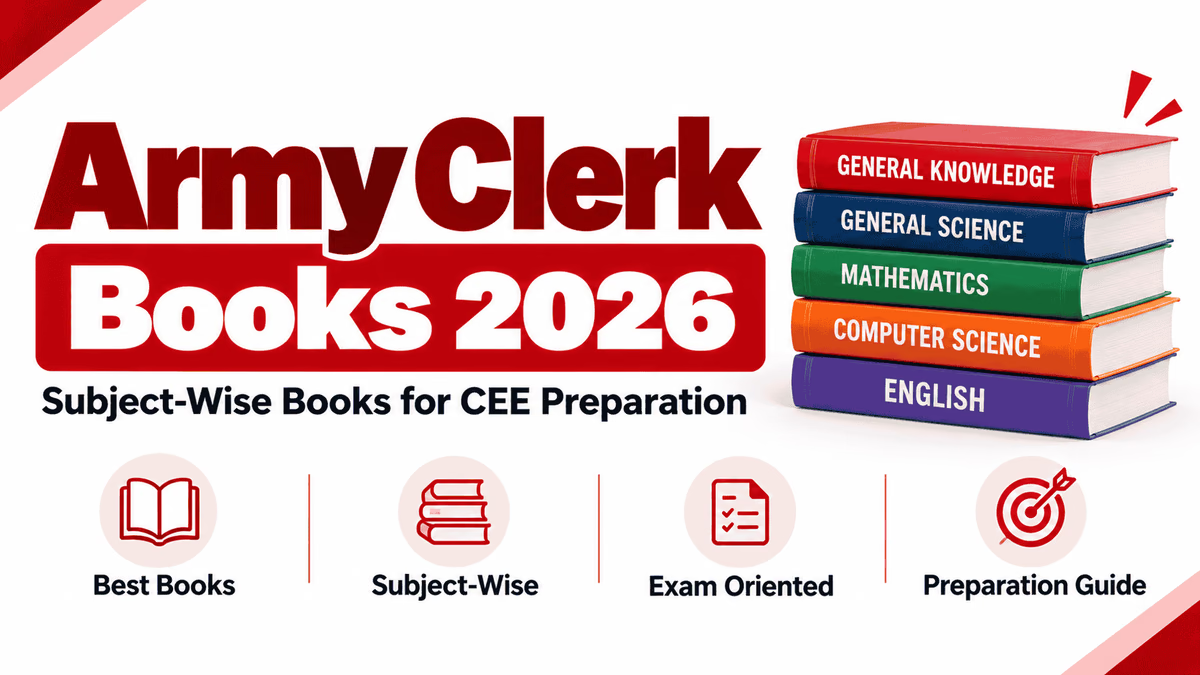

 Defence
 SSC
SSC Govt Job