Download the App & Start Learning
- Expert Faculty Guidance
- Updated Study Material
- Mock Tests & Practice Quiz
- Live Doubt Solving Sessions
- Exam-Oriented Preparation
- Motivation & Success Strategy
Katara Academy

Loading blogs…


SSC CGL EXAM ANALYSIS 2026
The SSC CGL Exam Analysis 2026 helps candidates understand the latest exam trends, section-wise difficulty level, important topics, and expected good attempts. Analyzing previous year papers allows aspirants to prepare strategically by focusing on frequently asked concepts and understanding the overall examination pattern.
In this article, you'll find a detailed SSC CGL Tier 1 Exam Analysis, previous year trends, subject-wise weightage, good attempts, expected difficulty level, and expert preparation insights to improve your chances of scoring well in SSC CGL 2026.
SSC CGL Exam Analysis provides a comprehensive understanding of the examination based on previous years' question papers and shift-wise reviews. It highlights the overall difficulty level, subject-wise question distribution, important topics, and expected good attempts. Candidates can use this analysis to identify high-scoring areas and improve their preparation strategy.
| Particular | Details |
|---|---|
| Exam Name | SSC Combined Graduate Level Examination (SSC CGL) |
| Exam Stage | Tier 1 |
| Mode of Examination | Computer-Based Test (CBT) |
| Purpose of Analysis | Difficulty Level, Good Attempts & Topic Trends |
| Based On | Previous Year Question Papers & Shift Reviews |
Exam analysis helps candidates understand how SSC frames questions and which topics are repeatedly asked. Instead of studying every topic equally, candidates can prioritize high-weightage chapters and prepare more efficiently.
Understanding the exam pattern is essential before reviewing the analysis. SSC CGL Tier 1 consists of four sections with equal weightage and includes negative marking for incorrect answers.
| Section | Questions | Marks |
|---|---|---|
| General Intelligence & Reasoning | 25 | 50 |
| General Awareness | 25 | 50 |
| Quantitative Aptitude | 25 | 50 |
| English Comprehension | 25 | 50 |
| Total | 100 | 200 |
Over the past few years, SSC CGL has maintained a balanced paper with moderate difficulty. Reasoning and English sections are generally easier, while Quantitative Aptitude and General Awareness often determine the overall score.
The approximate subject-wise weightage observed in previous SSC CGL examinations is shown below. Candidates should prioritize these topics during preparation.
| Subject | Approximate Weightage |
|---|---|
| Reasoning | 25 Questions |
| General Awareness | 25 Questions |
| Quantitative Aptitude | 25 Questions |
| English Language | 25 Questions |
SSC CGL Tier 1 consists of four sections carrying equal weightage. However, the difficulty level and scoring potential vary across subjects. Understanding the subject-wise analysis helps candidates allocate their preparation time effectively and maximize their overall score.
The Reasoning section is generally considered the easiest and most scoring part of the SSC CGL Tier 1 examination. Most questions are concept-based and can be solved quickly with regular practice.
General Awareness is often the deciding section in SSC CGL. Questions mainly focus on Static GK, History, Geography, Polity, Economy, Science, and important current affairs from recent months.
Quantitative Aptitude is generally the most challenging section of SSC CGL Tier 1. Strong conceptual understanding, speed, and continuous practice are essential for scoring well.
The English section is usually scoring for candidates with a good command of grammar and vocabulary. Regular reading and grammar practice can significantly improve performance.
Based on previous SSC CGL examinations, the overall paper is expected to remain at an easy-to-moderate level. Quantitative Aptitude and General Awareness generally require the most preparation, while English and Reasoning are comparatively easier.
| Subject | Difficulty Level | Good Attempts |
|---|---|---|
| Reasoning | Easy–Moderate | 22–24 |
| General Awareness | Moderate | 18–21 |
| Quantitative Aptitude | Moderate–Difficult | 18–21 |
| English Language | Easy–Moderate | 22–24 |
| Overall Paper | Easy–Moderate | 80–90 Questions |
SSC CGL Tier 1 is conducted in multiple shifts over several days. Although the difficulty level may vary slightly from shift to shift, the overall standard of the examination generally remains balanced. SSC uses a normalization process to ensure fairness across all shifts.
| Section | Observed Difficulty | Scoring Potential |
|---|---|---|
| Reasoning | Easy to Moderate | High |
| General Awareness | Moderate | Medium |
| Quantitative Aptitude | Moderate to Difficult | Medium |
| English Language | Easy to Moderate | High |
Based on recent examination patterns, SSC CGL 2026 is expected to maintain a balanced difficulty level. While the overall paper is likely to remain easy to moderate, candidates should expect a few challenging questions in Quantitative Aptitude and General Awareness.
Candidates should focus on topics that consistently appear in previous SSC CGL examinations. Mastering these areas can significantly improve overall scores.
Your preparation strategy should be based on previous year trends rather than random study plans. Prioritize high-weightage topics, revise regularly, and practice mock tests to improve speed and accuracy.
Many aspirants lose marks because of avoidable mistakes rather than lack of knowledge. Being aware of these mistakes can improve your final score.
In the final weeks before the SSC CGL examination, focus on revision instead of learning new concepts. Strengthen your strong areas, improve accuracy, and avoid unnecessary risks during the exam.
Based on previous years' trends, SSC CGL 2026 is expected to have an overall easy to moderate difficulty level. Quantitative Aptitude and General Awareness may be comparatively more challenging than Reasoning and English.
A good attempt generally ranges between 80–90 questions, depending on the overall difficulty level and normalization process. Accuracy is equally important because of negative marking.
Reasoning and English Language are generally considered the most scoring sections, provided candidates have practiced consistently and possess a strong understanding of the concepts.
Previous year paper analysis helps identify important topics, question trends, difficulty level, and section-wise weightage, enabling candidates to prepare more effectively.
Yes. Since the SSC CGL examination is conducted in multiple shifts, SSC applies a normalization process to ensure fairness in evaluating candidates across different shifts.
A detailed SSC CGL Exam Analysis 2026 provides valuable insights into previous year trends, section-wise difficulty, good attempts, and frequently asked topics. By studying these patterns, candidates can prepare more strategically, focus on high-weightage topics, improve time management, and increase their chances of securing a high score in the examination.
Stay updated with the latest SSC CGL Notification, including important dates, vacancies, eligibility, and the complete recruitment process.
Understand the latest Tier 1 and Tier 2 exam pattern, marking scheme, section-wise marks, and exam duration.
Download the latest SSC CGL syllabus for Tier 1 and Tier 2 and prepare topic-wise with confidence.
Practice SSC CGL Previous Year Question Papers to understand exam trends, improve speed, and build confidence.
Evaluate your preparation with SSC CGL Mock Tests designed to match the latest exam pattern and difficulty level.
Boost your SSC CGL preparation with expert faculty, live classes, comprehensive study material, mock tests, doubt-solving sessions, and regular performance analysis at Katara Academy.

SSC CGL BEST POST PREFERENCE 2026
Choosing the right SSC CGL Post Preference 2026 is one of the most important decisions after clearing the examination. Your post preference directly affects your salary, department, work profile, career growth, transfer policy, work-life balance, and promotion opportunities. Many candidates focus only on clearing the exam, but selecting the right post can significantly impact their long-term government career.
This complete guide explains the best SSC CGL posts, department-wise preferences, highest-paying posts, job responsibilities, promotion opportunities, transfer policies, and expert recommendations to help you make the right choice while filling your SSC CGL Post Preference Form.
After qualifying the SSC CGL examination, candidates are required to fill their preferred posts and departments during the selection process. The Staff Selection Commission allocates posts based on the candidate's merit, category, available vacancies, and the order of preferences submitted by the candidate. Therefore, filling the preference list carefully is extremely important.
| Particular | Details |
|---|---|
| Exam Name | SSC Combined Graduate Level (CGL) Examination 2026 |
| Conducting Body | Staff Selection Commission (SSC) |
| Preference Based On | Merit, Category, Vacancies & Candidate Preference |
| Number of Departments | Multiple Central Government Departments |
| Selection Criteria | Merit + Preference + Vacancy Availability |
Many candidates lose excellent career opportunities because they fill the post preference list without proper research. Once a post is allotted, changing it is generally not possible. Therefore, candidates should understand every department and post before submitting their preferences.
Every candidate has different career goals. Some prefer higher salaries, while others prioritize work-life balance or promotion opportunities. Before deciding your preference order, evaluate each post based on multiple factors rather than salary alone.
| Rank | Post | Department | Pay Level |
|---|---|---|---|
| 1 | Assistant Audit Officer (AAO) | Indian Audit & Accounts Department | Level 8 |
| 2 | Assistant Accounts Officer (AAO) | CGA | Level 8 |
| 3 | Assistant Section Officer (MEA) | Ministry of External Affairs | Level 7 |
| 4 | Inspector (Income Tax) | CBDT | Level 7 |
| 5 | Inspector (Examiner) | CBIC | Level 7 |
SSC CGL offers opportunities to work in some of the most prestigious Central Government departments. The best post depends on your career goals, preferred work profile, promotion prospects, and work-life balance. Below are the most preferred SSC CGL posts among aspirants.
| Rank | Post | Department | Pay Level | Career Growth |
|---|---|---|---|---|
| 1 | Assistant Audit Officer (AAO) | Indian Audit & Accounts Department | Level 8 | Excellent |
| 2 | Assistant Accounts Officer (AAO) | Controller General of Accounts | Level 8 | Excellent |
| 3 | Assistant Section Officer (MEA) | Ministry of External Affairs | Level 7 | Excellent |
| 4 | Inspector (Income Tax) | CBDT | Level 7 | Very Good |
| 5 | Inspector (Examiner) | CBIC | Level 7 | Very Good |
| 6 | Assistant Enforcement Officer | Directorate of Enforcement | Level 7 | Very Good |
| 7 | Central Excise Inspector | CBIC | Level 7 | Good |
| 8 | Preventive Officer | CBIC | Level 7 | Good |
| 9 | Assistant Section Officer (CSS) | Central Secretariat Service | Level 7 | Good |
| 10 | Sub Inspector (CBI) | Central Bureau of Investigation | Level 7 | Excellent |
Salary is one of the biggest factors while deciding SSC CGL post preferences. Higher pay levels generally offer better in-hand salary, allowances, and promotion opportunities.
| Post | Pay Level | Approx. In-Hand Salary |
|---|---|---|
| AAO / AAO (Accounts) | Level 8 | ₹65,000–₹80,000 |
| Inspector Posts | Level 7 | ₹55,000–₹70,000 |
| Assistant Section Officer | Level 7 | ₹55,000–₹68,000 |
Most SSC CGL posts provide structured promotions through departmental examinations, seniority, and performance. Higher-level posts like AAO and Inspector offer faster career growth compared to clerical positions.
Many female candidates prefer SSC CGL posts that provide a balanced work environment, fixed office timings, good promotion opportunities, and minimal field duties. However, the ideal post depends on individual career goals and personal preferences.
| Post | Why It Is Preferred |
|---|---|
| Assistant Section Officer (MEA) | Excellent career growth and foreign posting opportunities. |
| Assistant Section Officer (CSS) | Regular office hours and balanced work profile. |
| Assistant Audit Officer | High salary with excellent promotion opportunities. |
| Auditor | Stable office work and good work-life balance. |
Candidates looking for fixed office timings and comparatively less field work should prioritize posts known for maintaining a healthy work-life balance.
Candidates who prioritize salary should focus on posts with higher pay levels and attractive government allowances. These positions also provide better long-term financial growth through regular promotions.
| Post | Pay Level | Approx. In-Hand Salary |
|---|---|---|
| Assistant Audit Officer | Level 8 | ₹65,000–₹80,000 |
| Assistant Accounts Officer | Level 8 | ₹65,000–₹80,000 |
| Income Tax Inspector | Level 7 | ₹55,000–₹70,000 |
Some SSC CGL posts offer faster promotions, greater responsibilities, and opportunities to reach senior administrative positions. Candidates aiming for long-term career advancement should consider these posts.
Based on salary, promotion opportunities, work profile, prestige, and overall career prospects, the following preference order is commonly recommended for SSC CGL aspirants.
Many candidates make avoidable mistakes while filling their SSC CGL post preferences. A little research before submission can help you secure a post that aligns with your long-term career aspirations.
Assistant Audit Officer (AAO) is generally considered one of the best SSC CGL posts because of its higher pay level, excellent promotion opportunities, and prestigious work profile.
Assistant Audit Officer (AAO) and Assistant Accounts Officer (AAO) are among the highest-paying SSC CGL posts, offering Pay Level 8 along with government allowances.
No. Once the SSC CGL post preference form is submitted and the correction window closes, candidates are generally not allowed to modify their preferences. Therefore, review your choices carefully before final submission.
Assistant Section Officer (CSS), Assistant Section Officer (MEA), Auditor, and Accountant are among the preferred choices for candidates seeking a good work-life balance.
Consider factors such as salary, promotion opportunities, job profile, posting location, transfer policy, work-life balance, and your long-term career goals before deciding the preference order.
Choosing the right SSC CGL Post Preference 2026 is just as important as securing a good rank in the examination. A well-planned preference list can help you get a post that matches your career aspirations, offers better salary and promotions, and provides long-term job satisfaction. Before submitting your preferences, compare departments, understand the job profiles, and carefully review the latest SSC CGL notification.
Check the official SSC CGL Notification for vacancies, eligibility, important dates, selection process, and complete recruitment details.
Know the latest age limit, educational qualifications, nationality, and category-wise eligibility criteria for SSC CGL 2026.
Compare SSC CGL salary, pay levels, allowances, in-hand salary, and promotion benefits for every post.
View the complete SSC CGL Posts List with departments, pay levels, job profiles, and posting details.
Understand the latest Tier 1 & Tier 2 exam pattern, marking scheme, exam duration, and selection stages.
Stay updated with SSC CGL Result 2026, merit list, cut-off marks, scorecard, and further selection updates.
Prepare for SSC CGL 2026 with expert faculty, live classes, mock tests, doubt-solving sessions, comprehensive study material, and regular performance analysis to maximize your success.

SSC CGL PHYSICAL STANDARDS 2026
The SSC CGL Physical Standards 2026 are applicable only for specific posts such as Sub-Inspector in CBI and Sub-Inspector in NIA. Most SSC CGL posts are purely desk-based and do not require any Physical Standard Test (PST) or Physical Efficiency Test (PET). Therefore, candidates must carefully check whether their preferred post includes physical eligibility requirements before applying.
In this guide, you'll find the latest SSC CGL Physical Standards 2026, including minimum height, chest measurements, weight standards, medical fitness requirements, post-wise physical eligibility, exemptions, and important guidelines for candidates preparing for physical verification.
The Staff Selection Commission prescribes physical standards only for selected posts under the Combined Graduate Level Examination. Candidates applying for posts such as Sub-Inspector in the Central Bureau of Investigation (CBI) and National Investigation Agency (NIA) must satisfy the prescribed physical standards before final selection. Candidates applying for other SSC CGL posts like Assistant Section Officer, Auditor, Accountant, Tax Assistant, or Assistant Audit Officer are generally not required to undergo any physical measurement test.
| Particular | Details |
|---|---|
| Exam Name | SSC Combined Graduate Level (CGL) Examination 2026 |
| Conducting Body | Staff Selection Commission (SSC) |
| Applicable Posts | Sub-Inspector (CBI), Sub-Inspector (NIA) |
| Physical Test Required | Only for notified posts |
| Medical Examination | Applicable for eligible posts as per department rules |
Not every SSC CGL post requires physical standards. Candidates should carefully review the notification to identify posts that require physical eligibility. Choosing a post without understanding the physical requirements may lead to disqualification during document verification or medical examination.
| Post | Physical Standards Required | Medical Fitness |
|---|---|---|
| Sub-Inspector (CBI) | Yes | Required |
| Sub-Inspector (NIA) | Yes | Required |
| Assistant Section Officer | No | No Physical Standards |
| Auditor / Accountant / Tax Assistant | No | No Physical Standards |
The Physical Standard Test (PST) is conducted to verify whether candidates meet the prescribed physical measurements such as height, chest (for male candidates), and medical fitness. It is a qualifying process, and candidates must satisfy all the prescribed standards to remain eligible for the respective posts.
Candidates applying for SSC CGL posts that require physical standards must meet the prescribed minimum height criteria. The required height varies for male and female candidates, with relaxations available for candidates belonging to specified categories as per Government rules.
| Category | Male | Female |
|---|---|---|
| General Candidates | 165 cm | 150 cm |
| Hill Area / Tribal Candidates | Relaxation as per Government Rules | Relaxation as per Government Rules |
SSC does not prescribe a fixed weight for all candidates. Instead, weight should be proportionate to the candidate's height and age according to accepted medical standards. During the medical examination, candidates are assessed to ensure they are physically fit for the duties associated with the selected post.
Chest measurement is applicable only for male candidates applying for posts that require physical standards. Female candidates are generally not required to undergo chest measurement.
| Measurement | Requirement |
|---|---|
| Chest (Unexpanded) | 76 cm |
| Expansion | 5 cm |
Candidates selected for posts requiring physical standards must also qualify the medical examination conducted by the concerned department. The medical test evaluates the candidate's overall physical health and ability to perform official duties efficiently.
Certain categories, including candidates from notified hill areas, tribal regions, and other eligible groups, may receive relaxations in physical standards as specified in the official SSC CGL notification. Candidates should carefully check the latest notification to determine whether they qualify for these relaxations.
Candidates applying for SSC CGL posts that require physical standards must also satisfy the prescribed medical and vision requirements. During the medical examination, eyesight is assessed to ensure that candidates are medically fit to perform the responsibilities of the respective post.
Apart from height, chest, and weight measurements, candidates are expected to maintain good overall physical health. The medical board evaluates whether the candidate is capable of performing official duties without any physical limitations that may affect job performance.
Candidates appearing for the Physical Standard Test (PST) and medical examination should carry all required documents for verification. Failure to produce valid documents may result in cancellation of candidature.
Candidates may be declared ineligible if they fail to satisfy the prescribed physical or medical standards applicable to their chosen post. Therefore, candidates should carefully verify their eligibility before selecting posts requiring physical standards.
| Reason | Result |
|---|---|
| Height below prescribed standard | Not Eligible |
| Chest measurement not meeting criteria | Not Eligible |
| Medical examination declared unfit | Disqualified |
| Submission of invalid supporting documents | Candidature Cancelled |
Although SSC CGL does not conduct a Physical Efficiency Test (PET) for these posts, candidates should ensure they are physically healthy and prepared for medical and physical standard verification.
Before giving preference to posts like Sub-Inspector (CBI) or Sub-Inspector (NIA), make sure you meet all the prescribed physical and medical standards. This helps avoid disappointment during the final selection stage and ensures a smoother recruitment process.
Physical Standards are applicable only for specific SSC CGL posts such as Sub-Inspector in CBI and Sub-Inspector in NIA. Most other SSC CGL posts do not require any Physical Standard Test (PST).
No. SSC CGL generally requires only a Physical Standard Test (PST) and medical examination for eligible posts. There is no Physical Efficiency Test (PET) for regular SSC CGL recruitment.
Generally, the minimum prescribed height is 165 cm for male candidates and 150 cm for female candidates, with relaxations available for eligible categories as per Government rules.
No. Chest measurement is generally applicable only to male candidates applying for SSC CGL posts that require physical standards.
No. A medical examination is conducted only for posts where physical and medical standards are prescribed by the respective department.
The SSC CGL Physical Standards 2026 are applicable only to a limited number of posts such as Sub-Inspector in CBI and NIA. Candidates interested in these posts should carefully verify the prescribed height, chest measurement, medical fitness, and category-wise relaxations before submitting their application. Since most SSC CGL posts do not require physical standards, candidates should choose their post preferences wisely based on their eligibility and career goals.
Check the official SSC CGL Notification to know complete eligibility, vacancies, physical standards, selection process, and important dates.
Understand the complete eligibility criteria including age limit, educational qualification, nationality, and reservation rules.
Learn the latest Tier 1 & Tier 2 exam pattern, marking scheme, duration, and selection stages.
Know the latest SSC CGL salary structure, pay levels, allowances, in-hand salary, and career growth.
Download your SSC CGL Admit Card and check the exam schedule, reporting time, and important instructions.
View SSC CGL Result 2026, merit list, scorecard, qualifying status, and further recruitment updates.
Prepare for SSC CGL 2026 with expert faculty, comprehensive study material, mock tests, doubt-solving sessions, and personalized guidance to maximize your chances of success.

SSC CGL RESULT 2026
The SSC CGL Result 2026 is one of the most anticipated announcements for candidates appearing in the Combined Graduate Level (CGL) Examination conducted by the Staff Selection Commission (SSC). The result determines whether candidates qualify for the next stage of the recruitment process or secure their final selection for various Group B and Group C government posts.
Along with the result, SSC also releases the merit list, cut-off marks, and scorecard. Candidates can check their qualifying status online using the official SSC website. This guide explains everything about the SSC CGL Result 2026, including important dates, result stages, scorecard download, merit list, normalization process, and post-result procedures.
The SSC CGL Result is the official outcome of the Combined Graduate Level Examination conducted by the Staff Selection Commission. It indicates whether a candidate has qualified for the next stage of the recruitment process or has been finally selected based on performance, cut-off marks, and merit ranking. SSC publishes the result online in PDF format along with category-wise cut-off marks and the list of qualified candidates.
The Staff Selection Commission announces the SSC CGL Result separately for each stage of the examination. After evaluating candidates' responses and completing the normalization process, SSC publishes the Tier 1 Result, followed by the Tier 2 Result and the final selection list. Candidates should regularly check the official SSC website for the latest result notifications.
The following table provides the important events related to the SSC CGL Result 2026. Candidates should refer to the official SSC schedule for confirmed dates.
| Event | Status |
|---|---|
| SSC CGL Tier 1 Examination | As per Official Schedule |
| Tier 1 Result | To be Announced |
| Tier 2 Examination | As per Official Schedule |
| Tier 2 Result | To be Announced |
| SSC CGL Scorecard | After Result Declaration |
| Final Merit List | After Final Result |
The SSC CGL recruitment process consists of multiple stages, and the Commission declares separate results for each stage. Candidates must qualify at every stage to proceed further in the selection process.
| Result Stage | Purpose |
|---|---|
| Tier 1 Result | Shortlists candidates for the Tier 2 Examination. |
| Tier 2 Result | Determines candidates eligible for final selection. |
| Final Result | Prepared based on performance, merit, post preference, and document verification. |
After the SSC CGL Result is declared, immediately download the result PDF and scorecard, verify your details, check the category-wise cut-off, and keep all required documents ready for the next stage of the recruitment process.
The Staff Selection Commission publishes the SSC CGL Result online on its official website in PDF format. Candidates can check whether they have qualified by searching for their Roll Number or Name in the result PDF. SSC also releases category-wise cut-off marks and the list of shortlisted candidates along with the result notification.
After the declaration of the result, SSC releases the individual scorecard through the candidate login portal. The scorecard displays the marks obtained, normalized score (if applicable), qualifying status, and other examination details.
Candidates should keep their login credentials ready to access their SSC CGL scorecard and other examination details.
Candidates should carefully verify all the information mentioned in the SSC CGL Result and Scorecard. In case of any discrepancy, they should immediately contact the concerned SSC Regional Office.
The SSC CGL Merit List contains the Roll Numbers of candidates who have qualified for the next stage or final selection. It is prepared based on candidates' performance, normalization of marks, category-wise cut-off, and post preferences as applicable.
| Merit List Type | Purpose |
|---|---|
| Tier 1 Merit List | Shortlists candidates for Tier 2 Examination. |
| Tier 2 Merit List | Determines candidates shortlisted for final selection. |
| Final Merit List | Prepared after all stages of recruitment and document verification. |
Since the SSC CGL examination is conducted in multiple shifts, the Staff Selection Commission applies a normalization process to ensure fairness among candidates. The normalized score is used for preparing the merit list and determining the final qualifying status.
After checking your SSC CGL Result, immediately download both the Result PDF and Scorecard. Verify your personal details, marks, and qualifying status, and keep printed copies safely for document verification and future recruitment stages.
The Staff Selection Commission releases the SSC CGL Cut Off 2026 along with the result for each stage of the examination. The cut-off marks vary depending on the category, examination stage, number of vacancies, difficulty level of the paper, and overall candidate performance. Candidates scoring equal to or above the prescribed cut-off qualify for the next stage of the recruitment process.
The next step after the SSC CGL Result depends on the stage of the examination. Candidates qualifying in Tier 1 are shortlisted for Tier 2, while those clearing Tier 2 move towards the final selection process, which includes document verification and post allocation as per SSC rules.
Candidates shortlisted for final selection are required to participate in the Document Verification (DV) process. During verification, SSC verifies the authenticity of educational qualifications, identity, category certificates, and other required documents before confirming the final appointment.
In certain cases, SSC may temporarily withhold a candidate's result until specific issues are resolved. Candidates should carefully follow all examination instructions to avoid such situations.
If two or more candidates obtain the same marks, SSC applies the prescribed tie-breaking rules to determine the order of merit. The exact criteria are mentioned in the official notification and are followed while preparing the final merit list.
Candidates should carefully preserve all documents related to the SSC CGL examination even after the result declaration. These documents are often required during later stages of recruitment.
Qualifying the SSC CGL Result is only one step in the recruitment process. Keep your scorecard, admit card, identity proof, educational certificates, and category documents organized well in advance to ensure a smooth document verification and final selection process.
The Staff Selection Commission will announce the SSC CGL Result 2026 after completing the evaluation process. Candidates should regularly check the official SSC website for the latest result updates.
Visit the official SSC website, open the Result section, download the SSC CGL Result PDF, and search your Roll Number or Name using the search function.
Yes. SSC generally releases the individual scorecard after the declaration of the result. Candidates can download it by logging into their SSC candidate dashboard.
Yes. SSC publishes category-wise cut-off marks along with the result notification for every stage of the SSC CGL examination.
Qualified candidates should download their scorecard, verify all details, keep the required documents ready, and follow the official SSC instructions for the next stage of the recruitment process.
The SSC CGL Result 2026 plays a crucial role in determining a candidate's progress through the recruitment process. Along with the result, candidates should carefully review their scorecard, merit list, and category-wise cut-off marks. Staying updated with official SSC notifications and completing each post-result requirement on time will help ensure a smooth selection process. Keep all essential documents ready and regularly monitor the SSC website for further announcements regarding document verification, final merit list, and appointment.
Explore the complete SSC CGL Notification 2026, including eligibility, vacancies, important dates, selection process, and application details.
Learn how to download your SSC CGL Admit Card, check exam dates, reporting time, and important exam day instructions.
Check the official SSC CGL Answer Key, download your response sheet, calculate your score, and understand the objection process.
View expected and previous year SSC CGL Cut Off marks, category-wise qualifying scores, and cut-off trends.
Understand the latest SSC CGL syllabus with subject-wise topics, exam pattern, and preparation priorities.
Boost your preparation with expert study plans, mock tests, revision techniques, previous year papers, and time management tips.
Achieve your SSC CGL goals with Katara Academy's expert faculty, structured study plans, comprehensive notes, mock tests, doubt-solving sessions, and personalized mentorship designed to maximize your success.

SSC CGL ANSWER KEY 2026
The SSC CGL Answer Key 2026 enables candidates to evaluate their performance immediately after the examination. The Staff Selection Commission (SSC) releases the provisional answer key along with the candidate's response sheet on its official website. Using these documents, candidates can estimate their expected scores, identify incorrect answers, and raise objections if they find discrepancies in the provisional answer key.
This comprehensive guide covers everything you need to know about the SSC CGL Answer Key 2026, including the release date, download process, response sheet, score calculation, objection procedure, marking scheme, and important instructions for candidates.
The SSC CGL Answer Key is an official document released by the Staff Selection Commission after the completion of the examination. It contains the correct answers to all questions asked in the exam. Along with the answer key, SSC also provides each candidate's response sheet, allowing them to compare their responses with the official answers and calculate their probable score before the declaration of results.
The Staff Selection Commission generally releases the provisional SSC CGL Answer Key within a few days after the completion of the examination. Candidates can log in using their Registration Number and Password to access both the answer key and their individual response sheet. After reviewing objections submitted by candidates, SSC publishes the final answer key before or along with the declaration of the final result.
Candidates should regularly visit the official SSC website to stay informed about answer key updates. The following table outlines the important events related to the SSC CGL Answer Key 2026.
| Event | Status |
|---|---|
| SSC CGL Examination | As per Official Schedule |
| Provisional Answer Key | To be Announced |
| Response Sheet Availability | Along with Answer Key |
| Objection Window | Limited Period |
| Final Answer Key | After Objection Review |
| SSC CGL Result | After Final Answer Key |
SSC releases two types of answer keys during the recruitment process. Understanding the difference between them helps candidates know when they can raise objections and when the final answers become official.
| Answer Key Type | Purpose |
|---|---|
| Provisional Answer Key | Released first; candidates can review answers and submit objections within the specified time. |
| Final Answer Key | Released after evaluating objections and used for preparing the final result. |
Download both your response sheet and the provisional answer key as soon as they are released. Compare every response carefully and submit objections only when you have valid supporting evidence from authentic sources before the objection deadline.
The Staff Selection Commission publishes the SSC CGL Answer Key online through its official website. Candidates can access the provisional answer key by logging in with their registration credentials. Along with the answer key, SSC also provides the individual response sheet, enabling candidates to compare their responses with the official answers.
The SSC CGL Response Sheet contains the answers marked by the candidate during the examination. It helps candidates compare their attempted answers with the official answer key and accurately estimate their expected score.
Candidates must keep their login credentials ready before accessing the SSC Answer Key portal. Incorrect details may prevent successful login.
After downloading the answer key and response sheet, candidates can estimate their probable score by applying the official SSC marking scheme. Compare every marked response with the official answer key and calculate the total marks accordingly.
The SSC CGL examination includes negative marking for incorrect answers. Candidates should use the applicable marking scheme for the respective paper while calculating their expected score.
| Component | Details |
|---|---|
| Correct Answer | Award marks as per the official exam pattern. |
| Incorrect Answer | Negative marking applies as specified by SSC. |
| Unattempted Question | No marks awarded or deducted. |
The following example illustrates how candidates can estimate their score after downloading the answer key and response sheet.
Download your response sheet immediately after the answer key is released and calculate your expected score using the official marking scheme. This helps you assess your chances of qualifying and prepare for the next stage of the SSC CGL selection process.
After releasing the Provisional SSC CGL Answer Key, the Staff Selection Commission provides candidates with an opportunity to challenge any answer they believe is incorrect. Candidates must submit objections within the prescribed time along with valid documentary proof. Objections submitted after the deadline or without proper justification are generally not considered.
SSC generally charges a fixed fee for each question challenged in the provisional answer key. The fee must be paid online during the objection submission process. Candidates should always refer to the official SSC notification for the exact fee applicable to the examination.
| Particular | Details |
|---|---|
| Objection Fee | As specified in the official SSC notification. |
| Payment Mode | Online Payment. |
| Refund Policy | As per SSC guidelines. |
Candidates should ensure that every objection is supported by reliable evidence. Submitting random or unsupported objections may result in rejection without further review.
Many objections are rejected because candidates fail to follow the prescribed procedure. Avoid these common mistakes while submitting your challenge.
Reviewing the answer key provides valuable insights into your exam performance and helps you prepare for the next stage of the recruitment process.
After the objection window closes, SSC evaluates all valid challenges and prepares the final answer key. The result is generally announced after the publication of the final answer key and completion of the evaluation process.
| Stage | Expected Timeline |
|---|---|
| Provisional Answer Key | Within a few days after the examination. |
| Objection Window | Limited period after answer key release. |
| Final Answer Key | After reviewing all valid objections. |
| SSC CGL Result | Declared after completion of the evaluation process. |
Don't rely solely on unofficial answer keys available online. Always compare your responses with the official SSC Answer Key and Response Sheet, and submit objections only when you have strong evidence from authentic academic sources or official references.
The SSC CGL Provisional Answer Key is generally released within a few days after the examination. Candidates should regularly visit the official SSC website for the latest updates.
Candidates can log in to the official SSC portal using their Registration Number and Password to download both the Answer Key and the individual Response Sheet.
Yes. SSC allows candidates to challenge the Provisional Answer Key within the prescribed objection window by submitting valid supporting documents and paying the applicable objection fee.
Yes. The Final Answer Key is released after SSC reviews all valid objections submitted by candidates. It is used for preparing the final result.
Yes. By comparing your Response Sheet with the official Answer Key and applying the SSC marking scheme, you can estimate your expected score before the result is declared.
The SSC CGL Answer Key 2026 is an important resource that helps candidates evaluate their performance before the official result announcement. By downloading the Answer Key and Response Sheet, calculating your estimated score, and raising objections (if necessary), you can stay informed throughout the recruitment process. Always rely on the official SSC website for authentic updates regarding the provisional answer key, objection process, final answer key, and result declaration.
Get complete information about the SSC CGL Notification 2026, including vacancies, eligibility, important dates, application process, and official announcements.
Learn how to download your SSC CGL Admit Card, check exam dates, reporting time, required documents, and exam day guidelines.
Stay updated with SSC CGL Result 2026, merit list, scorecard, qualifying status, and result download process.
Check expected cut-off marks, previous year trends, category-wise cut-offs, and qualifying scores for SSC CGL 2026.
Boost your preparation with expert study plans, mock tests, revision strategies, time management tips, and subject-wise guidance.
Understand the latest SSC CGL syllabus with subject-wise topics, exam coverage, and preparation priorities.
Prepare for SSC CGL 2026 with expert faculty, comprehensive study material, regular mock tests, doubt-solving sessions, performance analysis, and personalized mentorship at Katara Academy.

SSC CGL ADMIT CARD 2026
The SSC CGL Admit Card 2026 is one of the most important documents required to appear for the Staff Selection Commission Combined Graduate Level (SSC CGL) Examination. Without a valid admit card, candidates will not be allowed to enter the examination centre. The admit card contains essential details such as the candidate's name, roll number, examination date, reporting time, exam centre address, and important instructions that must be followed on the examination day.
In this comprehensive guide, you'll learn everything about the SSC CGL Admit Card 2026, including the release date, download process, important dates, details mentioned on the hall ticket, region-wise admit card information, and exam day guidelines.
The SSC CGL Admit Card, also known as the Hall Ticket, is an official document issued by the Staff Selection Commission before each stage of the examination. It serves as proof that a candidate has successfully completed the application process and is eligible to appear for the examination. Candidates must carry a printed copy of the admit card along with a valid photo ID to the examination centre.
The Staff Selection Commission generally releases the SSC CGL Admit Card a few days before the examination. Candidates can download their hall ticket from the official SSC regional websites using their Registration Number and Date of Birth or Roll Number. The admit card for each examination stage is released separately.
Candidates should regularly check the official SSC website for updates regarding the admit card release schedule. The following table provides the important events related to the SSC CGL Admit Card 2026.
| Event | Status |
|---|---|
| SSC CGL Notification Release | As per Official SSC Calendar |
| Application Form Submission | As per Official Schedule |
| Application Status | Before Admit Card Release |
| Tier 1 Admit Card | To be Announced |
| Tier 1 Examination | As per Official Schedule |
| Tier 2 Admit Card | To be Announced |
| Tier 2 Examination | As per Official Schedule |
Candidates should carefully verify all the information printed on their SSC CGL Admit Card immediately after downloading it. In case of any discrepancy, they should contact the concerned SSC regional office before the examination.
Download your SSC CGL Admit Card as soon as it is released. Verify every detail carefully, print at least two copies, and visit your exam centre location in advance if it is unfamiliar to avoid last-minute stress.
Candidates can download the SSC CGL Admit Card 2026 from their respective SSC regional website. The admit card is available only in online mode, and candidates should keep their Registration Number or Roll Number along with their Date of Birth ready before downloading.
SSC releases admit cards through its regional websites. Candidates should download their hall ticket only from the region in which they submitted their application.
| SSC Region | States Covered |
|---|---|
| Northern Region (NR) | Delhi, Rajasthan, Uttarakhand |
| Central Region (CR) | Uttar Pradesh, Bihar |
| Western Region (WR) | Maharashtra, Gujarat, Goa |
| Southern Region (SR) | Andhra Pradesh, Tamil Nadu, Telangana, Puducherry |
| Eastern Region (ER) | West Bengal, Odisha, Andaman & Nicobar Islands, Sikkim |
| North Eastern Region (NER) | Assam, Arunachal Pradesh, Manipur, Meghalaya, Mizoram, Nagaland, Tripura |
| Karnataka Kerala Region (KKR) | Karnataka, Kerala, Lakshadweep |
| Madhya Pradesh Region (MPR) | Madhya Pradesh, Chhattisgarh |
Candidates must carry the required documents to the examination centre. Failure to produce the required documents may result in denial of entry.
Candidates who forget their Registration Number can still download their admit card by using the alternative search options provided on the SSC regional websites. Most regions allow candidates to retrieve their admit card using their name, father's name, and date of birth.
Sometimes candidates may experience technical issues while downloading the admit card. Most problems can be resolved by verifying login details or trying again after some time.
Candidates should immediately verify all details after downloading the admit card. If there is any error in personal information, photograph, signature, or examination details, they should contact their respective SSC regional office before the examination date.
Following the official SSC exam day guidelines is essential for a smooth examination experience. Candidates should carefully read all the instructions mentioned on the admit card and ensure they comply with the rules prescribed by the Staff Selection Commission. Failure to follow these instructions may result in denial of entry or cancellation of candidature.
Candidates should carry only the items permitted by SSC. Bringing unnecessary belongings may cause inconvenience during security checks.
SSC strictly prohibits electronic gadgets and other unauthorized materials inside the examination hall. Carrying prohibited items may lead to disqualification.
Candidates should familiarize themselves with the examination centre location before the exam day to avoid unnecessary delays. Always follow the directions provided by the examination staff.
Apart from the exam day guidelines, candidates should also follow these important instructions to avoid any issues during the examination.
Many candidates face avoidable problems on the examination day due to poor planning or failure to follow SSC instructions. Avoiding these common mistakes will help ensure a stress-free experience.
Download your admit card as soon as it becomes available, verify every detail, arrange your documents a day before the exam, and reach the examination centre well ahead of the reporting time. Good planning minimizes stress and helps you focus entirely on your performance.
The SSC CGL Admit Card 2026 is generally released a few days before the examination. Candidates should regularly visit the official SSC and regional SSC websites for the latest updates.
No. Entry to the examination centre is not permitted without a valid SSC CGL Admit Card and an original government-issued photo identity proof.
If you find any discrepancy in your name, photograph, signature, exam centre, or other details, immediately contact your concerned SSC Regional Office before the examination.
No. Candidates are generally required to carry a printed copy of the SSC CGL Admit Card. A digital copy on a mobile phone is usually not accepted at the examination centre.
Carry your printed admit card, original photo identity proof, passport-size photographs (if required), and any additional documents mentioned in the official SSC instructions.
The SSC CGL Admit Card 2026 is an essential document for every candidate appearing in the examination. Download it as soon as it is released, verify all the details carefully, keep multiple printed copies, and follow the official exam day guidelines. Proper preparation before the examination day ensures a smooth and stress-free experience, allowing you to focus entirely on performing your best.
Check the latest SSC CGL Notification 2026 for important dates, vacancies, eligibility, application process, and official announcements.
Know the age limit, educational qualifications, nationality, and category-wise relaxation before applying for SSC CGL 2026.
Review the latest SSC CGL syllabus with subject-wise topics and important sections to strengthen your preparation.
Learn the latest SSC CGL exam pattern, marking scheme, selection process, and section-wise weightage.
Build an effective preparation strategy with study plans, mock tests, revision techniques, and expert guidance for SSC CGL 2026.
Explore the latest expected SSC CGL cut-off, previous year trends, category-wise analysis, and qualifying marks.
Achieve your SSC CGL goals with expert faculty, structured classroom programs, online support, mock tests, doubt-solving sessions, and personalized mentorship at Katara Academy.

SSC CGL CUT OFF 2026
The SSC CGL Cut Off 2026 is one of the most important factors that determines whether a candidate qualifies for the next stage of the recruitment process. Every year, the Staff Selection Commission (SSC) releases category-wise and post-wise cut-off marks along with the examination results. Understanding the expected cut-off, previous year trends, and factors affecting the cut-off can help aspirants set realistic score targets and prepare more effectively.
In this detailed guide, you'll find the latest information on the SSC CGL Cut Off 2026, expected cut-off marks, previous year cut-off analysis, category-wise trends, Tier 1 and Tier 2 qualifying marks, and expert tips to maximize your chances of selection.
The SSC CGL Cut Off is the minimum score required for candidates to qualify for the next stage of the examination or final selection. The cut-off varies every year based on several factors such as the number of vacancies, total applicants, exam difficulty level, and overall candidate performance. Separate cut-offs are released for different categories including General, OBC, EWS, SC, ST, and PwBD.
The SSC CGL cut-off is not fixed and changes every recruitment cycle. Several factors influence the final qualifying marks announced by the Staff Selection Commission. Understanding these factors helps candidates estimate the expected cut-off and set an appropriate preparation target.
The Tier 1 cut-off is released after the completion of the preliminary examination. Candidates scoring equal to or above the prescribed cut-off are shortlisted for the Tier 2 examination. Since Tier 1 serves as the first screening stage, competition is usually very high.
Tier 2 is the main examination for SSC CGL selection. The Tier 2 cut-off plays a significant role in determining the final merit list. Candidates should aim for scores well above the expected cut-off to improve their chances of receiving their preferred post.
| Stage | Purpose |
|---|---|
| Tier 1 | Shortlisting candidates for Tier 2 |
| Tier 2 | Final merit preparation and post allocation |
Instead of preparing only to clear the expected cut-off, set your target score 15–20 marks higher than the previous year's cut-off. This provides a safety margin against fluctuations caused by exam difficulty, normalization, and increased competition.
Analyzing previous year cut-off marks helps candidates understand the competition level and estimate a safe target score for SSC CGL 2026. Although the cut-off changes every year depending on vacancies and exam difficulty, historical trends provide valuable insights for preparation.
| Year | General | OBC | EWS | SC | ST |
|---|---|---|---|---|---|
| Previous Recruitment | Official SSC Cut Off | Official SSC Cut Off | Official SSC Cut Off | Official SSC Cut Off | Official SSC Cut Off |
SSC publishes separate cut-off marks for different reservation categories. The qualifying marks vary because of reservation policies and the number of candidates competing within each category.
| Category | Cut Off Status |
|---|---|
| General (UR) | Highest Competition |
| OBC | Moderately High |
| EWS | Close to UR |
| SC | Lower than UR/OBC |
| ST | Lower than SC |
| PwBD | Separate Category-wise Cut Off |
Certain SSC CGL posts attract higher competition because of better salary packages, promotions, work profile, and departmental reputation. Consequently, these posts often have relatively higher cut-off marks.
SSC CGL generally does not release separate cut-off marks for male and female candidates. The cut-off is determined primarily on the basis of category, post, and merit. Both male and female candidates compete under the same category-wise cut-off criteria unless specified otherwise in the official notification.
SSC CGL is a central-level recruitment examination. Therefore, the Staff Selection Commission does not release state-wise cut-off marks. Candidates from all states compete under the same national merit list based on their category and post preferences.
Unlike state-level examinations, SSC CGL follows a nationwide selection process. As a result, there is no separate cut-off for Maharashtra, Uttar Pradesh, Delhi, Rajasthan, or any other individual state.
The expected SSC CGL Cut Off 2026 will depend on factors such as the number of vacancies, examination difficulty level, normalization process, and overall candidate performance. The figures below are indicative estimates based on previous recruitment trends and should not be considered official.
| Category | Expected Cut Off (Indicative) |
|---|---|
| General (UR) | To be Updated After Exam Analysis |
| OBC | To be Updated After Exam Analysis |
| EWS | To be Updated After Exam Analysis |
| SC | To be Updated After Exam Analysis |
| ST | To be Updated After Exam Analysis |
Rather than targeting only the expected cut-off, aim to score significantly above it. A higher score improves your chances of qualifying for your preferred department and post, especially in years with intense competition.
The Staff Selection Commission (SSC) releases the SSC CGL Cut Off 2026 along with the examination results on its official website. Candidates can easily download the result PDF and check the category-wise cut-off marks for different stages of the recruitment process.
Apart from the overall cut-off, SSC also prescribes minimum qualifying marks that candidates must secure in different stages of the examination. Meeting the minimum qualifying marks alone does not guarantee selection, as candidates must also clear the category-wise cut-off.
| Category | Minimum Qualifying Marks |
|---|---|
| General (UR) | As per Official SSC Notification |
| OBC / EWS | As per Official SSC Notification |
| SC / ST / PwBD | As per Official SSC Notification |
If two or more candidates secure the same marks in the SSC CGL examination, the Staff Selection Commission follows an official tie-breaking policy to determine the order of merit. The tie-breaking criteria are applied sequentially until the tie is resolved.
Studying cut-off trends over the past few recruitment cycles allows candidates to understand the changing level of competition. While annual variations are normal, candidates targeting scores comfortably above the previous year's cut-off generally have a stronger chance of progressing through the selection process.
| Factor | Impact on Cut Off |
|---|---|
| More Vacancies | Cut Off May Decrease |
| Fewer Vacancies | Cut Off May Increase |
| Difficult Question Paper | Cut Off Generally Falls |
| Easy Question Paper | Cut Off Generally Rises |
| Higher Competition | Higher Cut Off Expected |
Your preparation strategy should be designed to score well above the expected cut-off instead of merely meeting it. This provides a safety margin and improves your chances of securing your preferred post.
Many candidates narrowly miss the cut-off because of avoidable preparation mistakes. Identifying these issues early can improve your overall score and increase your chances of selection.
The safest strategy is to prepare for a score that comfortably exceeds the previous year's cut-off. Consistent practice, effective revision, and smart exam strategy will always provide a better advantage than relying solely on expected cut-off estimates.
The SSC CGL Cut Off 2026 will be released along with the Tier 1 and Tier 2 examination results on the official SSC website. Candidates can download the result PDF to check category-wise qualifying marks.
No. SSC releases separate cut-off marks for different categories such as General, OBC, EWS, SC, ST, and PwBD based on reservation policies and merit.
No. SSC CGL is a national-level recruitment examination, so there are no state-wise cut-off marks. Candidates across India compete under the same category-wise merit list.
Follow a structured study plan, revise regularly, solve previous year papers, attempt mock tests consistently, and aim to score at least 15–20 marks above the expected cut-off for better selection chances.
Not always. Final post allocation depends on your overall merit, category, post preferences, vacancies, and performance in the relevant stages of the SSC CGL selection process.
Understanding the SSC CGL Cut Off 2026 is essential for setting realistic preparation goals and evaluating your chances of selection. By analyzing previous year cut-offs, monitoring expected trends, practicing consistently, and aiming well above the qualifying marks, you can significantly improve your chances of securing your preferred SSC CGL post. Stay updated with official SSC announcements and continue preparing with confidence.
Stay updated with the official SSC CGL Notification 2026, including important dates, vacancies, eligibility criteria, exam schedule, and application process.
Learn about the age limit, educational qualification, nationality, and category-wise relaxation before applying for SSC CGL 2026.
Understand the latest SSC CGL syllabus and important topics to plan your preparation effectively.
Review the latest SSC CGL exam pattern, marking scheme, section-wise distribution, and selection process before appearing for the examination.
Discover SSC CGL salary structure, pay levels, allowances, job profiles, promotions, and career growth opportunities.
Explore a complete SSC CGL preparation strategy with subject-wise study plans, recommended books, revision schedules, mock test strategy, and expert preparation tips.
Prepare with expert faculty, comprehensive study material, classroom coaching, online support, mock tests, doubt-solving sessions, and personalized mentorship at Katara Academy to maximize your SSC CGL 2026 score.

SSC CGL PREPARATION 2026
The Staff Selection Commission Combined Graduate Level (SSC CGL) examination is one of India's most competitive government exams. Every year, lakhs of graduates compete for prestigious Group B and Group C posts in various Central Government departments. To succeed in this highly competitive examination, candidates need a smart and well-planned SSC CGL Preparation Strategy 2026 rather than simply studying for long hours.
This comprehensive guide explains the latest SSC CGL preparation strategy, subject-wise study plan, daily timetable, recommended books, revision techniques, mock test strategy, time management tips, and expert preparation advice to help you maximize your score in both Tier 1 and Tier 2 examinations.
A proper preparation strategy helps candidates complete the syllabus systematically, improve speed and accuracy, strengthen weak subjects, reduce exam stress, and perform confidently in the actual examination. Planning your preparation is often more important than the number of hours you study each day.
SSC CGL preparation requires a balanced approach that focuses on conceptual understanding, regular practice, revision, and mock test analysis. Candidates should prepare according to the latest syllabus and exam pattern while maintaining consistency throughout their preparation journey.
| Preparation Aspect | Recommendation |
|---|---|
| Preparation Duration | 6–12 Months (depending on your current level) |
| Daily Study Time | 4–8 Hours with consistency |
| Revision | Weekly & Monthly Revision |
| Mock Tests | Regular Full-Length Tests |
| Previous Year Papers | Solve Frequently |
Many aspirants begin preparing without understanding the examination requirements, leading to confusion and wasted effort. Starting with a structured plan ensures efficient preparation and better results.
Before starting your preparation, it is essential to understand the latest SSC CGL exam pattern. Knowing the number of sections, marks distribution, negative marking, and examination stages helps candidates prioritize their preparation effectively.
The SSC CGL syllabus covers Quantitative Aptitude, General Intelligence & Reasoning, English Language & Comprehension, General Awareness, and Computer Knowledge. Candidates should divide the syllabus into manageable sections and prepare each topic systematically instead of studying randomly.
| Subject | Preparation Focus |
|---|---|
| Quantitative Aptitude | Concepts, Shortcuts & Practice |
| Reasoning | Logical Thinking & Speed |
| English Language | Grammar, Vocabulary & Reading |
| General Awareness | Static GK & Current Affairs |
| Computer Knowledge | Fundamentals & Basic Applications |
Don't begin with difficult topics immediately. First build strong fundamentals, then gradually move to advanced concepts. Consistent practice, regular revision, and mock test analysis are the three pillars of successful SSC CGL preparation.
A balanced preparation strategy is essential for scoring well in SSC CGL. Since every subject contributes significantly to the final score, candidates should allocate sufficient time to each section based on their strengths and weaknesses. Regular practice and revision across all subjects improve both speed and accuracy.
Quantitative Aptitude is one of the highest-scoring sections in SSC CGL. Strong conceptual understanding combined with regular calculation practice helps candidates improve speed and accuracy. Daily numerical practice is essential for mastering this section.
Reasoning mainly evaluates logical thinking, analytical ability, observation skills, and decision-making. Continuous practice is the key to improving performance, as many questions follow recurring patterns.
English is often a scoring section for candidates with consistent practice. Improving vocabulary, grammar, reading comprehension, and sentence correction skills can significantly boost overall marks.
General Awareness requires continuous learning rather than last-minute preparation. Candidates should combine current affairs with static General Knowledge to maximize their score.
Computer Knowledge has become an important component of the SSC CGL examination. Candidates should focus on understanding basic computer concepts, hardware, software, networking, internet fundamentals, MS Office, and cybersecurity basics.
A disciplined daily routine helps candidates cover the syllabus efficiently while maintaining consistency throughout the preparation period.
| Activity | Suggested Time |
|---|---|
| Quantitative Aptitude Practice | 2 Hours |
| Reasoning Practice | 1 Hour |
| English Preparation | 1 Hour |
| General Awareness | 1 Hour |
| Computer Knowledge | 30–45 Minutes |
| Revision & Mock Analysis | 1 Hour |
Weekly planning helps ensure every subject receives adequate attention while leaving enough time for revision and mock test practice.
Consistency is more valuable than studying for long hours occasionally. Following a realistic daily schedule, practicing questions regularly, and revising every week will help you build confidence and improve your SSC CGL score steadily.
Selecting the right study material is one of the most important steps in SSC CGL preparation. Instead of using multiple books for the same subject, candidates should focus on a few trusted resources and revise them thoroughly. Quality study material combined with regular practice leads to better conceptual understanding and improved exam performance.
| Subject | Recommended Books |
|---|---|
| Quantitative Aptitude | Fast Track Objective Arithmetic, Quantitative Aptitude by R.S. Aggarwal |
| Reasoning | A Modern Approach to Verbal & Non-Verbal Reasoning by R.S. Aggarwal |
| English | Objective General English by S.P. Bakshi |
| General Awareness | Lucent's General Knowledge, Daily Current Affairs |
| Computer Knowledge | Objective Computer Awareness by Arihant Publications |
Online learning platforms provide flexibility and access to high-quality study material. Candidates should regularly watch concept-based lectures, solve online quizzes, and stay updated with current affairs using reliable educational resources.
Previous year question papers help candidates understand the actual exam pattern, question difficulty, frequently asked topics, and time management. Solving these papers also boosts confidence before the examination.
Mock tests simulate the real examination environment and help candidates improve time management, accuracy, and confidence. Simply attempting mock tests is not enough—analyzing mistakes is equally important for continuous improvement.
| Preparation Stage | Mock Test Frequency |
|---|---|
| Beginning Stage | 1 Mock Test per Week |
| Intermediate Stage | 2–3 Mock Tests per Week |
| Final Revision Stage | 4–5 Full-Length Mock Tests per Week |
Revision plays a crucial role in retaining concepts and formulas. Candidates should revise every topic multiple times instead of repeatedly learning new content. Short notes and formula sheets are especially helpful during the final weeks before the examination.
Time management is essential during both preparation and the actual examination. Candidates should learn to prioritize easier questions, avoid spending excessive time on difficult problems, and maintain a steady pace throughout the paper.
Many candidates lose valuable marks due to avoidable mistakes during preparation. Identifying these mistakes early can improve overall performance and increase the chances of success.
Success in SSC CGL depends on consistent preparation rather than last-minute efforts. A disciplined routine, smart planning, and regular self-assessment will help candidates perform confidently in the examination.
Beginners should first understand the latest SSC CGL syllabus and exam pattern, create a realistic study plan, build strong basic concepts, and gradually move to advanced-level practice. Regular mock tests and revision are equally important.
Most candidates should aim for 4–8 hours of focused study every day, depending on their preparation level. Consistency and quality of study are more important than simply studying for long hours.
Yes. Previous year papers help candidates understand the exam pattern, frequently asked topics, difficulty level, and improve both speed and accuracy before the examination.
Candidates should begin taking mock tests after completing the basic concepts of all subjects. As preparation progresses, the frequency of mock tests should gradually increase, along with detailed performance analysis.
The best strategy is to follow the latest syllabus, study consistently, revise regularly, solve previous year papers, attempt mock tests, analyze mistakes, and maintain a disciplined daily study routine.
Preparing for the SSC CGL 2026 examination requires consistency, smart planning, and disciplined execution. A well-structured preparation strategy that includes subject-wise study, regular revision, mock tests, and previous year paper practice can significantly improve your chances of success. Stay focused, evaluate your progress regularly, and continuously improve your weak areas to maximize your score in the examination.
Stay updated with the latest SSC CGL Notification 2026, including important dates, vacancies, eligibility criteria, application process, and selection stages.
Know the complete SSC CGL Eligibility Criteria 2026, including age limit, educational qualification, nationality, and age relaxation before applying.
Understand the complete SSC CGL syllabus, important topics, and subject-wise preparation roadmap to improve your exam readiness.
Learn about the latest SSC CGL exam pattern, marking scheme, exam stages, negative marking, and section-wise weightage before starting your preparation.
Compare SSC CGL in-hand salary, pay levels, allowances, job profiles, promotion opportunities, and employee benefits across different posts.
Prepare with expert faculty, comprehensive study material, classroom coaching, online learning support, regular mock tests, doubt-solving sessions, performance analysis, and personalized mentorship at Katara Academy to achieve success in SSC CGL 2026.

SSC CGL SALARY 2026
The SSC Combined Graduate Level (SSC CGL) examination offers one of the most attractive career opportunities in the central government sector. Along with job security and career growth, candidates receive an excellent salary package, multiple allowances, and numerous government benefits. Understanding the SSC CGL Salary 2026 helps aspirants choose the right post according to their career goals and financial expectations.
This detailed guide explains the latest SSC CGL salary structure, post-wise in-hand salary, pay levels under the 7th Pay Commission, allowances, city-wise salary differences, job profiles, promotion opportunities, and career growth for various SSC CGL posts.
SSC CGL Salary refers to the monthly pay received by candidates appointed through the SSC Combined Graduate Level Examination. The salary includes the basic pay, Dearness Allowance (DA), House Rent Allowance (HRA), Transport Allowance (TA), and several other government benefits depending on the post and city of posting.
The SSC CGL examination recruits candidates for various Group B and Group C posts in different ministries, departments, and organizations of the Government of India. The salary varies according to the assigned pay level, post, department, and city of posting. Apart from the monthly salary, employees also enjoy several financial and non-financial benefits.
| Particular | Details |
|---|---|
| Recruiting Body | Staff Selection Commission (SSC) |
| Recruitment | Combined Graduate Level Examination (CGL) |
| Posts | Group B & Group C Central Government Posts |
| Pay Commission | 7th Central Pay Commission |
| Salary Components | Basic Pay + DA + HRA + TA + Other Allowances |
SSC CGL posts are classified under different pay levels according to the 7th Central Pay Commission. Higher pay levels generally correspond to higher responsibilities, greater authority, and improved salary packages. Candidates should understand these pay levels before selecting their preferred post.
| Pay Level | Typical Basic Pay | Applicable Posts |
|---|---|---|
| Level 4 | ₹25,500 | Selected Group C Posts |
| Level 5 | ₹29,200 | Tax Assistant & Similar Posts |
| Level 6 | ₹35,400 | Inspector & Assistant Posts |
| Level 7 | ₹44,900 | Senior Group B Posts |
The monthly salary received by an SSC CGL employee is not limited to the basic pay. It is calculated by adding several allowances to the basic salary and then deducting applicable contributions such as the National Pension System (NPS), income tax (where applicable), and other recoveries. The actual in-hand salary therefore varies based on the city of posting, pay level, and applicable allowances.
While choosing your preferred SSC CGL post, don't compare only the basic pay. Consider the pay level, in-hand salary, promotion opportunities, department, work profile, posting location, and long-term career growth to make the best decision.
SSC CGL recruits candidates for various Group B and Group C posts across multiple Central Government ministries and departments. The salary differs depending on the pay level assigned to the post. Higher pay levels generally offer better in-hand salary, additional responsibilities, and improved career prospects.
| Post | Pay Level | Basic Pay |
|---|---|---|
| Assistant Section Officer (ASO) | Level 7 | ₹44,900 |
| Inspector (Income Tax) | Level 7 | ₹44,900 |
| Inspector (Central GST) | Level 7 | ₹44,900 |
| Examiner | Level 7 | ₹44,900 |
| Assistant Enforcement Officer | Level 7 | ₹44,900 |
| Sub Inspector (CBI/NIA) | Level 7 | ₹44,900 |
| Auditor | Level 5 | ₹29,200 |
| Accountant / Junior Accountant | Level 5 | ₹29,200 |
| Tax Assistant | Level 4 | ₹25,500 |
The in-hand salary is the amount credited to an employee's bank account after adding allowances and deducting statutory contributions such as NPS and taxes (where applicable). The exact amount varies depending on the city of posting, pay level, and applicable allowances.
| Pay Level | Approximate In-Hand Salary |
|---|---|
| Level 4 | ₹35,000 – ₹42,000 per month |
| Level 5 | ₹40,000 – ₹48,000 per month |
| Level 6 | ₹45,000 – ₹55,000 per month |
| Level 7 | ₹55,000 – ₹70,000+ per month |
The actual in-hand salary may differ depending on the posting location, HRA category, deductions, and periodic revisions in Dearness Allowance (DA).
House Rent Allowance (HRA) differs according to the city category. Employees posted in metropolitan (X) cities generally receive a higher in-hand salary than those posted in Y or Z category cities.
| City Category | HRA Benefit | Overall Salary |
|---|---|---|
| X City | Highest | Highest In-Hand Salary |
| Y City | Moderate | Moderate In-Hand Salary |
| Z City | Standard | Slightly Lower In-Hand Salary |
Before the implementation of the 7th Central Pay Commission, SSC CGL salaries were determined using the Grade Pay system. Although the Grade Pay structure has now been replaced by Pay Levels, many candidates still refer to it while comparing posts and older recruitment notifications.
| Old Grade Pay | Current Pay Level |
|---|---|
| ₹2,400 | Level 4 |
| ₹2,800 | Level 5 |
| ₹4,200 | Level 6 |
| ₹4,600 | Level 7 |
An SSC CGL employee's monthly salary consists of multiple components. The final in-hand salary is calculated after adding applicable allowances and deducting statutory contributions.
While salary is an important factor, candidates should also evaluate the department, job responsibilities, work-life balance, promotion opportunities, and posting location before selecting their preferred SSC CGL post.
Apart from the basic pay, SSC CGL employees receive several allowances that significantly increase their overall monthly earnings. These allowances are revised periodically according to Central Government rules and recommendations of the Dearness Allowance (DA) revisions.
Dearness Allowance (DA) is provided to Central Government employees to offset the impact of inflation. It is calculated as a percentage of the basic pay and is revised periodically based on Government of India notifications. As DA increases, the overall monthly salary of SSC CGL employees also increases.
House Rent Allowance (HRA) is provided to employees who do not occupy government accommodation. The amount depends on the city category (X, Y, or Z) where the employee is posted. Employees serving in metropolitan cities generally receive higher HRA than those posted in smaller cities.
| City Category | HRA Benefit |
|---|---|
| X Cities | Highest HRA |
| Y Cities | Moderate HRA |
| Z Cities | Standard HRA |
Transport Allowance is provided to compensate employees for daily commuting expenses between their residence and workplace. The amount varies depending on the employee's posting location and applicable government rules.
In addition to salary and regular allowances, SSC CGL employees enjoy several long-term benefits that make these government jobs highly attractive. These benefits enhance financial security, work-life balance, and overall career satisfaction.
SSC CGL offers a variety of job profiles across ministries and departments. While responsibilities differ from one post to another, all positions provide stable government employment with excellent promotion opportunities.
| Post | Primary Responsibilities |
|---|---|
| Assistant Section Officer (ASO) | Administrative work, file processing, policy implementation, and office management. |
| Income Tax Inspector | Tax assessment, investigation, surveys, and compliance monitoring. |
| GST Inspector | GST administration, audits, inspections, and enforcement activities. |
| Examiner | Customs-related inspections and examination of imported/exported goods. |
| Auditor | Financial audits, expenditure verification, and compliance checks. |
| Tax Assistant | Data management, tax-related documentation, and office support. |
One of the biggest advantages of joining through SSC CGL is the structured promotion system. Employees receive regular promotions based on departmental rules, experience, performance, and qualifying departmental examinations. Higher promotions lead to increased responsibilities, better pay, and leadership roles.
While the salary package is attractive, candidates should also consider promotion opportunities, department reputation, work-life balance, transfer policy, and long-term career growth before selecting their preferred SSC CGL post.
The in-hand salary varies depending on the post, pay level, city of posting, and applicable allowances. Generally, SSC CGL employees receive an attractive monthly salary along with DA, HRA, TA, and other government benefits.
Posts such as Assistant Section Officer (ASO), Income Tax Inspector, GST Inspector, Examiner, Assistant Enforcement Officer, and Sub Inspector generally fall under higher pay levels and offer some of the best salary packages in SSC CGL.
Yes. SSC CGL employees receive periodic Dearness Allowance (DA) revisions, annual increments, departmental promotions, and pay level upgrades, resulting in continuous salary growth throughout their career.
Yes. Employees receive multiple allowances including Dearness Allowance (DA), House Rent Allowance (HRA), Transport Allowance (TA), medical benefits, Leave Travel Concession (LTC), pension benefits, and other department-specific facilities.
Yes. SSC CGL is considered one of the best government career options because it offers an attractive salary package, job security, excellent promotion opportunities, work-life balance, pension benefits, and long-term career growth.
The SSC CGL Salary 2026 is one of the biggest attractions for government job aspirants. With competitive pay levels under the 7th Pay Commission, attractive in-hand salary, regular allowances, excellent promotion opportunities, and long-term job security, SSC CGL offers a rewarding career in various Central Government departments. Before selecting your preferred post, compare the salary, job profile, promotion prospects, and work environment to make an informed career decision.
Explore the complete SSC CGL Notification 2026, including important dates, vacancies, eligibility criteria, application process, selection stages, and official recruitment updates.
Before applying, verify the complete SSC CGL Eligibility Criteria 2026, including age limit, educational qualification, nationality, age relaxation, and post-wise eligibility requirements.
Understand the latest SSC CGL syllabus with subject-wise topics, important chapters, and preparation strategy to strengthen your exam preparation.
Prepare for SSC CGL 2026 with Katara Academy's expert faculty, comprehensive study material, classroom coaching, online learning support, mock tests, previous year paper discussions, doubt-solving sessions, and personalized mentorship to help you achieve success in the SSC CGL examination.

SSC CGL ELIGIBILITY CRITERIA 2026
Before applying for the SSC Combined Graduate Level (SSC CGL) 2026 Examination, candidates must ensure they meet all the prescribed eligibility requirements. The SSC CGL Eligibility Criteria 2026 include nationality, educational qualification, age limit, age relaxation, and post-specific conditions. Understanding these requirements beforehand helps candidates avoid application rejection and ensures a smooth recruitment process.
This comprehensive guide explains the latest SSC CGL eligibility criteria, including age limits for different posts, educational qualifications, nationality requirements, category-wise age relaxation, and important eligibility conditions that every aspirant should know before submitting the application form.
SSC CGL Eligibility Criteria refers to the set of rules established by the Staff Selection Commission regarding age, educational qualification, nationality, and other conditions that candidates must satisfy to be eligible for various Group B and Group C posts under the SSC CGL recruitment process.
The Staff Selection Commission specifies eligibility conditions for every recruitment cycle. Candidates should carefully verify all eligibility requirements before applying because failing to meet any prescribed condition may lead to cancellation of candidature during document verification.
| Eligibility Factor | Requirement |
|---|---|
| Nationality | As prescribed by SSC |
| Educational Qualification | Graduation from a recognized university (post-specific conditions may apply) |
| Age Limit | Varies according to the post |
| Age Relaxation | Applicable for eligible reserved categories |
| Document Verification | Mandatory before final appointment |
Candidates applying for SSC CGL must fulfill the nationality requirements specified by the Staff Selection Commission. In general, Indian citizens are eligible to apply, while certain categories of candidates from neighboring countries may also be eligible subject to the conditions mentioned in the official notification.
Educational qualification is one of the most important eligibility requirements for SSC CGL. Most posts require candidates to possess a bachelor's degree from a recognized university or institution. However, some posts require specific educational qualifications in addition to graduation.
Before submitting your SSC CGL application, carefully verify your age, educational qualification, and nationality requirements. Ensuring eligibility in advance helps avoid application rejection and saves valuable preparation time.
The age limit for SSC CGL varies depending on the post applied for. Different Group B and Group C posts have different minimum and maximum age requirements. Candidates should carefully check the age criteria for their preferred post before submitting the application form.
| Age Group | Applicable Posts |
|---|---|
| 18–27 Years | Selected Group C & Group B Posts |
| 20–30 Years | Various Inspector & Assistant Posts |
| 18–30 Years | Multiple Departments |
| 18–32 Years | Certain Group B Posts |
| 20–32 Years | Selected Administrative Posts |
The exact age limit for each post is mentioned in the official SSC CGL notification. Candidates should always verify the post-wise eligibility before applying.
Different ministries and departments prescribe different age limits for recruitment. The following table provides a general overview of commonly observed age brackets for SSC CGL posts.
| Post Category | Typical Age Limit |
|---|---|
| Assistant Posts | 18–30 / 20–30 Years |
| Inspector Posts | 18–30 / 20–30 Years |
| Auditor & Accountant | 18–27 / 18–30 Years |
| Tax Assistant | 18–27 Years |
| Executive & Administrative Posts | Up to 32 Years (Post Specific) |
The Staff Selection Commission provides age relaxation to eligible candidates belonging to reserved categories as per Government of India rules. Candidates claiming relaxation must produce valid supporting documents during document verification.
| Category | Age Relaxation |
|---|---|
| SC / ST | 5 Years |
| OBC | 3 Years |
| PwBD | As per Government Rules |
| Ex-Servicemen | As per SSC Guidelines |
| Other Eligible Categories | As Mentioned in the Official Notification |
Candidates must satisfy both the minimum and maximum age requirements prescribed for the specific post they are applying for. The age is calculated based on the cut-off date mentioned in the official SSC CGL notification.
Candidates who fulfill the prescribed nationality, educational qualification, age limit, and other post-specific eligibility conditions are eligible to apply for the SSC CGL Examination. Meeting the eligibility criteria does not guarantee selection; candidates must also qualify all stages of the recruitment process.
Before applying, compare your age, educational qualification, and category certificates with the official SSC CGL notification. A small eligibility mismatch can result in candidature cancellation during document verification.
While most SSC CGL posts require a bachelor's degree from a recognized university, some positions demand additional qualifications in specific subjects or disciplines. Candidates should carefully verify the educational requirements for the post they wish to apply for before submitting the application.
| Post Category | Educational Qualification |
|---|---|
| Most Group B & Group C Posts | Bachelor's Degree from a recognized university. |
| Junior Statistical Officer (JSO) | Bachelor's Degree with the prescribed Statistics/Mathematics eligibility as mentioned in the official notification. |
| Statistical Investigator Grade-II | Bachelor's Degree with Statistics as required in the official notification. |
| Research Assistant & Other Specialized Posts | Additional subject-specific qualifications wherever applicable. |
Candidates applying for specialized posts should carefully read the official SSC CGL notification to verify subject-specific educational requirements before completing the application form.
Most SSC CGL posts do not require physical measurements. However, certain Inspector and enforcement-related posts require candidates to satisfy prescribed Physical Standards and Physical Efficiency Tests (PET) as specified in the official recruitment notification.
Candidates applying for posts requiring physical standards should carefully verify the prescribed height, chest (where applicable), weight, and physical efficiency requirements mentioned in the official notification.
During the document verification stage, candidates must produce original documents supporting the information submitted in their application form. Failure to produce valid documents may lead to cancellation of candidature.
Many applications are rejected due to avoidable mistakes made during the registration process. Carefully reviewing the application before submission can prevent unnecessary rejection.
Verifying eligibility before beginning exam preparation helps candidates avoid unnecessary stress later in the recruitment process. A few minutes spent reviewing eligibility conditions can save months of effort.
Meeting the eligibility criteria is the first step toward success in SSC CGL. Once your eligibility is confirmed, focus on completing the syllabus, practicing previous year papers, and taking regular mock tests to improve your chances of securing a top rank.
Candidates who fulfill the prescribed nationality, educational qualification, age limit, and other post-specific eligibility conditions mentioned in the SSC CGL notification are eligible to apply for the examination.
Most SSC CGL posts require candidates to possess a bachelor's degree from a recognized university. However, certain specialized posts require additional subject-specific qualifications.
Yes. The Staff Selection Commission provides age relaxation to eligible reserved categories such as SC, ST, OBC, PwBD, Ex-Servicemen, and other eligible candidates according to Government of India rules.
Final-year students may apply only if they fulfill the educational qualification requirements by the date specified in the official SSC CGL notification. Candidates should verify the latest notification for exact eligibility conditions.
Candidates are generally required to produce their educational certificates, date of birth proof, category certificate (if applicable), valid photo ID, passport-size photographs, and other documents specified in the official notification.
Understanding the SSC CGL Eligibility Criteria 2026 is the first and most important step before submitting your application. Candidates should carefully verify their age limit, educational qualification, nationality, category benefits, and post-specific requirements to avoid rejection during document verification. Once your eligibility is confirmed, you can confidently focus on exam preparation through structured study, mock tests, and regular revision to maximize your chances of success in the SSC CGL examination.
Get complete information about SSC CGL Notification 2026, including important dates, vacancies, application process, selection stages, exam schedule, and official updates.
Understand the complete SSC CGL syllabus with subject-wise topics, important chapters, and preparation strategy to build a strong foundation for the examination.
Learn the latest SSC CGL Tier 1 & Tier 2 exam pattern, marking scheme, negative marking, and subject-wise paper structure to prepare effectively.
Prepare for SSC CGL 2026 with Katara Academy's experienced faculty, comprehensive study material, classroom coaching, online learning support, mock tests, previous year paper discussions, doubt-solving sessions, and personalized mentorship designed to help you secure your dream government job.

SSC CGL EXAM PATTERN 2026
Understanding the SSC CGL Exam Pattern 2026 is the first step toward effective preparation for the Staff Selection Commission Combined Graduate Level (SSC CGL) Examination. Before beginning your studies, it is important to know the selection process, exam stages, subject-wise marks distribution, negative marking, and time duration. A clear understanding of the exam pattern helps candidates create a focused study plan and maximize their chances of success.
This comprehensive guide covers the latest SSC CGL Tier 1 and Tier 2 exam pattern, marking scheme, selection process, section-wise question distribution, and expert preparation tips based on the expected SSC CGL 2026 examination structure.
The SSC CGL Exam Pattern defines the structure of the examination, including the number of tiers, subjects, total questions, marking scheme, exam duration, and selection process. Knowing the exam pattern enables candidates to allocate study time efficiently and prepare strategically for every stage of the recruitment process.
The SSC Combined Graduate Level (SSC CGL) Examination is one of India's most competitive recruitment exams for graduates. It is conducted annually by the Staff Selection Commission to recruit candidates for various Group B and Group C posts in different ministries, departments, and government organizations.
| Particular | Details |
|---|---|
| Exam Name | Staff Selection Commission Combined Graduate Level (SSC CGL) |
| Conducting Authority | Staff Selection Commission (SSC) |
| Exam Level | National Level |
| Mode of Examination | Computer-Based Test (CBT) |
| Selection Stages | Tier 1 & Tier 2 |
| Official Website | ssc.gov.in |
The SSC CGL recruitment process consists of multiple stages. Candidates must qualify each stage to move forward in the selection process. The final merit is prepared based on the prescribed examination criteria and document verification requirements.
Tier 1 serves as the preliminary stage of the SSC CGL examination. It evaluates candidates in four key subjects through objective-type multiple-choice questions. This stage is qualifying in nature for progressing to the next level of the recruitment process.
Before beginning your preparation, thoroughly understand the SSC CGL exam pattern and selection process. A clear understanding of the examination structure allows you to allocate study time efficiently, prioritize high-scoring subjects, and prepare with greater confidence.
The SSC CGL Tier 1 examination is conducted in online mode and consists of objective-type multiple-choice questions. All four sections carry equal weightage, making balanced preparation essential for securing a good score and qualifying for Tier 2.
| Section | Questions | Marks |
|---|---|---|
| General Intelligence & Reasoning | 25 | 50 |
| General Awareness | 25 | 50 |
| Quantitative Aptitude | 25 | 50 |
| English Comprehension | 25 | 50 |
| Total | 100 | 200 |
Each section in Tier 1 contributes equally to the total score. Candidates should avoid focusing only on one or two subjects and instead prepare all four sections consistently to maximize their overall performance.
Negative marking is an important aspect of the SSC CGL examination. Candidates should answer questions carefully and avoid unnecessary guessing, as incorrect responses reduce the overall score.
| Criteria | Details |
|---|---|
| Correct Answer | Full Marks Awarded |
| Incorrect Answer | Negative Marking Applicable |
| Unattempted Question | No Marks Deducted |
Time management plays a significant role in the SSC CGL examination. Candidates should divide their available time wisely among all sections to ensure maximum attempts with high accuracy.
Tier 2 is the main stage of the SSC CGL examination and carries greater importance in the final selection process. It includes multiple sections and modules designed to evaluate candidates' quantitative aptitude, reasoning ability, English proficiency, general awareness, computer knowledge, and other post-specific skills where applicable.
Since Tier 2 plays a major role in the final merit, candidates should begin preparing for both Tier 1 and Tier 2 simultaneously instead of waiting until the Tier 1 results are announced.
Understanding the SSC CGL marking scheme helps candidates attempt the examination strategically. Since negative marking is applicable, candidates should focus on maximizing accuracy rather than attempting every question. A balanced approach significantly improves the overall score.
| Criteria | Details |
|---|---|
| Correct Answer | Full marks awarded for every correct response. |
| Incorrect Answer | Negative marking applies as per SSC guidelines. |
| Unanswered Question | No marks awarded or deducted. |
| Final Score | Calculated after considering both correct and incorrect answers. |
Although every section contributes significantly to the overall score, candidates should allocate their preparation time according to their strengths and weaknesses. Consistent practice across all subjects ensures balanced performance.
Managing time efficiently is one of the biggest factors affecting SSC CGL performance. Candidates should practice completing every section within a fixed duration while maintaining a high level of accuracy.
| Section | Suggested Time |
|---|---|
| General Intelligence & Reasoning | 12–15 Minutes |
| General Awareness | 8–10 Minutes |
| Quantitative Aptitude | 20–22 Minutes |
| English Comprehension | 12–15 Minutes |
The exam pattern provides valuable insights into how candidates should organize their preparation. A balanced study plan covering every subject with regular revision and practice offers the highest probability of success.
Many candidates lose marks not because of a lack of preparation but because of avoidable mistakes during the examination. Recognizing these mistakes early can improve your overall performance.
Understanding the difference between Tier 1 and Tier 2 helps candidates prepare according to the requirements of each stage. While Tier 1 serves as the qualifying stage, Tier 2 plays a significant role in determining the final merit list.
| Feature | Tier 1 | Tier 2 |
|---|---|---|
| Purpose | Qualifying Stage | Main Examination |
| Exam Type | Objective CBT | Objective CBT with Multiple Modules |
| Difficulty Level | Moderate | Moderate to Advanced |
| Importance | Shortlisting Candidates | Final Merit Preparation |
Successful SSC CGL candidates prepare according to the exam pattern from the very beginning. Combine syllabus completion, previous year papers, regular mock tests, and continuous revision to build both speed and accuracy for Tier 1 and Tier 2.
The SSC CGL 2026 examination consists of two computer-based stages: Tier 1 and Tier 2. Tier 1 serves as the qualifying stage, while Tier 2 is the main examination used for preparing the final merit list for most posts.
Yes. SSC CGL includes negative marking for incorrect answers. Candidates should answer questions carefully and avoid unnecessary guessing to maximize their overall score.
Tier 1 includes four sections: General Intelligence & Reasoning, General Awareness, Quantitative Aptitude, and English Comprehension. Each section contributes equally to the overall marks.
Begin by understanding the complete exam pattern and syllabus, then prepare all subjects equally. Regularly solve previous year papers, attempt mock tests, analyze your performance, and revise important topics consistently.
A clear understanding of the exam pattern helps candidates manage time effectively, prioritize important subjects, avoid unnecessary mistakes, and prepare strategically for both Tier 1 and Tier 2 examinations.
The SSC CGL Exam Pattern 2026 provides a clear roadmap for effective preparation. By understanding the latest Tier 1 and Tier 2 structure, marking scheme, subject-wise distribution, and time allocation, candidates can create a focused study plan that improves both speed and accuracy. Consistent practice through mock tests, previous year papers, and regular revision will help maximize performance and increase the chances of securing a high rank in the SSC CGL examination.
Understand the latest SSC CGL syllabus, subject-wise topics, important chapters, and preparation strategy to build a strong foundation for the examination.
Strengthen your preparation with full-length SSC CGL mock tests, performance analysis, detailed solutions, and real exam-level practice.
Practice with SSC CGL previous year question papers to understand exam trends, improve accuracy, and gain confidence before the actual examination.
Prepare confidently for SSC CGL 2026 with Katara Academy's expert faculty, structured classroom coaching, comprehensive study material, mock tests, previous year paper discussions, doubt-solving sessions, and personalized mentorship designed to help you succeed.

SSC CGL MOCK TEST 2026
Preparing for the SSC CGL 2026 Examination requires more than just completing the syllabus. Regular mock tests help candidates understand the actual exam pattern, improve speed, increase accuracy, and build confidence before the examination. By attempting mock tests consistently, aspirants can identify weak areas, strengthen concepts, and develop effective time management skills.
This complete guide covers everything about the SSC CGL Mock Test 2026, including free online mock tests, preparation strategies, benefits, performance analysis, expert tips, and the best way to use mock tests for maximizing your SSC CGL score.
An SSC CGL Mock Test is a practice examination designed to simulate the actual SSC Combined Graduate Level Exam. It follows the latest exam pattern, question format, marking scheme, and time limit, allowing candidates to experience the real examination environment before appearing for the official exam.
| Particular | Details |
|---|---|
| Exam Name | SSC Combined Graduate Level (SSC CGL) |
| Mock Test Mode | Online |
| Purpose | Practice, Assessment & Performance Improvement |
| Suitable For | Beginners, Intermediate & Advanced Aspirants |
| Recommended Frequency | 2–4 Mock Tests Per Week |
| Preparation Goal | Improve Speed, Accuracy & Confidence |
Different types of mock tests help candidates prepare at various stages of their preparation. Beginners can start with subject-wise practice tests, while advanced candidates should regularly attempt full-length mock tests that simulate the actual SSC CGL examination.
Candidates should gradually progress from topic-wise tests to full-length mock tests as they complete the syllabus. This structured approach improves confidence and prepares candidates for the actual examination environment.
Do not wait until you finish the entire syllabus before attempting mock tests. Start with topic-wise and sectional mock tests early in your preparation, and gradually move to full-length tests as your confidence and subject knowledge improve.
Regular mock tests are an essential part of SSC CGL preparation. They not only help candidates assess their current performance but also improve problem-solving abilities, speed, and confidence. Consistent practice with mock tests enables aspirants to become familiar with the exam pattern and perform better under timed conditions.
Attempting mock tests correctly is as important as taking them regularly. Candidates should simulate the actual examination environment by maintaining the official time limit, avoiding distractions, and analyzing their performance immediately after each test.
A structured mock test strategy ensures continuous improvement throughout your preparation journey. Candidates should increase the frequency of mock tests as they complete more portions of the syllabus and gradually shift their focus from learning concepts to improving speed and accuracy.
| Preparation Stage | Mock Test Strategy |
|---|---|
| Beginner | Topic-wise and Subject-wise Mock Tests |
| Intermediate | Sectional Tests with Timed Practice |
| Advanced | Full-Length Mock Tests & Performance Analysis |
| Final Revision | Alternate-Day Full Mock Tests & Revision |
Many aspirants attempt numerous mock tests but fail to improve because they repeat the same mistakes. Identifying and correcting these errors is essential for achieving better scores in future tests and the actual SSC CGL examination.
Several online platforms provide high-quality SSC CGL mock tests based on the latest exam pattern. Candidates should choose reliable platforms that offer detailed performance analysis, updated question banks, and realistic exam simulations.
The real value of a mock test lies in its analysis. Spend at least as much time reviewing your mistakes as you spend attempting the test. Improving one mistake at a time leads to significant score improvements over the course of your preparation.
Attempting mock tests alone is not enough to improve your SSC CGL score. The real improvement comes from analyzing your performance after every test. Candidates should identify weak topics, understand the reasons behind incorrect answers, and make targeted improvements before attempting the next mock test.
Effective time management is one of the biggest advantages of practicing mock tests. Candidates should avoid spending excessive time on difficult questions and instead prioritize easy and moderate questions to maximize their scores within the allotted time.
| Section | Recommended Time Allocation |
|---|---|
| General Intelligence & Reasoning | 12–15 Minutes |
| General Awareness | 8–10 Minutes |
| Quantitative Aptitude | 20–22 Minutes |
| English Comprehension | 12–15 Minutes |
The number of mock tests you should attempt depends on your preparation stage. Beginners should focus on building concepts, while advanced candidates should regularly attempt full-length mock tests to improve examination readiness.
| Preparation Level | Recommended Mock Test Schedule |
|---|---|
| Beginner | 1 Topic-wise Test Every Week |
| Intermediate | 2–3 Sectional or Full-Length Tests Per Week |
| Advanced | 3–4 Full-Length Mock Tests Per Week |
| Last Month Before Exam | One Full-Length Mock Test Every Alternate Day |
Improving mock test scores requires consistent practice, detailed analysis, and continuous revision. Candidates should focus on correcting recurring mistakes rather than simply attempting more tests without reviewing their performance.
Both mock tests and previous year papers play an important role in SSC CGL preparation. While mock tests simulate the latest examination pattern and improve speed, previous year papers help candidates understand question trends and frequently asked topics. Using both resources together provides the most effective preparation strategy.
| Feature | Mock Tests | Previous Year Papers |
|---|---|---|
| Purpose | Practice & Performance Improvement | Understand Actual Exam Trends |
| Difficulty Level | Based on Latest Pattern | Actual Previous SSC Exams |
| Performance Analysis | Available | Limited |
| Best Use | Regular Weekly Practice | Revision & Trend Analysis |
The ideal SSC CGL preparation strategy combines regular mock tests with previous year question papers. Mock tests help improve exam temperament, while previous year papers provide valuable insights into the types of questions asked by the Staff Selection Commission.
Many educational platforms provide free SSC CGL mock tests with basic features, while premium test series offer detailed performance analysis, advanced question banks, and full-length practice tests. Candidates can use both free and paid mock tests depending on their preparation needs.
There is no fixed number, but attempting 30–50 quality full-length mock tests along with regular sectional and topic-wise tests can help candidates improve speed, accuracy, and confidence before the examination.
Candidates should start with topic-wise and sectional mock tests as soon as they complete the basics of each subject. Full-length mock tests should become a regular part of the preparation after covering a significant portion of the syllabus.
Yes. Performance analysis is one of the most important aspects of mock test preparation. Reviewing incorrect answers, identifying weak topics, and correcting mistakes helps improve future scores significantly.
Both are equally important. Previous year papers help candidates understand the actual exam trend, while mock tests improve speed, accuracy, confidence, and time management. A balanced preparation strategy should include both.
Regular SSC CGL Mock Tests 2026 are one of the most effective ways to prepare for the examination. They help candidates become familiar with the exam pattern, improve speed and accuracy, identify weak areas, and build confidence through continuous practice. Combining mock tests with thorough syllabus coverage, regular revision, and previous year question papers creates a strong foundation for success in the SSC CGL examination.
Strengthen your preparation by solving SSC CGL previous year question papers. Understand the exam pattern, frequently asked questions, and improve your confidence with real exam-level practice.
Discover a complete SSC CGL preparation strategy, subject-wise study plan, recommended books, revision techniques, and expert tips to boost your exam performance.
Prepare with confidence at Katara Academy through expert faculty guidance, structured classroom coaching, comprehensive study material, regular mock tests, doubt-solving sessions, performance analysis, and personalized mentoring designed to help you succeed in the SSC CGL 2026 examination.

SSC CGL PREPARATION TIPS 2026
Preparing for the SSC CGL 2026 Examination requires a smart strategy, disciplined study routine, and consistent practice. Every year, lakhs of candidates compete for prestigious Group B and Group C government posts through the Staff Selection Commission Combined Graduate Level (SSC CGL) Examination. To secure a high score, candidates need a well-planned preparation strategy that covers the syllabus, exam pattern, mock tests, revision, and time management.
This comprehensive guide provides the best SSC CGL Preparation Tips 2026, including a complete study plan, subject-wise preparation strategy, recommended books, daily schedule, revision techniques, and expert tips to help you crack the SSC CGL examination with confidence.
SSC CGL is one of India's most competitive government examinations. Since thousands of candidates compete for a limited number of vacancies, simply studying hard is not enough. A structured preparation strategy helps candidates complete the syllabus on time, improve accuracy, manage time effectively, reduce exam stress, and maximize their chances of qualifying for every stage of the examination.
| Particular | Details |
|---|---|
| Exam Name | SSC Combined Graduate Level (SSC CGL) |
| Conducting Body | Staff Selection Commission (SSC) |
| Preparation Duration | 4–8 Months (Recommended) |
| Preparation Mode | Self Study / Coaching / Online Learning |
| Key Focus Areas | Concept Building, Practice, Revision & Mock Tests |
| Official Website | ssc.gov.in |
Before beginning your preparation, it is important to understand the SSC CGL exam pattern. Knowing the number of questions, marking scheme, exam duration, and subjects helps candidates create an effective study plan and prioritize topics based on their weightage.
Candidates should understand the marking scheme, negative marking, and time allocation for each section to maximize their overall score.
The SSC CGL syllabus is extensive and covers topics from Quantitative Aptitude, English Language, General Intelligence & Reasoning, and General Awareness. Instead of studying randomly, candidates should prepare according to the official syllabus to avoid wasting time on irrelevant topics.
Successful SSC CGL preparation is not about studying for long hours—it is about studying consistently with the right strategy. Focus on concept clarity, regular practice, mock tests, and revision instead of trying to cover everything at once.
A balanced preparation strategy is essential to score well in SSC CGL. Since every subject carries significant weightage, candidates should focus on strengthening concepts, practicing questions regularly, and revising important topics consistently. Subject-wise preparation helps improve accuracy and boosts confidence before the examination.
Quantitative Aptitude is one of the highest-scoring sections in SSC CGL. Success in this section depends on conceptual clarity, calculation speed, and regular practice. Candidates should begin with fundamental mathematical concepts before moving on to advanced-level questions.
Reasoning tests logical thinking and problem-solving abilities. With consistent practice, this section can become one of the easiest scoring areas in the SSC CGL examination.
The English section evaluates grammar, vocabulary, reading comprehension, and language skills. Regular reading and grammar practice significantly improve performance in this section.
General Awareness requires both static knowledge and current affairs preparation. Candidates should maintain a habit of reading current affairs while revising important static topics regularly.
Choosing the right study material is equally important for effective preparation. Candidates should prefer trusted books that provide concept explanations, practice questions, and previous year papers.
| Subject | Recommended Books |
|---|---|
| Quantitative Aptitude | R.S. Aggarwal, Fast Track Objective Arithmetic by Rajesh Verma |
| Reasoning | A Modern Approach to Verbal & Non-Verbal Reasoning by R.S. Aggarwal |
| English | Objective General English by S.P. Bakshi |
| General Awareness | Lucent's General Knowledge and Monthly Current Affairs |
| Practice | SSC CGL Previous Year Question Papers & Mock Test Series |
Instead of studying from multiple books for the same subject, choose one reliable book, complete it thoroughly, revise it multiple times, and practice sufficient mock tests and previous year papers for maximum retention.
A well-planned daily routine helps candidates complete the syllabus on time while maintaining consistency. Instead of studying randomly, allocate dedicated time to each subject, revision, and mock test practice. Even 5–6 hours of focused study every day can produce excellent results when followed consistently.
| Time | Activity |
|---|---|
| 1–2 Hours | Quantitative Aptitude Practice |
| 1 Hour | Reasoning Practice |
| 1 Hour | English Language Preparation |
| 45 Minutes | General Awareness & Current Affairs |
| 45–60 Minutes | Revision & Formula Practice |
| 30–45 Minutes | Previous Year Questions / Mock Test Analysis |
Weekly planning ensures balanced preparation across all subjects. Candidates should dedicate sufficient time to learning new topics while also revising previously studied concepts and analyzing mock test performance.
Mock tests are one of the most effective tools for SSC CGL preparation. They simulate the actual examination environment, helping candidates improve speed, accuracy, confidence, and time management skills. Regular mock test analysis also helps identify weak areas that require additional practice.
Effective time management plays a crucial role in both preparation and the actual examination. Candidates should develop the habit of solving questions within a fixed time limit and avoid spending excessive time on difficult questions.
Many candidates work hard but fail to achieve their desired score due to avoidable mistakes. Recognizing these mistakes early can significantly improve preparation quality and overall performance.
Consistency is more important than studying for long hours. Follow your study plan every day, revise regularly, attempt mock tests weekly, and continuously improve based on your performance analysis to maximize your SSC CGL score.
The final month before the SSC CGL examination is crucial for improving accuracy, speed, and confidence. Instead of starting new topics, candidates should focus on revision, mock tests, previous year papers, and strengthening weak areas. A disciplined approach during the last 30 days can significantly improve overall performance.
Most candidates can prepare effectively within 4 to 8 months with consistent study, regular revision, and mock test practice. The exact duration depends on your current preparation level and study routine.
Yes. Many candidates successfully clear SSC CGL through self-study by following the official syllabus, using quality study material, practicing previous year papers, and attempting regular mock tests.
A focused study schedule of 5–7 hours daily is generally sufficient for most candidates. Quality of study, regular revision, and consistent practice are more important than the total number of study hours.
Yes. Mock tests improve speed, accuracy, confidence, and time management. They also help candidates identify weak areas and evaluate their preparation before the actual examination.
Popular books include R.S. Aggarwal for Quantitative Aptitude and Reasoning, S.P. Bakshi for English, Lucent's General Knowledge for General Awareness, along with SSC CGL previous year question papers and mock test series.
Cracking the SSC CGL 2026 Examination requires smart planning, disciplined preparation, and consistent practice. A clear understanding of the syllabus, regular revision, mock tests, previous year papers, and effective time management will significantly improve your chances of success. Stay focused on your study plan, monitor your progress regularly, and maintain confidence throughout your preparation journey.
Understand the latest SSC CGL syllabus, subject-wise topics, important chapters, and exam coverage to build a strong preparation strategy.
Improve your speed, accuracy, and exam confidence by solving SSC CGL previous year question papers with detailed solutions and exam-level practice.
Prepare for SSC CGL 2026 with Katara Academy's experienced faculty, structured classroom coaching, comprehensive study material, regular mock tests, personalized mentoring, doubt-solving sessions, and performance tracking designed to help you achieve your government job goals.

SSC CGL ANSWER KEY 2026
The SSC CGL Answer Key 2026 helps candidates evaluate their performance after the Combined Graduate Level (CGL) Examination conducted by the Staff Selection Commission (SSC). By using the official answer key and response sheet, candidates can compare their responses, estimate their expected score, and assess their chances of qualifying for the next stage of the recruitment process.
This comprehensive guide covers the SSC CGL Answer Key 2026, including the download process, response sheet, expected marks calculation, objection process, important dates, and frequently asked questions.
The Staff Selection Commission will release the SSC CGL Answer Key 2026 on its official website after the completion of the examination. Along with the answer key, candidates will also be able to download their response sheet and raise objections within the specified objection window, if required.
The SSC CGL Answer Key is an official document released by the Staff Selection Commission that contains the correct answers to all the questions asked in the examination. Candidates can use the answer key to compare their responses, estimate their scores, and identify any discrepancies before the final result is announced.
SSC generally releases a provisional answer key first, allowing candidates to submit objections if they find any incorrect answers. After reviewing all valid objections, the Commission publishes the final answer key, which is used for evaluating candidates' performance.
| Particular | Details |
|---|---|
| Exam Name | SSC Combined Graduate Level (SSC CGL) |
| Conducting Body | Staff Selection Commission (SSC) |
| Answer Key Type | Provisional & Final |
| Availability Mode | Online |
| Response Sheet | Available Along with Answer Key |
| Official Website | ssc.gov.in |
The Staff Selection Commission generally publishes the provisional answer key shortly after the examination. Candidates are provided with a limited period to review the answer key and submit objections before the final answer key is released.
| Event | Expected Timeline |
|---|---|
| SSC CGL Examination | As per Official Schedule |
| Provisional Answer Key Release | Within a Few Days After the Exam |
| Objection Window | Limited Time Period |
| Final Answer Key Release | After Reviewing Objections |
| SSC CGL Result Declaration | After Final Evaluation |
Download your SSC CGL Answer Key and Response Sheet as soon as they are released. Calculate your expected marks carefully and submit objections, if any, before the objection window closes.
The Staff Selection Commission publishes the SSC CGL Answer Key online through its official website. Candidates can access both the provisional answer key and their individual response sheet by logging in with their Registration Number and Password. Downloading the answer key early allows candidates to estimate their scores and raise objections within the prescribed time, if necessary.
Along with the provisional answer key, SSC also releases the individual response sheet for every candidate. The response sheet displays all the answers marked by the candidate during the examination, making it easy to compare them with the official answer key and estimate the expected score.
| Feature | Details |
|---|---|
| Availability | Along with Provisional Answer Key |
| Contains | Candidate's Submitted Responses |
| Purpose | Score Estimation |
| Access Mode | Candidate Login |
| Official Source | SSC Website |
Candidates should carefully review the information provided in the answer key and response sheet to ensure all details are correct before calculating their expected marks or submitting objections.
Using the official answer key and your response sheet, you can estimate your expected score before the declaration of the result. Follow the official SSC marking scheme applicable to the respective examination stage while calculating your marks.
The SSC CGL Answer Key provides transparency in the evaluation process and allows candidates to assess their performance before the official result is announced. It also offers an opportunity to challenge incorrect answers through the objection process.
After releasing the provisional SSC CGL Answer Key, the Staff Selection Commission provides candidates with an opportunity to challenge any answer they believe is incorrect. Candidates must submit their objections online within the specified objection window along with valid supporting evidence. Objections submitted after the deadline are generally not considered.
SSC generally charges a prescribed fee for each question challenged through the objection process. The exact fee, payment mode, and submission deadline are mentioned in the official answer key notification released by the Commission.
| Particular | Details |
|---|---|
| Objection Mode | Online |
| Fee Payment | Online Payment Gateway |
| Fee Applicability | Per Question Challenged |
| Submission Deadline | As Mentioned in Official Notification |
Candidates should provide authentic and relevant supporting evidence while challenging any question. Unsupported objections may be rejected during the review process.
Candidates should carefully read the official SSC notification before submitting objections. Following the prescribed process correctly increases the chances of successful submission and avoids rejection due to technical errors.
Due to heavy website traffic or incorrect login credentials, candidates may occasionally experience issues while accessing the SSC CGL Answer Key. Most of these problems can be resolved by following a few simple troubleshooting steps.
| Issue | Suggested Solution |
|---|---|
| Unable to Login | Verify your Registration Number and Password. |
| Website Not Responding | Try again after some time or use another browser. |
| Answer Key Not Visible | Confirm whether the answer key has been released officially. |
| Download Error | Refresh the page and download the PDF again. |
| Incorrect Candidate Details | Contact the concerned SSC authority immediately. |
Review the provisional answer key as soon as it is released. If you find any discrepancy, gather authentic supporting evidence and submit your objection well before the deadline to avoid last-minute technical issues.
The SSC CGL Answer Key 2026 is expected to be released a few days after the completion of the examination. Candidates can download the provisional answer key and response sheet from the official SSC website.
Candidates can download the SSC CGL Answer Key by visiting the official SSC website, logging in with their Registration Number and Password, and accessing the Answer Key and Response Sheet section.
Yes. SSC allows candidates to challenge the provisional answer key during the official objection window. Candidates must submit valid supporting evidence and pay the prescribed objection fee for each challenged question.
Compare your responses with the official answer key, count the correct answers, apply the SSC marking scheme, deduct negative marks for incorrect responses (where applicable), and calculate your estimated score.
The provisional answer key is released first to allow candidates to submit objections. After reviewing all valid objections, SSC publishes the final answer key, which is used for preparing the final evaluation and result.
The SSC CGL Answer Key 2026 enables candidates to evaluate their performance before the official results are announced. By downloading the answer key and response sheet, calculating expected marks, and raising objections when necessary, candidates can better understand their exam performance. Always rely on the official SSC website for the latest updates regarding the answer key, objection process, and final result.
After reviewing your answer key and estimating your score, check the latest SSC CGL Result 2026, merit list, score card, and qualifying status.
Compare your expected marks with the latest SSC CGL expected and previous year cut off to evaluate your chances of qualifying for the next stage.
Prepare for SSC CGL 2026 with Katara Academy's expert faculty, structured classroom coaching, comprehensive study material, regular mock tests, doubt-clearing sessions, performance analysis, and personalized mentorship. Build confidence and improve your chances of securing a prestigious government job.

SSC CGL ADMIT CARD 2026
The SSC CGL Admit Card 2026 is an essential document for candidates appearing in the Staff Selection Commission Combined Graduate Level (SSC CGL) Examination. Without a valid admit card, candidates will not be allowed to enter the examination center. The admit card contains important details such as the candidate's name, roll number, examination date, reporting time, exam center address, and exam-day instructions.
In this complete guide, you'll learn about the SSC CGL Admit Card 2026 release date, download process, region-wise admit card links, documents required on exam day, important instructions, and solutions to common admit card-related issues.
The SSC CGL Admit Card 2026 will be released online by the Staff Selection Commission before the examination. Candidates should regularly visit the official SSC website and their respective regional SSC websites for the latest updates regarding the admit card release.
The SSC CGL Admit Card is an official hall ticket issued by the Staff Selection Commission for candidates who have successfully registered for the SSC CGL Examination. It serves as proof of eligibility to appear for the examination and must be presented at the examination center along with a valid photo identity proof.
SSC releases separate admit cards for different examination stages, including Tier 1 and Tier 2. Candidates must download the appropriate admit card for the examination stage they are appearing in.
| Particular | Details |
|---|---|
| Exam Name | SSC Combined Graduate Level (SSC CGL) |
| Conducting Body | Staff Selection Commission (SSC) |
| Admit Card Mode | Online |
| Exam Stages | Tier 1 & Tier 2 |
| Login Credentials | Registration Number & Password/Date of Birth |
| Official Website | ssc.gov.in |
The Staff Selection Commission generally releases the SSC CGL Admit Card a few days before the examination. Candidates should keep checking the official website to avoid missing important updates related to the exam schedule.
| Event | Expected Timeline |
|---|---|
| SSC CGL Notification | As per Official Schedule |
| Application Form Submission | As per Notification |
| Tier 1 Admit Card Release | Few Days Before the Exam |
| Tier 1 Examination | As per Official Schedule |
| Tier 2 Admit Card Release | Before Tier 2 Examination |
Download your SSC CGL Admit Card as soon as it is released. Verify all details carefully and keep at least two printed copies along with a valid photo ID ready before the examination day.
The Staff Selection Commission releases the SSC CGL Admit Card online through its official website and regional SSC portals. Candidates can download their admit card using their Registration Number and Password or Date of Birth. It is recommended to download the admit card well before the examination date to avoid last-minute technical issues.
SSC releases admit cards through different regional websites. Candidates should download their admit card only from the region they selected during the application process.
| SSC Region | States/UT Covered |
|---|---|
| Northern Region (NR) | Delhi, Rajasthan, Uttarakhand |
| Central Region (CR) | Uttar Pradesh, Bihar |
| Western Region (WR) | Maharashtra, Gujarat, Goa |
| Eastern Region (ER) | West Bengal, Odisha, Jharkhand, A&N Islands |
| Southern Region (SR) | Andhra Pradesh, Telangana, Tamil Nadu, Puducherry |
| North Western Region (NWR) | Punjab, Haryana, Himachal Pradesh, Jammu & Kashmir, Chandigarh |
| North Eastern Region (NER) | Assam and North Eastern States |
| Karnataka Kerala Region (KKR) | Karnataka, Kerala, Lakshadweep |
| Madhya Pradesh Region (MPR) | Madhya Pradesh, Chhattisgarh |
Candidates should carefully verify all the information printed on the admit card. Any discrepancy should be reported to the concerned SSC regional office immediately before the examination.
Candidates must carry a printed copy of the admit card along with a valid original photo identity proof. Entry to the examination hall may be denied if the required documents are not produced during verification.
SSC follows strict examination guidelines to ensure fairness and transparency. Candidates should avoid carrying prohibited items to the examination centre, as possession of such items may result in disqualification.
Candidates appearing for the SSC CGL Examination must strictly follow all the instructions mentioned on the admit card. Reaching the examination centre on time, carrying the required documents, and following SSC guidelines will help ensure a smooth examination experience.
Sometimes candidates may face technical issues while downloading their SSC CGL Admit Card. Most of these problems can be resolved by checking the login credentials, using a stable internet connection, or trying again after some time when website traffic is lower.
| Problem | Possible Solution |
|---|---|
| Unable to Login | Verify Registration Number and Password/Date of Birth. |
| Website Not Loading | Wait for some time and try again during non-peak hours. |
| Admit Card Not Available | Check whether the admit card has been officially released for your region. |
| Download Error | Refresh the page or try using another browser. |
| Incorrect Information | Immediately contact the concerned SSC Regional Office. |
If you have forgotten your Registration Number, you should use the recovery option available on the official SSC website. Candidates may be required to provide details such as their name, date of birth, registered email address, or mobile number to retrieve their registration credentials.
After downloading the admit card, candidates should carefully verify all personal and examination details. If any incorrect information is found, it should be reported immediately to the concerned SSC Regional Office before the examination date. Corrections, if permitted, are processed according to SSC guidelines.
Proper planning before the examination can help candidates avoid unnecessary stress on exam day. Ensure that all required documents are ready in advance and visit the examination centre location beforehand if possible.
The SSC CGL Admit Card 2026 is expected to be released a few days before the examination. Candidates should regularly check the official SSC website and their respective regional SSC websites for the latest updates.
You can download your SSC CGL Admit Card by visiting the official SSC or regional SSC website, logging in with your Registration Number and Password or Date of Birth, and downloading the admit card in PDF format.
Yes. Candidates must carry a printed copy of the SSC CGL Admit Card along with a valid original photo identity proof. Digital copies on mobile phones are generally not accepted at the examination centre.
If you find any incorrect information on your admit card, immediately contact the concerned SSC Regional Office before the examination date. Do not wait until the exam day to report discrepancies.
No. Entry to the examination hall is not permitted without a valid SSC CGL Admit Card and an acceptable original photo identity proof. Candidates must carry both documents to the examination centre.
The SSC CGL Admit Card 2026 is one of the most important documents for appearing in the examination. Candidates should download it as soon as it becomes available, verify all the printed details, and carefully follow the exam-day instructions issued by the Staff Selection Commission. Proper preparation, timely arrival at the examination centre, and carrying the required documents will help ensure a smooth and stress-free examination experience.
Learn the latest SSC CGL Tier 1 and Tier 2 exam pattern, marking scheme, subject-wise weightage, and exam duration to prepare more effectively.
Download and explore the latest SSC CGL syllabus for Tier 1 and Tier 2, including subject-wise topics and important chapters to strengthen your preparation.
Prepare for SSC CGL 2026 with Katara Academy's expert faculty, structured classroom coaching, comprehensive study material, regular mock tests, doubt-solving sessions, performance tracking, and personalized mentoring. Build confidence and maximize your chances of securing a top government job.


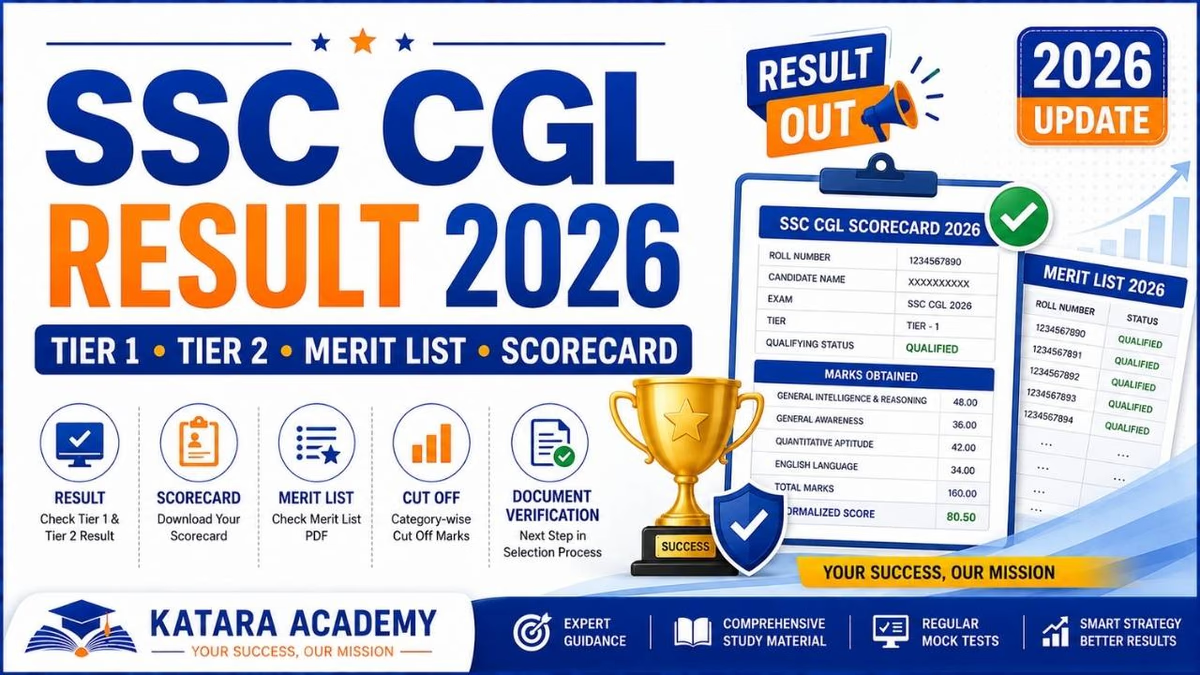
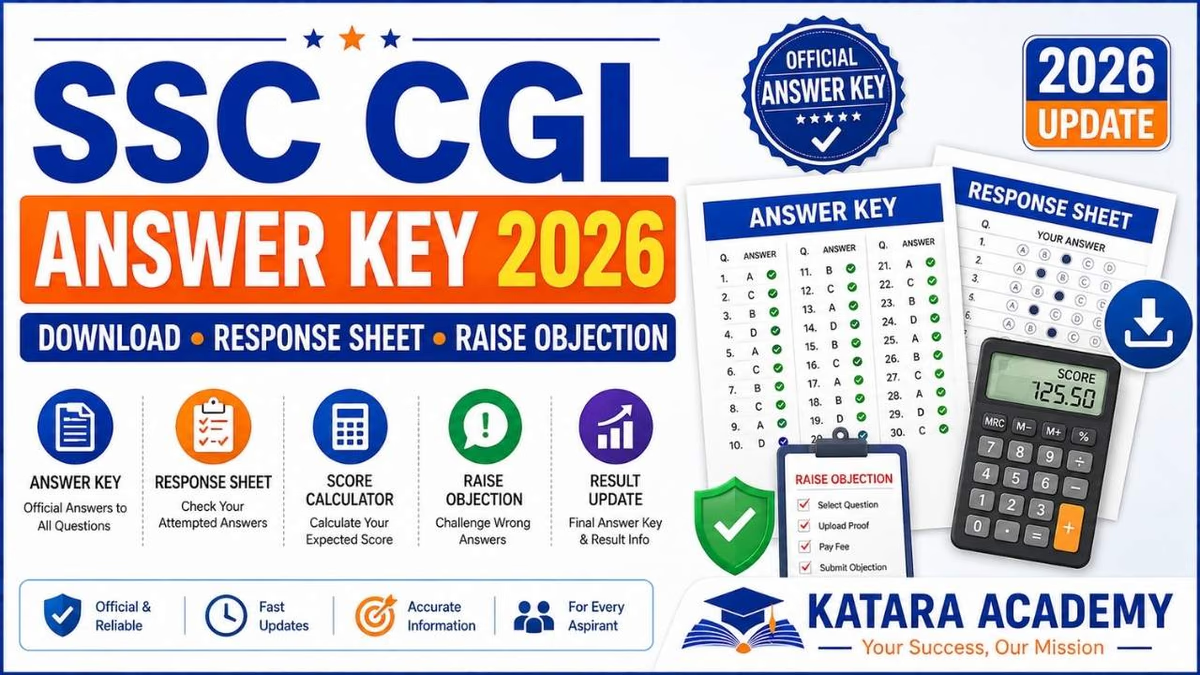
 Defence
 SSC
SSC Govt Job