






Download the App & Start Learning
- Expert Faculty Guidance
- Updated Study Material
- Mock Tests & Practice Quiz
- Live Doubt Solving Sessions
- Exam-Oriented Preparation
- Motivation & Success Strategy
Katara Academy

4/11/2026
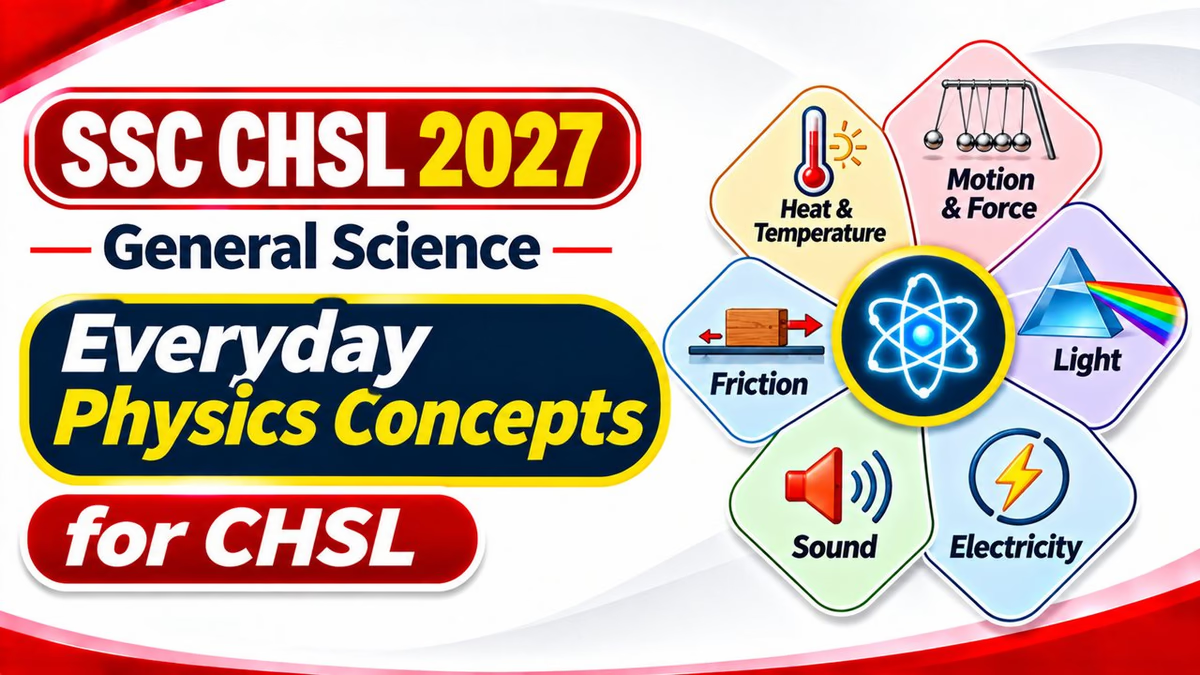
Physics is an important part of General Science for SSC CHSL 2027. Many basic physics questions are connected to everyday activities such as walking, driving, cooking, using electrical appliances and observing light and sound.Understanding these concepts through simple examples can make revision easier. This guide covers important everyday physics principles, practical applications and practice MCQs.
| Concept | Everyday Example | Key Fact |
|---|---|---|
| Inertia | Passengers move forward when a moving bus stops suddenly. | Resistance to change in the state of motion. |
| Friction | Tyres grip the road. | Opposes relative motion between surfaces. |
| Gravity | A ball falls towards the ground. | Attractive force between masses. |
| Action and Reaction | Walking and swimming. | Newton's Third Law of Motion. |
| Centripetal Force | A vehicle turning along a circular path. | Directed towards the centre of the circular path. |
Important Fact: The SI unit of temperature is Kelvin (K), while Celsius is commonly used in daily life.
| Phenomenon | Example |
|---|---|
| Reflection | Image formed in a plane mirror. |
| Refraction | A pencil appears bent in water. |
| Dispersion | Formation of a rainbow. |
| Scattering | The sky appears blue due to scattering of sunlight. |
| Total Internal Reflection | Used in optical fibres. |
| Concept | Formula |
|---|---|
| Speed | Distance ÷ Time |
| Force | F = ma |
| Pressure | Pressure = Force ÷ Area |
| Work | W = Force × Displacement (in the direction of force) |
| Power | P = Work ÷ Time |
| Ohm's Law | V = IR |
Choose the correct option for each question.
Q1. Why do passengers move forward when a moving bus stops suddenly?
A. Gravity
B. Inertia
C. Friction
D. Pressure
Q2. Which mode of heat transfer does not require a material medium?
A. Conduction
B. Convection
C. Radiation
D. Evaporation
Q3. A pencil appears bent when placed in water due to which phenomenon?
A. Reflection
B. Refraction
C. Dispersion
D. Scattering
Q4. Which phenomenon is responsible for the formation of a rainbow?
A. Dispersion of light
B. Magnetic effect
C. Conduction
D. Inertia
Q5. Which unit is used to measure the frequency of sound?
A. Newton
B. Joule
C. Hertz
D. Watt
Q6. Which device protects an electrical circuit from excessive current?
A. Switch
B. Fuse
C. Motor
D. Generator
Q7. Why do we feel cool when sweat evaporates?
A. It releases heat
B. It absorbs heat from the skin
C. It increases pressure
D. It produces light
Q8. Which law explains the action and reaction involved in walking?
A. Newton's First Law
B. Newton's Second Law
C. Newton's Third Law
D. Law of Gravitation
Q9. What is the SI unit of electric resistance?
A. Ampere
B. Volt
C. Ohm
D. Watt
Q10. Which phenomenon is used in optical fibre communication?
A. Diffraction
B. Total internal reflection
C. Conduction
D. Dispersion only
| Q. | Answer | Explanation |
|---|---|---|
| 1 | B. Inertia | The body tends to maintain its state of motion. |
| 2 | C. Radiation | Radiation transfers heat through electromagnetic waves. |
| 3 | B. Refraction | Light changes direction when it passes between different media. |
| 4 | A. Dispersion of light | Water droplets separate sunlight into different colours. |
| 5 | C. Hertz | Frequency is measured in Hertz (Hz). |
| 6 | B. Fuse | A fuse melts and breaks the circuit when excessive current flows. |
| 7 | B. It absorbs heat from the skin | Evaporation takes energy from the skin, producing a cooling effect. |
| 8 | C. Newton's Third Law | The foot pushes the ground backward, and the ground exerts a forward force on the foot. |
| 9 | C. Ohm | Ohm (Ω) is the SI unit of resistance. |
| 10 | B. Total internal reflection | Optical fibres guide light using repeated total internal reflection. |
Everyday physics becomes easier when you connect scientific principles with real-life situations. Revise important concepts, understand their applications and practise questions regularly to strengthen your General Science preparation.
Explore General Science and exam preparation courses at Katara Academy.
Due to inertia, the upper part of the body tends to continue moving forward when the bus stops suddenly.
Radiation transfers heat from the Sun to Earth without requiring a material medium.
Sound is a mechanical wave and requires a material medium to travel.
