
Download the App & Start Learning
- Expert Faculty Guidance
- Updated Study Material
- Mock Tests & Practice Quiz
- Live Doubt Solving Sessions
- Exam-Oriented Preparation
- Motivation & Success Strategy
Katara Academy

28/10/2026
Typing accuracy is an important skill for candidates preparing for SSC CHSL 2027. While practising typing speed, many candidates focus on words and sentences but overlook punctuation marks. Missing a comma, typing the wrong symbol, or adding unnecessary spaces can affect the accuracy of a copied passage.
Learning the correct placement of punctuation keys and practising them regularly can help you develop better keyboard control. This guide covers important punctuation marks, common typing mistakes, practical exercises, and a daily practice routine for SSC CHSL 2027 preparation.
Punctuation accuracy means typing punctuation marks correctly and placing them in the same positions as they appear in the original text. It includes commas, full stops, question marks, apostrophes, quotation marks, colons, and other symbols.
For example, if the original sentence is “How are you today?”, typing “How are you today.” changes the punctuation. When copying a passage during practice, your goal should be to reproduce the original text accurately rather than rewrite it in your own words.
Begin with the punctuation marks that commonly appear in English passages. Learn their keyboard positions and practise typing them in complete sentences.
Practise each symbol individually before combining several punctuation marks in longer passages.
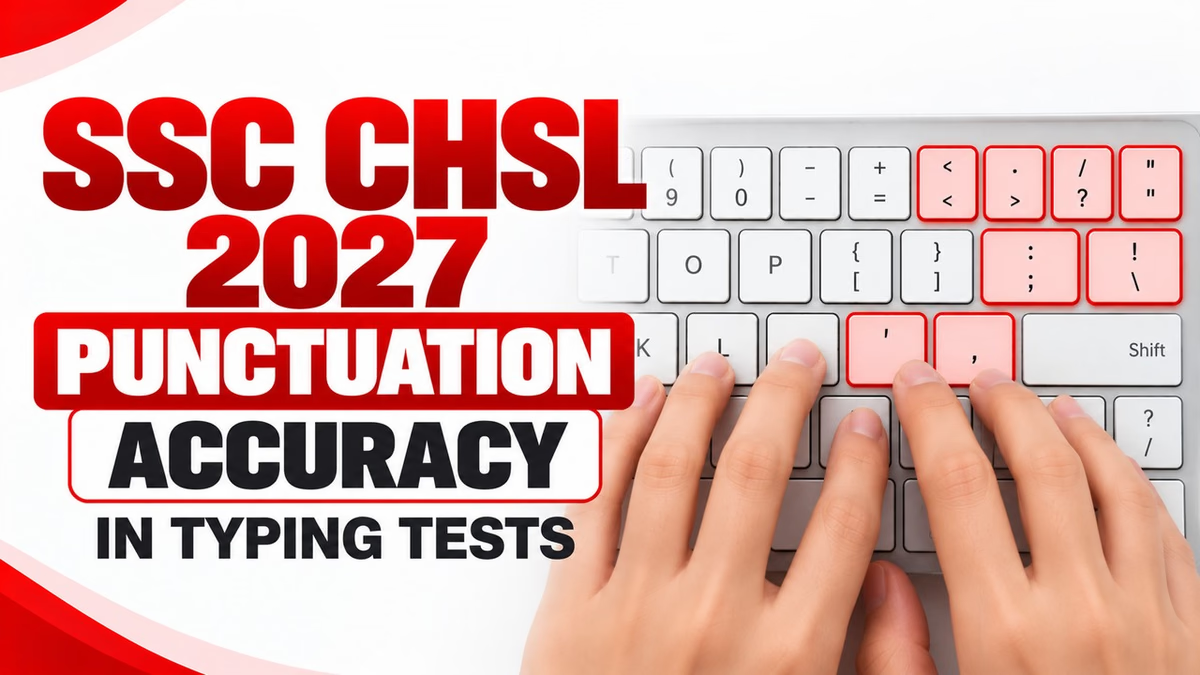
On a standard US-English keyboard layout, some punctuation marks can be typed directly, while others require the Shift key. The exact combinations may differ with your keyboard layout.
| Symbol | Key Combination |
|---|---|
| Comma (,) | Comma key |
| Full stop (.) | Period key |
| Question mark (?) | Shift + / |
| Exclamation mark (!) | Shift + 1 |
| Colon (:) | Shift + ; |
| Quotation mark (") | Shift + ' |
| Opening bracket ( | Shift + 9 |
| Closing bracket ) | Shift + 0 |
Spend a few minutes locating these keys on your own keyboard. Practising the correct movement can reduce hesitation and help you maintain a steady typing rhythm.
Recognising your common mistakes is the first step towards improving accuracy. Watch out for the following errors during practice.
Incorrect: Where are you going
Correct: Where are you going?
Always check whether the original sentence ends with a full stop, question mark, or another punctuation mark.
Incorrect: Hello , how are you ?
Correct: Hello, how are you?
In standard English typing, do not insert a space before a comma or full stop. Usually, insert one space after a punctuation mark when the sentence continues.
Do not confuse a colon (:) with a semicolon (;), or a hyphen (-) with other dash characters. Observe the source passage carefully and reproduce the exact symbol.
Incorrect: dont, cant
Correct: don't, can't
When copying text, preserve apostrophes and quotation marks exactly as they appear in the original passage.
Type the following sentences exactly as written. Focus on punctuation, spacing, spelling, and capital letters. These are sample exercises for practice, not official SSC examination passages.
Every morning, Rahul reads the newspaper. He prepares his notes before starting his studies.
Focus: Commas, full stops, and spaces between sentences.
When does the examination begin? Have you checked the instructions carefully?
Focus: Question marks and capital letters.
Riya doesn't miss her practice session. The student's notebook is on the teacher's desk.
Focus: Apostrophes in contractions and possessive forms.
The instructor said, "Read the passage carefully." Remember three things: accuracy, consistency, and patience.
Focus: Quotation marks, commas, full stops, and colons.
Please bring your admit card, identity proof, and a pen. Are all the documents ready? Don't forget to check the reporting time!
Focus: Multiple punctuation marks in a short passage.
A short, consistent practice session can help you identify errors and build confidence. Follow this 15-minute routine every day.
| Duration | Practice Activity |
|---|---|
| 3 minutes | Practise common punctuation keys individually. |
| 5 minutes | Type short sentences with commas, full stops, and question marks. |
| 4 minutes | Copy a paragraph containing mixed punctuation. |
| 3 minutes | Compare your text with the original and note your errors. |
Start without a timer if you frequently make mistakes. Once your accuracy becomes consistent, gradually introduce timed practice and work on maintaining both speed and accuracy.
Punctuation practice helps candidates reproduce passages more accurately. Missing or incorrect symbols and spacing mistakes can reduce transcription accuracy.
Focus on accuracy first, then gradually increase speed. Consistent practice helps you develop a better balance between the two.
Start with 10–15 minutes daily. Increase or adjust your practice time based on your mistakes and progress.
No. Punctuation practice is only one part of preparation. Candidates should also practise full passages, typing speed, spelling, and the requirements specified in the applicable official notification.
Improving punctuation accuracy for SSC CHSL 2027 requires regular practice, careful observation, and consistent error correction. Learn common punctuation keys, practise sample sentences, and compare your typed text with the original passage. Over time, these habits can help you type more accurately and confidently.
