

Download the App & Start Learning
- Expert Faculty Guidance
- Updated Study Material
- Mock Tests & Practice Quiz
- Live Doubt Solving Sessions
- Exam-Oriented Preparation
- Motivation & Success Strategy
Katara Academy

9/3/2026
The SSC MTS Job Profile 2026 is an important topic for candidates preparing for the Multi-Tasking (Non-Technical) Staff examination. Many aspirants want to know what an MTS employee actually does after selection, what daily duties are assigned, where they can be posted, whether the job is difficult, and what career opportunities are available.
SSC MTS is a Group ‘C’, Non-Gazetted, Non-Ministerial Central Government post. MTS employees can be appointed in different Ministries, Departments, Offices, Constitutional Bodies, Statutory Bodies and Tribunals. The exact nature of work depends on the department, office and place of posting. The Staff Selection Commission's recruitment notice describes MTS as a Group ‘C’ post under the Central Government. :contentReference[oaicite:0]{index=0}
MTS stands for Multi-Tasking Staff. The role is designed to provide essential support for the day-to-day functioning of government offices. Unlike highly specialized technical posts, MTS work is generally related to routine administrative and office-support activities.
The word “Multi-Tasking” reflects the fact that employees may be assigned different types of support duties according to the requirements of their office. Therefore, the work performed by one MTS employee may not be exactly the same as the work performed by another employee in a different department.
Important: There is no single universal daily-duty list that applies identically to every SSC MTS employee. Responsibilities are influenced by the concerned department, office, section and administrative requirements.
| Particular | Details |
|---|---|
| Post | Multi-Tasking (Non-Technical) Staff |
| Group | Group ‘C’ |
| Service | Central Government Service |
| Nature of Work | General office and administrative support |
| Work Location | Various Ministries, Departments and Government Offices |
| Pay Level | Level-1 |
| Job Type | Non-Technical Government Support Role |
The primary purpose of an MTS employee is to assist the office in performing routine support functions. Depending on the department, the employee may handle different combinations of responsibilities.
One of the major areas of an MTS job is general office support. Employees may assist officers and other staff in completing routine work necessary for the smooth functioning of the office.
This can include helping with day-to-day administrative activities, arranging materials, assisting in moving documents and performing other tasks assigned by supervisors.
MTS employees may be required to carry or move files, documents and official papers between different sections or offices. This is particularly relevant in offices where physical records and documents are still used alongside digital systems.
The employee may also assist in arranging files or delivering documents to the appropriate section as instructed.
An MTS employee may provide support in maintaining or organizing routine records, registers and documents. The exact responsibilities depend on the office's workflow and the duties assigned to the employee.
In some offices, MTS staff may assist with routine documentation-related activities such as photocopying, arranging papers or preparing documents for internal use.
These tasks are generally support functions and do not mean that every MTS employee will perform the same activities every day.
MTS employees may be assigned to deliver files, letters, notices or other official documents to different sections within an office or establishment.
An important part of the role is assisting senior officials and other office staff with routine support requirements. This helps different departments and sections complete their regular administrative activities efficiently.
Because MTS is a multi-tasking role, employees may receive other duties assigned by the competent authority according to the requirements of the office.
Key Point: The actual workload and responsibilities can vary considerably between government offices. Candidates should not judge the entire MTS job only from examples of duties performed in one particular department.
There is no fixed daily routine that applies to all MTS employees. A typical working day may involve a combination of office-support activities based on the workload of the section.
For example, an employee may start the day by reporting to the concerned section, receiving assigned instructions, moving files or documents, assisting with routine office work and completing tasks assigned by supervisors.
| Time/Stage | Possible Work |
|---|---|
| Beginning of Day | Reporting to office and receiving assigned instructions |
| Morning Work | File/document movement and routine office assistance |
| During Office Hours | Section-wise support and other assigned tasks |
| Later in the Day | Completing pending assignments and delivering required documents |
The amount of computer-related work can depend on the department and office. Government offices increasingly use digital systems and e-office processes, and the Department of Personnel and Training's current induction-training material for MTS includes MS Office and E-Office as training topics. It also covers office procedures, handling office equipment and communication skills. :contentReference[oaicite:1]{index=1}
However, candidates should not assume that the MTS role is purely a computer-based job. The actual balance between physical office-support work and computer-related activities depends on the posting.
The nature of MTS work is generally associated with office support, but the exact working environment can differ. Some employees may spend most of their time inside an office, while others may have duties that require movement within an establishment or between office sections.
| Work Type | Examples |
|---|---|
| Office-Based | Document handling, records support and routine assistance |
| Movement Within Office | Carrying files and documents between sections |
| Administrative Support | Assisting officers and sections with assigned tasks |
SSC MTS recruitment covers vacancies reported by different user departments. The recruitment notice provides for MTS positions in various Central Government offices, meaning the place and department of work can differ from one candidate to another. :contentReference[oaicite:2]{index=2}
The Staff Selection Commission's current website also lists the Multi Tasking (Non-Technical) Staff Examination, 2026 among its examinations, confirming that MTS remains part of the Commission's current recruitment framework. :contentReference[oaicite:3]{index=3}
MTS employees may work in different types of Central Government establishments. Depending on the vacancy and allocation, the working environment can include ministries, departments, subordinate offices and other organizations participating in the recruitment process.
This variety is one reason the SSC MTS job profile can differ from one posting to another.
The difficulty of an MTS job cannot be described by one universal standard. Some postings may involve more routine office support, while others may require more movement or a higher volume of administrative assistance.
Compared with technical posts, MTS work is generally not centered on specialized technical expertise. However, employees are expected to be responsible, punctual, disciplined, cooperative and capable of handling assigned duties efficiently.
| Skill | Why It Is Useful |
|---|---|
| Time Management | Helps complete multiple routine assignments efficiently |
| Communication | Useful for receiving and conveying office instructions |
| Basic Computer Skills | Increasingly useful in modern digital government offices |
| Teamwork | MTS employees work with officers and other staff |
| Discipline | Important for following office procedures and instructions |
| Responsibility | Important when handling files, documents and assigned work |
Work pressure can vary according to the department, office, section and workload. Some offices may have a relatively predictable routine, while others may have periods of increased workload.
Therefore, statements such as “MTS always has very low workload” or “MTS is always a stressful job” are too general. The experience can differ significantly according to the posting.
Bottom Line: SSC MTS is a support-oriented Central Government position, but the day-to-day experience depends heavily on the department, office and responsibilities assigned at the posting.
The MTS post can also provide a foundation for long-term government service. The Department of Personnel and Training notes that the Staff Selection Commission conducts departmental competitive examinations, including an examination related to promotion from Multi-Tasking Staff to Lower Division Clerk (LDC) Grade. :contentReference[oaicite:4]{index=4}
This does not mean every MTS employee will automatically receive an LDC promotion after a fixed number of years. Eligibility, vacancies, departmental rules and the relevant examination or selection process must be satisfied where applicable.
Get structured classes, study material, previous year questions, mock tests, doubt-solving support and performance-focused preparation for SSC and other competitive examinations.
In Part 1, we introduced the SSC MTS Job Profile 2026 and explained the nature of the Multi-Tasking Staff post. In this part, we will look more closely at the daily work, common responsibilities, office tasks, document handling, computer-related work, communication and working routine of an MTS employee.
The exact duties assigned to an SSC MTS employee can differ according to the concerned Ministry, Department, office, section and local requirements. The Department of Personnel and Training's induction-training material for MTS specifically covers areas such as office procedures, handling of office equipment, MS Office, E-Office, communication skills and reporting to seniors, which gives a useful indication of the broad competencies expected in the role. :contentReference[oaicite:0]{index=0}
There is no single fixed daily routine for every MTS employee. The day's work depends on the office's workload and the instructions received from senior staff. An employee may be asked to complete several routine support tasks during the same working day.
A typical day can involve reporting to the assigned section, receiving work instructions, handling files or documents, supporting office procedures, using basic office equipment, assisting staff and completing other tasks allocated by the concerned supervisor.
| Work Stage | Possible Activities |
|---|---|
| Start of Work | Reporting to the assigned office/section and receiving instructions |
| Morning Tasks | File movement, document delivery and routine office assistance |
| During Office Hours | Supporting staff, handling assigned office work and using office equipment |
| Later Tasks | Completing pending work and carrying out additional instructions |
| End of Day | Finishing assigned work and reporting relevant updates to seniors |
One of the common support activities associated with MTS work is handling and moving files and official documents. Government offices often have multiple sections, and documents may need to move between them according to established procedures.
An MTS employee may be responsible for delivering a file or document to the appropriate section, collecting papers, arranging documents or assisting with routine movement of records.
Important: Handling a document does not mean that the MTS employee independently takes decisions on official matters. Decision-making and file processing responsibilities are governed by the concerned office's established hierarchy and procedures.
The Department of Personnel and Training's induction-training programme for MTS includes “Handling of Office Equipments” as a specific training topic. :contentReference[oaicite:1]{index=1}
This reflects the need for MTS employees to be familiar with routine office equipment and to provide practical support within the workplace. Depending on the office, this may involve assisting with photocopying, scanning, printing or other routine equipment-related activities.
Some MTS employees may assist with routine photocopying, printing, scanning or arranging documents. These activities support the day-to-day workflow of government offices.
The amount of such work depends entirely on the office. In a highly digitized office, some of these tasks may be less frequent, while in offices that continue to work extensively with physical records, document-support work may be more prominent.
Modern government offices increasingly use digital systems. The DoPT induction programme specifically includes Introduction to E-Office, including “Diarization of Dak,” as part of MTS training. It also includes an introductory MS Office session. :contentReference[oaicite:2]{index=2}
This means that basic digital awareness can be useful for an MTS employee. However, the job should not be considered a purely computer-based position. The actual amount of computer work varies according to the department and assigned duties.
| Digital Area | Possible Role of MTS |
|---|---|
| MS Office | Basic familiarity may be useful depending on office requirements |
| E-Office | Awareness of digital office workflow may be required |
| Digital Documents | Supporting document-related processes where assigned |
| Office Equipment | Using or assisting with routine office equipment |
Government offices handle incoming and outgoing correspondence, commonly referred to as dak. The DoPT's MTS induction material specifically mentions E-Office and “Diarization of Dak,” highlighting the importance of understanding basic correspondence-related office processes. :contentReference[oaicite:3]{index=3}
Depending on the office, MTS staff may assist with the movement or delivery of correspondence and documents according to established office procedures.
An MTS employee may be attached to a particular section but can be required to provide support for different routine activities within the office. The multi-tasking nature of the role means that assignments may change according to the immediate requirement.
For example, one task may involve taking a document to another section, followed by arranging papers, assisting with office equipment and then completing another assignment given by a supervisor.
Communication with supervisors is an important part of government office work. The DoPT training programme specifically includes communication skills—oral and written, listening skills and reporting to seniors. :contentReference[oaicite:4]{index=4}
An MTS employee should therefore be able to understand instructions, communicate appropriately and report the status of assigned tasks when required.
Government employees are expected to follow workplace procedures, official instructions and applicable conduct requirements. The MTS induction programme includes conduct and workplace ethics, indicating the importance of professional behaviour from the beginning of service. :contentReference[oaicite:5]{index=5}
| Professional Quality | Importance in MTS Job |
|---|---|
| Punctuality | Important for reporting on time and completing assigned work |
| Discipline | Helps employees follow office rules and instructions |
| Communication | Necessary for understanding and conveying instructions |
| Responsibility | Important when handling documents and completing assigned tasks |
| Teamwork | MTS employees work with officers and other staff |
A common question among candidates is whether MTS is a desk job or a physical job. The practical answer is that it can contain both office-based and movement-based responsibilities.
An employee may spend part of the day working within a section and another part moving documents or assisting elsewhere in the office. The balance depends on the department and assignment.
| Type of Work | Examples |
|---|---|
| Office-Based | Arranging documents, records support and routine administrative assistance |
| Movement-Based | Carrying files, documents or correspondence between sections |
| Equipment Support | Assisting with routine office equipment and document work |
| Digital Support | Basic computer or E-Office-related activities where assigned |
SSC MTS is not necessarily a purely desk-based job. Some responsibilities may be performed at a workstation, while others involve movement around the office. The exact ratio differs from one posting to another.
Candidates who prefer a role with some variety in routine tasks may find the multi-tasking nature of the post suitable.
MTS duties can involve physical movement such as carrying files, documents or office materials, but the job should not be described as a dedicated physical or field-force position. The nature and intensity of physical work depend on the office and assigned responsibilities.
Working hours depend on the concerned government office and its operational requirements. Candidates should understand that there is no single universal daily schedule covering every MTS workplace.
Most importantly, MTS employees are expected to report on time, follow the prescribed office schedule and complete assigned duties within the applicable working arrangements.
Important: Working hours, workload and specific duties should be understood in the context of the department and posting. Avoid relying on a single employee's experience as the standard for every MTS position.
Basic computer awareness can be useful because the official MTS induction programme includes MS Office and E-Office. :contentReference[oaicite:6]{index=6}
Candidates do not necessarily need advanced technical skills for the post. However, learning basic computer operations, document handling and digital-office concepts can make it easier to adapt to a modern government workplace.
| Situation | Possible MTS Work |
|---|---|
| Normal Office Day | Routine document movement and general office assistance |
| High Document Workload | More file/document handling and section support |
| Digital Workflow | Support for E-Office and digital document processes where assigned |
| Administrative Activity | Additional office-support tasks based on requirements |
In Part 1 and Part 2, we discussed the basic nature of the SSC MTS post, daily duties, file handling, office support, computer-related work and the skills required for the job. In this part, we will understand the departments, posting locations, workload, transfer, work environment, job difficulty and work-life balance associated with SSC MTS.
SSC MTS employees are recruited for various Central Government Ministries, Departments, Offices and other organizations. The SSC recruitment framework allows MTS posts to exist across different States and Union Territories, so the actual work environment and responsibilities can vary significantly from one posting to another. ([ssc.gov.in](https://ssc.gov.in/api/attachment/uploads/masterData/NoticeBoards/Notice_of_adv_mts_2025.pdf?mode=light&utm_source=chatgpt.com))
One of the biggest features of the SSC MTS recruitment is the variety of departments and government offices in which selected candidates can be placed. The official recruitment notice describes MTS vacancies across various Ministries, Departments and Offices of the Government of India, as well as Constitutional Bodies, Statutory Bodies and Tribunals. ([ssc.gov.in](https://ssc.gov.in/api/attachment/uploads/masterData/NoticeBoards/Notice_of_adv_mts_2025.pdf?mode=light&utm_source=chatgpt.com))
| Type of Organization | Possible Working Environment |
|---|---|
| Central Ministries | Administrative and departmental office support |
| Government Departments | Section-based office and record support |
| Attached/Subordinate Offices | Routine administrative and operational support |
| Constitutional Bodies | Organization-specific support duties |
| Statutory Bodies | Office and administrative assistance |
| Tribunals | Routine office and document support |
The place of posting is determined according to available vacancies, department requirements and the recruitment/allocation process. Since MTS posts are spread across different States and Union Territories, candidates should be prepared for the possibility of being posted away from their home city.
A candidate should therefore consider location flexibility before applying. The recruitment notice itself provides for MTS vacancies in different States and Union Territories. ([ssc.gov.in](https://ssc.gov.in/api/attachment/uploads/masterData/NoticeBoards/Notice_of_adv_mts_2025.pdf?mode=light&utm_source=chatgpt.com))
Important: SSC MTS recruitment is not a guarantee of posting in your preferred city. The available vacancies and applicable allocation rules determine the actual place of appointment.
The work environment of an MTS employee depends heavily on the department. Some employees may work in a conventional administrative office, while others may be attached to an office with different operational requirements.
The Department of Personnel and Training's 2025 induction-training instructions describe MTS personnel as being involved in diverse roles such as office maintenance, record-keeping and assistance in day-to-day government operations. The same instructions state that MTS is a decentralized cadre under the administrative control of the concerned Ministry, Department or Organization. ([dopt.gov.in](https://dopt.gov.in/sites/default/files/Instructions%20for%20Mandatory%20Induction%20Training%20Programme%20of%20Multi-Tasking%20Staff%20of%20Central%20Secretariat.pdf?utm_source=chatgpt.com))
Workload is not identical in every MTS posting. It depends on the size of the office, number of employees, nature of the department, volume of records, daily activities and additional responsibilities.
| Workload Level | Possible Situation |
|---|---|
| Routine | Regular file movement, document handling and office assistance |
| Moderate | Multiple sections or assignments handled during the day |
| High-Activity Period | Increased documentation, correspondence or administrative activity |
Therefore, statements such as “SSC MTS has no workload” should not be taken as universally true. At the same time, the workload should not automatically be assumed to be extremely difficult. Actual experience depends on the posting.
The difficulty of the job depends more on the nature of assigned duties than on the designation itself. MTS is primarily a support role, so the employee is expected to complete routine tasks carefully, follow instructions and maintain discipline.
Some tasks may require physical movement, such as carrying documents or moving between sections, while others can involve record-keeping, office equipment or digital-office support.
For Aspirants: The MTS job is generally manageable for candidates who are disciplined, punctual, comfortable with routine responsibilities and willing to adapt to the requirements of their department.
Transfer-related matters are generally governed by the concerned department or cadre. Since MTS is administered by the respective Ministries/Departments/Organizations, there is not one single transfer experience that applies identically to every employee. ([dopt.gov.in](https://dopt.gov.in/sites/default/files/Instructions%20for%20Mandatory%20Induction%20Training%20Programme%20of%20Multi-Tasking%20Staff%20of%20Central%20Secretariat.pdf?utm_source=chatgpt.com))
Transfers may depend on administrative requirements, cadre rules, vacancy position and other applicable departmental policies. Candidates should therefore study the rules of their allotted department after appointment.
A home-state or home-city posting cannot be assumed simply because a candidate belongs to that State. The actual posting depends on the vacancies and allocation process applicable to the recruitment.
Candidates should keep their location preferences realistic and be prepared to work at the location assigned by the concerned authority.
Work-life balance is one of the factors that attracts candidates toward government employment. In many office-based MTS roles, work follows the schedule of the concerned government establishment. However, the exact routine can differ according to the nature of the department and operational requirements.
Candidates should avoid assuming that every MTS posting will have exactly the same working hours or workload. The office's working arrangements and the employee's assigned responsibilities remain important factors.
| Advantage | Why It Matters |
|---|---|
| Central Government Service | Provides entry into the Central Government employment system |
| Structured Pay | Salary is governed by the applicable pay matrix and government rules |
| Varied Workplaces | Employees can be posted in different types of government offices |
| Career Development | Departmental opportunities may provide routes for career progression |
| Office Experience | Employees gain experience with government office procedures |
| Job Stability | Offers a structured long-term government service framework |
Like any job, MTS also has certain challenges that candidates should understand before joining.
Candidates often compare SSC MTS with other SSC posts. The main difference is the level and nature of responsibility. MTS is an entry-level support-oriented role, whereas examinations such as SSC CHSL and SSC CGL recruit candidates for different clerical, assistant, inspector and other positions with different qualifications and responsibilities.
| Feature | SSC MTS |
|---|---|
| Role Type | General office/support role |
| Pay Level | Level-1 |
| Qualification Level | Matriculation-based eligibility for the recruitment |
| Work Nature | Multi-tasking, administrative and office support |
| Workplace | Various Central Government offices |
SSC MTS should not necessarily be viewed as the final stage of a government career. The Department of Personnel and Training's annual report states that SSC conducts Limited Departmental Competitive Examinations for promotion from MTS to Lower Division Clerk (LDC) Grade. ([dopt.gov.in](https://dopt.gov.in/sites/default/files/AR2022-23English.pdf?utm_source=chatgpt.com))
This is an important career-growth opportunity, but eligibility and progression depend on the applicable departmental rules, qualifying conditions and selection process. It should not be interpreted as an automatic promotion for every MTS employee.
Career Strategy: An MTS employee who continues learning, improves computer skills, understands office procedures and prepares for eligible departmental opportunities can build a stronger long-term career path.
SSC MTS can be suitable for candidates who want to enter Central Government service and are comfortable with routine support responsibilities. It may particularly appeal to aspirants who value a structured workplace and want to build a long-term government career.
Candidates should be willing to adapt to different office environments, follow instructions carefully and accept the possibility of a posting outside their preferred location.
SSC MTS is an entry-level Central Government position, but selection as MTS does not necessarily mean that an employee's career ends at the same designation. Depending on the concerned department, cadre rules, eligibility and vacancies, employees may have opportunities for advancement through departmental mechanisms. The Staff Selection Commission continues to conduct departmental examinations for existing government employees, and its official site currently lists several Limited Departmental Competitive Examinations. :contentReference[oaicite:0]{index=0}
Promotion is one of the main factors candidates consider while choosing a government job. For MTS employees, the exact promotion route is not identical in every department. It depends on the applicable recruitment rules, cadre structure, qualifying service, educational qualifications, vacancies and the departmental selection process.
Therefore, candidates should avoid claims such as “every MTS employee is promoted after exactly X years.” A fixed universal timeline cannot be applied to all MTS employees because the administrative and cadre structure can differ.
A well-known departmental progression route associated with MTS is advancement toward clerical posts such as Lower Division Clerk (LDC), now commonly associated with the Junior Secretariat Assistant (JSA) designation in the relevant Central Secretariat framework. The Department of Personnel and Training has documented Limited Departmental Competitive Examinations for promotion from MTS to LDC grade. :contentReference[oaicite:1]{index=1}
However, this should be understood as a departmental opportunity subject to rules and eligibility, rather than an automatic promotion available to every MTS employee at the same time.
Important Career Point: A departmental examination can create a route for eligible MTS employees to compete for higher posts. The exact eligibility conditions and vacancies should always be checked in the relevant departmental/SSC notice.
A Limited Departmental Competitive Examination (LDCE) is a selection mechanism intended for eligible serving government employees. Instead of competing directly with all external applicants, eligible employees of the relevant cadre or service can compete under the rules specified for that departmental examination.
The SSC website identifies “Departmental Examination” as an area through which existing government employees can seek promotion or related advancement within their departments. :contentReference[oaicite:2]{index=2}
| Factor | Effect on Career Progression |
|---|---|
| Department/Cadre | Determines the applicable service and promotion rules |
| Qualifying Service | Some departmental opportunities require a specified period of regular service |
| Educational Qualification | Certain higher posts may prescribe additional qualifications |
| Departmental Examination | Applicable competitive examinations may provide an advancement route |
| Vacancies | Promotion opportunities depend partly on available sanctioned posts |
| Service Record | Relevant departmental rules and service conditions may affect progression |
Career growth is not limited to a change in designation. An MTS employee's basic pay can progress through the applicable Pay Level-1 pay matrix, while allowances are governed by the prevailing Central Government rules.
This means that an employee who remains in service for several years may have a significantly higher basic pay than at the time of joining, subject to applicable increments and service progression.
| Career Stage | Possible Salary Development |
|---|---|
| Initial Joining | Entry-level basic pay under Level-1 |
| After Service Progression | Basic pay moves through applicable pay-matrix stages |
| Higher Responsibility | Higher pay can result from promotion where applicable |
| Long-Term Career | Higher basic pay and career progression subject to service rules |
Yes. Working as MTS does not prevent an employee from continuing to prepare for other competitive examinations. In fact, government employees may continue improving their educational qualifications and preparing for future opportunities, subject to the applicable rules governing applications and service.
An employee may therefore use MTS as a starting point in government service while simultaneously building qualifications and preparation for suitable higher-level opportunities.
Career Tip: Getting an MTS job does not mean you have to stop learning. Building computer skills, communication skills and educational qualifications can be useful for future departmental or competitive opportunities.
The modern government workplace is increasingly digital. The DoPT's MTS induction programme includes MS Office, E-Office, office equipment, communication skills and reporting to seniors among its training areas. :contentReference[oaicite:3]{index=3}
For this reason, an MTS employee can benefit from developing practical computer skills after joining. Basic knowledge of word processing, spreadsheets, email, scanning, digital documents and office systems can make everyday work easier.
| Skill | Career Benefit |
|---|---|
| MS Word | Useful for basic document-related work |
| Excel | Helpful for simple data and tabular office work |
| E-Office | Useful in digital government workflows |
| Email & Internet | Supports modern office communication |
| Typing | Can be useful for administrative work and future clerical opportunities |
Communication skills are valuable in any government office. The official MTS induction programme specifically includes oral and written communication, listening skills and reporting to seniors. :contentReference[oaicite:4]{index=4}
An MTS employee regularly interacts with colleagues, officers and other sections. Clear communication helps reduce mistakes when receiving instructions, delivering information or completing assigned tasks.
An employee becomes more effective when they understand how their office operates. Familiarity with basic office procedures, record handling, correspondence and digital systems can help an MTS employee perform duties confidently.
Learning how files move through the office, how documents are handled and how communication is routed can also help employees understand the wider functioning of government administration.
An MTS employee works within an official administrative structure. Punctuality, discipline, respectful communication, confidentiality where applicable and responsible handling of documents are therefore important professional qualities.
The DoPT induction-training framework also emphasizes conduct and workplace ethics, highlighting the importance of professional behaviour after appointment. :contentReference[oaicite:5]{index=5}
SSC MTS Selection
↓
Joining in Level-1 Post
↓
Work Experience + Service Progression
↓
Departmental Eligibility / Examination
↓
Higher Post Where Applicable
↓
Further Career Progression
This roadmap is a simplified representation of possible career development. The actual route can vary by department, cadre and applicable service rules.
Departmental examinations can be especially important for employees who want faster or competitive career progression within an eligible cadre. The DoPT has documented the MTS-to-LDC departmental examination route, while the SSC continues to conduct limited departmental examinations for serving employees. :contentReference[oaicite:6]{index=6}
Eligible employees should therefore keep track of departmental notifications and service-rule updates rather than waiting for promotion automatically.
| Area | Long-Term Advantage |
|---|---|
| Experience | Greater familiarity with government office procedures |
| Pay Progression | Basic pay can progress under the applicable pay structure |
| Skills | Improved administrative, digital and communication abilities |
| Departmental Opportunities | Eligible employees may be able to compete through departmental mechanisms |
| Career Flexibility | Experience can support future career planning within or beyond the current role |
Many aspirants rely on social-media posts and unofficial articles that mention a fixed promotion timeline or a guaranteed designation after a certain number of years. Such claims can be misleading.
Do not assume: “MTS promotion is automatic,” “every department follows the same rules,” or “everyone gets promoted after the same number of years.” Always check the applicable cadre rules and the latest official departmental notice.
Yes, there can be scope for growth. Growth may come through regular pay progression, additional responsibilities, departmental opportunities and promotion where the relevant service rules provide for it.
The existence of an MTS-to-LDC departmental competitive examination route documented by DoPT is one example of how an entry-level position can provide a platform for progression. :contentReference[oaicite:7]{index=7}
This is the final part of our detailed SSC MTS Job Profile 2026 guide. In the previous parts, we covered the nature of the MTS post, daily duties, office work, file handling, computer-related responsibilities, departments, posting locations, workload, transfer, work-life balance, promotion and departmental career opportunities. This part brings everything together in one complete guide for SSC MTS aspirants.
SSC MTS stands for Multi-Tasking (Non-Technical) Staff. It is a Central Government Group ‘C’, Non-Gazetted, Non-Ministerial post. MTS employees are recruited for various Ministries, Departments, Offices, Constitutional Bodies, Statutory Bodies and Tribunals. The exact responsibilities can vary depending on the department and place of posting.
| Particular | Details |
|---|---|
| Post Name | Multi-Tasking (Non-Technical) Staff |
| Group | Group ‘C’ |
| Nature of Job | Office, administrative and general support work |
| Workplace | Various Central Government offices |
| Pay Level | Level-1 |
| Work Nature | Multi-tasking and support-oriented |
The MTS role involves performing different routine support activities required for the smooth functioning of a government office. The exact responsibilities depend on the concerned department and section.
The Department of Personnel and Training's MTS induction programme includes office procedures, office equipment, MS Office, E-Office, communication skills, reporting to seniors and workplace ethics among its training areas. ([dopt.gov.in](https://dopt.gov.in/sites/default/files/Instructions%20for%20Mandatory%20Induction%20Training%20Programme%20of%20Multi-Tasking%20Staff%20of%20Central%20Secretariat.pdf?utm_source=chatgpt.com))
SSC MTS should not be considered a purely desk job or a purely physical job. The role can combine office-based responsibilities and movement-related support work.
| Work Area | Examples |
|---|---|
| Office Work | Document arrangement, record support and routine assistance |
| Movement Work | Carrying files and documents between sections |
| Digital Work | Basic computer or E-Office tasks where assigned |
| Equipment Support | Routine use or assistance with office equipment |
SSC MTS vacancies are available across different Central Government establishments. The recruitment notice provides for appointments in various Ministries, Departments and Offices and other government organizations across different States and Union Territories. ([ssc.gov.in](https://ssc.gov.in/api/attachment/uploads/masterData/NoticeBoards/Notice_of_adv_mts_2025.pdf?mode=light&utm_source=chatgpt.com))
Because vacancies are distributed across different offices, candidates should be prepared for different types of workplaces and should not assume that selection guarantees a posting in their hometown.
Important: The actual posting is determined according to the recruitment and allocation process and the requirements of the concerned organization.
Workload is not the same in every MTS posting. It can depend on the office size, number of staff members, type of department, document volume and daily administrative requirements.
Some postings may involve a predictable routine, while others may become busier during periods of increased correspondence, record work or administrative activity.
Transfer-related conditions depend on the concerned department, cadre and applicable administrative rules. Since different organizations can have different service structures, the transfer experience is not identical for every MTS employee.
Candidates should understand that selection through SSC MTS does not necessarily mean that they will remain at the initial posting location throughout their service.
Work-life balance can vary according to the department and office. Many office-based responsibilities follow the working arrangements of the concerned government establishment. However, the workload and daily routine may differ depending on operational requirements.
For candidates who prefer structured employment and routine administrative responsibilities, the MTS role can be an attractive government career option.
An important advantage of entering government service through MTS is that there can be opportunities for career progression. Promotion depends on the applicable service rules, cadre structure, qualifying service, educational qualification, departmental examinations and availability of vacancies.
The Department of Personnel and Training has documented departmental competitive examination arrangements for progression from MTS to LDC Grade. Such opportunities are subject to the relevant eligibility conditions and departmental rules. ([dopt.gov.in](https://dopt.gov.in/sites/default/files/DOPT-PG-AND-TRAINING-ANNUAL-REPORT-2017-18.pdf?utm_source=chatgpt.com))
Career Reminder: Promotion should not be treated as automatic after a fixed number of years for every MTS employee. Always check the service rules and official departmental notifications applicable to your cadre.
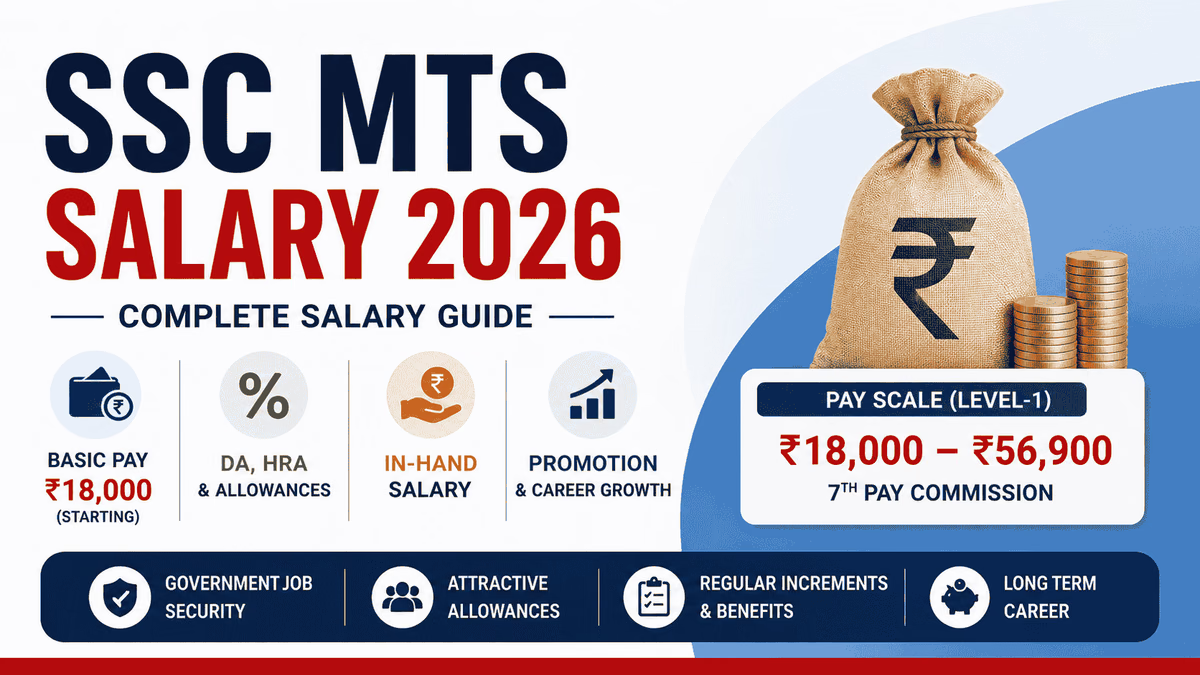
The MTS post is placed in Pay Level-1. The starting basic pay is ₹18,000, while the applicable Level-1 pay matrix extends to ₹56,900. Salary progression can occur through the applicable increment mechanism, while allowances are governed by prevailing Government orders.
Therefore, employees can experience salary growth even while continuing in the same post, and a higher salary level may also result from promotion where applicable.
| Skill | How It Helps |
|---|---|
| Computer Skills | Useful for modern digital office systems |
| MS Office | Useful for basic document and data-related work |
| E-Office Knowledge | Helps employees adapt to digital workflows |
| Communication | Helps with instructions, coordination and reporting |
| Time Management | Helps manage multiple assignments |
| Teamwork | Useful when supporting different sections and staff |
The main work is general office and administrative support. Duties may include file and document handling, office assistance, record support, correspondence and other tasks assigned by the concerned authority.
Not necessarily. The job can include desk-based office support as well as movement-related duties such as carrying files or documents between sections.
Some assignments can involve physical movement, but MTS is fundamentally a general support role rather than a dedicated physical or field-force post.
Computer-related work can be part of the role depending on the posting. The official MTS induction-training programme includes MS Office and E-Office among its training areas. ([dopt.gov.in](https://dopt.gov.in/sites/default/files/Instructions%20for%20Mandatory%20Induction%20Training%20Programme%20of%20Multi-Tasking%20Staff%20of%20Central%20Secretariat.pdf?utm_source=chatgpt.com))
Transfer conditions depend on the concerned department or cadre and its applicable rules. Candidates should not assume that the initial posting will necessarily remain permanent.
Yes, departmental career-progression opportunities can exist. However, the exact route depends on the applicable service rules, qualifying service, eligibility, departmental examinations and vacancies.
There are departmental competitive examination arrangements for progression from MTS to LDC grade in relevant Central Government frameworks. Eligibility and selection conditions must be satisfied. ([dopt.gov.in](https://dopt.gov.in/sites/default/files/DOPT-PG-AND-TRAINING-ANNUAL-REPORT-2017-18.pdf?utm_source=chatgpt.com))
Workload varies by department, office and posting. Some offices may have a predictable routine, while others may have a higher volume of work.
The work-life balance depends on the department and office. Many candidates find the structured government-office environment attractive, but the actual experience can differ by posting.
For candidates seeking Central Government employment with a structured pay system and scope for long-term career development, SSC MTS can be a useful career option.
| Aspect | SSC MTS |
|---|---|
| Job Type | Central Government support role |
| Group | Group ‘C’ |
| Pay Level | Level-1 |
| Work Nature | Multi-tasking and administrative support |
| Computer Work | Depends on department and assignment |
| Physical Movement | May be required for certain duties |
| Posting | Various Central Government offices |
| Promotion | Subject to applicable departmental rules and opportunities |
| Career Growth | Possible through pay progression and eligible departmental advancement |
SSC MTS can be suitable for candidates who want to enter Central Government service and are comfortable with general office-support duties. Candidates should be ready to work according to the requirements of their department and should have a willingness to learn new office systems and procedures.
It is particularly useful for aspirants who want to establish themselves in government service and may later pursue eligible departmental or competitive career opportunities.
The SSC MTS Job Profile 2026 is centered around providing essential administrative and operational support in Central Government offices. The role can involve file and document handling, office assistance, record support, equipment-related work, digital-office activities and other duties assigned according to the department's requirements.
The job offers a structured government employment framework and can provide opportunities for salary progression and departmental career advancement. At the same time, candidates should be realistic about posting location, routine responsibilities, workload and department-specific rules.
For aspirants who want a stable entry into Central Government service and are willing to learn, adapt and take responsibility, SSC MTS can be a valuable starting point for a long-term government career.
SSC MTS is not just an entry-level job—it can be the first step toward a longer government career.
Ready to prepare for SSC MTS 2026? Build your preparation with structured classes, study material, previous year questions, mock tests, doubt-solving support and performance-focused learning.
Katara Academy helps SSC aspirants prepare with a focused and systematic approach for competitive examinations.
Disclaimer: Job duties, posting arrangements, promotion opportunities and service conditions may vary according to the concerned department, cadre and Government rules. Candidates should verify the latest official SSC and departmental notifications before making decisions.