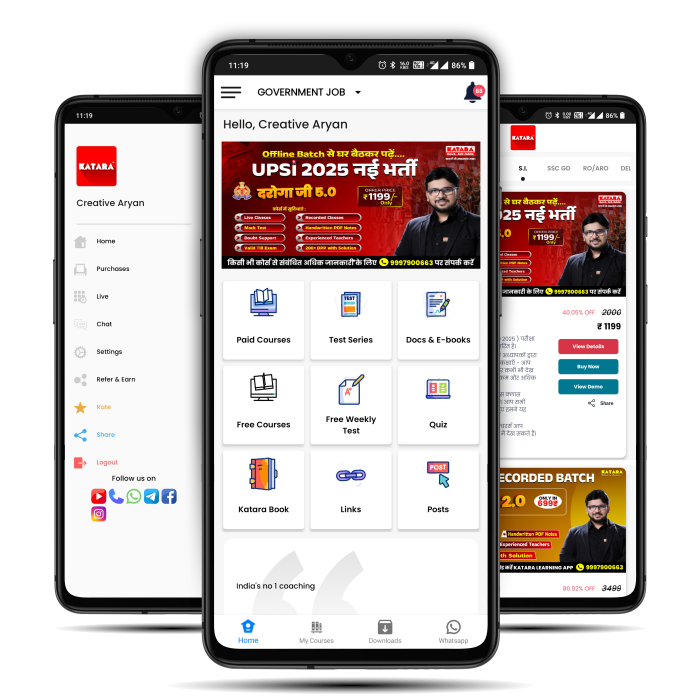


Download the App & Start Learning
- Expert Faculty Guidance
- Updated Study Material
- Mock Tests & Practice Quiz
- Live Doubt Solving Sessions
- Exam-Oriented Preparation
- Motivation & Success Strategy
Katara Academy

9/5/2026
SSC MTS Mock Test is an important part of preparation for candidates appearing for the Multi-Tasking (Non-Technical) Staff examination. Mock tests help aspirants practise the examination pattern, improve speed, manage time, identify weak areas and build confidence before the actual Computer Based Examination.
A mock test should not be treated simply as a collection of questions. When attempted seriously, it becomes a complete preparation tool that can show a candidate exactly where marks are being gained and lost. Regular mock-test practice can help improve question selection, accuracy and overall examination strategy.
There is also an important distinction between the official SSC mock test and a regular practice mock test. SSC made an official mock test available from 18 July 2025 specifically to familiarize candidates with the Computer-Based Test environment and interface. SSC clearly stated that this official mock test is for familiarization, that its format may differ from the actual examination, and that it should not be treated as a practice paper or a simulation of the actual test. ([ssc.gov.in](https://ssc.gov.in/api/attachment/uploads/masterData/NoticeBoards/notice_18725.pdf?utm_source=chatgpt.com))
Important: The official SSC mock test and coaching-institute practice mocks serve different purposes. The SSC mock test mainly helps candidates become comfortable with the CBT interface, while practice mocks are used for score improvement, revision and exam preparation.
An SSC MTS Mock Test is a practice examination designed around the MTS Computer Based Examination. It may reproduce the structure, subject areas, time pressure and question style of the actual examination so that candidates can practise before appearing in the real test.
A good mock test should allow candidates to experience the pressure of solving multiple questions within a limited period. It should also provide an opportunity to review incorrect answers and understand why marks were lost.
| Mock Test Feature | Purpose |
|---|---|
| Timed Questions | Develops speed and time-management skills. |
| Exam-Like Questions | Provides realistic practice. |
| Performance Score | Measures preparation level. |
| Answer Analysis | Helps identify mistakes and weak topics. |
| Repeated Practice | Builds confidence and consistency. |
Under the current SSC MTS examination scheme, the Computer Based Examination is conducted in two sessions. Both sessions are mandatory.
| Session | Subject | Questions | Maximum Marks | Duration |
|---|---|---|---|---|
| Session-I | Numerical and Mathematical Ability | 20 | 60 | 45 Minutes |
| Session-I | Reasoning Ability and Problem Solving | 20 | 60 | |
| Session-II | General Awareness | 25 | 75 | 45 Minutes |
| Session-II | English Language and Comprehension | 25 | 75 |
Source: SSC MTS recruitment notice and examination scheme. ([ssc.gov.in](https://ssc.gov.in/api/attachment/uploads/masterData/NoticeBoards/Notice_of_adv_mts_2025.pdf?utm_source=chatgpt.com))
The official scheme provides no negative marking in Session-I. In Session-II, there is negative marking of one mark for each wrong answer. Where the examination is conducted in multiple shifts, SSC normalizes the marks and uses the normalized scores for final merit and cut-off determination. ([ssc.gov.in](https://ssc.gov.in/api/attachment/uploads/masterData/NoticeBoards/Notice_of_adv_mts_2025.pdf?utm_source=chatgpt.com))
Mock tests provide a controlled environment in which candidates can practise the skills required in the actual examination. A candidate may understand all the concepts but still struggle to finish the paper within the available time. Mock tests help reveal such problems before the examination.
| Benefit | How It Helps |
|---|---|
| Time Management | Helps candidates learn how much time to spend on different questions. |
| Speed | Repeated timed practice improves solving speed. |
| Accuracy | Regular analysis helps reduce avoidable mistakes. |
| Weak Areas | Shows which subjects and topics need more revision. |
| Question Selection | Helps candidates decide which questions to attempt first. |
| Confidence | Familiarity with timed tests reduces examination anxiety. |
The difference between these two types of mock tests is important. SSC's official mock test was introduced to familiarize candidates with the CBT process and interface. SSC specifically stated that it should not be treated as a practice paper or an actual examination simulation. ([ssc.gov.in](https://ssc.gov.in/api/attachment/uploads/masterData/NoticeBoards/notice_18725.pdf?utm_source=chatgpt.com))
| Feature | Official SSC Mock Test | Practice Mock Test |
|---|---|---|
| Main Purpose | CBT familiarization | Preparation and performance improvement |
| Question Content | Sample-based | Practice-oriented |
| Exam Simulation | Not intended as a full simulation | Can be designed as a full simulation |
| Best Use | Learn the CBT interface | Improve score, speed and accuracy |
Candidates should attempt practice mocks under conditions that resemble the actual examination as closely as possible. This creates a more realistic picture of preparation.
The score shown after a mock test is only the starting point. A detailed analysis tells candidates why the score was high or low.
| Metric | Question to Ask |
|---|---|
| Total Score | Is my score improving over time? |
| Correct Answers | Which areas are strongest? |
| Wrong Answers | Why did I get these questions wrong? |
| Unattempted Questions | Were they difficult, unfamiliar or time-consuming? |
| Time Taken | Which questions consumed too much time? |
| Accuracy | Are additional attempts actually improving my score? |
A useful mock-test analysis should distinguish between knowledge problems and execution problems.
| Problem | Example | Improvement Method |
|---|---|---|
| Knowledge Gap | Did not know the fact or formula | Study and revise |
| Concept Error | Used the wrong approach | Practise similar questions |
| Calculation Error | Arithmetic mistake | Practise calculations |
| Reading Error | Misread the question | Read carefully |
| Time Problem | Spent too long on one question | Use timed practice |
| Guessing | Attempted without sufficient confidence | Improve question selection |
Time management should be developed gradually rather than trying to change the entire strategy during the final days of preparation. Mock tests provide repeated opportunities to practise how much time should be spent on easy, moderate and difficult questions.
Candidates should note which questions are taking too long. A question that consumes several minutes may not be worth prioritizing when easier questions are still available.
Time Management Rule: A mock test should teach you when to solve, when to skip and when to return to a difficult question.
Session-I contains Numerical and Mathematical Ability and Reasoning Ability and Problem Solving. There is no negative marking in this session under the current examination scheme. ([ssc.gov.in](https://ssc.gov.in/api/attachment/uploads/masterData/NoticeBoards/Notice_of_adv_mts_2025.pdf?utm_source=chatgpt.com))
Candidates should use Session-I mock tests to improve calculation speed, reasoning recognition and overall time management. Since wrong answers do not carry negative marks in Session-I under the stated scheme, candidates can practise attempting questions more confidently while still aiming for accuracy.
Session-II consists of General Awareness and English Language and Comprehension. The official framework states that MTS merit is based on Session-II performance and that one mark is deducted for each wrong answer in this session. ([ssc.gov.in](https://ssc.gov.in/api/attachment/uploads/masterData/NoticeBoards/Notice_of_adv_mts_2025.pdf?utm_source=chatgpt.com))
For this reason, candidates should pay special attention to accuracy while taking Session-II mocks. A good strategy is to attempt questions with a high level of confidence first and carefully evaluate doubtful questions before marking an answer.
The ideal frequency depends on the preparation stage. Candidates in the early stage may require more topic-wise practice and fewer full-length tests, while candidates closer to the examination can increase the number of complete timed mocks.
| Preparation Stage | Mock Test Focus |
|---|---|
| Beginning | Topic-wise and sectional tests |
| Middle | Mixed subject tests and regular full mocks |
| Advanced | Full-length timed mocks and detailed analysis |
| Final Revision | Exam-like mocks, error revision and strategy refinement |
Attempt → Analyse → Revise → Reattempt → Improve
A candidate should judge the success of a mock test by the improvement that follows it. If the same mistakes continue across several tests, simply taking more tests will not solve the problem. The relevant concepts need to be revised and practised.
SSC's official mock-test initiative is designed to help candidates become comfortable with the CBT environment, while regular practice mocks can be used to improve subject knowledge, speed, accuracy and test-taking strategy. Keeping these two purposes separate helps candidates use each resource effectively. ([ssc.gov.in](https://ssc.gov.in/api/attachment/uploads/masterData/NoticeBoards/notice_18725.pdf?utm_source=chatgpt.com))
Final Tip: A mock test should not be judged only by the marks shown on the result screen. The real benefit comes from understanding every mistake and using that analysis to perform better in the next test.
SSC MTS Mock Test – Subject-Wise Practice, Sectional Tests & Score Improvement
An effective SSC MTS Mock Test strategy should include full-length tests as well as subject-wise and sectional practice. Candidates can use these tests to identify weak subjects, improve accuracy, increase solving speed and develop a reliable approach for the Computer Based Examination.
SSC MTS preparation covers four major subject areas across the two sessions of the Computer Based Examination: Numerical and Mathematical Ability, Reasoning Ability and Problem Solving, General Awareness, and English Language and Comprehension. The current SSC MTS recruitment notice specifies two mandatory sessions of 45 minutes each. ([ssc.gov.in](https://ssc.gov.in/api/attachment/uploads/masterData/NoticeBoards/Notice_of_adv_mts_2025.pdf?mode=light))
| Subject | Session | Main Mock-Test Objective |
|---|---|---|
| Numerical and Mathematical Ability | Session-I | Improve calculation and problem-solving speed. |
| Reasoning Ability and Problem Solving | Session-I | Improve logical recognition and question selection. |
| General Awareness | Session-II | Improve factual knowledge and question-selection accuracy. |
| English Language and Comprehension | Session-II | Improve grammar, vocabulary, comprehension and accuracy. |
Mathematics mock tests are useful for improving both conceptual understanding and calculation speed. Candidates should use them to identify which topics can be solved quickly and which topics continue to consume too much time.
While analysing a Maths mock, separate your mistakes into formula errors, calculation errors and conceptual errors. Each type of mistake requires a different preparation approach.
| Problem | What to Do |
|---|---|
| Formula not remembered | Revise the relevant formula regularly. |
| Calculation mistake | Practise calculations and avoid rushing. |
| Question misunderstood | Revise the concept and solve similar problems. |
| Question takes too long | Practise faster methods and question selection. |
The exact distribution of questions can vary between papers, so candidates should use mock tests for broad preparation rather than assuming a fixed number of questions from every individual topic.
Reasoning mock tests help candidates develop the ability to recognize patterns quickly. The main objective should be to reduce unnecessary thinking time on familiar question types.
| Reasoning Area | Mock-Test Focus |
|---|---|
| Analogy | Identify the relationship quickly. |
| Classification | Find the logical difference. |
| Series | Recognize numerical or alphabetical patterns. |
| Coding-Decoding | Understand the transformation rule. |
| Direction Sense | Use a quick and accurate diagram. |
| Blood Relations | Create a clear relationship chain. |
| Non-Verbal Reasoning | Improve visual pattern recognition. |
General Awareness mock tests are useful for identifying knowledge gaps. A wrong answer should not be treated merely as one lost mark; it should be used to identify the broader topic that requires revision.
Candidates should maintain short revision notes for facts and concepts repeatedly missed in mocks. This makes the next revision more focused.
| General Awareness Area | How to Analyse Mock Mistakes |
|---|---|
| History | Revise the period, event or personality related to the question. |
| Geography | Review the relevant geographical concept or fact. |
| Polity | Revise the relevant constitutional or governmental concept. |
| Economics | Revise terminology and basic concepts. |
| Science | Strengthen basic scientific concepts. |
| Current Affairs | Review the relevant event and surrounding context. |
English mock tests can help candidates improve both accuracy and reading speed. Candidates should identify whether an incorrect answer resulted from a grammar rule, vocabulary gap, comprehension problem or careless reading.
| English Topic | Mock-Test Practice |
|---|---|
| Grammar | Understand the rule behind incorrect answers. |
| Vocabulary | Record unfamiliar words and revise them. |
| Error Detection | Identify the exact grammatical error. |
| Sentence Improvement | Understand why the correct construction works. |
| Comprehension | Improve reading speed and answer selection. |
Sectional tests are especially useful when a candidate knows the full pattern but has one subject that consistently lowers the score. Instead of repeatedly taking complete mocks, the candidate can isolate the weaker section and practise it intensively.
| Situation | Useful Test |
|---|---|
| Maths score is low | Numerical and Mathematical Ability sectional tests |
| Reasoning is slow | Reasoning sectional tests |
| GA accuracy is weak | General Awareness sectional tests |
| English mistakes are high | English sectional tests |
Not every mock test will have the same difficulty level. Different test providers may use different question-writing approaches. Therefore, candidates should avoid becoming discouraged by one unusually difficult test or overconfident after one very easy test.
| Mock Result | Correct Interpretation |
|---|---|
| Very High Score | Check whether the paper was unusually easy before drawing conclusions. |
| Moderate Score | Analyse the specific errors instead of focusing only on the number. |
| Low Score | Identify whether the cause was difficulty, weak concepts or poor time management. |
A practical improvement cycle is:
Take Mock → Check Score → Find Errors → Revise → Reattempt → Track Improvement
For example, if a candidate repeatedly loses marks in English grammar, the next step should not simply be another full mock. The candidate should revise the relevant grammar topics, solve targeted questions and then verify improvement in the next test.
Maintaining a performance tracker can turn multiple mock tests into measurable progress. Candidates can record the following information after every test.
| Date | Mock | Score | Accuracy | Main Weak Area |
|---|---|---|---|---|
| Day 1 | Mock 1 | Record score | Record % | Identify topic |
| Day 4 | Mock 2 | Record score | Record % | Identify topic |
| Day 7 | Mock 3 | Record score | Record % | Identify topic |
The sample dates and labels are only an illustration. Candidates can maintain the same format according to their own study schedule.
Mock tests should help candidates understand the relationship between attempts and accuracy. Increasing attempts is useful only when the number of correct answers also increases.
| Pattern | What It Suggests | Action |
|---|---|---|
| More Attempts + More Correct | Healthy improvement | Continue |
| More Attempts + More Wrong | Over-attempting | Improve question selection |
| Fewer Attempts + High Accuracy | Knowledge may be good but speed may be low | Practise timed tests |
| Fewer Attempts + Low Accuracy | Conceptual preparation may need work | Strengthen fundamentals |
Once the candidate is comfortable with individual subjects, complete mock tests should be attempted regularly. The purpose is to combine knowledge, speed, accuracy and question selection into one examination strategy.
The current SSC MTS scheme provides 45 minutes for Session-I, after which Session-II starts immediately and is also allotted 45 minutes. Both sessions are mandatory. ([ssc.gov.in](https://ssc.gov.in/api/attachment/uploads/masterData/NoticeBoards/Notice_of_adv_mts_2025.pdf?mode=light))
For this reason, candidates should practise both sessions separately and also become comfortable with the transition between them.
Because Session-I closes automatically after its allotted time and Session-II begins immediately, candidates should not depend on extra time between the sessions. Mock-test practice should include this transition so that the candidate becomes comfortable moving from Mathematics and Reasoning to General Awareness and English.
Practice Tip: Complete a full Session-I mock, take only the normal transition available in the test platform, and then begin Session-II immediately. This creates better exam-day familiarity.
The SSC website currently lists Mock Test, Previous Year Question Paper, Normalization Method, Scheme of Examination and other candidate resources in its examination resources area. Candidates should use official SSC resources alongside their regular practice material. ([ssc.gov.in](https://ssc.gov.in/?utm_source=chatgpt.com))
Take every mock seriously, analyse every mistake and make every next test better than the previous one.
Taking an SSC MTS Mock Test regularly is useful, but the real benefit comes from analysing the result correctly. A candidate may take several tests and still show little improvement if the mistakes are not identified and corrected. Proper mock-test analysis helps convert every test into a learning opportunity.
The first thing to check after a mock test is the total score. However, the total score alone does not explain why a candidate performed well or poorly. A proper analysis should include attempts, correct answers, incorrect answers, accuracy, time spent and subject-wise performance.
| Performance Metric | Why It Matters |
|---|---|
| Total Score | Shows overall performance. |
| Total Attempts | Shows how many questions were attempted. |
| Correct Answers | Shows the number of successful attempts. |
| Wrong Answers | Highlights knowledge and execution problems. |
| Accuracy | Shows the quality of attempts. |
| Time Taken | Shows whether the paper was managed efficiently. |
Every incorrect answer should be assigned a reason. This prevents candidates from repeating the same mistake in later tests.
| Mistake Type | Meaning | Corrective Action |
|---|---|---|
| Knowledge Gap | You did not know the information. | Study and revise the topic. |
| Concept Error | You knew the topic but applied it incorrectly. | Study the concept and practise similar questions. |
| Calculation Error | The method was correct but calculation went wrong. | Practise calculations and check critical steps. |
| Reading Error | The question or options were misread. | Read carefully before selecting an answer. |
| Guessing Error | The answer was marked without sufficient confidence. | Improve question selection, especially in Session-II. |
The purpose of mock analysis is not merely to know the correct answer. Candidates should identify the reason behind the mistake. If the same error occurs repeatedly, the preparation method should be changed.
For example, if a candidate repeatedly makes percentage-related calculation errors, solving another full mock immediately may not help much. The candidate should first revise the percentage concept and solve targeted questions before returning to a full mock.
Golden Rule: Never allow the same mistake to appear in multiple mock tests without taking a specific corrective action.
Question selection is one of the most important skills developed through mock tests. A candidate does not need to solve questions in the order in which they appear. The objective is to use the available time efficiently.
| Question Category | Recommended Approach |
|---|---|
| Easy & Familiar | Attempt early and secure the marks. |
| Moderate | Attempt after the easy questions. |
| Time-Consuming | Return to it only if sufficient time remains. |
| Uncertain | Evaluate carefully before attempting. |
Many candidates know how to solve a question but lose marks because they spend too much time deciding whether to attempt it. Repeated mock-test practice helps develop a better instinct for question selection.
After every mock, identify questions that consumed too much time. Ask yourself whether the question was worth the time invested. This gradually helps create a personal decision-making strategy.
Improving accuracy is often more useful than simply increasing attempts. A candidate who attempts more questions but makes many mistakes may not improve the final score.
| Performance Pattern | Possible Issue | Action |
|---|---|---|
| Attempts increase, score decreases | Over-attempting | Improve question selection |
| Attempts remain low, accuracy high | Speed may be low | Practise timed questions |
| Attempts high, accuracy high | Strong execution | Maintain consistency |
| Attempts low, accuracy low | Conceptual preparation needs improvement | Revise fundamentals |
Session-II has special importance in MTS preparation because the official examination scheme uses Session-II performance for determining MTS merit. It includes General Awareness and English Language and Comprehension. The current scheme also provides one mark negative marking for every wrong answer in Session-II. ([ssc.gov.in](https://ssc.gov.in/api/attachment/uploads/masterData/NoticeBoards/Notice_of_adv_mts_2025.pdf?mode=light))
Because of this negative marking, candidates should analyse not only which questions were wrong but also why those questions were attempted. A wrong answer caused by a careless mistake is different from a wrong answer caused by an educated guess.
Session-II Tip: During mock analysis, mark every wrong answer that came from guessing. If the same pattern continues, reduce risky attempts and focus on accuracy.
Mock-test providers may create papers with different difficulty levels. Therefore, candidates should not become discouraged by one difficult test or overconfident after one very easy test.
The most useful measure is performance across multiple tests. Look at the average score and accuracy rather than judging preparation from a single test result.
| Mock Result | Best Interpretation |
|---|---|
| Very Easy Mock | Use it mainly to check speed and basic accuracy. |
| Moderate Mock | Useful for balanced performance analysis. |
| Difficult Mock | Useful for testing adaptability and identifying weak concepts. |
Maintaining a performance tracker makes preparation measurable. Instead of remembering test scores mentally, record them in one place.
| Mock | Score | Attempts | Accuracy | Weak Subject | Main Error |
|---|---|---|---|---|---|
| Mock 1 | Record | Record | Record | Identify | Identify |
| Mock 2 | Record | Record | Record | Identify | Identify |
| Mock 3 | Record | Record | Record | Identify | Identify |
| Mock 4 | Record | Record | Record | Identify | Identify |
The purpose of this tracker is to see whether performance is improving consistently. Candidates should pay attention to the trend rather than one isolated result.
Improvement does not always mean that every mock score must be higher than the previous one. A difficult paper may produce a lower score even when the candidate's preparation has improved.
Better indicators of progress include:
A mock test can identify a weak topic, but the improvement happens during targeted practice. Suppose a candidate consistently loses marks in ratio and proportion. The candidate should temporarily shift attention toward that topic, revise the concept, solve practice questions and then test it again.
| Weak Area | Improvement Activity |
|---|---|
| Mathematics Calculation | Daily calculation practice |
| Reasoning Pattern | Topic-wise timed questions |
| General Awareness | Focused revision and short notes |
| English Grammar | Rule revision and targeted practice |
| English Vocabulary | Regular word-list revision |
Mock tests should train candidates to recognize when a question is not worth the time or risk. A question may be technically solvable but still be a poor choice if it consumes too much time.
This is especially relevant to Session-II because wrong answers attract negative marking. Candidates should avoid turning a doubtful question into an unnecessary loss of marks.
| Situation | Better Decision |
|---|---|
| Question is familiar and quick | Attempt confidently. |
| Question needs moderate thinking | Attempt when sufficient time remains. |
| Question appears highly time-consuming | Move ahead and return later if possible. |
| Answer is based mainly on guessing in Session-II | Consider leaving it unanswered. |
Mock-test scores should primarily be used for personal performance tracking. Comparing your score with another candidate can be misleading because different candidates may attempt different test providers, difficulty levels and preparation stages.
A better comparison is between your own current performance and your previous performance under similar test conditions.
| Problem | Possible Solution |
|---|---|
| Score is not improving | Analyse repeated errors before taking more tests. |
| Too many wrong answers | Improve accuracy and question selection. |
| Paper remains incomplete | Practise timed sectional tests and faster question selection. |
| Careless mistakes | Read questions carefully and slow down at critical steps. |
| Weak GA score | Build a regular revision routine. |
| Weak English score | Practise grammar, vocabulary and comprehension regularly. |
Mock Test + Detailed Analysis + Targeted Revision = Score Improvement
Taking more tests is useful only when each test adds something to the preparation. Candidates should use the result to decide what to revise, what to practise and what to change in their examination strategy.
Candidates with limited study time can still use mock tests effectively by dividing preparation into short but focused sessions.
| Activity | Purpose |
|---|---|
| Sectional Practice | Strengthen weak areas. |
| Previous Year Questions | Understand actual question styles. |
| Full Mock | Test overall preparation. |
| Error Analysis | Identify mistakes. |
| Revision | Correct weak areas before the next test. |
Remember: A mock-test score tells you where you are today. The analysis tells you what you need to do to score better tomorrow.
A well-planned SSC MTS Mock Test routine can help candidates convert their preparation into actual examination performance. After understanding the paper pattern and analysing mock-test results, the next priority should be consistent practice, targeted revision, proper time management and a stable attempt strategy.
Advanced mock-test practice should not mean taking as many tests as possible. The objective is to create a balanced routine in which candidates can test, analyse, revise and improve.
A candidate who takes one mock every day but does not analyse mistakes may improve much less than a candidate who takes fewer tests and carefully works on weak areas. Therefore, every test should have a clear purpose.
| Mock Type | Main Purpose |
|---|---|
| Topic Test | Strengthen one specific concept or chapter. |
| Sectional Test | Improve performance in one complete subject area. |
| Session Test | Practise an entire session under time pressure. |
| Full-Length Mock | Test the complete examination strategy. |
| Previous-Year Paper | Practise authentic past-exam question styles. |
Previous Year Questions and mock tests should complement each other. Previous-year papers provide exposure to actual past examination questions, while practice mocks provide a larger pool of fresh questions.
| Resource | Primary Use | Best Time to Use |
|---|---|---|
| Previous Year Papers | Understand actual question patterns | Throughout preparation |
| Sectional Mocks | Improve weak subjects | During concept building and revision |
| Full Mocks | Test complete performance | Middle and advanced stages |
| Error Revision | Correct recurring mistakes | After every test |
A weekly mock-test schedule can help candidates maintain consistency. The exact number of tests can be adjusted according to preparation level, but the routine should include both practice and analysis.
| Day | Suggested Activity | Main Focus |
|---|---|---|
| Monday | Maths sectional test | Calculation and accuracy |
| Tuesday | English sectional test | Grammar and vocabulary |
| Wednesday | Reasoning sectional test | Speed and logic |
| Thursday | General Awareness test | Revision and retention |
| Friday | Previous-year paper | Authentic exam practice |
| Saturday | Full-length mock | Complete exam strategy |
| Sunday | Error analysis and revision | Correction and improvement |
This schedule is only a sample. Candidates should modify the workload according to their preparation stage and available study hours.
Candidates who are close to the examination can use a more intensive revision cycle. The focus should gradually shift from learning new concepts to improving accuracy, speed and consistency.
| Period | Main Activity | Objective |
|---|---|---|
| Days 1–3 | Sectional mocks | Identify weak sections |
| Days 4–6 | PYQs + weak-topic revision | Strengthen concepts |
| Days 7–9 | Full-length mocks | Improve complete-paper management |
| Days 10–12 | Error notebook + PYQ revision | Reduce repeated mistakes |
| Days 13–14 | Full mocks | Test consistency |
| Day 15 | Light revision + confidence practice | Avoid unnecessary overload |
One of the best ways to use mock tests during revision is to create a list of high-frequency mistakes. These are questions or concepts that repeatedly cause problems.
Instead of revising the entire syllabus equally every day, candidates can dedicate specific revision time to these recurring mistakes.
| Error Frequency | Revision Priority |
|---|---|
| Repeated 3+ Times | Very high priority |
| Repeated Twice | High priority |
| One-Time Error | Review and monitor |
A mock test should teach candidates that not every question deserves the same amount of time. Difficult questions can often be left temporarily while easier questions are completed.
The ability to move forward without becoming stuck is especially important in a timed Computer Based Examination. Candidates should practise using the review and navigation options available in the test interface.
Smart Decision: If a question is taking too much time, move ahead and return to it later when the test interface permits. Do not let one difficult question affect the entire paper.
On examination day, candidates should follow the strategy that has already been tested in multiple mock tests. The examination is not the right time to experiment with a completely new method.
A practical approach is to identify comfortable questions first, solve them efficiently and return to moderate or difficult questions afterward. The exact order can differ between candidates depending on their strengths.
Under the current official SSC MTS scheme, Session-I is allotted 45 minutes and closes automatically when the time ends. Session-I contains Numerical and Mathematical Ability and Reasoning Ability and Problem Solving. There is no negative marking in Session-I.
Candidates should therefore use mock tests to determine how they want to divide their available time between Mathematics and Reasoning. The best approach is the one that consistently gives good accuracy without leaving easy questions unanswered.
Session-II also lasts 45 minutes and begins immediately after Session-I. It contains General Awareness and English Language and Comprehension. The official scheme provides one mark negative marking for each wrong answer in Session-II.
Because Session-II performance is used for MTS merit, candidates should use mock tests to develop a strategy that balances speed and accuracy. Risky guessing should be controlled, especially when the candidate is not sufficiently confident about an answer.
The official SSC notice states that when the Computer Based Examination is conducted in multiple shifts, candidate marks are normalized using the formula prescribed by the Commission. These normalized scores are used to determine final merit and cut-off marks.
Mock-test scores should therefore be treated as practice indicators, not exact predictions of the final normalized score. Their main purpose is to help candidates improve performance under timed conditions.
Candidates should select mock tests that are reasonably close to the official examination structure and provide useful performance analysis. A good platform should make it easy to identify correct answers, incorrect answers, skipped questions and subject-wise performance.
| Feature | Why It Is Useful |
|---|---|
| Exam-Like Interface | Builds familiarity with online testing. |
| Detailed Solutions | Helps understand mistakes. |
| Subject Analysis | Shows strengths and weaknesses. |
| Time Analysis | Helps improve question-solving speed. |
| Performance History | Helps track improvement across tests. |
The purpose of mock-test preparation is to make the exam-day process familiar. Candidates should enter the examination with a tested strategy rather than depending on last-minute decisions.
During the final week, candidates should avoid excessive experimentation. The focus should be on maintaining performance, revising known weak areas and practising enough full-length tests to remain comfortable with the exam environment.
| Focus | What to Do |
|---|---|
| Mocks | Take realistic full-length tests without overloading yourself. |
| PYQs | Revisit important and previously incorrect questions. |
| Error Notebook | Revise recurring mistakes. |
| Strategy | Use the question order and time strategy already tested in mocks. |
| Confidence | Avoid unnecessary panic caused by one difficult test. |
Practice like the exam, analyse like a teacher and improve like a serious aspirant.
SSC MTS Mock Test is one of the most important practice tools for candidates preparing for the Multi-Tasking (Non-Technical) Staff examination. A properly attempted mock test helps candidates understand the examination interface, improve speed, develop time-management skills, identify weak subjects, reduce mistakes and build confidence.
However, the value of a mock test does not come only from the score displayed after submission. The real improvement happens when candidates analyse their performance, identify the reason behind every mistake, revise weak concepts and apply the lessons to the next test.
A strong SSC MTS mock-test strategy should contain four major elements: sectional practice, previous-year paper practice, full-length mock tests and detailed performance analysis.
| Practice Type | Main Purpose |
|---|---|
| Topic Test | Strengthen a specific concept or chapter. |
| Sectional Mock | Improve performance in one subject. |
| Previous Year Paper | Practise authentic past-examination question styles. |
| Full-Length Mock | Test the complete examination strategy. |
| Error Analysis | Convert mistakes into improvement opportunities. |
Under the current SSC MTS recruitment framework, the Computer Based Examination consists of two mandatory sessions. Session-I contains Numerical and Mathematical Ability and Reasoning Ability and Problem Solving. Session-II contains General Awareness and English Language and Comprehension. Each session is conducted for 45 minutes.
| Session | Subject | Questions | Marks | Duration |
|---|---|---|---|---|
| Session-I | Numerical and Mathematical Ability | 20 | 60 | 45 Minutes |
| Session-I | Reasoning Ability and Problem Solving | 20 | 60 | |
| Session-II | General Awareness | 25 | 75 | 45 Minutes |
| Session-II | English Language and Comprehension | 25 | 75 |
The official scheme provides no negative marking in Session-I, whereas Session-II has one-mark negative marking for each wrong answer. For examinations conducted in multiple shifts, SSC uses the prescribed normalization procedure and normalized scores for merit and cut-off determination.
Preparation Priority: Practice both sessions, but give special attention to Session-II accuracy because incorrect answers carry negative marks and Session-II performance is used for MTS merit.
There is no single mock-test score that can be called “good” for every candidate. Test difficulty, subject distribution and the candidate's preparation stage can differ. A better method is to compare your performance across multiple tests.
| Performance Pattern | Interpretation |
|---|---|
| Score Increasing + Accuracy Increasing | Healthy improvement |
| Score Increasing + Accuracy Falling | Possible over-attempting |
| Score Stable + Fewer Mistakes | Execution is improving |
| Score Falling + Same Mistakes | Weak areas need targeted revision |
The best way to use a mock test is to convert each mistake into an action. A useful cycle is:
Attempt → Analyse → Revise → Practise → Reattempt
Suppose a candidate loses marks repeatedly in English grammar. The correct response is not simply to take another full mock. First identify the grammar topic, revise the rule, solve targeted questions and then check performance in another test.
Confidence should come from repeated preparation rather than from one unusually high mock score. A candidate who has completed multiple timed tests, analysed mistakes and developed a stable attempt strategy is generally better prepared to handle unexpected questions.
Mock tests can also reduce the fear of the online examination environment. Candidates become more comfortable with reading questions on screen, moving between questions, monitoring time and making decisions under pressure.
SSC has also provided an official mock-test facility to familiarize candidates with the Computer Based Test environment and interface. In its notice, SSC clarified that the official mock test is intended for familiarization and may differ from the actual examination in content, format and other aspects. It should not be treated as a practice paper or exact simulation of the actual exam.
This distinction is important. Candidates should use the official SSC mock test to become comfortable with the CBT environment, while regular practice mocks should be used for improving knowledge, speed, accuracy and examination strategy.
An SSC MTS Mock Test is a practice test designed around the MTS examination structure. It helps candidates practise questions under time pressure and analyse their performance.
No. SSC's official mock test is primarily intended to familiarize candidates with the CBT interface. It is not intended to serve as a full practice paper or exact examination simulation.
There is no fixed number. Candidates should take enough tests to develop speed, accuracy and consistency while allowing sufficient time to analyse and revise mistakes.
A daily full-length mock is not compulsory. Depending on the preparation stage, candidates can combine sectional tests, previous-year papers and full mocks. The important point is to analyse the test after completion.
This usually indicates that the tests are being taken without sufficient analysis or targeted revision. Identify recurring mistakes and work specifically on those areas.
Both matter, but the priority should be correct attempts. In Session-II, negative marking makes uncontrolled guessing particularly risky.
Yes. Previous-year papers provide exposure to actual past examination questions, while practice mocks provide additional questions and repeated timed practice.
No. Mock scores are preparation indicators. They cannot exactly predict the official examination score or normalized score.
Session-II deserves special attention because it contains General Awareness and English Language and Comprehension, includes negative marking and is used for determining MTS merit under the current framework.
Record the score, analyse incorrect and doubtful questions, identify weak topics, revise them and then apply the learning in the next practice test.
A well-planned SSC MTS Mock Test strategy can significantly improve the quality of preparation. Mock tests allow candidates to practise the examination environment, identify weaknesses, improve time management and develop a practical question-selection strategy.
The most important lesson is that taking a mock is only half of the process. The other half is analysing the result and correcting the underlying mistakes. Candidates should track their performance over multiple tests rather than becoming dependent on the score of one paper.
Previous-year papers, sectional tests and full-length mocks should be used together. The current SSC MTS framework makes Session-II particularly important because MTS merit is based on Session-II performance and wrong answers in that session attract negative marking.
Mock Tests Do Not Just Measure Preparation — They Improve It.
Preparing for SSC MTS 2026? Build your preparation with regular mock tests, previous-year questions, structured study material, revision and focused practice.
Katara Academy helps aspirants prepare for SSC and other competitive examinations with systematic learning, practice and performance-focused guidance.
Disclaimer: Examination patterns, timings, marking schemes, mock-test availability and other SSC instructions may change. Candidates should verify the latest official SSC notification and candidate resources before relying on examination-related information.