





Download the App & Start Learning
- Expert Faculty Guidance
- Updated Study Material
- Mock Tests & Practice Quiz
- Live Doubt Solving Sessions
- Exam-Oriented Preparation
- Motivation & Success Strategy
Katara Academy

10/7/2026
Army SKT, or Store Keeper Technical, is recruited under the Agnipath Scheme as an Agniveer category. Candidates selected as Agniveer SKT receive military training, trade training and practical service experience. However, the promotion and rank structure of an Agniveer is different from the traditional promotion system followed by regular Army personnel.
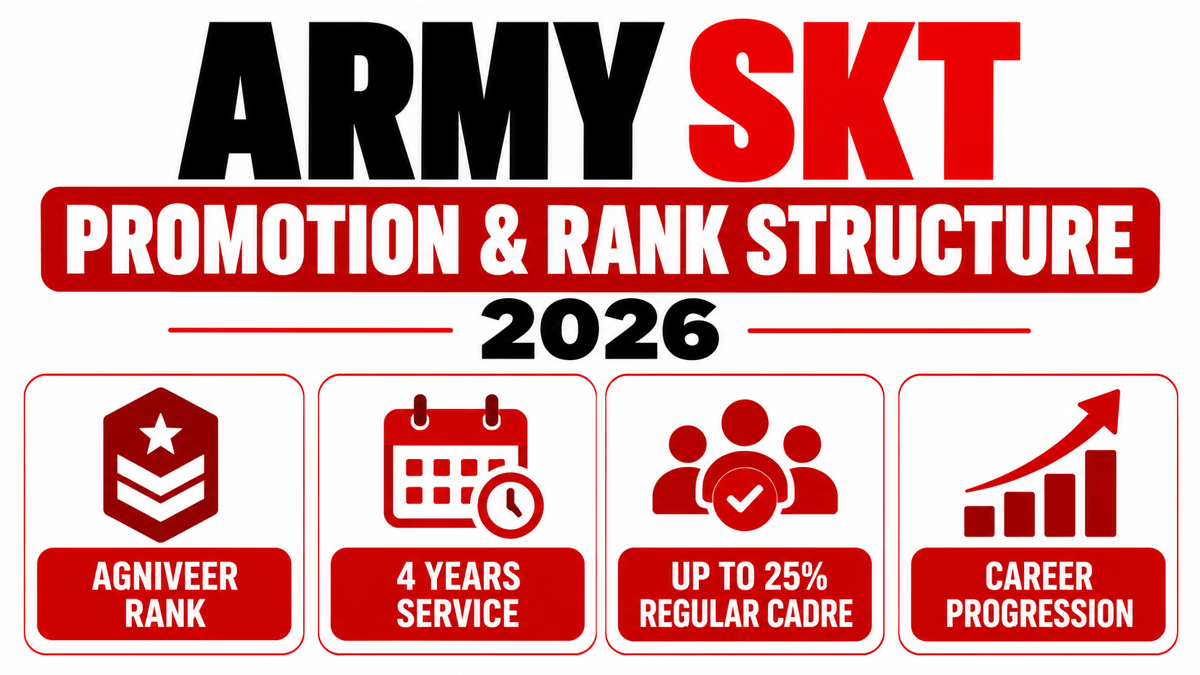
For candidates preparing for Army SKT Recruitment 2026, it is important to understand that Agniveers form a distinct rank during their four-year engagement. There is no automatic promotion ladder from Agniveer to regular Army ranks during this initial period. After four years, eligible Agniveers can apply for enrolment in the regular cadre, and up to 25% of a specific batch may be selected according to organisational requirements, policies and objective criteria.
Important: Army SKT Agniveer is not the same as a regular Army Clerk/SKT appointment. During the four-year Agniveer engagement, candidates hold a distinct Agniveer rank. Regular rank progression applies only after selection into the regular cadre.
Under the Agnipath Scheme, Agniveers form a distinct rank in the Armed Forces that is different from the existing regular ranks. Therefore, candidates should not assume that they will receive the conventional rank progression of regular personnel during the four-year Agniveer period.
| Career Stage | Status |
|---|---|
| Selection | Selected as Agniveer under the applicable Army category. |
| Training | Military, trade and service-related training. |
| Agniveer Service | Four-year engagement under the Agnipath Scheme. |
| Regular Cadre Selection | Up to 25% of each specific batch may be selected. |
| Regular Army Career | Applicable regular Army rank and promotion rules become relevant after regular enrolment. |
The Agnipath framework does not provide a conventional promotion ladder for Agniveers during their four-year engagement. Agniveers serve as a distinct category and rank. Their four-year period focuses on military training, trade skills, service performance, discipline and operational experience.
Therefore, candidates should be careful with online information that presents a fixed sequence of regular Army ranks for an Agniveer during the four-year period. Such a sequence should not be treated as an official Agniveer promotion structure unless specifically stated in an applicable Army notification.
The major career progression opportunity comes at the end of the four-year engagement. Agniveers are given an opportunity to apply for permanent enrolment in the Armed Forces. Applications are considered centrally on the basis of objective criteria, including performance during the four-year engagement period.
Up to 25% of each specific batch may be enrolled in the regular cadre. Selection is subject to organisational requirements and policies issued by the Armed Forces.
Key Point: Four years of service does not automatically result in permanent Army service. Regular cadre selection is a separate process, and the Armed Forces have the exclusive authority to determine selection according to applicable criteria.
An Agniveer selected for regular enrolment continues into the regular Armed Forces cadre. The Government's Agnipath framework states that individuals selected for regular cadre will be required to serve for a further engagement period of a minimum of 15 years and will be governed by the existing terms and conditions applicable to Junior Commissioned Officers and Other Ranks in the Indian Army, as amended from time to time.
This means that the conventional career and promotion system becomes relevant after regular enrolment. The exact rank progression, promotion criteria, service conditions and career opportunities are governed by the applicable Army rules and policies.
The regular cadre selection process considers objective criteria, including the performance of an Agniveer during the four-year engagement. Candidates should therefore focus on maintaining a strong overall service record.
Important areas for candidates to focus on include:
Once an Agniveer is selected for the regular cadre, the candidate becomes part of the regular Army system. Promotion thereafter is governed by the applicable service rules rather than the four-year Agniveer framework.
Candidates should therefore understand the career in two separate stages: the initial four-year Agniveer engagement and the subsequent regular Army career for those who are selected for retention.
| Stage | Promotion / Career Position |
|---|---|
| Four-Year Agniveer Period | Distinct Agniveer rank; no conventional regular-rank promotion ladder. |
| End of Four Years | Eligible Agniveers may apply for regular enrolment. |
| Regular Cadre Selection | Up to 25% of a specific batch may be retained. |
| After Regular Enrolment | Regular Army service and applicable promotion rules. |
Not during the initial four-year Agniveer engagement. Army SKT Agniveer and regular Army personnel are governed by different career structures during this period. The Agniveer holds a distinct rank under the Agnipath framework.
If the candidate is subsequently selected for regular enrolment, the candidate enters the regular service structure and becomes eligible for career progression under the applicable regular Army rules.
Because selection for regular cadre considers objective criteria including performance during the four-year engagement, candidates should treat the entire service period as an opportunity to build a strong professional record.
An Army SKT candidate should concentrate on duty performance, discipline, physical fitness, technical knowledge, computer skills and teamwork. Consistent professional conduct is more useful than focusing only on the final selection stage.
Not being selected for regular cadre does not mean that the four-year service experience has no career value. Ex-Agniveers leave with military experience, discipline, training and recognised skills that can support further career opportunities.
The Government has also established measures to support Ex-Agniveers in civilian employment. In 2026, the Ministry of Home Affairs announced a dedicated Ex-Agniveer category for Constable (General Duty) and Rifleman recruitment in CAPFs and Assam Rifles, with 50% reservation of vacancies under the announced provisions, along with specified age relaxation and exemptions from PST, PET and the written examination.
Promotion and career growth are related but should not be treated as the same thing. During the Agniveer period, career growth mainly comes through military experience, trade training, skills and professional development. Traditional rank promotion becomes relevant after regular cadre enrolment.
Remember: Do not calculate an Agniveer career using the traditional Army rank ladder from the first year itself. The official Agnipath framework defines Agniveers as a distinct rank during their four-year engagement.
| Question | Answer |
|---|---|
| Initial Service | Four-year Agniveer engagement. |
| Agniveer Rank | Distinct rank different from existing regular ranks. |
| Automatic Promotion | No conventional regular-rank promotion during the four-year engagement. |
| Regular Cadre | Up to 25% of each specific batch may be selected. |
| Regular Service | Minimum further engagement of 15 years under applicable regular service terms. |
| Post-Service | Government, CAPF, private-sector, education and other career opportunities. |
Agniveers form a distinct rank during the four-year engagement and do not follow the conventional regular Army rank-promotion ladder during this period.
Yes. At the end of four years, eligible Agniveers can apply for regular enrolment. Up to 25% of each specific batch may be selected based on organisational requirements, policies and objective criteria.
Agniveers form a distinct rank in the Armed Forces that is different from the existing regular Army ranks during their four-year engagement.
The selected individual enters the regular Armed Forces cadre and is governed by the applicable regular service terms and conditions. The Government framework specifies a further engagement period of a minimum of 15 years.
No. Up to 25% of each specific batch may be enrolled in the regular cadre. Selection is based on organisational requirements, policies and objective criteria.
Yes. Military training, discipline, store-management experience, computer skills and other service skills can support further employment, education and career opportunities.
Yes. Government provisions announced in 2026 created a dedicated Ex-Agniveer category for specified Constable GD/Rifleman recruitment in CAPFs and Assam Rifles, subject to the applicable recruitment rules.
Final Takeaway: Army SKT Agniveer has a distinct four-year service structure rather than the traditional regular Army promotion ladder. The main progression opportunity is selection into the regular cadre after four years, with up to 25% of each specific batch eligible for enrolment based on applicable criteria. Candidates should focus on discipline, performance, fitness and trade skills while also preparing for future career opportunities.
