Download the App & Start Learning
- Expert Faculty Guidance
- Updated Study Material
- Mock Tests & Practice Quiz
- Live Doubt Solving Sessions
- Exam-Oriented Preparation
- Motivation & Success Strategy
Katara Academy

10/18/2026
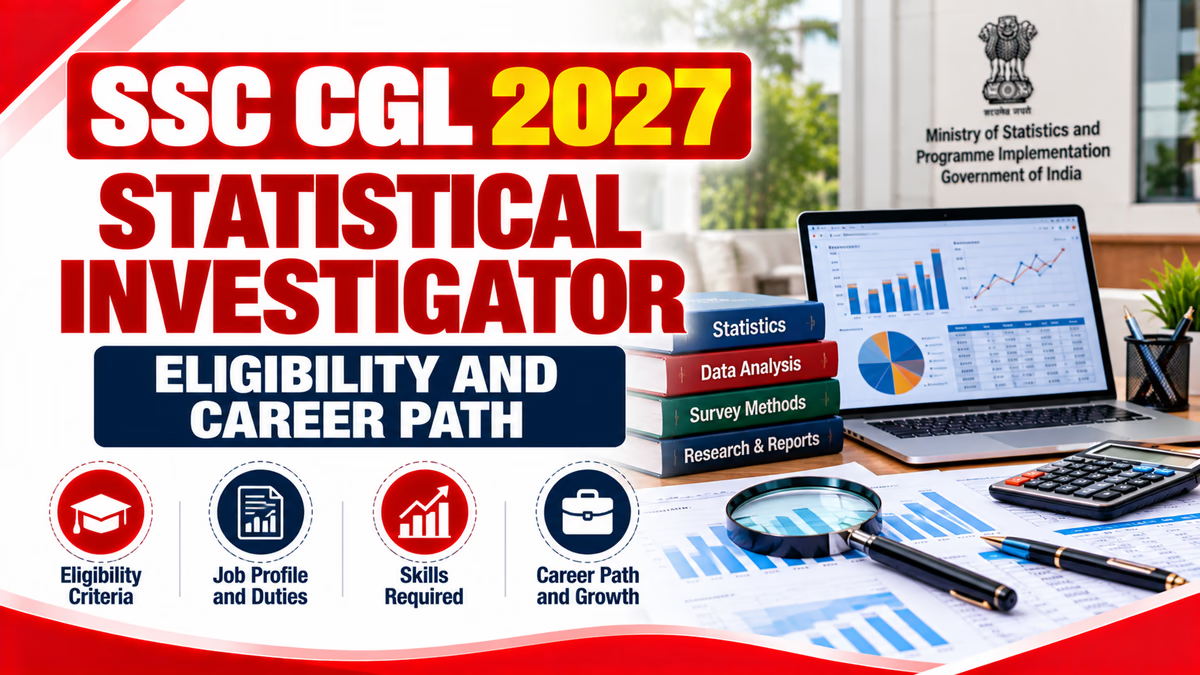
The Staff Selection Commission Combined Graduate Level (SSC CGL) examination offers graduates opportunities to work in various central government departments. Statistical Investigator is a specialised post for candidates interested in statistics, data collection, surveys, numerical analysis, and government research.
For SSC CGL 2027 aspirants, understanding the Statistical Investigator eligibility criteria is essential before choosing this post. Candidates should know the educational requirements, age limit, job responsibilities, salary factors, career progression, and preparation strategy before making their final decision.
A Statistical Investigator is a post associated with statistical data collection, compilation, analysis, and reporting. Depending on the vacancies notified in a particular recruitment cycle, the role may involve supporting government statistical surveys and related research activities.
Statistical work helps government organisations understand economic, social, demographic, and other measurable trends. The information collected and processed through statistical activities can support planning, policy evaluation, and evidence-based decision-making.
The exact duties and department allocation depend on the applicable SSC CGL notification, the organisation, and the responsibilities assigned to the employee.
Educational eligibility is one of the most important considerations for candidates interested in the Statistical Investigator post. Unlike posts with general graduation requirements, this post has commonly carried a specific requirement relating to Statistics as a subject.
Under eligibility criteria used in recent SSC CGL recruitment notifications, candidates generally need a bachelor's degree from a recognised university with Statistics as a subject studied throughout the prescribed degree course. The notification may specify that Statistics must have been studied in all parts or semesters of the relevant degree programme.
Candidates should carefully check the exact wording of the SSC CGL 2027 notification before applying. Having a degree in a related subject, completing a short statistics course, or studying Mathematics alone does not automatically establish eligibility for this post.
Important: These are general details based on criteria used in previous recruitment cycles. The official SSC CGL 2027 notification must be treated as the final authority for eligibility.
The age limit for Statistical Investigator can differ from the age limits applicable to other SSC CGL posts. Recent recruitment notifications have commonly listed an age range of 18–30 years for the Statistical Investigator Grade-II post, subject to the prescribed cut-off date and applicable rules.
Age relaxation may be available to eligible candidates belonging to specified categories under government rules. The precise age range, cut-off date, and relaxation provisions must be confirmed from the SSC CGL 2027 notification.
To assess age eligibility correctly, candidates should:
The work profile may vary according to the department and assignment. However, statistical investigation roles can involve the following areas.
Statistical work may require collecting information through approved surveys, administrative records, or other authorised sources. An employee may help organise collected information and check whether the required details have been recorded properly.
Data must be checked for missing entries, inconsistent values, duplication, and other quality issues. Statistical staff may assist with verification procedures and report discrepancies for further review.
Information from different sources may need to be arranged in structured formats. This can involve preparing tables, grouping observations, organising datasets, and summarising numerical information.
Depending on the assignment and required skills, the work may involve calculating averages, percentages, distributions, comparisons, or other statistical measures. The methods used depend on the nature of the data and the objectives of the project.
Statistical findings need to be communicated clearly. Employees may assist with preparing tables, charts, summaries, and supporting documents for review by senior officers.
Some assignments may involve supporting survey operations, maintaining data records, checking survey information, or assisting with other statistical research activities.
These activities are illustrative rather than a guaranteed daily task list. Candidates should review the official job and departmental information available for the notified post.
Statistical Investigator and Junior Statistical Officer are both statistics-related posts that may interest candidates with a suitable academic background. However, they should not be treated as interchangeable posts.
| Comparison Factor | Statistical Investigator | Junior Statistical Officer |
|---|---|---|
| Broad Work Area | Statistical investigation, data collection, compilation, and analysis-related duties | Statistical data processing, analysis, and reporting-related duties |
| Educational Requirements | Specific Statistics-related qualification requirements may apply | Specific educational criteria relating to Statistics or Mathematics may apply |
| Work Environment | Depends on the department, office, and assignment | Depends on the department, office, and assignment |
| Technical Skills | Statistics, data verification, numerical analysis, and documentation | Statistics, quantitative analysis, data processing, and reporting |
| Final Eligibility Check | Applicable SSC CGL notification | Applicable SSC CGL notification |
The two posts may have different eligibility conditions, pay levels, duties, and service rules. Compare the official details separately before selecting your post preferences.
Candidates interested in this role should develop strong numerical, analytical, and data-handling skills. These abilities can be useful both during preparation and in statistical work.
| Skill | Importance |
|---|---|
| Statistics | Helps in understanding distributions, averages, variation, and statistical interpretation. |
| Mathematics | Supports calculations, numerical reasoning, and quantitative problem-solving. |
| Data Interpretation | Helps analyse tables, charts, graphs, percentages, and numerical comparisons. |
| Attention to Detail | Helps identify missing information, inconsistent entries, and possible errors. |
| Computer Literacy | Supports spreadsheet work, data organisation, documentation, and computer-based analysis. |
| Analytical Thinking | Helps identify patterns and interpret information logically. |
| Report Writing | Helps communicate findings through clear tables, summaries, and documents. |
The salary for Statistical Investigator depends on the specific post, pay level, applicable allowances, posting location, and service conditions. Candidates should not assume that all statistics-related posts under SSC CGL have the same pay structure.
Before making a comparison with other SSC CGL posts, check the following details in the official recruitment notification:
Basic pay is different from take-home salary. The actual amount received each month can vary according to allowances, deductions, and posting-related conditions. Verify the pay level specified for the relevant Statistical Investigator vacancy rather than relying on unverified online salary estimates.
Career progression depends on the applicable departmental service rules, cadre structure, vacancies, seniority, eligibility, and other prescribed conditions. There is no universal promotion timeline that applies to every Statistical Investigator appointment.
Experience in statistical work can help employees develop skills in data management, survey support, numerical analysis, statistical reporting, and government procedures. These skills may also be useful for professional development in research and data-related fields.
Candidates should consult the relevant department's official service rules to understand promotion pathways, eligibility requirements, and other career conditions. Do not assume that a particular promotion or timeline is guaranteed.
This post may be worth considering if you:
If you prefer roles with little numerical analysis, first understand the actual duties before choosing this post. A well-informed decision should consider your qualifications, interests, preferred work environment, pay level, and the official service conditions.
Preparing for SSC CGL requires a structured plan based on the latest official syllabus and examination pattern. Candidates targeting Statistical Investigator should also verify the post-specific requirements and ensure that they meet the educational criteria.
Confirm your degree subjects, age, qualification cut-off date, and any other conditions in the official notification. This helps avoid spending time targeting a post for which you may not qualify.
Practise the Mathematics topics included in the official SSC CGL syllabus. Focus on concepts, calculation accuracy, question-solving speed, and regular revision.
Review relevant Statistics concepts from your academic studies and the official examination requirements. Use topic-wise questions to identify gaps in your understanding.
Solve questions involving tables, bar graphs, line graphs, pie charts, averages, percentages, and comparisons. Pay attention to units, labels, and calculation accuracy.
Do not ignore Reasoning, English, and General Awareness. Follow the latest official examination structure and divide study time according to your performance in practice tests.
Take regular mock tests under timed conditions. Maintain an error log, review incorrect answers, and revise weak topics. Focus on improving accuracy as well as speed.
The role may involve statistical data collection, verification, compilation, analysis, survey-related work, and report preparation, depending on the department and assignment.
Recent recruitment criteria have commonly required a bachelor's degree with Statistics studied throughout the prescribed degree course. Candidates must confirm the exact requirements in the SSC CGL 2027 notification.
Recent notices have commonly specified an age range of 18–30 years for Statistical Investigator Grade-II, subject to the applicable cut-off date and relaxation rules. Verify the official notification for the relevant recruitment cycle.
The requirement is based on the exact educational criteria in the notification. Candidates should check whether their degree and the way Statistics was studied meet the prescribed conditions.
Statistics, Mathematics, data interpretation, analytical thinking, computer literacy, attention to detail, and report writing can be useful for statistical work.
No. These are separate posts and may have different eligibility criteria, responsibilities, pay structures, and service rules. Check each post independently.
Check the applicable SSC CGL notification for pay-level details and consult the relevant department's official service rules for promotion and career conditions.
Q1. Which subject is particularly relevant to the Statistical Investigator post?
A. Statistics
B. Music
C. Fine arts only
D. Theatre studies
Answer: A. Statistics is relevant to the specialised nature of the post.
Q2. What is an important first step before choosing Statistical Investigator?
A. Checking eligibility in the official notification
B. Relying only on social media
C. Ignoring educational requirements
D. Choosing without comparing post details
Answer: A. Candidates should verify eligibility before finalising their post preferences.
Q3. Why is data verification important?
A. It helps identify missing or inconsistent information
B. It makes every value identical
C. It removes the need for analysis
D. It guarantees promotion
Answer: A. Verification helps improve data quality and reliability.
Q4. Which skill helps interpret tables and charts?
A. Data interpretation
B. Acting
C. Music composition
D. Painting only
Answer: A. Data interpretation involves understanding and analysing numerical information presented in tables and charts.
Q5. What should candidates check when calculating age eligibility?
A. The official age cut-off date and applicable rules
B. Only the examination date
C. A random online calculator result without checking the rules
D. Their preferred post title
Answer: A. The official notification determines the applicable age calculation date and relaxation rules.
Q6. Which task may be part of statistical reporting?
A. Preparing tables and summaries
B. Replacing data with guesses
C. Ignoring discrepancies
D. Removing all records
Answer: A. Tables and summaries help communicate statistical findings.
Q7. Which of the following can support data organisation?
A. Spreadsheet software
B. A music player alone
C. A gaming controller
D. A photo filter alone
Answer: A. Spreadsheet software can help organise and process numerical information.
Q8. Are promotion timelines guaranteed for every Statistical Investigator?
A. Yes, always
B. No, they depend on applicable service rules and other conditions
C. Promotions never occur
D. They depend only on mock-test scores
Answer: B. Promotion depends on the relevant departmental rules, vacancies, and eligibility.
Q9. What is a useful way to improve SSC CGL preparation?
A. Review mock-test errors and revise weak topics
B. Avoid practice questions
C. Study without a syllabus
D. Memorise answers without understanding
Answer: A. Reviewing errors helps identify weaknesses and improve performance.
Q10. Which source is authoritative for SSC CGL 2027 post eligibility?
A. The applicable official SSC notification
B. An unrelated advertisement
C. An old online comment only
D. An unverified social media post
Answer: A. The official notification provides the recruitment requirements for the relevant cycle.
Statistical Investigator is a specialised SSC CGL career option for candidates interested in Statistics, data collection, numerical analysis, and statistical reporting. Understanding the eligibility criteria is particularly important because the post may require Statistics to have been studied throughout the prescribed degree course.
For SSC CGL 2027, verify the official educational qualifications, age criteria, vacancies, pay level, and service conditions before applying. Build a consistent study routine, practise quantitative and data-interpretation questions, and review your mock-test performance to strengthen your preparation.