Download the App & Start Learning
- Expert Faculty Guidance
- Updated Study Material
- Mock Tests & Practice Quiz
- Live Doubt Solving Sessions
- Exam-Oriented Preparation
- Motivation & Success Strategy
Katara Academy

10/18/2026
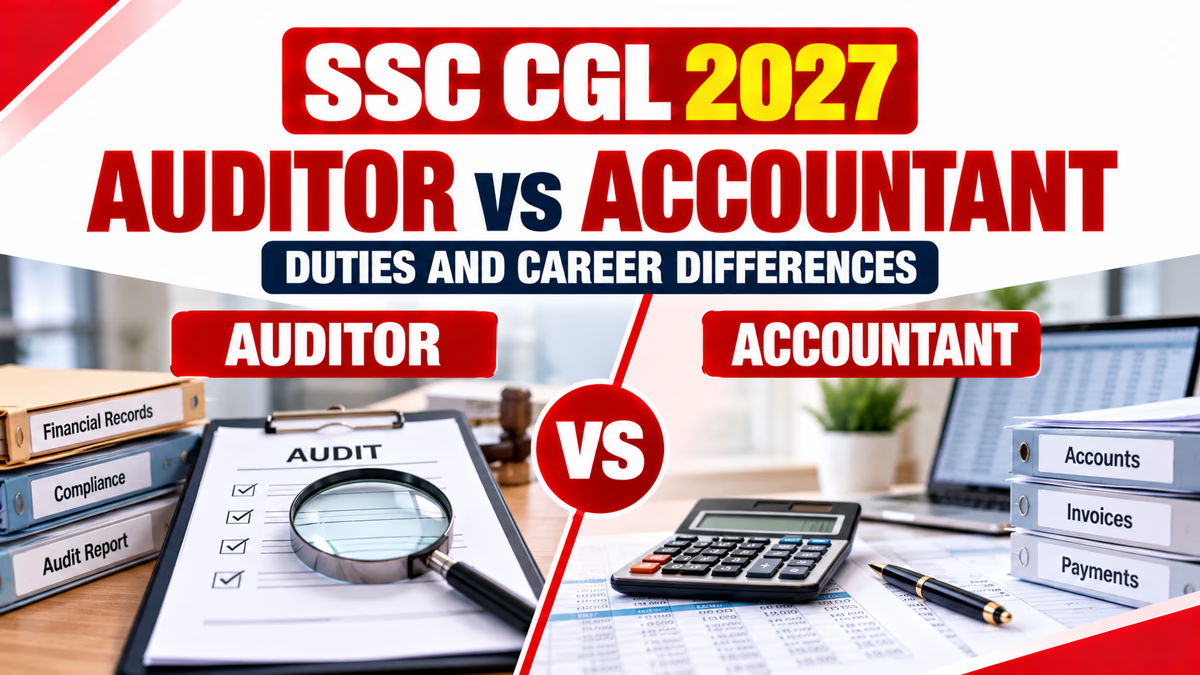
SSC CGL is a popular recruitment examination for graduates who want to work in various departments of the Central Government. Among the posts available through the examination, Auditor and Accountant are important options for candidates interested in finance, accounts, auditing, and government administration.
Although these posts are related to financial records, their responsibilities and working environments can differ. Understanding the difference between an Auditor and an Accountant can help SSC CGL 2027 aspirants choose posts according to their interests, skills, and career goals.
An Auditor generally works with government audit organisations and examines financial records, transactions, expenditure, and supporting documents. The purpose of auditing is to check whether financial activities follow the applicable rules, procedures, and regulations.
Depending on the department and assignment, an Auditor may assist in checking bills, verifying vouchers, reviewing records, identifying discrepancies, and preparing audit-related observations. Some assignments may involve office-based work, while others may require visits to offices or establishments being audited.
An Accountant generally handles accounting records and financial transactions in the department to which they are assigned. The work may include maintaining accounts, recording transactions, preparing statements, checking financial entries, and assisting with expenditure or payment-related documentation.
The exact duties depend on the department, office, and applicable financial procedures. Accountants may work with bills, receipts, expenditure records, reconciliations, and other accounting documents to ensure that financial information is properly recorded and maintained.
| Comparison Factor | Auditor | Accountant |
|---|---|---|
| Main Purpose | Examines financial records and checks compliance with applicable rules. | Maintains and processes accounting records and financial transactions. |
| Typical Work | Audit checks, verification, document examination, and reporting observations. | Accounting entries, records, statements, reconciliation, and financial documentation. |
| Work Environment | Office-based work and, depending on assignment, audit-related visits. | Usually office-based accounting and documentation work, depending on the department. |
| Skills Required | Analytical thinking, attention to detail, rule interpretation, and verification skills. | Numerical accuracy, organisation, accounting knowledge, and attention to detail. |
| Nature of Responsibility | Checks whether records and expenditure meet applicable requirements. | Helps ensure that financial records and transactions are correctly maintained. |
| Suitable Interest | Candidates who enjoy checking records and identifying discrepancies. | Candidates who prefer structured accounting and financial record management. |
Important: These are general distinctions. Actual duties can overlap and may vary according to the department, office, posting, and instructions issued by the competent authority.
SSC CGL vacancies can include Auditor and Accountant posts in different government organisations, depending on the recruitment notification and vacancies available for a particular year.
The organisations, post names, eligibility requirements, pay levels, and number of vacancies may change from one recruitment cycle to another. Candidates preparing for SSC CGL 2027 should consult the official notification for the final list of posts and departments.
The salary of an Auditor or Accountant recruited through SSC CGL depends on the specific post, department, applicable pay level, allowances, and place of posting. The basic pay is determined by the relevant pay matrix, while the actual monthly salary also depends on admissible allowances and deductions.
Do not assume that every Auditor or Accountant post has the same salary. Before selecting post preferences, verify the pay level and other service conditions mentioned in the official SSC CGL 2027 notification.
When comparing compensation, consider the following:
Career progression for both posts depends on the organisation's service rules, seniority, departmental examinations where applicable, vacancies, performance requirements, and other prescribed conditions.
Auditors may progress to higher responsibilities and supervisory positions according to the rules of their organisation. Their work experience can help them develop expertise in audit procedures, financial compliance, record verification, and government expenditure review.
Accountants may progress to higher accounting or supervisory roles under the applicable departmental promotion rules. Experience in financial documentation, accounting systems, reconciliation, and government financial procedures can support professional development.
Note: No particular promotion timeline or higher post is guaranteed. Candidates should review the service rules of the specific organisation before making a career decision.
Both posts require accuracy, responsibility, and the ability to handle financial information carefully. However, candidates can strengthen different skills according to the nature of their preferred work.
| Skill | Why It Matters |
|---|---|
| Numerical Accuracy | Helps prevent mistakes while checking amounts, calculations, and financial entries. |
| Attention to Detail | Supports careful examination of bills, vouchers, records, and supporting documents. |
| Basic Accounting Knowledge | Helps candidates understand financial statements, transactions, and accounting terminology. |
| Analytical Thinking | Useful for identifying inconsistencies and understanding financial information. |
| Computer Skills | Helps with spreadsheets, digital records, document preparation, and office software. |
| Communication and Writing | Supports clear documentation, reporting, and communication with colleagues. |
There is no single best choice for every candidate. Your preference should depend on the nature of work you enjoy, the department offering the post, the notified service conditions, and your long-term goals.
Before submitting your post preferences, compare the available options carefully rather than choosing a post based only on its title or assumptions about workload.
Understanding the posts is useful, but qualifying for SSC CGL requires a consistent preparation strategy. Candidates should focus on the subjects and examination pattern specified in the official notification.
Use the latest SSC CGL notification as the final reference for the exam pattern, syllabus, and any post-specific requirements. Do not rely exclusively on older examination patterns.
An Auditor generally examines financial records and checks compliance, while an Accountant generally maintains accounting records and processes financial transactions. Actual responsibilities depend on the department.
No. Auditor work can include office-based verification and documentation. Field visits may be required depending on the organisation and assignment.
No. Accounting responsibilities may include maintaining records, checking transactions, preparing statements, reconciliation, and other financial documentation.
Salary depends on the specific notified post, pay level, allowances, and service conditions. Compare the official details for the relevant recruitment cycle before deciding.
Basic accounting and numerical skills can be useful for both posts. The exact qualifications and requirements must be checked in the official notification.
Yes. Responsibilities, work environment, and reporting procedures can vary according to the organisation, posting, and assignment.
Compare job responsibilities, department, pay level, location-related conditions, promotion rules, and your personal interests. Use official recruitment information to make the final decision.
Test your understanding with these practice questions.
Q1. What is the general purpose of an audit?
A. To advertise products
B. To examine records and check compliance
C. To recruit employees
D. To design websites
Answer: B. Auditing involves examining financial records and checking compliance with applicable requirements.
Q2. Which activity is generally associated with an Accountant?
A. Maintaining accounting records
B. Conducting elections
C. Issuing driving licences
D. Preparing weather forecasts
Answer: A. Maintaining accounting records is a common accounting responsibility.
Q3. Which skill is useful for both Auditors and Accountants?
A. Numerical accuracy
B. Acting
C. Professional sports
D. Music composition
Answer: A. Both roles require care while handling financial information.
Q4. Which organisation is associated with the Comptroller and Auditor General of India?
A. C&AG
B. ISRO
C. BCCI
D. FSSAI
Answer: A. C&AG refers to the Comptroller and Auditor General of India.
Q5. What should candidates check for the final SSC CGL 2027 post list?
A. An unofficial social media post
B. An old coaching advertisement only
C. The official SSC notification
D. An unrelated website
Answer: C. The official notification is the authoritative source for notified vacancies and post details.
Q6. What is reconciliation in accounting?
A. Comparing records to identify differences
B. Deleting all financial records
C. Advertising a service
D. Conducting an interview
Answer: A. Reconciliation helps identify and resolve differences between related financial records.
Q7. Which is a useful computer skill for financial office work?
A. Spreadsheet handling
B. Video game streaming only
C. Photo filters only
D. Animation acting
Answer: A. Spreadsheets can support calculations, record management, and reporting.
Q8. Are promotion timelines identical in every government organisation?
A. Yes, always
B. No, they depend on applicable service rules and other conditions
C. Promotions never occur
D. Only salary determines promotion
Answer: B. Promotion opportunities depend on the relevant service rules and other conditions.
Q9. Which factor should be considered when choosing between Auditor and Accountant?
A. Only the post title
B. Only rumours about salary
C. Responsibilities, department, and official service conditions
D. An unrelated subject
Answer: C. Candidates should compare verified job details and personal preferences.
Q10. What is a good SSC CGL preparation practice?
A. Avoiding revision
B. Depending only on guesses
C. Regular practice and mock-test analysis
D. Studying without understanding the syllabus
Answer: C. Consistent practice and analysis help candidates identify weaknesses and improve performance.
Auditor and Accountant are distinct career options for SSC CGL aspirants interested in government financial work. Auditors generally focus on examining records and compliance, whereas Accountants generally focus on maintaining and processing accounting information. However, actual responsibilities and career conditions depend on the organisation and the notified post.
For SSC CGL 2027, prepare consistently, understand the latest examination requirements, and compare official post details before filling in your preferences. A well-informed choice can help you align your government career with your skills and interests.