

Download the App & Start Learning
- Expert Faculty Guidance
- Updated Study Material
- Mock Tests & Practice Quiz
- Live Doubt Solving Sessions
- Exam-Oriented Preparation
- Motivation & Success Strategy
Katara Academy

8/12/2026
Delhi Police Government Jobs 2026
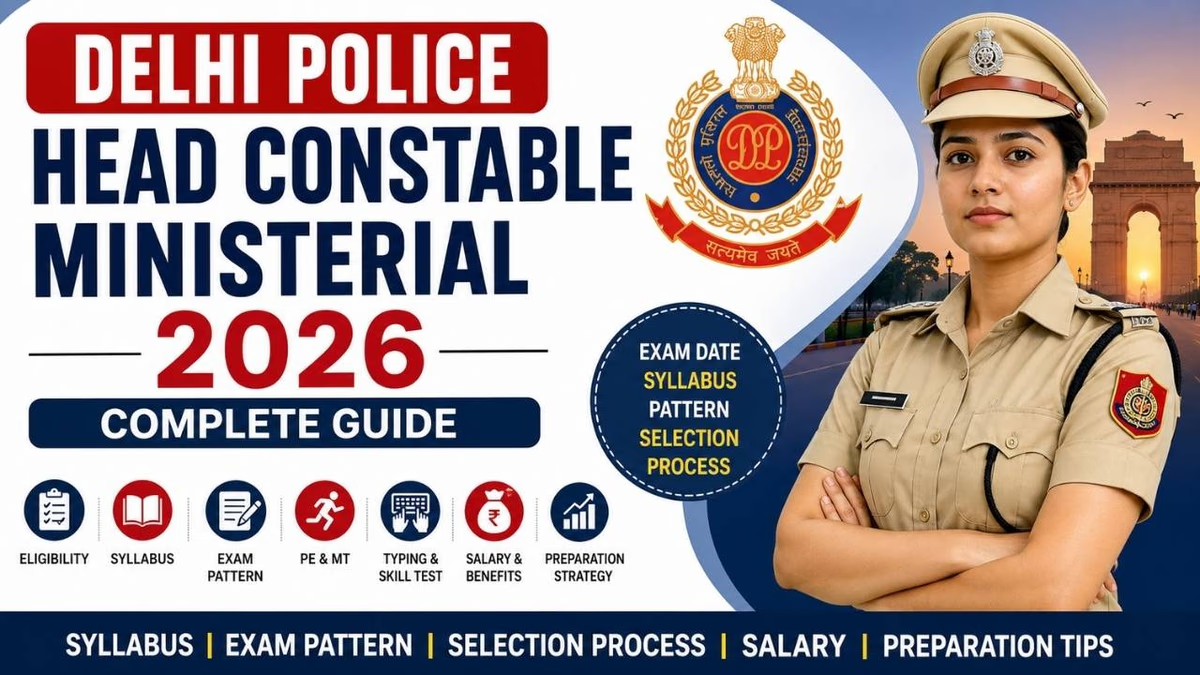
The Delhi Police Head Constable Ministerial 2026 recruitment is an important government job opportunity for candidates who are interested in working in Delhi Police in a ministerial and administrative role. The post is different from the regular Constable (Executive) post because the recruitment process includes a combination of the Computer-Based Examination, Physical Endurance & Measurement Test, typing and computer-related skill tests, document verification and medical examination.
The Staff Selection Commission conducts the open competitive examination for the post of Head Constable (Ministerial) in Delhi Police in coordination with Delhi Police. Candidates from all parts of India are eligible to apply, subject to fulfilling the prescribed eligibility conditions. The application process is conducted online through the SSC platform.
For candidates preparing during 2026, it is important to distinguish between the Delhi Police Head Constable Ministerial 2025 recruitment cycle and a fresh 2026 recruitment notification. SSC conducted the 2025 Computer-Based Examination from 7 January 2026 to 12 January 2026, and the CBE result was declared on 5 June 2026. Therefore, the latest official recruitment framework is the best reference for preparation until a fresh notification is issued.
Important 2026 Update:
The details in this article are based on the latest official SSC Head Constable (Ministerial) recruitment framework and subsequent 2026 updates. Vacancy numbers, dates, age cut-off, examination pattern and other conditions for a fresh 2026 recruitment must be verified from the new SSC notification when released.
The Head Constable (Ministerial) post combines police-department service with ministerial, clerical and office-related responsibilities. Candidates selected for the post may work in administrative environments within Delhi Police and may be required to handle records, correspondence, computer-based work and other duties assigned by the department.
Unlike a recruitment process that depends only on a written examination, the Head Constable Ministerial recruitment requires candidates to clear multiple stages. The latest official framework provides for a Computer-Based Examination followed by the applicable PE&MT, Document Verification and Skill/Trade Tests. The Delhi Police conducts the physical and skill-related stages, while SSC handles the CBE and final result processing.
Candidates searching for Delhi Police Head Constable Ministerial Recruitment 2026 should carefully check whether a website is referring to the 2025 examination cycle or a fresh 2026 notification. SSC published the Head Constable (Ministerial) in Delhi Police Examination, 2025 notice on 29 September 2025.
The original application window for that recruitment was from 29 September 2025 to 20 October 2025. SSC had initially scheduled the Computer-Based Examination for December 2025/January 2026. The actual CBE was subsequently conducted from 7 January 2026 to 12 January 2026.
SSC declared the CBE result on 5 June 2026, shortlisting candidates for the subsequent PE&MT, Document Verification and Trade/Skill Test stages. SSC later uploaded the final answer keys, question papers cum response sheets and marks on 22 June 2026.
A recruitment examination named Head Constable (Ministerial) Examination 2025 can have important stages and updates during 2026. Such updates do not automatically mean that a new 2026 application form has been released. Candidates should use the latest SSC notification as the final authority before applying.
Vacancies for Head Constable (Ministerial) are reported by Delhi Police to the Staff Selection Commission. SSC publishes the vacancies based on the information received from Delhi Police. The number of vacancies is provisional and may be revised during the recruitment process.
In the original 2025 recruitment notice, SSC reported 509 tentative vacancies in total, consisting of 341 male vacancies and 168 female vacancies. Delhi Police subsequently revised the vacancy position.
According to the revised vacancy notice dated 25 February 2026, the total number of vacancies became 456, consisting of 306 male vacancies and 150 female vacancies.
| Post / Category | UR | EWS | OBC | SC | ST | Total |
|---|---|---|---|---|---|---|
| Male – Open | 134 | 27 | 64 | 42 | 8 | 275 |
| Male – Ex-Servicemen | 15 | 3 | 7 | 5 | 1 | 31 |
| Male Total | 149 | 30 | 71 | 47 | 9 | 306 |
| Female – Open | 72 | 15 | 35 | 23 | 5 | 150 |
| Female Total | 72 | 15 | 35 | 23 | 5 | 150 |
| Grand Total | 221 | 45 | 106 | 70 | 14 | 456 |
The above table represents the revised vacancy position for the 2025 recruitment cycle. It should not be treated as confirmed vacancies for a fresh Delhi Police Head Constable Ministerial 2026 recruitment.
The revised vacancy notice also provides for vacancies under the Persons with Benchmark Disabilities category. For the male open vacancies, specified locomotor disabilities are covered under the notified PwBD reservation. For the female open vacancies, specified locomotor disability reservations are also included. The applicable post is civilian in nature for candidates selected against these PwBD vacancies and such candidates do not wear the Delhi Police uniform.
Candidates often notice different vacancy figures on different websites. The primary reason is that vacancies are reported by Delhi Police and can be revised. SSC's official notification clearly states that the vacancies are provisional and liable to change, and the Commission does not determine the total number of Delhi Police vacancies or the category-wise segregation.
Whenever you see a Delhi Police Head Constable Ministerial vacancy number online, check whether it is the original vacancy or the latest revised vacancy. For a new 2026 recruitment, always use the vacancy figure published in the fresh official SSC notification.
The Delhi Police Head Constable Ministerial salary is placed at Pay Level-4 under the latest official recruitment framework. The pay scale is ₹25,500–₹81,100, and the post is classified as Group 'C'.
Delhi Police Head Constable (Ministerial)
₹25,500 – ₹81,100
Pay Level-4 | Group 'C'
The pay-matrix range should not be interpreted as the exact monthly in-hand salary. Actual monthly earnings depend on applicable government allowances, deductions, posting conditions and other service rules.
The Head Constable (Ministerial) role is designed for candidates who can perform office, clerical, documentation and computer-related responsibilities within the police department. The position combines government office work with the requirements of a police organisation.
The exact duties may vary according to the unit, branch, posting and operational requirements of Delhi Police. Candidates should be comfortable working with documents, records, computers and official communication.
The recruitment is open to eligible Indian citizens who satisfy the prescribed age, educational qualification, typing and other requirements. Candidates from all parts of India are eligible to apply, subject to the reservation and certificate requirements mentioned in the official notification.
The candidate must be a citizen of India. The recruitment is conducted on an all-India basis, meaning candidates from different states and Union Territories can apply if they satisfy the prescribed eligibility conditions.
For the latest available recruitment cycle, the prescribed age limit was 18 to 25 years as on 1 July 2025. Candidates had to be born not before 2 July 2000 and not later than 1 July 2007.
For a fresh 2026 recruitment, the crucial date and corresponding date-of-birth range may change. Candidates must calculate their age using the date specified in the new notification rather than automatically using the 2025 dates.
The official recruitment framework provides upper-age relaxation for several categories. Candidates claiming relaxation must satisfy the specific conditions and produce the required certificate in the prescribed format.
| Category | Age Relaxation / Upper Age |
|---|---|
| SC / ST | 5 years |
| OBC | 3 years |
| PwBD – UR/EWS | 10 years |
| PwBD – OBC | 13 years |
| PwBD – SC/ST | 15 years |
| Eligible Ex-Servicemen | 3 years after deduction of military service |
| Specified Sportspersons – Other than SC/ST | 5 years |
| Specified Sportspersons – SC/ST | 10 years |
| Delhi Police Departmental Candidates – UR/EWS | Up to 40 years |
| Delhi Police Departmental Candidates – OBC | Up to 43 years |
| Delhi Police Departmental Candidates – SC/ST | Up to 45 years |
The latest available notification also provides special upper-age provisions for widows, divorced women and women judicially separated from their husbands who have not remarried, subject to the prescribed conditions.
The latest recruitment framework provides specific physical-standard relaxations for sons and daughters of serving, retired or deceased Delhi Police personnel and Multi-Tasking Staff of Delhi Police, subject to the conditions specified in the Standing Order.
Candidates must have passed 10+2 (Senior Secondary) or an equivalent qualification from a recognised Board at the time of applying for the post, as prescribed in the latest official recruitment notice.
Candidates appearing for the qualifying examination should not assume that appearing in the examination is sufficient. The result of the required qualification must have been declared by the prescribed cut-off date. At Document Verification, candidates are required to produce the relevant original certificates as proof.
Typing ability is one of the most important eligibility-related requirements for the Head Constable Ministerial post. Candidates need to have the prescribed typing speed in either English or Hindi.
| Typing Language | Required Speed |
|---|---|
| English | 30 words per minute |
| Hindi | 25 words per minute |
Candidates should start typing practice early because typing speed is not something that can normally be developed effectively through last-minute preparation. Regular practice on a computer keyboard is important for improving speed while maintaining accuracy.
Candidates possessing eligible NCC certificates can receive additional marks according to the prescribed recruitment rules. The benefit is granted only after the original certificate is produced and verified at the applicable stage.
| NCC Certificate | Bonus Marks |
|---|---|
| NCC 'C' Certificate | 5% of maximum examination marks |
| NCC 'B' Certificate | 3% of maximum examination marks |
| NCC 'A' Certificate | 2% of maximum examination marks |
The NCC benefit is subject to the conditions and verification requirements prescribed in the official notification and is not available to Ex-Servicemen under the stated rules.
The latest official recruitment framework also provides additional marks for candidates possessing a qualifying Degree or Post Graduate Diploma Certificate awarded by Rashtriya Raksha University (RRU). The additional marks depend on the class obtained.
| Class Obtained | Additional Marks |
|---|---|
| Distinction | 5% |
| First Class | 4% |
| Second Class | 3% |
| Pass Class | 2% |
Candidates claiming reservation or age-relaxation benefits must possess the required certificate in the prescribed format. Simply selecting a reserved category in the online application does not guarantee the benefit.
Candidates should ensure that their certificates meet the exact format and validity requirements. If a claimed category or relaxation cannot be supported during verification, the candidate may lose the benefit and the candidature can be affected according to the recruitment rules.
Candidates should enter their personal, educational and category information carefully in the application form. Delhi Police verifies the information against original documents during the later recruitment stages. Incorrect or false information can lead to rejection of candidature.
The application for the Head Constable Ministerial examination is submitted online through the SSC website or the applicable official SSC application platform. Candidates must first complete the required One-Time Registration on the new SSC website if they have not already done so.
The latest available recruitment notice also provided the option of applying through the mySSC mobile application. Candidates should follow the application instructions given in the fresh notification for the relevant recruitment year.
For the latest available 2025 recruitment, the application fee was ₹100. Women candidates and eligible candidates belonging to SC, ST, PwBD and Ex-Servicemen categories were exempted from payment of the fee.
| Candidate Category | Latest Available Fee |
|---|---|
| General / Non-Exempted Candidates | ₹100 |
| Women Candidates | Exempted |
| SC / ST | Exempted |
| PwBD | Exempted |
| Eligible Ex-Servicemen | Exempted |
The application fee and exemption rules should be checked again when a fresh 2026 notification is published.
Part 2 will cover the Delhi Police Head Constable Ministerial exam pattern, subject-wise marks, detailed syllabus, General Awareness, Quantitative Aptitude, General Intelligence, English Language, Computer Fundamentals, negative marking, qualifying marks and preparation priorities.
The Delhi Police Head Constable Ministerial 2026 exam pattern is designed to test a candidate's general awareness, numerical ability, reasoning skills, English language knowledge and basic computer knowledge. The first stage is a Computer-Based Examination (CBE) conducted by the Staff Selection Commission.
The latest available official recruitment framework consists of 100 objective-type questions carrying 100 marks. Candidates get 90 minutes to complete the examination. The paper is divided into five parts: General Awareness, Quantitative Aptitude, General Intelligence, English Language and Computer Fundamentals.
The exam structure and negative-marking details above are based on the latest available Delhi Police Head Constable Ministerial recruitment framework. Candidates appearing for a fresh 2026 recruitment should verify the new SSC notification for any changes. :contentReference[oaicite:0]{index=0}
| Part | Subject | Questions | Marks |
|---|---|---|---|
| Part A | General Awareness | 20 | 20 |
| Part B | Quantitative Aptitude | 20 | 20 |
| Part C | General Intelligence | 25 | 25 |
| Part D | English Language | 25 | 25 |
| Part E | Computer Fundamentals | 10 | 10 |
| Total | 100 | 100 | |
The latest available pattern allocates 20 questions each to General Awareness and Quantitative Aptitude, 25 each to General Intelligence and English Language, and 10 questions to Computer Fundamentals. :contentReference[oaicite:1]{index=1}
The highest individual weightage in the CBE is given to General Intelligence and English Language, with 25 marks each. Together, these two sections account for half of the written examination. General Awareness and Quantitative Aptitude contribute another 40 marks, while Computer Fundamentals contributes 10 marks.
This distribution can help candidates decide how to allocate study time. However, candidates should not completely ignore a lower-weightage section because even a few marks can affect ranking in a competitive examination.
Negative marking is an important part of the written examination. Under the latest available framework, 0.25 mark is deducted for every incorrect answer. Therefore, candidates should avoid random guessing when they are not reasonably confident about an answer.
Suppose a candidate attempts 80 questions, answers 70 correctly and 10 incorrectly.
Correct marks = 70 × 1 = 70
Negative marks = 10 × 0.25 = 2.50
Final score = 70 − 2.50 = 67.50
The exact scoring calculation should always follow the marking scheme specified in the relevant examination notification.
Candidates get 90 minutes for 100 questions. This means the examination requires both knowledge and speed. Spending too much time on a difficult question can reduce the time available for easier questions.
| Section | Suggested Time | Approach |
|---|---|---|
| English | 15–18 minutes | Attempt familiar grammar, vocabulary and comprehension questions first. |
| General Intelligence | 20–22 minutes | Solve direct reasoning questions first and skip time-consuming puzzles temporarily. |
| General Awareness | 12–15 minutes | Answer known facts quickly; do not spend excessive time on uncertain questions. |
| Quantitative Aptitude | 18–20 minutes | Use formulas and calculation shortcuts only when they are reliable. |
| Computer | 7–10 minutes | Use basic computer knowledge to answer direct questions quickly. |
The time allocation above is a preparation strategy, not an official section-wise time limit. Candidates can modify it according to their strengths and weaknesses.
The syllabus should be approached topic by topic rather than studied as a single large list. Candidates should first understand the fundamentals and then solve previous-year questions and mock questions from each area.
The five CBE sections cover a broad range of topics. General Awareness tests awareness of India and the world, Quantitative Aptitude focuses on basic arithmetic and numerical ability, General Intelligence tests logical thinking, English evaluates basic language skills and Computer Fundamentals tests practical computer awareness.
General Awareness carries 20 questions for 20 marks. This section can cover both static knowledge and current events. Candidates should develop a habit of regular revision because General Awareness contains a wide variety of topics.
General Awareness should be studied every day rather than left for the final weeks. Candidates can divide preparation into two broad areas: static GK and current affairs. Static GK can be revised through notes, while current affairs should be updated regularly.
Quantitative Aptitude carries 20 questions for 20 marks. The section is based primarily on basic arithmetic and numerical ability. Candidates should focus on understanding concepts and improving calculation speed.
Candidates should first master basic formulas and then solve questions of increasing difficulty. Calculation speed is especially important because the entire CBE must be completed within 90 minutes.
General Intelligence is one of the highest-weightage sections, carrying 25 questions for 25 marks. The section tests the candidate's ability to identify patterns, relationships, logical connections and solutions.
Reasoning can become a high-scoring area when candidates practise regularly. Instead of solving questions randomly, candidates should identify the pattern of each question type and learn the shortest reliable method.
English Language carries 25 questions for 25 marks, making it one of the most important sections in the written examination. The section tests basic English-language knowledge and practical understanding.
Candidates who are weak in English should not try to complete the entire subject in a few days. Grammar, vocabulary and reading skills improve through consistent practice. Candidates should begin with basic grammar rules and gradually move towards exam-level questions.
| Area | Daily Practice |
|---|---|
| Vocabulary | 10–15 new words + revision |
| Grammar | One concept + practice questions |
| Error Detection | 10–20 questions |
| Reading | Short passage or editorial reading |
Computer Fundamentals carries 10 questions for 10 marks. Although this is the smallest section in terms of marks, candidates should not ignore it because questions are often based on basic concepts that can be prepared systematically.
Candidates should focus on definitions, functions, shortcuts, terminology and basic practical concepts. Because the section contains only 10 questions, preparation should be concise but regular.
Candidates should divide their preparation time according to both marks and individual strengths. A candidate who is already strong in English may need less learning time but should still practise regularly to maintain accuracy. Similarly, a candidate weak in Mathematics should devote additional time to arithmetic fundamentals.
| Subject | Marks | Recommended Priority |
|---|---|---|
| General Intelligence | 25 | Very High |
| English Language | 25 | Very High |
| General Awareness | 20 | High |
| Quantitative Aptitude | 20 | High |
| Computer Fundamentals | 10 | Moderate but Important |
The minimum qualifying marks specified in the latest available recruitment framework should not be confused with the actual cut-off for shortlisting. A candidate may technically qualify the examination but still not be shortlisted if their score is not high enough compared with other candidates in their category.
| Category | Minimum Qualifying Percentage |
|---|---|
| UR / EWS | 40% |
| SC / ST / OBC | 35% |
| PwBD / Ex-Servicemen | 30% |
For example, if the minimum qualifying requirement is 40 marks, scoring exactly 40 does not mean that the candidate will necessarily be called for the next stage. Shortlisting depends on merit, category, vacancies and the applicable recruitment rules.
Mock tests should become an important part of preparation after the basic concepts have been covered. A mock test is not useful only for checking the final score. It helps candidates understand speed, accuracy, weak topics and question-selection habits.
Candidates who have already completed most of the syllabus can use a structured 30-day revision cycle. The objective should be to revise important concepts, solve questions and improve mock-test performance rather than trying to learn every new topic.
| Period | Main Focus |
|---|---|
| Days 1–7 | Revise General Intelligence and Quantitative Aptitude fundamentals. |
| Days 8–14 | Revise English grammar, vocabulary and General Awareness. |
| Days 15–21 | Computer revision + mixed practice + sectional tests. |
| Days 22–26 | Full-length mock tests and detailed analysis. |
| Days 27–29 | Revision of weak areas and important notes. |
| Day 30 | Light revision, formulas, vocabulary, current affairs and confidence-building practice. |
A successful preparation strategy should combine concept learning, question practice, revision, mock tests and typing practice. Since the recruitment also contains physical and skill-related stages, candidates should not postpone those preparations until after the written examination.
| Preparation Area | What to Do |
|---|---|
| Concepts | Complete the basics of every syllabus section. |
| MCQ Practice | Practise topic-wise and mixed questions. |
| Revision | Use short notes and repeat important topics. |
| Mock Tests | Attempt full papers under the 90-minute limit. |
| Typing | Practise English or Hindi typing regularly. |
| Physical Fitness | Maintain regular physical preparation for PE&MT. |
The following is a practical example for a candidate who can devote several hours to preparation. Candidates can increase or decrease the duration according to their individual schedule.
| Study Block | Focus |
|---|---|
| Block 1 | General Awareness + Current Affairs |
| Block 2 | General Intelligence |
| Block 3 | Quantitative Aptitude |
| Block 4 | English Language |
| Block 5 | Computer Fundamentals |
| Final Revision | Mistakes + formulas + vocabulary + current affairs |
One major mistake candidates make is waiting for the CBE result before beginning typing practice. The Head Constable Ministerial recruitment includes a typing/skill component, and the prescribed typing speed is an important part of the recruitment requirements.
Candidates should therefore spend at least a short period each day practising on a computer keyboard. The objective should be to develop both speed and accuracy. Increasing speed while making a large number of errors is not an effective strategy.
Part 3 will cover the Delhi Police Head Constable Ministerial PE&MT, male and female physical standards, race, long jump, high jump, height and chest requirements, typing test, computer formatting test, skill test, document verification, medical examination and complete selection process.
Delhi Police Head Constable Ministerial 2026
The Delhi Police Head Constable Ministerial selection process is not limited to the Computer-Based Examination. Candidates shortlisted after the written examination have to clear the Physical Endurance & Measurement Test, Typing Test on Computer and Computer Formatting Test, followed by document verification, medical fitness and police verification as applicable. The latest official recruitment framework clearly separates the stages into written examination, qualifying physical and computer tests, and the final merit-based selection process.
The Computer-Based Examination carries 100 marks, while the Typing Test on Computer carries 25 marks. PE&MT and the Computer Formatting Test are qualifying in nature. The final merit is prepared using the prescribed marks from the Computer-Based Examination, Typing Test and applicable incentive or bonus marks, subject to qualifying all required stages.
Under the official recruitment scheme, candidates who fall within the prescribed merit range in the CBE are shortlisted for PE&MT. In the 2025 examination framework, the number of candidates called for PE&MT was generally up to 20 times the number of vacancies in each applicable category. PwBD candidates covered by the specified disability provisions are exempted from PE&MT and are instead called directly for the Typing Test after qualifying the CBE, along with the required Document Verification. :contentReference[oaicite:0]{index=0}
The Physical Endurance & Measurement Test (PE&MT) is conducted by Delhi Police after the declaration of the CBE result. It is a qualifying stage, which means candidates must clear the prescribed physical events and measurements to continue in the recruitment process.
The latest available official framework specifies separate endurance requirements for male and female candidates and provides different standards according to age. Candidates should therefore prepare for the exact standard applicable to their age category rather than following a single physical-test target.
| Age | 1600 Metres Race | Long Jump | High Jump |
|---|---|---|---|
| Up to 30 years | 7 minutes | 12½ feet | 3½ feet |
| Above 30 to 40 years | 8 minutes | 11½ feet | 3¼ feet |
| Above 40 years | 9 minutes | 10½ feet | 3 feet |
The above standards are from the latest available official Head Constable (Ministerial) recruitment notice. :contentReference[oaicite:1]{index=1}
| Age | 800 Metres Race | Long Jump | High Jump |
|---|---|---|---|
| Up to 30 years | 5 minutes | 9 feet | 3 feet |
| Above 30 to 40 years | 6 minutes | 8 feet | 2½ feet |
| Above 40 years | 7 minutes | 7 feet | 2¼ feet |
The official notice states that female candidates who qualify the race proceed to the Long Jump and then High Jump. Long Jump and High Jump are to be cleared within the chances provided under the recruitment rules. :contentReference[oaicite:2]{index=2}
The physical test follows a defined sequence. Candidates should understand this sequence before appearing for the test so that they know what happens after each event.
The official notice states that physical measurement is taken only for candidates who qualify the endurance events. It also specifies that height and chest measurements are taken using digital equipment, while RFID tags are used during the race. :contentReference[oaicite:3]{index=3}
The specified height relaxation includes eligible residents of notified hill areas, ST candidates and sons of serving, retired or deceased Delhi Police personnel/Multi-Tasking Staff, subject to the prescribed certificate and conditions. :contentReference[oaicite:4]{index=4}
There is no chest measurement requirement listed for female candidates in the official physical measurement standards. :contentReference[oaicite:5]{index=5}
Sons and daughters of eligible serving, retired or deceased Delhi Police personnel and Delhi Police Multi-Tasking Staff can receive specified physical-standard relaxation. For eligible male candidates, both height and chest relaxation provisions apply; for eligible female candidates, height relaxation is applicable.
Candidates who are dissatisfied with their physical measurement have to use the prescribed appeal mechanism on the day of the PE&MT itself. The official notification states that an appeal against physical-measurement disqualification will not be entertained at a later stage.
If you believe that a physical measurement has been recorded incorrectly, raise the matter through the prescribed appellate mechanism on the same day. Do not wait until later to submit an appeal.
This requirement is specifically stated in the official recruitment notice. :contentReference[oaicite:6]{index=6}
Document verification is closely linked with the PE&MT process. Candidates who successfully complete the required physical events and measurements are required to produce their original documents and self-attested copies as instructed.
The official notice states that candidates should bring original documents as well as self-attested copies. If a required document is not produced during the PE&MT process, candidature can be rejected, although the rules provide for a possible opportunity to submit the required document within the specified period in applicable cases. :contentReference[oaicite:7]{index=7}
The Typing Test on Computer is an important stage because it carries marks in the final merit. Candidates who qualify the PE&MT are called for the typing test, while eligible PwBD candidates who qualify the CBE are also called for the typing test according to the notified procedure.
The test is conducted for 10 minutes. Candidates are given a printed passage and must type it on the computer within the prescribed time. Typing beyond the end of the 10-minute test is not permitted. :contentReference[oaicite:8]{index=8}
| Typing Speed | English Marks | Hindi Marks |
|---|---|---|
| Below minimum speed | Disqualify | Disqualify |
| 30 WPM English / 25 WPM Hindi | 10 | 10 |
| 31–35 WPM English / 26–30 WPM Hindi | 12 | 12 |
| 36–40 WPM English / 31–35 WPM Hindi | 15 | 15 |
| 41–45 WPM English / 36–40 WPM Hindi | 18 | 18 |
| 46–50 WPM English / 41–45 WPM Hindi | 21 | 21 |
| Above 50 WPM English / Above 45 WPM Hindi | 25 | 25 |
The official evaluation table awards higher marks for higher typing speed, up to a maximum of 25 marks. :contentReference[oaicite:9]{index=9}
Typing speed is not simply the number displayed by a typing website. Under the official evaluation method, mistakes are deducted while calculating the actual speed. The notice explains that one word is counted for each mistake.
If a candidate types 2,000 strokes in 10 minutes, this is treated as 400 words because 5 strokes are counted as one word.
Tentative Speed = 400 ÷ 10 = 40 WPM
If the candidate makes 10 mistakes, the actual speed becomes 40 − 10 = 30 WPM.
This is why candidates should focus on both speed and accuracy. Increasing raw typing speed while making frequent errors can result in a much lower effective speed during the recruitment test. :contentReference[oaicite:10]{index=10}
Candidates should begin typing preparation well before the skill-test stage. The minimum requirement should not be treated as the target. A candidate aiming only for exactly 30 WPM in English or 25 WPM in Hindi has very little margin for mistakes.
Candidates who qualify the Typing Test are called for the Computer Formatting Test. This test is qualifying in nature. Under the latest official framework, candidates are tested on MS Word, MS PowerPoint and MS Excel.
Candidates are given a supplied handout and are required to reproduce the formatting in the specified software. The completed work is then printed according to the instructions. Each test is allotted 10 minutes.
Each of the three formatting tests carries a maximum of 10 marks for the specified formatting features. The official framework states that each feature carries ½ mark. Candidates need to secure at least 6 marks in each individual test to qualify.
| Test | Maximum Marks | Minimum Required |
|---|---|---|
| MS Word | 10 | 6 |
| MS PowerPoint | 10 | 6 |
| MS Excel | 10 | 6 |
The Computer Formatting Test is qualifying and its marks are not added to the final merit in the same manner as the CBE and Typing Test. :contentReference[oaicite:11]{index=11}
Candidates should practise the actual formatting commands rather than only reading about MS Office. The test is practical, so familiarity with the location of menus, ribbons, keyboard shortcuts and formatting tools can save valuable time.
Medical fitness is an important condition for final appointment. The latest official recruitment framework states that candidates should be in a sound state of health and free from defect, deformity or disease that would affect the prescribed requirements.
PwBD candidates are governed by the specific physical and functional requirements mentioned in the recruitment notice. The official notice permits the specified locomotor disability category and separately provides for exemption from PE&MT. :contentReference[oaicite:12]{index=12}
Candidates who qualify the applicable written, physical and skill stages must produce original documents for verification. The purpose of Document Verification is to establish that the information entered in the application form is supported by valid documents.
The official notice specifically lists educational certificates, category certificates, PwBD certificates, Hill Area Certificate, Ex-Servicemen documents, age-relaxation documents, ward certificates, RRU certificate, sports certificate and departmental-candidate certificate among the documents that may be required during verification. :contentReference[oaicite:13]{index=13}
After candidates qualify the required stages, the final merit is prepared according to the notified recruitment rules. The latest official framework states that the provisional selection list is prepared category-wise from candidates who qualify the Computer Formatting Test.
This means that a candidate cannot rely only on the written-examination score. The Typing Test can contribute up to 25 marks to the merit, making typing speed and accuracy an important part of final selection. :contentReference[oaicite:14]{index=14}
For candidates following the current recruitment cycle, SSC conducted the Head Constable (Ministerial) Examination 2025 Computer-Based Examination from 7 January 2026 to 12 January 2026. SSC declared the CBE result on 5 June 2026, shortlisting candidates for the PE&MT, Document Verification and Trade/Skill Test stages.
SSC subsequently issued an additional shortlisting notice on 25 June 2026, adding 51 candidates after considering representations concerning the OBC category from the NCT of Delhi. The additional candidates were included for the PE&MT/Document Verification/Trade Test process. :contentReference[oaicite:15]{index=15}
The 2025 recruitment cycle is progressing through its post-CBE stages during 2026. Candidates preparing for a future fresh recruitment should nevertheless use the latest official notification as the final authority because dates, vacancies and other conditions can change from one recruitment cycle to another.
Candidates should not wait for the CBE result to start physical preparation. Once the written examination is over, there may be limited time before the PE&MT. A gradual fitness routine is therefore more practical than trying to build endurance suddenly.
| Activity | Suggested Practice | Goal |
|---|---|---|
| Typing | 10–20 minutes | Speed + accuracy |
| MS Word | 10 minutes | Formatting speed |
| MS PowerPoint | 10 minutes | Slide formatting |
| MS Excel | 10 minutes | Cell formatting + formulas |
| Physical Fitness | According to fitness plan | Endurance + agility |
Part 4 will cover the Delhi Police Head Constable Ministerial preparation strategy, subject-wise study plan, recommended preparation approach, previous-year question strategy, expected cut-off discussion, salary and career growth, important documents, exam-day tips, FAQs and final checklist for aspirants.
Delhi Police Head Constable Ministerial 2026
The Delhi Police Head Constable Ministerial selection process is not limited to the Computer-Based Examination. Candidates shortlisted after the written examination have to clear the Physical Endurance & Measurement Test, Typing Test on Computer and Computer Formatting Test, followed by document verification, medical fitness and police verification as applicable. The latest official recruitment framework clearly separates the stages into written examination, qualifying physical and computer tests, and the final merit-based selection process.
The Computer-Based Examination carries 100 marks, while the Typing Test on Computer carries 25 marks. PE&MT and the Computer Formatting Test are qualifying in nature. The final merit is prepared using the prescribed marks from the Computer-Based Examination, Typing Test and applicable incentive or bonus marks, subject to qualifying all required stages.
Under the official recruitment scheme, candidates who fall within the prescribed merit range in the CBE are shortlisted for PE&MT. In the 2025 examination framework, the number of candidates called for PE&MT was generally up to 20 times the number of vacancies in each applicable category. PwBD candidates covered by the specified disability provisions are exempted from PE&MT and are instead called directly for the Typing Test after qualifying the CBE, along with the required Document Verification. :contentReference[oaicite:0]{index=0}
The Physical Endurance & Measurement Test (PE&MT) is conducted by Delhi Police after the declaration of the CBE result. It is a qualifying stage, which means candidates must clear the prescribed physical events and measurements to continue in the recruitment process.
The latest available official framework specifies separate endurance requirements for male and female candidates and provides different standards according to age. Candidates should therefore prepare for the exact standard applicable to their age category rather than following a single physical-test target.
| Age | 1600 Metres Race | Long Jump | High Jump |
|---|---|---|---|
| Up to 30 years | 7 minutes | 12½ feet | 3½ feet |
| Above 30 to 40 years | 8 minutes | 11½ feet | 3¼ feet |
| Above 40 years | 9 minutes | 10½ feet | 3 feet |
The above standards are from the latest available official Head Constable (Ministerial) recruitment notice. :contentReference[oaicite:1]{index=1}
| Age | 800 Metres Race | Long Jump | High Jump |
|---|---|---|---|
| Up to 30 years | 5 minutes | 9 feet | 3 feet |
| Above 30 to 40 years | 6 minutes | 8 feet | 2½ feet |
| Above 40 years | 7 minutes | 7 feet | 2¼ feet |
The official notice states that female candidates who qualify the race proceed to the Long Jump and then High Jump. Long Jump and High Jump are to be cleared within the chances provided under the recruitment rules. :contentReference[oaicite:2]{index=2}
The physical test follows a defined sequence. Candidates should understand this sequence before appearing for the test so that they know what happens after each event.
The official notice states that physical measurement is taken only for candidates who qualify the endurance events. It also specifies that height and chest measurements are taken using digital equipment, while RFID tags are used during the race. :contentReference[oaicite:3]{index=3}
The specified height relaxation includes eligible residents of notified hill areas, ST candidates and sons of serving, retired or deceased Delhi Police personnel/Multi-Tasking Staff, subject to the prescribed certificate and conditions. :contentReference[oaicite:4]{index=4}
There is no chest measurement requirement listed for female candidates in the official physical measurement standards. :contentReference[oaicite:5]{index=5}
Sons and daughters of eligible serving, retired or deceased Delhi Police personnel and Delhi Police Multi-Tasking Staff can receive specified physical-standard relaxation. For eligible male candidates, both height and chest relaxation provisions apply; for eligible female candidates, height relaxation is applicable.
Candidates who are dissatisfied with their physical measurement have to use the prescribed appeal mechanism on the day of the PE&MT itself. The official notification states that an appeal against physical-measurement disqualification will not be entertained at a later stage.
If you believe that a physical measurement has been recorded incorrectly, raise the matter through the prescribed appellate mechanism on the same day. Do not wait until later to submit an appeal.
This requirement is specifically stated in the official recruitment notice. :contentReference[oaicite:6]{index=6}
Document verification is closely linked with the PE&MT process. Candidates who successfully complete the required physical events and measurements are required to produce their original documents and self-attested copies as instructed.
The official notice states that candidates should bring original documents as well as self-attested copies. If a required document is not produced during the PE&MT process, candidature can be rejected, although the rules provide for a possible opportunity to submit the required document within the specified period in applicable cases. :contentReference[oaicite:7]{index=7}
The Typing Test on Computer is an important stage because it carries marks in the final merit. Candidates who qualify the PE&MT are called for the typing test, while eligible PwBD candidates who qualify the CBE are also called for the typing test according to the notified procedure.
The test is conducted for 10 minutes. Candidates are given a printed passage and must type it on the computer within the prescribed time. Typing beyond the end of the 10-minute test is not permitted. :contentReference[oaicite:8]{index=8}
| Typing Speed | English Marks | Hindi Marks |
|---|---|---|
| Below minimum speed | Disqualify | Disqualify |
| 30 WPM English / 25 WPM Hindi | 10 | 10 |
| 31–35 WPM English / 26–30 WPM Hindi | 12 | 12 |
| 36–40 WPM English / 31–35 WPM Hindi | 15 | 15 |
| 41–45 WPM English / 36–40 WPM Hindi | 18 | 18 |
| 46–50 WPM English / 41–45 WPM Hindi | 21 | 21 |
| Above 50 WPM English / Above 45 WPM Hindi | 25 | 25 |
The official evaluation table awards higher marks for higher typing speed, up to a maximum of 25 marks. :contentReference[oaicite:9]{index=9}
Typing speed is not simply the number displayed by a typing website. Under the official evaluation method, mistakes are deducted while calculating the actual speed. The notice explains that one word is counted for each mistake.
If a candidate types 2,000 strokes in 10 minutes, this is treated as 400 words because 5 strokes are counted as one word.
Tentative Speed = 400 ÷ 10 = 40 WPM
If the candidate makes 10 mistakes, the actual speed becomes 40 − 10 = 30 WPM.
This is why candidates should focus on both speed and accuracy. Increasing raw typing speed while making frequent errors can result in a much lower effective speed during the recruitment test. :contentReference[oaicite:10]{index=10}
Candidates should begin typing preparation well before the skill-test stage. The minimum requirement should not be treated as the target. A candidate aiming only for exactly 30 WPM in English or 25 WPM in Hindi has very little margin for mistakes.
Candidates who qualify the Typing Test are called for the Computer Formatting Test. This test is qualifying in nature. Under the latest official framework, candidates are tested on MS Word, MS PowerPoint and MS Excel.
Candidates are given a supplied handout and are required to reproduce the formatting in the specified software. The completed work is then printed according to the instructions. Each test is allotted 10 minutes.
Each of the three formatting tests carries a maximum of 10 marks for the specified formatting features. The official framework states that each feature carries ½ mark. Candidates need to secure at least 6 marks in each individual test to qualify.
| Test | Maximum Marks | Minimum Required |
|---|---|---|
| MS Word | 10 | 6 |
| MS PowerPoint | 10 | 6 |
| MS Excel | 10 | 6 |
The Computer Formatting Test is qualifying and its marks are not added to the final merit in the same manner as the CBE and Typing Test. :contentReference[oaicite:11]{index=11}
Candidates should practise the actual formatting commands rather than only reading about MS Office. The test is practical, so familiarity with the location of menus, ribbons, keyboard shortcuts and formatting tools can save valuable time.
Medical fitness is an important condition for final appointment. The latest official recruitment framework states that candidates should be in a sound state of health and free from defect, deformity or disease that would affect the prescribed requirements.
PwBD candidates are governed by the specific physical and functional requirements mentioned in the recruitment notice. The official notice permits the specified locomotor disability category and separately provides for exemption from PE&MT. :contentReference[oaicite:12]{index=12}
Candidates who qualify the applicable written, physical and skill stages must produce original documents for verification. The purpose of Document Verification is to establish that the information entered in the application form is supported by valid documents.
The official notice specifically lists educational certificates, category certificates, PwBD certificates, Hill Area Certificate, Ex-Servicemen documents, age-relaxation documents, ward certificates, RRU certificate, sports certificate and departmental-candidate certificate among the documents that may be required during verification. :contentReference[oaicite:13]{index=13}
After candidates qualify the required stages, the final merit is prepared according to the notified recruitment rules. The latest official framework states that the provisional selection list is prepared category-wise from candidates who qualify the Computer Formatting Test.
This means that a candidate cannot rely only on the written-examination score. The Typing Test can contribute up to 25 marks to the merit, making typing speed and accuracy an important part of final selection. :contentReference[oaicite:14]{index=14}
For candidates following the current recruitment cycle, SSC conducted the Head Constable (Ministerial) Examination 2025 Computer-Based Examination from 7 January 2026 to 12 January 2026. SSC declared the CBE result on 5 June 2026, shortlisting candidates for the PE&MT, Document Verification and Trade/Skill Test stages.
SSC subsequently issued an additional shortlisting notice on 25 June 2026, adding 51 candidates after considering representations concerning the OBC category from the NCT of Delhi. The additional candidates were included for the PE&MT/Document Verification/Trade Test process. :contentReference[oaicite:15]{index=15}
The 2025 recruitment cycle is progressing through its post-CBE stages during 2026. Candidates preparing for a future fresh recruitment should nevertheless use the latest official notification as the final authority because dates, vacancies and other conditions can change from one recruitment cycle to another.
Candidates should not wait for the CBE result to start physical preparation. Once the written examination is over, there may be limited time before the PE&MT. A gradual fitness routine is therefore more practical than trying to build endurance suddenly.
| Activity | Suggested Practice | Goal |
|---|---|---|
| Typing | 10–20 minutes | Speed + accuracy |
| MS Word | 10 minutes | Formatting speed |
| MS PowerPoint | 10 minutes | Slide formatting |
| MS Excel | 10 minutes | Cell formatting + formulas |
| Physical Fitness | According to fitness plan | Endurance + agility |
Delhi Police Head Constable Ministerial 2026
Preparing for the Delhi Police Head Constable Ministerial exam requires a balanced approach because the recruitment process includes more than the written examination. Candidates have to prepare for the Computer-Based Examination while also developing typing speed, computer-formatting skills and physical fitness where applicable.
The most effective strategy is to divide preparation into phases. First, complete the syllabus and strengthen basic concepts. Next, move towards topic-wise and sectional practice. Finally, use full-length mock tests, revision and skill-test practice to improve speed and accuracy.
| Phase | Focus | Main Objective |
|---|---|---|
| Phase 1 | Syllabus & Concepts | Build strong fundamentals |
| Phase 2 | Topic-wise Practice | Improve accuracy |
| Phase 3 | Sectional Tests | Improve speed and question selection |
| Phase 4 | Full Mock Tests | Build exam temperament |
| Phase 5 | Final Revision + Skill Preparation | Maximise final performance |
Every section requires a different preparation method. Candidates should avoid using the same study technique for General Awareness, Mathematics, Reasoning, English and Computer Fundamentals.
General Awareness requires continuous revision. Instead of trying to memorise a huge amount of information in one sitting, divide the syllabus into smaller areas such as History, Geography, Polity, Science, Economy, Current Affairs, Sports, Awards and Important Events.
Mathematics becomes easier when concepts are followed by regular question practice. Start with basic arithmetic and gradually move towards mixed question sets. Maintain a separate formula notebook for quick revision.
Reasoning is one of the sections where practice can produce significant improvement. Candidates should learn the basic approach to each question type and then solve multiple variations.
English preparation should combine grammar, vocabulary and reading practice. Candidates who are weak in English should begin with basic grammar rather than immediately attempting difficult questions.
Computer Fundamentals carries fewer marks than some other sections, but the questions can be prepared systematically. Focus on terminology, hardware, software, memory, operating systems, Internet, MS Office and common computer abbreviations.
A fixed daily routine helps candidates maintain consistency. The exact study duration can vary depending on whether the candidate is a student, working professional or full-time aspirant.
| Study Session | Focus Area | Suggested Duration |
|---|---|---|
| Session 1 | General Awareness / Current Affairs | 45–60 minutes |
| Session 2 | Quantitative Aptitude | 60–90 minutes |
| Session 3 | General Intelligence | 45–60 minutes |
| Session 4 | English Language | 45–60 minutes |
| Session 5 | Computer + Typing | 30–45 minutes |
| Session 6 | Revision / Practice Test | 30–60 minutes |
| Day | Primary Focus |
|---|---|
| Monday | Maths + English + Current Affairs |
| Tuesday | Reasoning + Maths + Computer |
| Wednesday | English + GK + Typing |
| Thursday | Maths + Reasoning + Current Affairs |
| Friday | English + Computer + Typing |
| Saturday | Mixed Practice + Sectional Tests |
| Sunday | Full Mock + Analysis + Revision |
Mock tests should be treated as a diagnostic tool rather than merely a way to obtain a score. A candidate who scores poorly in an early mock should not become discouraged. The important question is why the marks were lost.
Candidates should maintain a mock-test error notebook. Whenever a question is answered incorrectly, write down the topic and the reason for the mistake. This prevents the same error from being repeated in subsequent tests.
Previous-year questions are useful because they help candidates understand the type, difficulty and framing of questions asked in the examination. They should be used after learning the relevant concepts, not as a substitute for syllabus preparation.
There is no single permanent Delhi Police Head Constable Ministerial cut-off. The cut-off changes from one recruitment cycle to another depending on vacancies, candidate performance, category, examination difficulty and the number of candidates available for shortlisting.
Candidates should therefore avoid treating an unofficial expected cut-off as a guaranteed target. The practical goal should be to score substantially above the minimum qualifying requirement and maintain strong accuracy.
| Term | Meaning |
|---|---|
| Minimum Qualifying Marks | Basic percentage required to qualify the examination according to the notification. |
| Cut-Off | Score used for shortlisting candidates based on merit and applicable recruitment conditions. |
Instead of preparing only to cross the minimum qualifying marks, candidates should set progressive targets. For example, first aim to achieve a stable score in practice tests, then gradually improve it through better accuracy and time management.
The Head Constable (Ministerial) post in Delhi Police is placed in Pay Level-4 under the applicable pay structure, with the basic pay scale beginning at ₹25,500 and extending to ₹81,100. The actual monthly salary received by an employee depends on basic pay, applicable allowances, deductions and the place and conditions of posting.
| Component | Details |
|---|---|
| Post | Head Constable (Ministerial), Delhi Police |
| Pay Level | Level-4 |
| Basic Pay Range | ₹25,500 – ₹81,100 |
| Allowances | As applicable under Government rules |
The salary package can include applicable allowances such as Dearness Allowance, House Rent Allowance and Transport Allowance, subject to the prevailing Government rules and eligibility. The in-hand amount will be lower than gross salary after applicable deductions.
The official 2025 recruitment notice specifies the post at Pay Level-4 with the ₹25,500–₹81,100 pay scale. ([ssc.gov.in](https://ssc.gov.in/api/attachment/uploads/masterData/NoticeBoards/Notice_of_DPHCM_2025.pdf))
The Head Constable (Ministerial) position offers candidates an opportunity to build a long-term career within Delhi Police. Employees can progress through departmental promotion opportunities subject to service rules, eligibility, vacancies, departmental examinations and performance.
A candidate should therefore consider the position not only as an entry-level government job but also as an opportunity for long-term service, experience and professional progression.
Exact promotion designations, timelines and eligibility should always be checked against the applicable Delhi Police service rules because promotion is not automatic and may depend on several departmental conditions.
A candidate's preparation can be affected by avoidable mistakes on examination day. Proper planning for travel, documents, reporting time and examination instructions can reduce unnecessary stress.
| Days | Main Focus |
|---|---|
| 1–7 | Revise weak concepts and important formulas. |
| 8–14 | Solve previous-year questions and sectional tests. |
| 15–21 | Attempt full-length mocks and analyse every mistake. |
| 22–26 | Revise current affairs, vocabulary, formulas and computer notes. |
| 27–29 | Light revision + mock analysis + typing practice. |
| 30 | Only short notes, formulas, current affairs and confidence-building revision. |
The Delhi Police Head Constable Ministerial examination is a recruitment examination conducted through SSC for appointment to the Head Constable (Ministerial) post in Delhi Police. The recruitment process includes a Computer-Based Examination and subsequent qualifying and skill stages according to the applicable notification.
The latest available recruitment framework has 100 objective questions carrying 100 marks.
The CBE duration is 90 minutes under the latest available recruitment framework.
Yes. The latest available framework provides for 0.25 mark deduction for each incorrect answer.
PE&MT applies according to the recruitment rules. Candidates covered by the specified PwBD exemption provisions are exempted from PE&MT and follow the alternative process prescribed in the notification.
Under the latest available framework, the minimum typing speed is 30 words per minute in English or 25 words per minute in Hindi.
The Typing Test on Computer carries a maximum of 25 marks.
Yes. The Computer Formatting Test is qualifying. The latest framework tests formatting skills in MS Word, MS PowerPoint and MS Excel.
Each individual formatting test is conducted for 10 minutes under the latest available recruitment framework.
The latest available SSC recruitment notice places the post in Pay Level-4, with a basic pay range of ₹25,500 to ₹81,100.
Yes. Typing is particularly important because the Typing Test carries up to 25 marks, which can directly affect merit after candidates qualify the mandatory stages.
Typing practice should ideally begin during written-exam preparation rather than after the CBE result. Consistent daily practice helps candidates improve both speed and accuracy.
Yes. Self-study can be effective when candidates have a structured timetable, reliable study material, previous-year questions, mock tests and a consistent revision system. Coaching can provide additional guidance, but disciplined practice remains essential.
There is no universal number of hours. Candidates should focus on productive study time rather than simply sitting with books for long hours. A consistent daily schedule covering all major sections, revision and practice is more important.
No. The cut-off can change from one recruitment cycle to another depending on vacancies, candidate performance, category, examination difficulty and other recruitment factors.
Candidates should rely primarily on the official Staff Selection Commission website and the relevant Delhi Police/SSC notices for application dates, admit cards, examination schedules, results, answer keys and subsequent-stage information.
The Delhi Police Head Constable Ministerial recruitment should be approached as a complete selection process rather than just a written examination. A strong CBE score is important, but candidates must also pay attention to typing speed, computer formatting, physical fitness where applicable and document readiness.
The best preparation strategy is simple: complete the syllabus, practise daily, analyse mistakes, revise repeatedly, take mock tests and start skill-test preparation early. Candidates should also monitor the official SSC website because recruitment dates, vacancies and stage-specific instructions can change between examination cycles.
Stay consistent, focus on accuracy and prepare for every stage of the selection process.
Source Note: Recruitment details in this article are based on the latest available SSC Head Constable (Ministerial) in Delhi Police Examination framework. Candidates should always verify the applicable notification for their recruitment cycle before relying on vacancies, dates, eligibility, physical standards, salary or selection-stage details.