




Download the App & Start Learning
- Expert Faculty Guidance
- Updated Study Material
- Mock Tests & Practice Quiz
- Live Doubt Solving Sessions
- Exam-Oriented Preparation
- Motivation & Success Strategy
Katara Academy

7/17/2026
RAILWAY GROUP D 2026
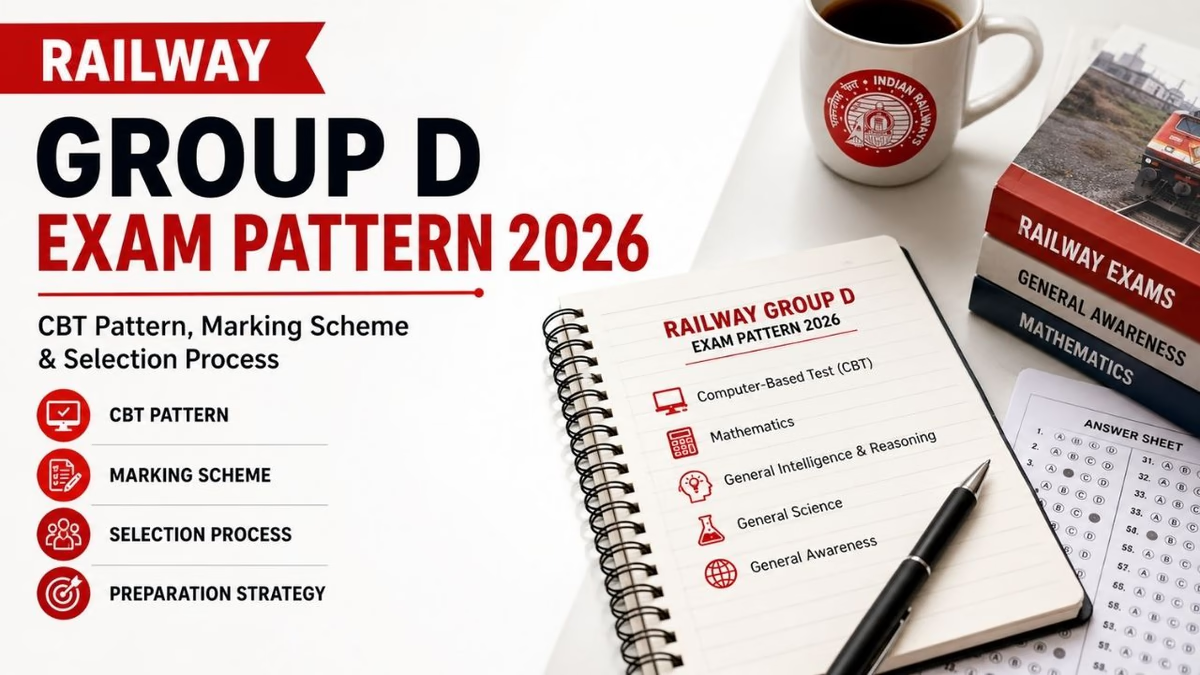
Understand the latest Railway Group D Exam Pattern 2026, including the Computer-Based Test (CBT), marking scheme, selection process, subject-wise distribution and preparation tips to improve your chances of success.
| Recruitment Authority Railway Recruitment Boards (RRBs) | Exam Mode Computer-Based Test (CBT) |
| Selection Stages CBT, Physical Efficiency Test (PET), Document Verification and Medical Examination | Preparation Focus Understand the pattern, practise regularly and improve time management through mock tests. |
The Railway Group D examination is one of India's most competitive government recruitment exams, attracting lakhs of candidates every year. Since the level of competition is high, understanding the latest exam pattern is just as important as completing the syllabus. Candidates who are familiar with the structure of the examination are better prepared to manage time, prioritise questions and avoid unnecessary mistakes.
The Railway Recruitment Boards (RRBs) conduct the Group D examination through a Computer-Based Test followed by additional selection stages. Every stage evaluates a different aspect of a candidate's suitability for the job, making it essential to prepare according to the complete recruitment process rather than focusing only on the written examination.
This guide explains the Railway Group D Exam Pattern 2026 in detail, including the CBT structure, marking scheme, subject-wise distribution, selection process and practical preparation tips to help candidates plan their studies more effectively.
The Railway Group D recruitment process consists of multiple stages designed to assess a candidate's knowledge, physical fitness and eligibility for appointment. Clearing every stage is necessary to move forward in the recruitment process.
| Stage | Purpose |
|---|---|
| Computer-Based Test (CBT) | Evaluates candidates on Mathematics, Reasoning, General Science and General Awareness. |
| Physical Efficiency Test (PET) | Assesses the physical fitness required for Railway Group D posts. |
| Document Verification | Verification of educational qualifications and supporting documents. |
| Medical Examination | Confirms medical fitness according to Railway recruitment standards. |
The Computer-Based Test (CBT) is the first and most important stage of the Railway Group D recruitment process. Candidates who perform well in this examination move to the Physical Efficiency Test (PET). Therefore, understanding the CBT pattern is essential for effective preparation.
The examination evaluates candidates across four major subjects. Balanced preparation and regular practice are necessary because questions are distributed across multiple sections rather than focusing on a single subject.
Candidates should understand the subject-wise distribution of questions before creating a study plan. Giving equal attention to every section improves overall performance and reduces the risk of scoring poorly in any subject.
| Subject | Focus Areas |
|---|---|
| Mathematics | Number System, Percentage, Ratio, Profit & Loss, Time & Work, Simplification and Arithmetic. |
| General Intelligence & Reasoning | Analogy, Coding-Decoding, Classification, Series, Puzzle and Logical Reasoning. |
| General Science | Physics, Chemistry, Biology and Everyday Science concepts. |
| General Awareness | Current Affairs, History, Geography, Indian Polity, Economy, Environment and Sports. |
Understanding the marking scheme helps candidates make better decisions during the examination. Instead of attempting every question, aspirants should focus on answering confidently while avoiding unnecessary mistakes.
| Component | Details |
|---|---|
| Question Type | Objective Multiple-Choice Questions (MCQs) |
| Mode of Examination | Computer-Based Test (CBT) |
| Scoring Method | Marks are awarded based on the official Railway Recruitment Board examination guidelines. |
| Preparation Tip | Practice mock tests regularly to improve speed, accuracy and question selection. |
Understanding the exam pattern is useful only when it is combined with a practical preparation strategy. Candidates should divide their study time equally among all subjects, revise regularly and evaluate their performance through mock tests and previous year papers.
Rather than studying randomly, aspirants should create a structured timetable that focuses on concept building, question practice and regular revision. Consistency is more important than studying for long hours occasionally.
Many candidates fail to achieve their target score because of poor planning rather than lack of knowledge. Avoiding these common mistakes can significantly improve your examination performance.
Success in Railway Group D requires more than completing the syllabus. Aspirants need expert guidance, structured classroom learning, regular assessments and continuous performance improvement. Katara Academy provides a focused learning environment designed specifically for competitive examinations.
| Feature | Benefit |
|---|---|
| Experienced Faculty | Learn concepts through structured classroom teaching. |
| Updated Study Material | Prepared according to the latest Railway Group D exam pattern and syllabus. |
| Regular Mock Tests | Improve examination readiness through continuous practice. |
| Performance Analysis | Identify strengths and improve weak areas with expert guidance. |
| Doubt Resolution | Regular doubt-solving sessions to strengthen concepts. |
The first stage is the Computer-Based Test (CBT). Candidates who qualify in this examination are shortlisted for the Physical Efficiency Test (PET), followed by Document Verification and Medical Examination.
The CBT generally includes questions from Mathematics, General Intelligence & Reasoning, General Science and General Awareness & Current Affairs.
Knowing the exam pattern helps candidates understand the structure of the examination, prepare each subject systematically and improve time management during the test.
Yes. Regular mock tests help improve speed, accuracy, confidence and time management. They also help identify weak areas that require additional practice.
The overall structure generally remains similar, but candidates should always refer to the latest Railway Recruitment Board notification for any official updates or changes.
Understanding the Railway Group D Exam Pattern 2026 is the foundation of effective exam preparation. A clear understanding of the selection process, Computer-Based Test structure, subject-wise coverage and marking scheme enables candidates to create a focused study plan and use their preparation time efficiently.
Consistent practice, regular revision, mock tests and previous year papers remain the most effective ways to improve performance. Instead of relying on last-minute preparation, candidates should build strong concepts, strengthen weak areas and monitor their progress throughout the preparation journey.
If you are preparing for Railway Group D 2026 and looking for expert classroom guidance, structured study material and regular test practice, Katara Academy provides comprehensive coaching designed to help aspirants prepare confidently for every stage of the recruitment process.
Prepare with experienced faculty, updated study material, regular mock tests and personalized guidance to boost your chances of success in Railway Group D 2026.