







Download the App & Start Learning
- Expert Faculty Guidance
- Updated Study Material
- Mock Tests & Practice Quiz
- Live Doubt Solving Sessions
- Exam-Oriented Preparation
- Motivation & Success Strategy
Katara Academy

10/10/2026
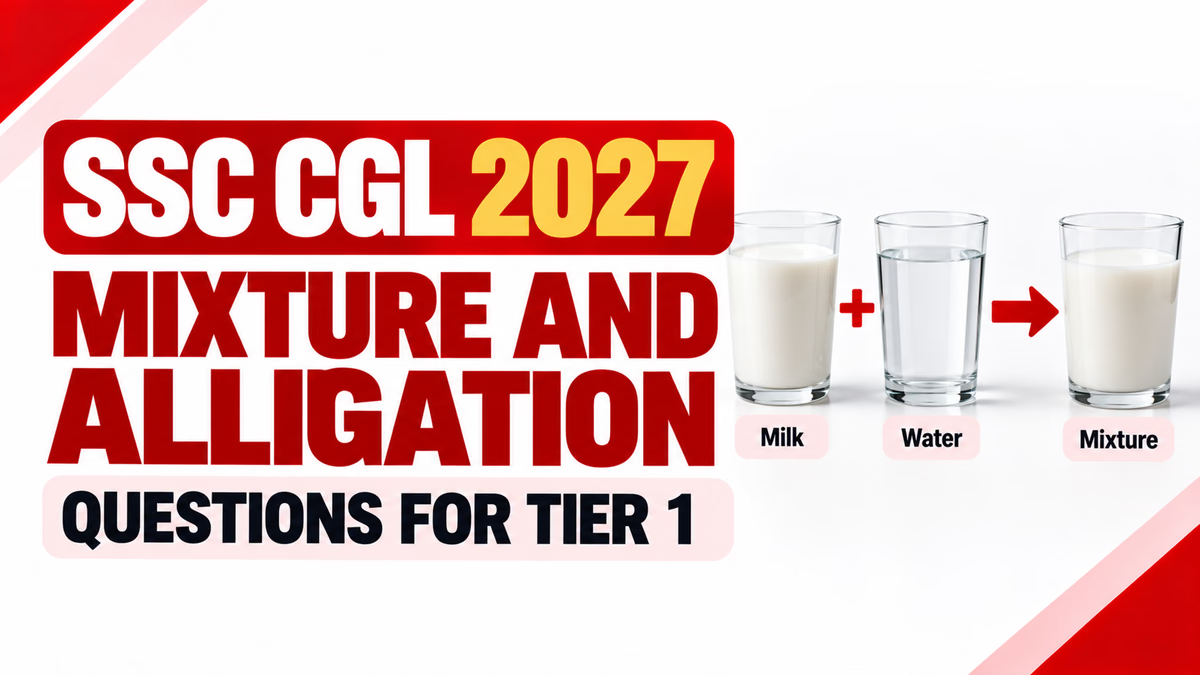
Mixture and alligation is a useful arithmetic topic for SSC CGL Quantitative Aptitude preparation. Questions commonly involve mixing two products with different prices or concentrations, finding the ratio in which they should be mixed, and calculating the average price or concentration of the resulting mixture.
Understanding the alligation method can help candidates solve these questions without lengthy calculations. In this guide, you will learn the basic concepts, important formulas, solved examples, shortcuts, and practice questions with answers for SSC CGL 2027 Tier 1 preparation.
Topics covered
A mixture is formed when two or more substances are combined. The substances may have different prices, concentrations, or proportions. In competitive-exam questions, you may need to calculate the average cost, final concentration, or ratio of the quantities mixed.
For example, if rice costing ₹40 per kg is mixed with rice costing ₹60 per kg, the average cost depends on the quantities of each type used.
Remember: The average value of a mixture must lie between the values being mixed when both quantities are positive.
Alligation is a shortcut used to find the ratio in which two ingredients with different values must be mixed to obtain a desired average value.
Cheaper : Dearer = (Dearer Value − Mean Value) : (Mean Value − Cheaper Value)
Use this when the desired mean lies between the two values.
Example: In what ratio should rice costing ₹40 per kg and ₹60 per kg be mixed to obtain a mixture worth ₹48 per kg?
Cheaper price = ₹40 per kg.
Dearer price = ₹60 per kg.
Mean price = ₹48 per kg.
Cheaper : Dearer = (60 − 48) : (48 − 40)
= 12 : 8
= 3 : 2
Answer: Mix the cheaper and dearer rice in the ratio 3:2.
Question: Rice costing ₹30 per kg is mixed with rice costing ₹50 per kg to obtain a mixture worth ₹38 per kg. Find the ratio of cheaper rice to dearer rice.
Solution:
Cheaper : Dearer = (50 − 38) : (38 − 30)
= 12 : 8
= 3 : 2
Answer: 3:2.
Question: Five kilograms of tea costing ₹200 per kg are mixed with three kilograms of tea costing ₹280 per kg. Find the average cost per kg.
Solution:
Total cost of first tea = 5 × ₹200 = ₹1,000.
Total cost of second tea = 3 × ₹280 = ₹840.
Total cost = ₹1,840.
Total quantity = 5 + 3 = 8 kg.
Average cost = ₹1,840 ÷ 8 = ₹230 per kg.
Answer: ₹230 per kg.
Milk and water questions often involve finding the ratio of milk to water, calculating the amount of water added, or determining the final concentration of milk in a mixture.
When water is added to pure milk, the quantity of milk remains unchanged while the total volume increases. This distinction is important when calculating the final proportion.
Question: A container contains 24 litres of milk. How much water must be added to make the ratio of milk to water 4:1?
Solution:
Milk : Water = 4 : 1.
Four parts represent 24 litres of milk.
One part = 24 ÷ 4 = 6 litres.
Water required = 6 litres.
Answer: 6 litres of water.
Question: A mixture contains 30 litres of milk and 10 litres of water. What percentage of the mixture is milk?
Solution:
Total mixture = 30 + 10 = 40 litres.
Milk percentage = (30 ÷ 40) × 100 = 75%.
Answer: 75%.
Some questions involve removing part of a mixture and replacing it with another liquid. When a quantity is removed from a well-mixed solution, the removed liquid contains the same proportions of the original ingredients as the mixture itself.
If a container holds V litres of a well-mixed liquid and x litres are removed and replaced with water, the fraction of the original liquid remaining after one replacement is:
Original Liquid Remaining = V × (1 − x/V)
For repeated removal and replacement with water, the quantity of the original liquid remaining after n operations is:
V × (1 − x/V)n
This formula assumes the container is mixed thoroughly before each removal and the same quantity is removed and replaced each time.
Question: A container has 40 litres of pure milk. Ten litres are removed and replaced with water. How much milk remains?
Solution:
Milk removed = 10 litres.
Milk remaining = 40 − 10 = 30 litres.
Water added = 10 litres.
Total mixture = 40 litres.
Answer: 30 litres of milk remain.
Try these questions before checking the answer key.
Question 1: In what ratio should rice costing ₹20 per kg and ₹35 per kg be mixed to obtain a mixture costing ₹26 per kg?
A) 2:3 B) 3:2 C) 4:3 D) 5:2
Question 2: Four kilograms of sugar costing ₹40 per kg are mixed with six kilograms costing ₹50 per kg. Find the average cost per kg.
A) ₹44 B) ₹45 C) ₹46 D) ₹48
Question 3: A mixture contains 18 litres of milk and 6 litres of water. What percentage of the mixture is milk?
A) 60% B) 65% C) 70% D) 75%
Question 4: A container holds 20 litres of pure milk. Five litres are removed and replaced with water. How much milk remains?
A) 10 litres B) 12 litres C) 15 litres D) 16 litres
Question 5: In what ratio should a liquid containing 20% water be mixed with a liquid containing 50% water to obtain a mixture containing 30% water?
A) 1:2 B) 2:1 C) 3:2 D) 2:3
1. B) 3:2: Cheaper : Dearer = (35 − 26) : (26 − 20) = 9:6 = 3:2.
2. C) ₹46: Total cost = (4 × 40) + (6 × 50) = ₹460. Total quantity = 10 kg. Average = ₹460 ÷ 10 = ₹46 per kg.
3. D) 75%: Total mixture = 18 + 6 = 24 litres. Milk percentage = 18/24 × 100 = 75%.
4. C) 15 litres: The removed liquid is pure milk, so 20 − 5 = 15 litres of milk remain.
5. B) 2:1: Using alligation, the ratio of the first liquid to the second is (50 − 30):(30 − 20) = 20:10 = 2:1.
Begin by practising weighted averages and simple ratio calculations. Next, learn the alligation shortcut and apply it to price and concentration problems. Once these basics are clear, practise milk-and-water and replacement questions.
Maintain a formula notebook and solve a small set of questions under timed conditions. After each session, review errors in ratio order, arithmetic and units. Understanding why a shortcut works is more useful than memorising it without context.
Check the official SSC CGL notification and syllabus when released for the applicable 2027 examination details. This article is a preparation resource and does not guarantee that a particular question will appear in the examination.
Alligation is a shortcut for finding the ratio in which two values should be mixed to obtain a desired mean.
Use weighted average when the quantities of the ingredients are given. Alligation is especially useful when you need to find their mixing ratio.
Calculate the total volume and identify the quantity of milk and water separately. Apply the changes described in the question carefully.
Yes. It can be used when mixing two concentrations to obtain a target concentration between them.
Practise alligation, weighted averages and ratio simplification, then review your calculation errors regularly.
Mixture and alligation questions become easier when you understand weighted averages, mixing ratios and the difference between quantity and concentration. Practise the formulas and solved examples regularly to strengthen your SSC CGL Quantitative Aptitude preparation.
Keep practising with Katara Academy and improve your accuracy one concept at a time.
