



Download the App & Start Learning
- Expert Faculty Guidance
- Updated Study Material
- Mock Tests & Practice Quiz
- Live Doubt Solving Sessions
- Exam-Oriented Preparation
- Motivation & Success Strategy
Katara Academy

2/11/2026
Embedded Figure questions are an important part of non-verbal reasoning. These questions test your ability to identify a simple shape hidden inside a larger or more complicated figure.
For SSC CHSL 2027 preparation, candidates should develop visual observation, shape recognition and mental rotation skills. This guide explains the main concepts, useful solving techniques and practice questions.
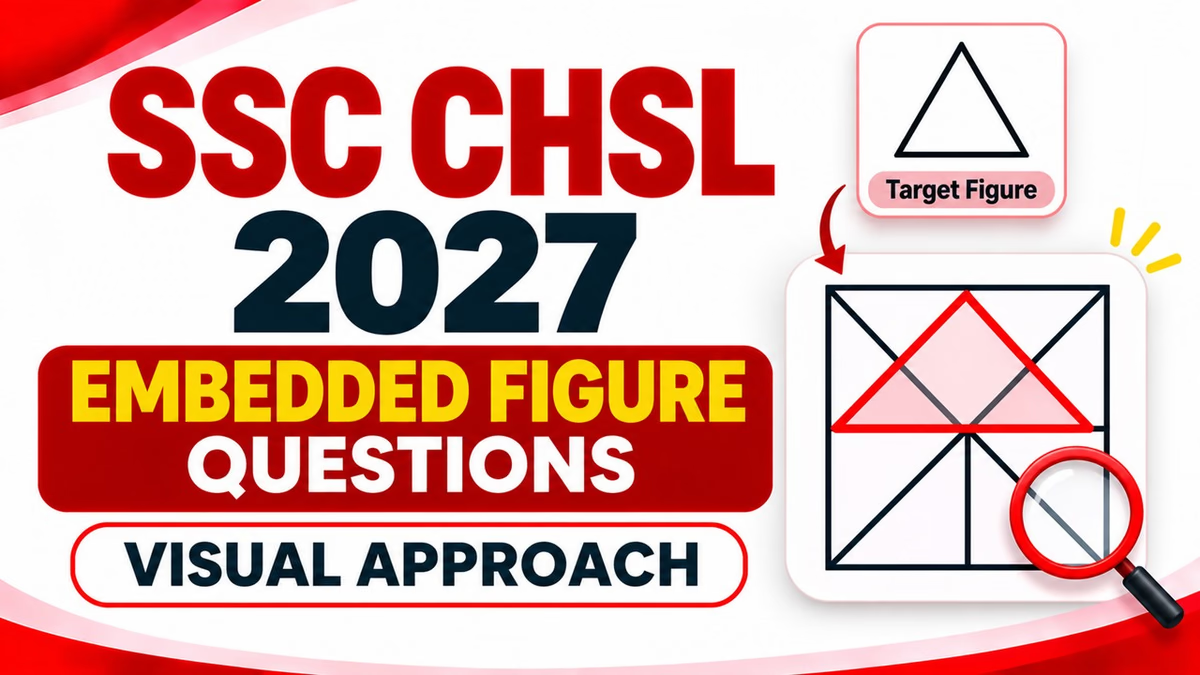
In an Embedded Figure question, a simple figure is given along with a complex diagram. You have to identify whether the simple figure is hidden within the complex figure, even if it is rotated, enlarged or placed in a different direction.
Example: A simple triangle may be hidden inside a complex arrangement of intersecting lines. Your task is to locate the same triangle without being distracted by the extra lines.
Find a basic shape such as a triangle, square, rectangle or circle within a complex figure.
The target figure may appear at a different angle or orientation. You must recognise the same shape even when it is rotated.
These questions involve identifying a triangle formed by different line segments inside a larger diagram. Check the direction and connection of all three sides.
Two or more shapes may overlap to create a complex pattern. Look for the required figure among the intersecting lines.
You may be given multiple options and asked to select the figure that contains the exact target shape.
Choose the correct answer for each question. These concept-based questions help revise the visual identification rules used in embedded figure problems.
Q1. What should you compare first when searching for a triangle hidden inside a complex figure?
A. Colour of the figure
B. Three sides and their connections
C. Size of the diagram
D. Background of the figure
Q2. A target figure is rotated by 90 degrees inside a complex diagram. What should you do?
A. Reject it immediately
B. Compare its shape after mentally rotating it
C. Compare only its colour
D. Ignore its sides
Q3. Which feature is most important when identifying an embedded square?
A. Four equal sides and four right angles
B. Three sides
C. A curved boundary
D. Unequal opposite sides
Q4. Extra lines pass through a hidden figure. What is the correct approach?
A. Reject the figure
B. Ignore the extra lines and trace the required outline
C. Count only the extra lines
D. Look for a different shape
Q5. Which technique helps locate a hidden shape efficiently?
A. Random guessing
B. Tracing connected line segments
C. Ignoring the target figure
D. Counting colours
Q6. If the target figure has five sides, which shape should you look for?
A. Triangle
B. Square
C. Pentagon
D. Circle
Q7. Why is mental rotation useful in embedded figure questions?
A. It changes the number of sides
B. It helps recognise a shape in a different orientation
C. It removes extra lines
D. It changes the shape's dimensions
Q8. What should you verify before selecting an answer?
A. Only the first side
B. The complete outline and all corners
C. Only the position of the figure
D. The colour of the options
Q9. Which method is useful when several answer options look similar?
A. Process of elimination
B. Random selection
C. Ignoring the target shape
D. Selecting the largest option
Q10. What is the best way to improve performance in embedded figure questions?
A. Memorising colours
B. Regular visual reasoning practice
C. Avoiding complex diagrams
D. Solving without observing the target
| Q. | Answer | Explanation |
|---|---|---|
| 1 | B | A triangle is identified by its three connected sides. |
| 2 | B | Rotation changes orientation, not the basic shape. |
| 3 | A | A square has four equal sides and four right angles. |
| 4 | B | The required outline may remain visible despite extra lines. |
| 5 | B | Tracing connected segments helps locate the target shape. |
| 6 | C | A pentagon has five sides. |
| 7 | B | Mental rotation helps identify the same shape from another direction. |
| 8 | B | Checking all sides and corners confirms the match. |
| 9 | A | Eliminating options with incorrect outlines narrows the choices. |
| 10 | B | Regular practice improves visual recognition and speed. |
Embedded Figure questions become easier when you develop strong observation skills and learn to recognise shapes in different orientations. Practise visual reasoning regularly to improve accuracy and confidence.
Explore reasoning preparation courses at Katara Academy.
These questions require you to find a simple target shape hidden inside a larger or more complex diagram.
Yes. The target figure may appear in a different orientation, so mental rotation is a useful technique.
Focus on distinctive corners, trace connected lines and compare the complete outline of the target shape.
