.avif)





Download the App & Start Learning
- Expert Faculty Guidance
- Updated Study Material
- Mock Tests & Practice Quiz
- Live Doubt Solving Sessions
- Exam-Oriented Preparation
- Motivation & Success Strategy
Katara Academy

2/11/2026
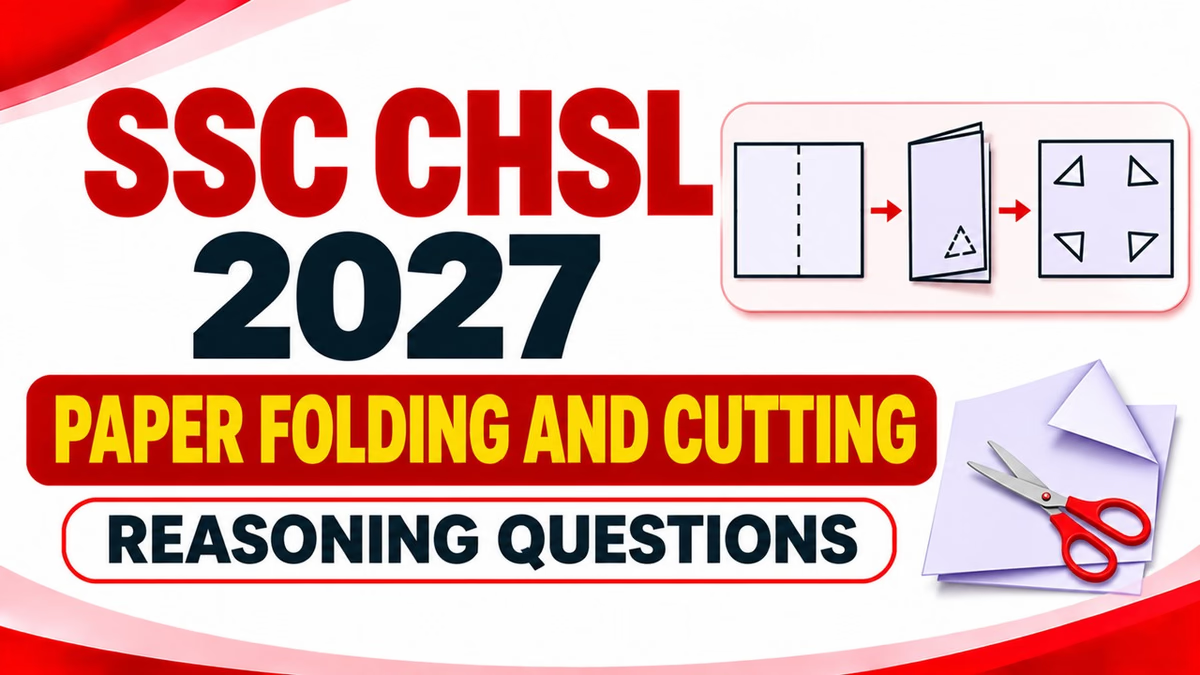
Paper Folding and Cutting is a visual reasoning topic that tests your ability to understand how a paper changes when it is folded, cut and unfolded. These questions require observation, spatial understanding and logical thinking.
For SSC CHSL 2027 preparation, candidates should practise paper folding, hole punching, cut patterns and symmetry-based questions. This guide explains the basic concepts, solving methods and practice questions.
In paper folding questions, a sheet is folded one or more times. A cut or hole is then made in the folded paper. Candidates must identify how the paper will look after it is completely unfolded.
Example: If a folded paper has one hole punched through all its layers, unfolding it produces multiple holes at corresponding symmetrical positions.
The paper is folded once along a line. A cut or hole made on the folded sheet is reflected across the fold line when unfolded.
The paper is folded two or more times. Each fold creates additional layers, so a cut may appear at several corresponding positions after unfolding.
One or more holes are punched into the folded paper. After unfolding, the holes appear in positions determined by the folds and the number of layers.
A cut made along an edge or corner of folded paper may create a repeated pattern when the sheet is opened. Pay attention to whether the cut reaches a folded edge or an open edge.
Some questions involve cutting shapes such as triangles, circles or squares. The final pattern depends on the direction and position of each fold.
Choose the most appropriate answer for each question.
Q1. A square paper is folded once vertically. One hole is punched through the folded paper. How many holes will appear after unfolding?
A. 1
B. 2
C. 3
D. 4
Q2. A paper is folded twice, creating four layers. One hole is punched through all layers. How many holes will appear after complete unfolding?
A. 2
B. 3
C. 4
D. 8
Q3. A paper is folded horizontally once. A small cut is made away from the fold and outer edges. What should you expect after unfolding?
A. One cut only
B. Two symmetrical cuts
C. Three cuts
D. No cut
Q4. In a paper folding question, which fold should be reversed first while solving the final pattern?
A. The first fold
B. The middle fold
C. The last fold
D. Any fold
Q5. A paper is folded vertically and then horizontally. One hole is punched through all four layers. How many holes will appear after unfolding?
A. 2
B. 3
C. 4
D. 6
Q6. A square paper is folded once along its vertical centre line. A cut is made on the folded edge. What should be checked carefully after unfolding?
A. Only the paper colour
B. Whether the cut creates a matching pattern across the fold line
C. The paper thickness only
D. The size of the original sheet only
Q7. A paper is folded three times, with each fold creating two layers from the previous sheet. How many layers are present before cutting?
A. 4
B. 6
C. 8
D. 12
Q8. A hole is punched at a position away from the fold lines in a paper folded twice into four layers. How many corresponding holes are generally produced after unfolding?
A. 1
B. 2
C. 4
D. 6
Q9. Why is symmetry important in paper cutting questions?
A. It helps identify corresponding cuts after unfolding
B. It changes the paper colour
C. It reduces the number of folds
D. It removes the cut marks
Q10. Which method is most useful for checking a difficult paper folding pattern?
A. Guessing the answer
B. Ignoring the fold sequence
C. Reversing each fold step by step
D. Counting only the visible corners
| Q. | Answer | Explanation |
|---|---|---|
| 1 | B. 2 | One fold creates two layers, so the hole appears twice. |
| 2 | C. 4 | Four layers produce four corresponding holes when unfolded. |
| 3 | B. Two symmetrical cuts | The cut is reflected across the horizontal fold line. |
| 4 | C. The last fold | Unfolding must follow the reverse order of folding. |
| 5 | C. 4 | Two folds create four layers, producing four corresponding holes. |
| 6 | B | A cut on a folded edge can produce a different result from a cut inside the folded sheet. |
| 7 | C. 8 | The number of layers doubles with each fold: 2, 4 and 8. |
| 8 | C. 4 | One hole through four layers produces four corresponding holes, assuming all layers are punched. |
| 9 | A | Symmetry helps locate matching cuts and holes after unfolding. |
| 10 | C | Reversing the folds step by step helps reconstruct the final pattern. |
Paper Folding and Cutting questions become easier when you understand the folding sequence, number of layers and symmetry of cuts. Practise different patterns regularly to strengthen your reasoning preparation.
Explore reasoning preparation courses at Katara Academy.
These are visual reasoning questions in which a paper is folded and cut or punched. Candidates identify the pattern formed after unfolding it.
Follow the fold sequence carefully, locate the cut and reverse the folds one by one to identify the final pattern.
If each fold doubles the layers, three folds produce eight layers.