
Download the App & Start Learning
- Expert Faculty Guidance
- Updated Study Material
- Mock Tests & Practice Quiz
- Live Doubt Solving Sessions
- Exam-Oriented Preparation
- Motivation & Success Strategy
Katara Academy

28/10/2026
Improving typing speed for SSC CHSL 2027 starts with learning the correct finger positions. The home row keys help you keep your fingers in the right position and reduce unnecessary movement across the keyboard. With regular practice, you can improve typing accuracy, develop better keyboard control and gradually increase your speed.
This guide explains home-row finger placement, beginner-friendly typing drills and a simple daily practice routine for SSC CHSL aspirants.
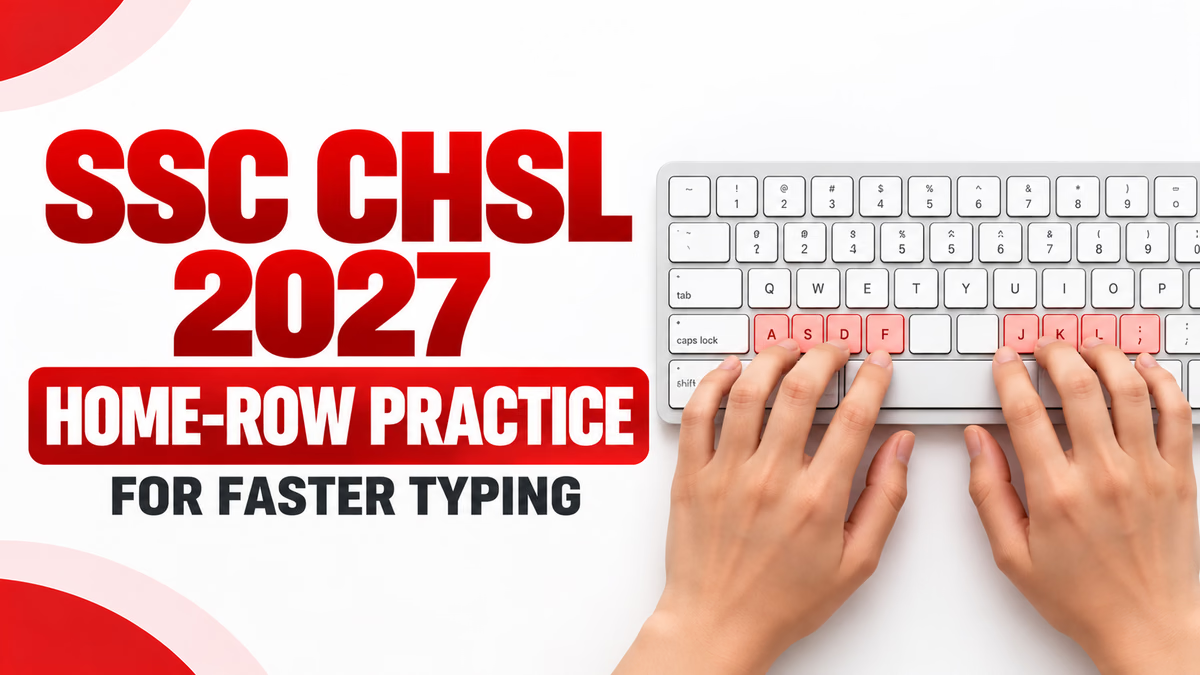
The home row is the middle row of letters on a standard QWERTY keyboard. It is the starting position for touch typing, where you learn to type without looking at the keyboard constantly.
Home Row Keys
Place your fingers on A, S, D, F and J, K, L, ; respectively.
The small raised marks on the F and J keys help you find the correct starting position by touch. Once your fingers return to the home row after reaching other keys, typing becomes more consistent.
| Finger | Home Row Key |
|---|---|
| Left little finger | A |
| Left ring finger | S |
| Left middle finger | D |
| Left index finger | F and nearby keys |
| Right index finger | J and nearby keys |
| Right middle finger | K |
| Right ring finger | L |
| Right little finger | ; |
Keep your wrists relaxed and avoid pressing the keys too hard. Your thumbs can be used for the spacebar. Return your fingers to the home row after reaching other keys.
Begin with slow, controlled repetitions. Keep your fingers on the assigned keys and avoid looking down whenever possible.
Practice:
ffff jjjj dddd kkkk ssss llll aaaa ;;;;
Once you are comfortable with individual keys, practise alternating between the left and right hands.
Practice:
asdf jkl; fdsa ;lkj asdf jkl;
Move on to short words that use home-row letters. Concentrate on entering each letter correctly instead of racing through the exercise.
Practice words:
ask, dad, fall, flask, salad, glass, adds
After practising letters and words, type a short sentence to develop rhythm and spacing.
Practice sentence:
A lad asks dad; a lass adds a salad.
These are beginner exercises, not official SSC typing passages. Use them to develop finger familiarity before progressing to longer timed passages.
| Activity | Time |
|---|---|
| Home-row finger warm-up | 5 minutes |
| Letter and key combinations | 5 minutes |
| Word and sentence practice | 5 minutes |
| Timed practice and error review | 10 minutes |
This 25-minute routine is a suggested practice plan. As your accuracy improves, gradually introduce longer passages and timed tests suitable for your exam preparation.
The home row keys on a standard QWERTY keyboard are A, S, D, F, G, H, J, K, L and the semicolon (;). The fingers rest on A, S, D, F and J, K, L, ; as their starting positions.
It helps develop finger familiarity, reduces unnecessary hand movement and supports more consistent typing accuracy.
A focused 15–25 minute session is a useful starting point. Practise regularly and adjust the duration according to your comfort and progress.
Focus on accuracy and correct finger placement first. Increase your typing speed gradually as your control improves.
No. Home-row practice builds the foundation, but candidates should also practise full passages, punctuation, spacing and timed typing according to the requirements in the applicable official notification.
Continue your preparation with these related Katara Academy articles:
Looking for structured support for your competitive-exam preparation? Visit Katara Academy to explore the courses currently available and find learning resources that match your goals.
Home-row practice is a simple but valuable first step towards better typing skills for SSC CHSL 2027 preparation. Learn the correct finger positions, practise key combinations and short sentences, and review your mistakes regularly. With consistent practice, you can build a stronger foundation before moving on to longer timed passages.
Disclaimer: This article provides general typing practice guidance. Check the official SSC notification for the examination requirements applicable to your recruitment cycle.