




Download the App & Start Learning
- Expert Faculty Guidance
- Updated Study Material
- Mock Tests & Practice Quiz
- Live Doubt Solving Sessions
- Exam-Oriented Preparation
- Motivation & Success Strategy
Katara Academy

8/8/2026
SSC GD Recruitment 2026
The SSC GD Map-Based Geography Preparation 2026 guide helps candidates strengthen their knowledge of Indian States and Union Territories, Major Rivers, Mountains, Plateaus, Passes, Dams, National Parks, Wildlife Locations, Important Cities, Ports and Coastal Regions. Regular map practice can make location-based Geography questions easier to understand, remember and solve during the SSC GD Constable Examination.
Preparation Focus:
Candidates preparing for SSC GD Recruitment 2026 should combine textbook study with regular India map practice. Focus on important geographical locations, river systems, mountain ranges, states, protected areas and major infrastructure locations. Repeated map revision and MCQ practice can improve accuracy in location-based questions.
Map-Based Geography is an important part of Indian Geography preparation because many geographical facts become easier to understand when they are connected with their actual locations. SSC GD aspirants should regularly use an India map to revise states, rivers, mountains, plateaus, passes, dams, national parks and other important locations.
| Particular | Details |
|---|---|
| Exam Name | SSC GD Constable Recruitment 2026 |
| Section | Map-Based Geography |
| Preparation Focus | States, Rivers, Mountains, Dams, Parks & Important Locations |
| Recommended Study Time | 20–30 Minutes Daily |
| Goal | Improve Location Awareness & Geography Accuracy |
Map-based learning helps candidates connect geographical facts with their locations. Instead of memorizing isolated names, students can understand the relationship between rivers, states, mountains, dams, national parks and other physical and human features of India.
Candidates do not need to memorize every geographical feature on the map. Focus first on frequently studied locations and gradually expand your map knowledge through regular practice.
| Map Topic | What to Study |
|---|---|
| States & Union Territories | Location, Borders & Neighbouring States |
| Major Rivers | Origin, Course, Tributaries & States |
| Mountains & Plateaus | Ranges, Peaks, Plateaus & Locations |
| Dams & Power Projects | Dam, River, State & Project Location |
| National Parks & Wildlife | Park, State & Important Wildlife |
| Cities & Ports | Important Cities, Ports & Coastal Locations |
| Preparation Activity | Recommended Frequency |
|---|---|
| State & Location Revision | Daily |
| River & Mountain Map Practice | Daily |
| Dams, Parks & Important Locations | 3–4 Times Per Week |
| Map-Based MCQ Practice | 2–3 Times Per Week |
| Complete Map Revision | Weekly |
The political map of India is the foundation of map-based Geography preparation. Candidates should first become familiar with the location of states and Union Territories, neighbouring states, international borders and important geographical directions.
After learning the basic political map, candidates should practice identifying states and Union Territories without looking at labels. This improves location memory and makes later topics such as rivers, mountains, dams and national parks easier to understand.
| Region | Map Focus |
|---|---|
| North India | Himalayan States & Northern Plains |
| West India | Rajasthan, Gujarat, Maharashtra & Goa |
| Central India | Madhya Pradesh & Chhattisgarh |
| South India | Peninsular States & Coastal Locations |
| East India | West Bengal, Odisha, Jharkhand & Bihar |
| North-East India | Seven Sister States & Sikkim |
Major rivers are one of the most useful topics for map-based Geography. Candidates should not only memorize river names but also trace their approximate course, identify their origin, tributaries, states through which they flow and the place where they drain.
| River System | What to Practice |
|---|---|
| Ganga River System | Origin, Major Tributaries, States & Course |
| Brahmaputra River System | Origin, Course, Tributaries & Assam Region |
| Indus River System | Major Tributaries & Northern Region |
| Narmada | Origin, Course & Westward Flow |
| Godavari | Origin, Tributaries & Peninsular Course |
| Krishna | Origin, Tributaries & States |
| Mahanadi | Origin, Course & Odisha Region |
| Cauvery | Origin, Course & Southern States |
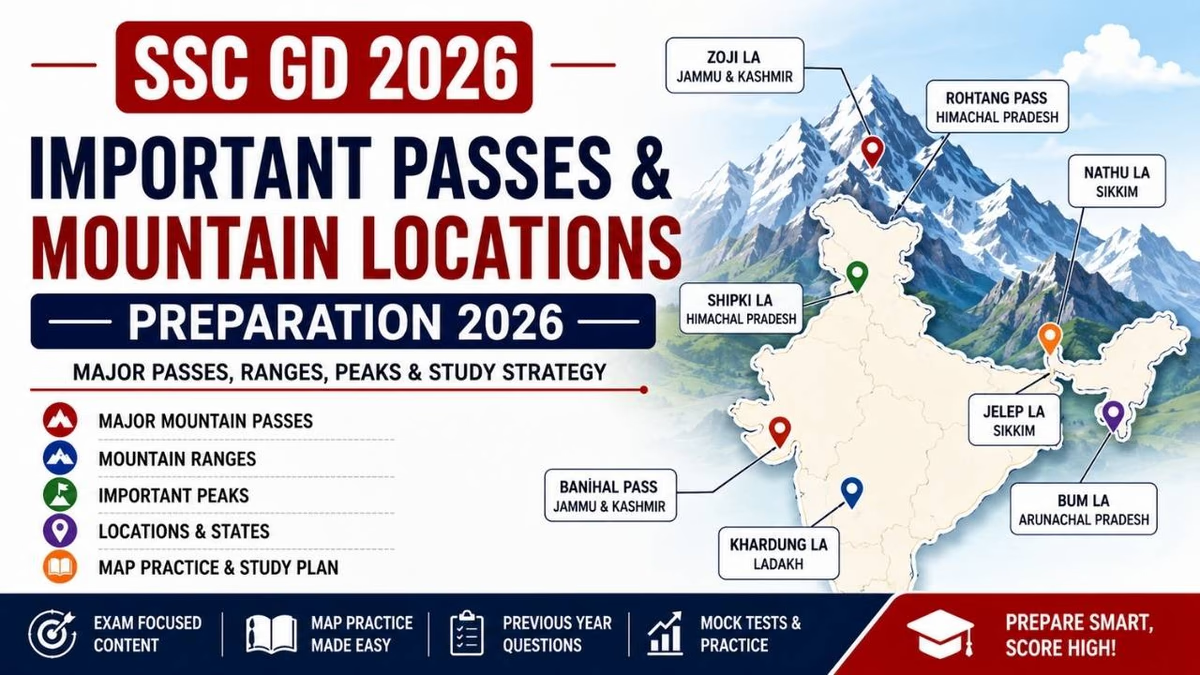
Physical features should be studied directly on a physical map. Candidates should learn the location and direction of major mountain ranges, plateaus, important peaks and passes.
Dams become easier to remember when they are marked on the map together with their rivers and states. Candidates should connect the three details instead of memorizing dam names separately.
Protected areas should also be revised using maps. Connect each important National Park with its state and famous wildlife species to create a strong visual memory.
| Protected Area | State | Map Association |
|---|---|---|
| Jim Corbett National Park | Uttarakhand | Himalayan Foothills |
| Kaziranga National Park | Assam | Brahmaputra Valley |
| Gir National Park | Gujarat | Saurashtra Region |
| Ranthambore National Park | Rajasthan | Eastern Rajasthan |
| Sundarbans National Park | West Bengal | Ganga-Brahmaputra Delta |
Consistent short sessions are more useful than trying to memorize the complete map in one sitting. Follow a simple routine and gradually increase the number of locations you can identify without looking at labels.
| Time | Activity |
|---|---|
| 5 Minutes | States & Union Territories Revision |
| 10 Minutes | Major Rivers & Physical Features |
| 10 Minutes | Dams, National Parks & Important Locations |
| 10 Minutes | Map-Based MCQs & Self-Testing |
Map-based Geography becomes easier when topics are practiced in a fixed order. Candidates should begin with states and major physical features and then connect them with rivers, dams, protected areas and other important locations.
A good atlas should be part of your daily Geography preparation. Use an atlas together with standard Geography books so that factual information can be connected with actual locations on the map.
| Study Material | Purpose |
|---|---|
| Oxford School Atlas | Detailed Political & Physical Map Practice |
| NCERT Geography Books | Build Basic Geography Concepts |
| Lucent's General Knowledge | Quick Revision of Geography Facts |
| Previous Year SSC GD Papers | Understand Location-Based Question Trends |
Previous year SSC GD questions can help candidates identify the types of geographical locations that are repeatedly tested. Use these questions to guide revision rather than trying to memorize every location on the map.
Mock tests help candidates check whether they can recall geographical locations quickly. After every test, locate the questions you answered incorrectly and revise them on the map.
| Practice Activity | Recommended Frequency |
|---|---|
| Map Location Quiz | Daily |
| Geography Sectional Test | 2–3 Times Per Week |
| Full-Length Mock Test | Weekly |
| Map Error Revision | After Every Test |
Map preparation becomes difficult when candidates try to memorize too many locations without understanding their geographical relationships. A simple and consistent approach is more effective.
| SSC GD Article | Read Here |
|---|---|
| SSC GD Notification 2026 | Read Now → |
| SSC GD Eligibility 2026 | Read Now → |
| SSC GD Syllabus 2026 | Read Now → |
| SSC GD Exam Pattern 2026 | Read Now → |
| SSC GD Study Plan 2026 | Read Now → |
| SSC GD General Knowledge Preparation 2026 | Read Now → |
| SSC GD Current Affairs 2026 | Read Now → |
| SSC GD Indian Geography Preparation 2026 | Read Now → |
| SSC GD Physical Geography Preparation 2026 | Read Now → |
| SSC GD World Geography Preparation 2026 | Read Now → |
| SSC GD Indian Rivers Preparation 2026 | Read Now → |
| SSC GD Mountains & Plateaus of India Preparation 2026 | Read Now → |
| SSC GD Indian Climate & Monsoon Preparation 2026 | Read Now → |
| SSC GD Soils of India Preparation 2026 | Read Now → |
| SSC GD Agriculture in India Preparation 2026 | Read Now → |
| SSC GD Mineral Resources of India Preparation 2026 | Read Now → |
| SSC GD National Parks & Wildlife Sanctuaries Preparation 2026 | Read Now → |
| SSC GD Important Dams & Power Projects Preparation 2026 | Read Now → |
| SSC GD Mock Test 2026 | Read Now → |
Prepare for SSC GD Recruitment 2026 with expert Geography classes at Katara Academy. Learn Indian maps, states, rivers, mountains, plateaus, passes, dams, National Parks, wildlife locations, important cities and other geographical features through concept-based teaching, map practice, previous year questions, mock tests and regular revision.
Candidates can spend around 20–30 minutes daily on map practice. Focus on states, rivers, mountains, dams, National Parks and other important geographical locations.
Use both political and physical maps of India. The political map helps with states and boundaries, while the physical map helps with rivers, mountains, plateaus and other natural features.
Important topics include states and Union Territories, major rivers, mountains, plateaus, passes, dams, National Parks, Wildlife Sanctuaries, important cities, ports and coastal regions.
Use blank maps, repeated visual revision and location-based MCQs. Connect related facts such as a dam with its river and state or a National Park with its state and wildlife.
Yes. Previous year questions help identify commonly tested geographical facts and locations. After solving a question, locate the relevant place on the map for better retention.
A consistent SSC GD Map-Based Geography Preparation 2026 strategy can make Indian Geography easier to understand and revise. Start with states and Union Territories, then gradually add rivers, mountains, plateaus, passes, dams, National Parks, cities and other important locations. Regular map practice, previous year questions, MCQs and mock tests can help candidates improve their location awareness and accuracy in the SSC GD examination.