



Download the App & Start Learning
- Expert Faculty Guidance
- Updated Study Material
- Mock Tests & Practice Quiz
- Live Doubt Solving Sessions
- Exam-Oriented Preparation
- Motivation & Success Strategy
Katara Academy

9/5/2026
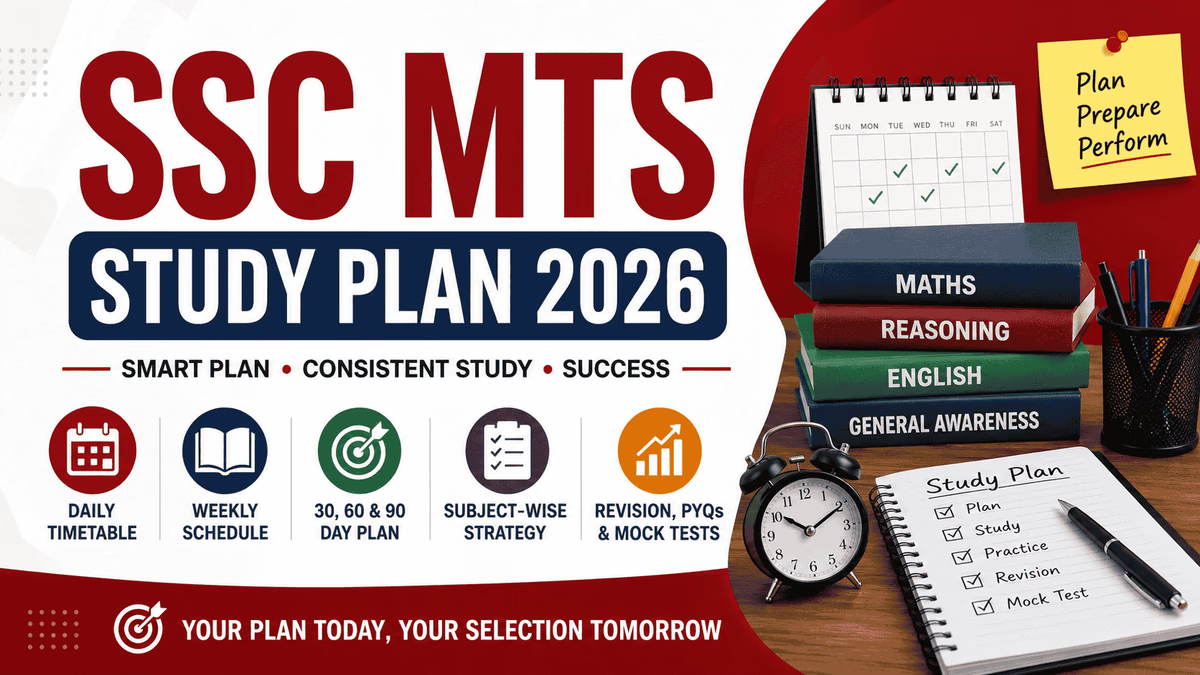
SSC MTS Preparation Strategy 2026 is important for candidates who want to prepare for the Multi-Tasking (Non-Technical) Staff examination in a systematic and result-oriented way. Clearing SSC MTS is not only about studying more hours; it is about understanding the exam structure, selecting the right topics, building accuracy, practising questions regularly, and revising consistently.
Many candidates begin preparation without a clear timetable. They collect several books, watch multiple lectures, solve random questions, and take mock tests without analysing their mistakes. This often leads to incomplete preparation. A proper strategy helps candidates use their available time efficiently and gradually improve their score.
An SSC MTS preparation strategy is a structured plan that explains what to study, how to study, how much to practise, when to revise, and how to analyse performance. A good strategy combines syllabus coverage, question practice, previous year questions, mock tests, revision and time management.
Since the SSC MTS examination contains different sections, candidates should not spend all their preparation time on only one subject. A balanced plan is necessary to maintain performance across Mathematics, Reasoning, General Awareness and English.
According to the SSC MTS examination scheme used in recent official notices, the Computer Based Examination is conducted in two sessions. Session-I covers Numerical and Mathematical Ability and Reasoning Ability and Problem Solving, while Session-II covers General Awareness and English Language and Comprehension. The 2025 official notice also states that candidates first need to qualify Session-I for their Session-II performance to be evaluated.
The official SSC website currently lists the Multi Tasking (Non-Technical) Staff Examination, 2026 in its examination calendar. Candidates should always verify the latest notice, schedule and instructions on the official SSC website before making final exam-day assumptions.
SSC MTS is a competitive examination. Merely completing the syllabus does not guarantee a good result. Candidates need to convert their knowledge into correct answers within the available time.
| Preparation Area | What You Need to Do |
|---|---|
| Concept Building | Understand basic concepts before solving advanced questions. |
| Practice | Solve sufficient questions to improve speed and confidence. |
| PYQs | Understand the style, level and recurring concepts of SSC questions. |
| Revision | Regularly revise formulas, rules, facts, vocabulary and mistakes. |
| Mock Tests | Practise under exam-like conditions and analyse performance. |
| Accuracy | Avoid unnecessary guesses, especially in sections where negative marking applies. |
The first step in preparation should be understanding the examination structure. Without knowing the sections and marking approach, candidates may create an ineffective study routine.
Session-I includes:
The recent SSC MTS pattern provides a separate session for these two areas. The 2024 official notice specifies that there is no negative marking in Session-I.
Session-II includes:
For Session-II, the official notice specifies negative marking of one mark for each wrong answer. This makes accuracy particularly important while attempting this session.
A common mistake is starting preparation directly from a book or YouTube playlist. A better approach is to first create a syllabus checklist.
For Numerical and Mathematical Ability, the official syllabus includes areas such as integers and whole numbers, LCM and HCF, decimals and fractions, percentage, ratio and proportion, averages, work and time, simple interest, profit and loss, discount, distance and time, geometry-related basics, data interpretation and square and square roots.
Reasoning Ability and Problem Solving broadly covers areas such as alpha-numeric series, coding-decoding, analogy, directions, similarities and differences, jumbling, problem solving, non-verbal reasoning, age calculations, calendar and clock.
General Awareness broadly covers Social Studies such as History, Geography, Art and Culture, Civics and Economics, together with General Science and Environmental Studies at the prescribed level.
English Language and Comprehension tests areas such as basic English language knowledge, vocabulary, grammar, sentence structure, synonyms, antonyms, correct usage and comprehension.
Once the syllabus is available, divide every topic into three groups:
| Level | Meaning | Action |
|---|---|---|
| Level 1 – Strong | You can solve most basic questions correctly. | Maintain with regular practice and revision. |
| Level 2 – Average | You understand the concept but make mistakes or take too much time. | Practise more questions and improve speed. |
| Level 3 – Weak | You are unfamiliar with the concept or cannot solve questions independently. | Learn the concept from the basics and then practise. |
This simple classification helps candidates avoid spending unnecessary time on topics they already know well.
A study schedule should be realistic rather than impressive on paper. Studying for 12 hours for two days and then doing nothing for three days is less useful than maintaining a consistent four-to-eight-hour routine according to your personal situation.
A candidate who is starting from zero can initially focus on building concepts. A candidate who has already completed the syllabus should dedicate more time to PYQs, mock tests and revision.
| Study Block | Suggested Activity |
|---|---|
| Morning | Mathematics concept + practice |
| Late Morning | Reasoning practice |
| Afternoon | General Awareness study and revision |
| Evening | English grammar, vocabulary or comprehension |
| Night | PYQs, error review and quick revision |
The exact number of hours can be adjusted according to whether you are a student, working candidate, full-time aspirant or beginner.
For most candidates, the following sequence is more effective than randomly jumping between chapters:
Understand the Syllabus →
Learn Basic Concepts →
Practise Topic-wise Questions →
Solve Previous Year Questions →
Take Sectional Tests →
Take Full-Length Mocks →
Analyse Mistakes →
Revise and Repeat
This creates a continuous improvement cycle. Every test should produce useful information about your weak areas, speed and accuracy.
Preparation should not be measured only by the number of questions attempted. A candidate who solves 80 questions with poor accuracy may perform worse than a candidate who solves fewer questions carefully.
This becomes especially important in Session-II because the official SSC MTS notice specifies one-mark negative marking for every wrong answer.
During practice, maintain a simple record of:
After a few weeks, this record can reveal whether your main problem is conceptual knowledge, calculation speed, question selection, reading comprehension or careless errors.
| Pillar | Focus |
|---|---|
| Concepts | Understand the chapter and basic methods. |
| Practice | Solve enough questions to build familiarity and speed. |
| Revision | Repeatedly review formulas, rules, facts and mistakes. |
| Testing | Use PYQs and mocks to measure real progress. |
SSC MTS Preparation Strategy 2026 should be based on consistency rather than last-minute studying. Start with the official syllabus and current exam structure, divide topics according to your strengths and weaknesses, build concepts, practise questions, solve PYQs, take tests and revise regularly.
The most important thing is to create a preparation system that you can follow every day. A simple and consistent strategy is usually more effective than a complicated timetable that cannot be maintained.
Note: Examination schedules, patterns, instructions and other recruitment details may be revised by the Staff Selection Commission. Candidates should refer to the latest official SSC notice for the examination cycle they are applying for. The official SSC website should be treated as the final source for recruitment-related updates.
After understanding the overall SSC MTS preparation approach, the next important step is to build a strong subject-wise preparation strategy. Mathematics, Reasoning, English and General Awareness require different methods of study. A strategy that works well for one subject may not work equally well for another.
Therefore, SSC MTS aspirants should divide their preparation according to the nature of each section. Numerical Ability requires concept clarity and calculation practice, Reasoning requires logical thinking and repeated question practice, English requires grammar and vocabulary development, while General Awareness requires consistent reading and revision.
Mathematics can become a high-scoring area when the basic concepts are clear and calculations are sufficiently fast. Many candidates make the mistake of memorising formulas without understanding where and how to use them.
The SSC MTS syllabus includes topics such as integers and whole numbers, LCM and HCF, decimals and fractions, percentage, ratio and proportion, averages, work and time, simple interest, profit and loss, discount, distance and time, basic geometry, data interpretation, square and square roots and other fundamental arithmetic concepts. :contentReference[oaicite:0]{index=0}
Beginners should first strengthen the arithmetic basics. Before moving towards speed-based practice, make sure that basic operations, fractions, percentages, ratios and calculation methods are comfortable.
A simple progression can be:
| Stage | Focus |
|---|---|
| Stage 1 | Learn basic concepts and formulas. |
| Stage 2 | Solve easy examples without a timer. |
| Stage 3 | Practise mixed-level questions. |
| Stage 4 | Solve SSC MTS previous year questions. |
| Stage 5 | Introduce time limits and sectional tests. |
Instead of studying every chapter with equal intensity, candidates can initially focus on frequently practised arithmetic areas and then cover the remaining syllabus systematically.
These topics should not be treated merely as a list to memorise. The better strategy is to understand the standard methods, identify question patterns and practise similar questions repeatedly.
Create a small notebook for formulas, shortcuts and common mistakes. Write only the information that you actually need for revision.
For example, keep separate sections for:
Reasoning is often considered one of the more approachable sections because many questions are based on patterns, logic and relationships rather than lengthy calculations. However, speed comes only with practice.
The official syllabus broadly includes alpha-numeric series, coding and decoding, analogy, directions, similarities and differences, jumbling, problem solving, analysis, non-verbal reasoning, age calculations, calendar and clock, among other areas. :contentReference[oaicite:1]{index=1}
Do not simply read the methods. Reasoning is a practice-oriented subject. You need to solve questions regularly until common patterns become familiar.
A useful strategy is to divide topics into three categories:
| Category | Examples |
|---|---|
| Pattern Based | Series, analogy, coding-decoding |
| Logic Based | Directions, similarities, differences, problem solving |
| Visual / Mixed | Non-verbal reasoning, diagrams, calendar and clock |
For an individual reasoning topic, first understand the concept and then solve a meaningful set of questions. The exact number is less important than understanding the mistakes.
After completing a topic, mark questions that were:
These marked questions become a highly useful revision source.
During the initial phase, focus on accuracy before speed. Once the pattern is understood and mistakes decrease, start using a timer.
Do not try to solve every question by a shortcut. A method that is easy to remember and consistently accurate is better than a complicated shortcut that creates errors.
English preparation is different from Mathematics and Reasoning because improvement happens through regular exposure as well as question practice. Candidates should build their preparation around grammar, vocabulary, sentence understanding and comprehension.
The SSC MTS syllabus includes basics of English language, vocabulary, grammar, sentence structure, synonyms, antonyms, correct usage and comprehension. :contentReference[oaicite:2]{index=2}
| Area | Daily Focus |
|---|---|
| Grammar | Rules + examples + practice questions |
| Vocabulary | New words + revision + usage |
| Sentence Skills | Correct usage and sentence-based questions |
| Comprehension | Read short passages and identify answers from context |
Do not attempt to memorise all grammar rules at once. Study one concept, understand a few examples, and then solve questions based on that concept.
A useful order can begin with:
Once these concepts become comfortable, shift more time towards mixed practice and previous year questions.
Vocabulary should be studied every day instead of once a week. However, learning a large list of words without revision usually gives poor long-term retention.
Maintain a vocabulary notebook with:
Revise older words regularly before adding a large number of new words.
General Awareness can be one of the most time-consuming areas because its syllabus covers different subjects and factual information. The official SSC MTS syllabus broadly covers Social Studies such as History, Geography, Art and Culture, Civics and Economics, along with General Science and Environmental Studies at the prescribed level. :contentReference[oaicite:3]{index=3}
The major challenge in General Awareness is not only learning information but also remembering it until the examination.
Keep two separate preparation tracks:
Static General Awareness: History, Geography, Civics, Economics, Science, Environment, Culture and related factual topics.
Current Awareness: Recent events and developments that may be relevant to the examination period.
For current information, candidates should use a reliable and recent source and revise important points regularly rather than collecting information from many unrelated sources.
Divide the syllabus into small daily targets. For example, instead of deciding to “finish History”, set a smaller target such as one specific historical period or topic.
| Day | Example Focus |
|---|---|
| Monday | History |
| Tuesday | Geography |
| Wednesday | Science |
| Thursday | Civics / Polity |
| Friday | Economics |
| Saturday | Art, Culture and Environment |
| Sunday | Weekly revision + quiz |
This type of rotation prevents candidates from ignoring subjects while making the syllabus feel more manageable.
There is no universal timetable that is perfect for every candidate. The right allocation depends on your current level, available study hours and weak areas.
A candidate who is weak in Mathematics may need additional practice there, while another candidate may need more time for English vocabulary and General Awareness.
An example of a balanced full-time preparation schedule can look like this:
| Subject | Daily Focus |
|---|---|
| Maths | Concept + 25–40 practice questions |
| Reasoning | Topic practice + timed questions |
| English | Grammar + vocabulary + practice |
| GA | Static topic + current awareness + revision |
| Revision | Mistakes + formulas + facts + vocabulary |
The exact question count should depend on quality and difficulty. The purpose is to establish a sustainable routine rather than chase an arbitrary daily number.
Studying the same subject for many hours continuously can reduce concentration. Subject rotation can keep preparation balanced.
For example:
Block 1: Mathematics
Block 2: Reasoning
Block 3: English
Block 4: General Awareness
Block 5: PYQs + Revision
The number and duration of blocks can be adjusted. The important point is to touch multiple subjects regularly instead of completely ignoring one subject for several days.
Previous year questions should be integrated into preparation rather than postponed until the very end.
After completing a chapter, solve relevant SSC MTS PYQs. This helps you understand how the concepts are converted into actual examination questions.
While solving PYQs, do not simply check whether the final answer is correct. Ask:
This turns PYQs into a learning tool rather than merely a test.
An error notebook is one of the simplest ways to improve. Every time you make a significant mistake, record it in a short form.
| Column | Example |
|---|---|
| Subject | Mathematics |
| Topic | Percentage |
| Mistake | Wrong calculation |
| Correct Method | Use the percentage conversion carefully. |
| Revision Date | Weekly review |
Over time, this notebook becomes a personalised list of the areas that need attention.
A preparation plan should gradually shift from learning towards testing as the examination approaches.
| Preparation Stage | Main Focus |
|---|---|
| Beginning | Concepts + basic practice |
| Middle | PYQs + mixed practice + revision |
| Advanced | Mocks + analysis + weak-area correction |
| Final Revision | Short notes + PYQs + targeted tests |
Mathematics: Concepts → formulas → practice → PYQs → timed tests
Reasoning: Learn patterns → practise → improve speed → PYQs → sectional tests
English: Grammar → vocabulary → sentence practice → comprehension → PYQs
General Awareness: Static topics → current awareness → short notes → repeated revision → quizzes
A successful SSC MTS Preparation Strategy 2026 should be subject-specific but built around one common objective: improving accuracy and performance through consistent practice.
Mathematics needs calculation and concept clarity. Reasoning needs logical thinking and repeated practice. English requires grammar, vocabulary and comprehension skills. General Awareness requires structured study and repeated revision.
Do not compare your preparation with someone else's timetable. Instead, identify your present level, set achievable daily targets, measure your performance and continuously work on weak areas.
Note: SSC may revise examination-related details through official notices or updates. The latest SSC notification applicable to the candidate should always be treated as the final authority. The SSC MTS 2025 official notice confirms two mandatory 45-minute sessions, no negative marking in Session-I and one-mark negative marking per wrong answer in Session-II. :contentReference[oaicite:4]{index=4}
A strong SSC MTS Preparation Strategy 2026 is not complete without a practical daily timetable. Many candidates know what to study but struggle with how to divide their day, how much time to give to each subject, when to practise PYQs, and when to take mock tests.
The ideal study plan should be flexible enough to suit a student's or working candidate's routine while still ensuring that every subject receives regular attention. Instead of creating an unrealistic timetable, SSC MTS aspirants should focus on a routine that can be followed consistently for several weeks or months.
The recent SSC MTS examination scheme consists of two mandatory sessions conducted on the same day. Session-I contains Numerical and Mathematical Ability and Reasoning Ability and Problem Solving, while Session-II contains General Awareness and English Language and Comprehension. Each session is of 45 minutes for candidates under the standard timing provision. :contentReference[oaicite:0]{index=0}
The current SSC website also lists the Multi Tasking (Non-Technical) Staff Examination, 2026 in its examination calendar, so candidates preparing for the 2026 cycle should continue to follow official SSC updates for the final examination schedule and applicable instructions. :contentReference[oaicite:1]{index=1}
This means your preparation should not be designed around only one favourite subject. You need to build sufficient familiarity with all four areas.
There is no fixed number of hours that guarantees selection. Some candidates may have six to eight hours available every day, while students with college or jobs may have only three to five productive hours.
The more important factors are:
A candidate who studies four focused hours every day can make better progress than someone who sits with books for ten hours but spends most of that time watching lectures or repeatedly changing resources.
| Candidate Type | Practical Daily Target | Main Focus |
|---|---|---|
| Full-Time Aspirant | 6–8 productive hours | Complete preparation + tests + revision |
| College Student | 3–5 productive hours | Concepts + practice + daily revision |
| Working Candidate | 2–4 productive hours | High-priority topics + PYQs + revision |
| Beginner | 3–5 hours initially | Basics + gradual practice |
These are practical examples rather than official requirements. Your timetable should depend on your circumstances and current preparation level.
A full-time candidate can divide the day into multiple study blocks. The purpose is to maintain concentration while covering every subject.
| Time | Activity | Purpose |
|---|---|---|
| 6:30 AM – 8:30 AM | Mathematics | Concepts + practice |
| 9:30 AM – 11:00 AM | Reasoning | Topic practice + timed questions |
| 12:00 PM – 1:30 PM | English | Grammar + vocabulary + questions |
| 3:00 PM – 4:30 PM | General Awareness | Static topics + revision |
| 5:30 PM – 6:30 PM | PYQs | SSC-style question practice |
| 8:00 PM – 8:45 PM | Revision | Formulas, vocabulary, facts and errors |
The exact clock time is not important. Candidates can shift the blocks according to their personal routine. What matters is maintaining the same study structure.
Candidates who have a job or other responsibilities do not need to abandon their SSC MTS preparation. The strategy should simply become more selective.
| Time | Focus |
|---|---|
| 45 minutes | Mathematics or Reasoning |
| 45 minutes | English or General Awareness |
| 45 minutes | PYQs or sectional test |
| 45 minutes | Revision + error analysis |
On weekends, working candidates can compensate with longer practice sessions, full-length tests and detailed analysis.
Daily study is important, but a weekly plan gives you a broader picture of your progress.
| Day | Main Focus | Additional Task |
|---|---|---|
| Monday | Maths + English | Vocabulary revision |
| Tuesday | Reasoning + GA | PYQs |
| Wednesday | Maths + Reasoning | Timed practice |
| Thursday | English + GA | Short-note revision |
| Friday | Maths + English | Topic test |
| Saturday | Mixed Revision | PYQs + weak areas |
| Sunday | Mock Test | Detailed analysis |
This rotation ensures that every subject gets repeated exposure during the week.
A 30-day plan is useful for candidates who already have a basic understanding of the syllabus and now want a focused revision and practice cycle.
Use the first phase to identify weak chapters and complete important concepts. Do not attempt to finish several resources at once.
At this stage, the emphasis should be on understanding rather than maximum speed.
Once the basic concepts are stable, increase question-solving volume.
Start solving topic-wise and mixed SSC MTS previous year questions. Use a timer for selected practice sets and record the questions you get wrong.
This phase should gradually reveal the difference between what you know theoretically and what you can actually solve under time pressure.
The final phase of a 30-day cycle should focus increasingly on testing and correction.
Candidates with around two months can divide preparation into clear phases.
| Period | Primary Goal |
|---|---|
| Days 1–20 | Concepts + chapter-wise practice |
| Days 21–40 | PYQs + mixed practice + sectional tests |
| Days 41–50 | Mocks + weak-area improvement |
| Days 51–60 | Final revision + targeted tests |
The most important change during this period should be a gradual shift from learning new material towards testing and revision.
One of the biggest mistakes in competitive-exam preparation is spending all available time on new chapters.
As your preparation progresses, revision should occupy an increasing percentage of your schedule.
| Preparation Stage | New Learning | Practice & Revision |
|---|---|---|
| Early Stage | High | Moderate |
| Middle Stage | Moderate | High |
| Final Stage | Low | Very High |
This prevents the common situation where a candidate has technically completed the syllabus but cannot recall older topics during the examination.
Candidates who find it difficult to sit for long periods can use focused study blocks. A simple method is to study for approximately 40–45 minutes, take a short break and then begin the next block.
For example:
Block 1: Maths concept
Break
Block 2: Maths questions
Break
Block 3: Reasoning
Break
Block 4: English / GA
The objective is to protect concentration, not to follow a particular productivity technique rigidly.
A weekly review day should not be treated as a holiday from preparation. It should be used to understand your progress.
At the end of every week, check:
Write these observations in a simple progress sheet. This makes your preparation measurable.
Suppose you solve 50 questions and get 42 correct. Your accuracy is:
Keeping track of accuracy is particularly useful for Session-II because the SSC MTS scheme applies negative marking for wrong answers in that session. :contentReference[oaicite:2]{index=2}
Do not become obsessed with one day's accuracy. Look for the trend across multiple tests.
Speed should be developed gradually. Trying to solve every question as quickly as possible from the first day can increase careless mistakes.
Use this progression:
Over time, familiar question patterns should take less time without requiring risky shortcuts.
Missing one day does not mean your preparation has failed. The bigger mistake is trying to compensate by studying an unrealistic number of hours the next day and then becoming exhausted.
Instead:
Consistency over a long period matters more than perfection on every single day.
Modern preparation often includes books, online classes, PDFs, video lectures, test platforms and mobile applications. Having access to many resources can help, but excessive resource switching can create confusion.
A simple resource structure can be:
| Resource | Main Use |
|---|---|
| Book / Notes | Concept learning |
| Video Lecture | Difficult concepts |
| PYQ Book | Actual SSC-style practice |
| Mock Test | Exam simulation and analysis |
| Error Notebook | Personalised revision |
Beginners should avoid comparing themselves with candidates who have already completed multiple revisions.
The first goal for a beginner should be:
Understand the syllabus → Learn basics → Practise easy questions → Move to mixed questions → Solve PYQs → Take tests → Revise weak areas
Do not rush directly towards difficult mock tests before developing basic familiarity with the syllabus.
Repeat candidates have an advantage because they already know the examination environment. However, repeating the exact same study routine may not solve the problems that prevented better performance previously.
Start by analysing the previous preparation:
The new strategy should directly target the reason for the previous weakness.
☐ Mathematics practice completed
☐ Reasoning practice completed
☐ English studied
☐ General Awareness revised
☐ PYQs solved
☐ Mistakes recorded
☐ Short revision completed
This simple checklist can help candidates stay accountable without making the preparation unnecessarily complicated.
The best timetable is one that you can repeat. Your daily routine should contain four basic components:
| Component | Purpose |
|---|---|
| Learning | Build conceptual understanding. |
| Practice | Convert concepts into solving ability. |
| Testing | Measure performance under time pressure. |
| Revision | Retain information and correct repeated mistakes. |
When these four components become part of your routine, preparation becomes much easier to manage.
A practical SSC MTS Preparation Strategy 2026 should focus on consistency, not just long study hours. Build your timetable around your actual availability, give regular time to all four subjects, practise PYQs, take timed tests and revise your mistakes.
For full-time candidates, longer study blocks can be used for detailed concept building and extensive practice. Working candidates can use shorter focused sessions and make better use of weekends. Beginners should prioritise fundamentals, while repeat candidates should focus heavily on correcting previous weaknesses.
The ultimate goal is to reach a stage where you can recognise question patterns, solve familiar concepts efficiently, maintain good accuracy and remain calm under examination conditions.
A successful SSC MTS Preparation Strategy 2026 is not limited to completing the syllabus. Once the major concepts have been studied, candidates need to focus on previous year questions, mock tests, revision, error analysis, time management and score improvement.
Many aspirants work hard during the initial preparation phase but do not see consistent improvement in their mock-test scores. The reason is often not a lack of study material. Instead, they may be solving questions without analysing mistakes, taking tests without improving speed, or revising without identifying their weak areas.
Previous Year Questions (PYQs) are one of the most valuable resources for SSC MTS preparation. They help candidates understand the actual style of questions asked by SSC and identify the concepts that repeatedly appear in different forms.
PYQs should not be treated simply as a collection of questions to solve after finishing the syllabus. They can be used throughout the preparation process.
| Stage | How to Use PYQs |
|---|---|
| After a Topic | Solve PYQs related to the chapter you have studied. |
| After a Subject | Solve mixed questions from different chapters. |
| Before Exam | Use PYQs for revision, speed practice and question-pattern familiarity. |
While solving a PYQ, ask yourself not only whether the answer is correct but also whether your method was efficient and whether you could solve a similar question under time pressure.
Chapter-wise PYQs are particularly useful during the learning stage. Suppose you have completed Percentage in Mathematics. Instead of immediately moving to another chapter, solve questions related to Percentage from available SSC MTS PYQ sets.
Do the same for topics such as:
This creates a direct connection between concept learning and actual exam-style practice.
For every difficult or incorrect question, identify the reason:
This analysis is more valuable than simply seeing the correct answer.
Many beginners make one of two opposite mistakes. Some start taking full-length mock tests before understanding the basics, while others wait until the last few days before the examination.
A better strategy is to gradually increase testing as preparation develops.
| Preparation Level | Recommended Test Type |
|---|---|
| Beginner | Topic-wise quizzes and basic practice sets |
| Intermediate | Sectional tests and mixed-topic tests |
| Advanced | Full-length mock tests |
| Final Preparation | Regular full-length mocks + detailed analysis |
Tests should increase gradually. The purpose is not to collect the largest number of mock scores but to improve performance from one test to the next.
Before starting a full-length mock, create an examination-like environment as much as possible. Sit in a quiet place, keep distractions away and use the prescribed time limit.
During the test:
The mock should feel like a real test rather than casual practice.
A common misconception is that attempting more questions automatically means a better score. In a competitive examination, the quality of attempts is more important than simply increasing the number of attempts.
For Session-II of the recent SSC MTS scheme, the official notice provides negative marking for wrong answers. Therefore, candidates should develop a sensible balance between attempts and accuracy rather than making uncontrolled guesses.
Taking a mock test and immediately moving to the next one is one of the biggest mistakes candidates can make.
The real improvement happens during post-test analysis.
| Question Type | What It Means | Action |
|---|---|---|
| Correct + Fast | Strong area | Maintain with revision |
| Correct + Slow | Knowledge exists but speed needs improvement | Timed practice |
| Wrong | Concept, calculation or reading problem | Identify and correct cause |
| Unattempted | Could not solve or time ran out | Check difficulty and time management |
Make a note of repeated mistakes. If the same type of error appears in multiple tests, it should become a priority revision topic.
Create a simple scorecard to track your progress.
| Mock | Score | Accuracy | Main Weakness | Action Taken |
|---|---|---|---|---|
| Mock 1 | Example | 78% | Maths calculation | Extra practice |
| Mock 2 | Example | 82% | English vocabulary | Vocabulary revision |
| Mock 3 | Example | 86% | Time management | Timed practice |
The numbers in this table are only examples. Candidates should maintain their actual performance data.
Mathematics improvement usually comes from a combination of concept clarity, calculation accuracy and repeated pattern practice.
When you get a Mathematics question wrong, determine whether the problem came from the formula, calculation, question interpretation or method.
For repeated mistakes:
Do not simply memorise the answer to a question you got wrong. Your goal is to make sure that the same concept does not cause another mistake later.
Reasoning improvement depends heavily on recognising patterns quickly.
For every topic, identify the standard logic behind the questions. As practice increases, many common patterns become easier to recognise.
Focus on:
A strong reasoning strategy is not about memorising hundreds of solutions. It is about developing the ability to identify the correct logical approach.
English requires regular revision because grammar rules, vocabulary and sentence patterns need repeated exposure.
Create three small revision lists:
Revise these lists regularly instead of repeatedly studying the entire book from the beginning.
For comprehension-based questions, practise reading carefully and identifying the information directly supported by the passage rather than making assumptions beyond the text.
General Awareness requires a different revision strategy because a large amount of factual information can be forgotten without repetition.
Use short notes and revise them multiple times.
| Study Material | Best Use |
|---|---|
| Main GK Source | Learn concepts and facts |
| Short Notes | Quick revision |
| PYQs | Identify question areas and application |
| Quizzes | Test memory and recall |
Do not wait for the final week to revise General Awareness. Small but frequent revision sessions are easier to maintain.
Short notes should contain only information that deserves repeated revision.
For Mathematics, include formulas and common approaches.
For Reasoning, include difficult patterns or approaches that you repeatedly forget.
For English, include grammar rules, confusing words and vocabulary.
For General Awareness, include important facts, dates, terms, concepts and information you repeatedly forget.
A simple spaced-revision approach can be used for important concepts.
After studying a topic:
The exact intervals do not need to be rigid. The important principle is to revisit material before it becomes completely forgotten.
Do not decide that a subject is weak simply because it feels difficult. Use evidence from practice and tests.
A topic should be considered a priority when you repeatedly:
Make a Weak Topic List and revise it every week.
| Subject | Weak Topic | Improvement Action |
|---|---|---|
| Maths | Time and Work | Concept revision + practice |
| Reasoning | Coding-Decoding | Pattern practice |
| English | Grammar | Rule revision + PYQs |
| GA | History | Short notes + repeated revision |
A low score in one mock test should not create panic. Instead, compare performance across several tests.
Suppose your mock scores are:
Mock 1: 112
Mock 2: 118
Mock 3: 121
Mock 4: 127
The important information is the upward trend. At the same time, if your score remains stagnant, the solution is not necessarily “take more mocks”. You need to identify what is preventing improvement.
| Problem | Possible Solution |
|---|---|
| Too many wrong answers | Improve accuracy and question selection. |
| Too many unattempted questions | Improve speed and identify easy questions faster. |
| Slow Mathematics | Practise calculations and standard methods. |
| Low English accuracy | Revise grammar and analyse incorrect PYQs. |
| Low GA performance | Increase short-note revision and practice quizzes. |
A good candidate should learn to differentiate between questions according to difficulty and time requirement.
Easy: Solve confidently when recognised.
Moderate: Attempt after securing easier questions.
Difficult: Avoid getting trapped if the question consumes excessive time.
This does not mean that difficult questions should always be left. It means that question selection should be based on the value of the question compared with the time required to solve it.
During the final preparation phase, candidates may be tempted to purchase a new book, change teachers, download another PDF or join a different test series because someone recommends it.
Constantly changing resources can interrupt revision and create duplicate work.
Before adding a new resource, ask:
In many cases, improving the use of your existing resources is more beneficial than collecting new ones.
During the final stage, the priority should shift towards revision, PYQs, mock tests, error correction and maintaining confidence.
| Area | Final-Stage Focus |
|---|---|
| Maths | Formulas + PYQs + weak chapters + timed practice |
| Reasoning | Mixed practice + recurring patterns + speed |
| English | Grammar rules + vocabulary + PYQs + comprehension |
| GA | Short notes + repeated revision + quizzes |
| Testing | Full-length mocks + detailed analysis |
Avoid trying to learn huge amounts of completely new material during the final days unless it is genuinely important and manageable.
Before ending a study day, spend a short amount of time reviewing what you learned.
☐ Review today's Mathematics formulas
☐ Revise important Reasoning patterns
☐ Review English vocabulary / grammar points
☐ Revise General Awareness notes
☐ Check today's incorrect questions
☐ Mark topics requiring further practice
Competitive-exam preparation can become stressful when candidates constantly compare themselves with others.
Another candidate's mock score does not determine your performance. Focus on your own progress.
Instead of saying, “I am still weak,” ask:
Turning a vague problem into a measurable task makes preparation easier to control.
Study the Concept
↓
Solve Practice Questions
↓
Solve PYQs
↓
Take a Test
↓
Analyse Mistakes
↓
Revise Weak Areas
↓
Take Another Test
↓
Repeat
This cycle gradually transforms preparation from passive study into active performance improvement.
| Task | Status |
|---|---|
| Syllabus covered | ☐ |
| Important concepts revised | ☐ |
| Subject-wise PYQs completed | ☐ |
| Multiple mock tests attempted | ☐ |
| Mock-test mistakes analysed | ☐ |
| Weak topics revised | ☐ |
| Formula notebook revised | ☐ |
| English vocabulary revised | ☐ |
| General Awareness short notes revised | ☐ |
| Time-management strategy practised | ☐ |
The most effective SSC MTS Preparation Strategy 2026 combines learning with continuous performance improvement. Previous year questions help you become familiar with SSC-style questions, while mock tests show how well you can perform under time pressure.
However, the real benefit comes from analysing your mistakes. Every wrong answer should teach you something. Every slow question should tell you where speed can improve. Every weak topic should become a clear revision target.
As the examination approaches, reduce unnecessary resource collection and increase revision, PYQ practice, mock analysis and targeted improvement. The objective is to enter the examination with a reliable strategy rather than last-minute confusion.
The final stage of SSC MTS Preparation Strategy 2026 is about converting months of study into a confident examination performance. By this stage, candidates should avoid unnecessary resource changes and concentrate on revision, previous year questions, mock tests, weak-topic improvement, accuracy and exam-day discipline.
The SSC MTS Computer Based Examination is conducted in two mandatory sessions. In the recent official scheme, Session-I covers Numerical and Mathematical Ability and Reasoning Ability and Problem Solving, while Session-II covers General Awareness and English Language and Comprehension. Each session has a 45-minute duration under the standard timing provision. The recent official scheme also provides negative marking in Session-II, making accuracy especially important there. :contentReference[oaicite:0]{index=0}
The final phase should have four major objectives:
At this stage, completely new resources should be used cautiously. A new book or a new study source is useful only when it solves a specific preparation gap.
Candidates with approximately one month remaining can divide the final preparation into four focused phases.
| Days | Main Focus | Objective |
|---|---|---|
| Days 1–7 | Weak topics + concepts | Remove major knowledge gaps |
| Days 8–15 | PYQs + sectional tests | Improve question-solving ability |
| Days 16–23 | Mock tests + error analysis | Improve speed and accuracy |
| Days 24–30 | Revision + targeted practice | Build exam readiness |
This structure is flexible. Candidates should increase or reduce the duration according to their current level and the actual examination schedule.
The last 15 days should be highly focused. The objective is no longer to study everything in detail but to strengthen the areas that can improve your examination performance.
Revise important Mathematics formulas, Reasoning patterns, English grammar rules and General Awareness notes. Solve topic-wise PYQs along with revision.
Increase the frequency of timed sectional tests and full-length practice. Analyse every test carefully and spend additional time on repeated weaknesses.
Concentrate on short notes, error notebooks, frequently forgotten facts, vocabulary and formulas. Continue selected PYQs and mock-test practice.
Keep preparation light but focused. Revise only trusted notes and previously studied material. Avoid exhausting yourself with large amounts of new content.
During the final revision, Mathematics should focus on formulas, common question patterns and repeated mistakes.
Prepare a compact revision sheet covering:
After revising a formula, solve a small number of representative questions. This ensures that your revision is connected to actual problem-solving.
Do not try to memorise a large number of new shortcuts. Use the methods that you have already practised and know to be reliable.
Reasoning revision should focus on pattern recognition rather than reading lengthy explanations again and again.
Quickly revise the methods for:
Use your error notebook to identify the specific reasoning patterns where you repeatedly make mistakes.
English revision should be compact and repeated.
Prepare short revision lists for:
Do not attempt to learn thousands of new words during the final days. Revise the vocabulary you have already studied and test yourself repeatedly.
General Awareness can become difficult to revise if the notes are not organised. Keep the final revision material short and divided into manageable categories.
| Area | Final Revision Method |
|---|---|
| History | Important events, personalities and major facts |
| Geography | Key facts, resources, locations and concepts |
| Science | Basic concepts and factual information |
| Civics | Important constitutional and governance concepts |
| Economics | Basic terms and important concepts |
| Culture & Environment | Short-note revision |
For current affairs and other time-sensitive information, always rely on a reliable and recent preparation source appropriate to your examination cycle.
There is no official fixed number of mock tests that every candidate must attempt. The useful number depends on how well you analyse each test.
For some candidates, several carefully analysed tests may be more useful than a very large number of tests taken casually.
Your mock routine should answer three questions:
If the answer to the third question is yes, spend more time correcting the underlying problem before simply taking another test.
Maintain a simple table after every major test.
| Parameter | Your Result |
|---|---|
| Total Score | ________ |
| Total Attempts | ________ |
| Correct Answers | ________ |
| Wrong Answers | ________ |
| Unattempted | ________ |
| Slowest Subject | ________ |
| Most Errors | ________ |
| Action for Next Test | ________ |
This makes your preparation measurable and helps you avoid repeating the same mistakes.
Since the recent SSC MTS scheme divides the Computer Based Examination into two sessions, candidates should become familiar with working under separate time blocks.
Session-I covers Numerical and Mathematical Ability and Reasoning Ability and Problem Solving. The recent official scheme gives 45 minutes for the session under standard timing provisions. :contentReference[oaicite:1]{index=1}
During practice, candidates should therefore develop the ability to work continuously on numerical and reasoning questions without becoming stuck on one question.
Session-II covers General Awareness and English Language and Comprehension. The recent official scheme also provides 45 minutes for this session and includes negative marking for wrong answers. :contentReference[oaicite:2]{index=2}
This makes careful question selection and accuracy an especially important part of final preparation.
One of the most valuable exam skills is knowing when not to spend additional time on a question.
During mock tests, notice questions that consume substantially more time than the surrounding questions. Mark their pattern and practise similar questions separately.
A practical approach is:
This prevents one difficult question from damaging your overall time management.
The final week should be focused on consolidation.
Avoid drastic changes in your routine. The final days should increase confidence rather than create unnecessary panic.
The day before the examination should not be treated as another full study marathon.
Focus on light revision of familiar material:
Keep the required documents and exam-related materials ready according to the latest instructions issued by SSC.
On the examination day, calm execution is as important as preparation.
Before starting the examination:
The exam environment may feel different from home practice. That is why regular timed tests are valuable.
Some candidates begin comparing their preparation with other aspirants immediately before the examination. This often reduces confidence instead of improving performance.
Remember that you cannot control the questions that SSC will ask. You can control:
Focus on executing your strategy instead of predicting the entire paper.
Some candidates may begin preparation late. In such a situation, trying to complete everything equally is not realistic.
Use a priority-based strategy:
| Priority | Focus |
|---|---|
| High | Core syllabus + important concepts + PYQs |
| Medium | Additional practice + sectional tests |
| Low | Extra resources and low-priority material |
With limited time, high-quality revision and PYQ practice are usually more practical than attempting to consume every available resource.
| Preparation Task | Completed |
|---|---|
| Official syllabus checked | ☐ |
| Current examination scheme understood | ☐ |
| Mathematics concepts revised | ☐ |
| Reasoning topics practised | ☐ |
| English grammar and vocabulary revised | ☐ |
| General Awareness notes revised | ☐ |
| PYQs completed | ☐ |
| Mock tests attempted | ☐ |
| Mock mistakes analysed | ☐ |
| Weak topics revised | ☐ |
| Time-management practice completed | ☐ |
| Exam-day instructions checked | ☐ |
There is no single mandatory number of study hours. The ideal duration depends on your availability and preparation level. Consistent, focused study with regular practice and revision is more important than simply sitting with books for a large number of hours.
Yes. PYQs are extremely useful for understanding question styles, recurring concepts and the practical difficulty of the examination. They should be integrated with preparation rather than postponed until the end.
Beginners can start with topic-wise quizzes and sectional practice. Full-length mocks become more useful as the syllabus and basic concepts become sufficiently familiar.
Analyse incorrect answers, identify repeated mistakes, work on weak topics and improve time management. Taking more tests without analysis may not produce the desired improvement.
Study General Awareness in small sections, make concise notes and revise them repeatedly. Use PYQs and quizzes to test recall.
Usually, one reliable primary source combined with PYQs and tests is easier to manage than several books. Additional resources should be added only when they solve a specific gap.
Accuracy is essential throughout preparation and becomes particularly important in the session where negative marking applies. The recent official MTS scheme includes one-mark negative marking for each wrong answer in Session-II. :contentReference[oaicite:3]{index=3}
Only when necessary and manageable. The final days should primarily be used for revision, PYQs, mock tests and correction of known weaknesses.
There is no single magic resource. A combination of concept clarity, regular practice, PYQs, revision, testing, error analysis and time management creates a strong preparation system.
Candidates should rely on the official Staff Selection Commission website and the latest notice applicable to their examination cycle. The SSC website is the authoritative source for official recruitment notices and updates. :contentReference[oaicite:4]{index=4}
Understand the Syllabus
↓
Build Concepts
↓
Practise Daily
↓
Solve PYQs
↓
Take Mock Tests
↓
Analyse Mistakes
↓
Revise Weak Areas
↓
Repeat Consistently
SSC MTS Preparation Strategy 2026 should be simple, practical and measurable. Start with the official syllabus and examination structure, build strong subject fundamentals, practise questions regularly, solve previous year papers, take mock tests and analyse every important mistake.
Mathematics should be approached through concepts and calculation practice. Reasoning requires pattern recognition and repeated practice. English improves through grammar, vocabulary and comprehension work. General Awareness requires structured study and repeated revision.
As the examination approaches, your preparation should become increasingly focused. Reduce unnecessary resource switching, revise your short notes, revisit your error notebook and practise under timed conditions.
The SSC MTS examination is competitive, but a disciplined preparation system can make the process much more manageable. The objective is not simply to study more. It is to study intelligently, practise consistently, learn from mistakes and perform accurately on the examination day.
Get structured guidance and exam-focused preparation resources for SSC MTS and other competitive examinations with Katara Academy.
Disclaimer: This article is intended for educational and preparation purposes. SSC may revise examination dates, rules, patterns, instructions or other recruitment-related details. Candidates should always verify the latest official notification and updates issued by the Staff Selection Commission. The official SSC website should be treated as the final authority for examination-related information. :contentReference[oaicite:5]{index=5}