




Download the App & Start Learning
- Expert Faculty Guidance
- Updated Study Material
- Mock Tests & Practice Quiz
- Live Doubt Solving Sessions
- Exam-Oriented Preparation
- Motivation & Success Strategy
Katara Academy

9/5/2026
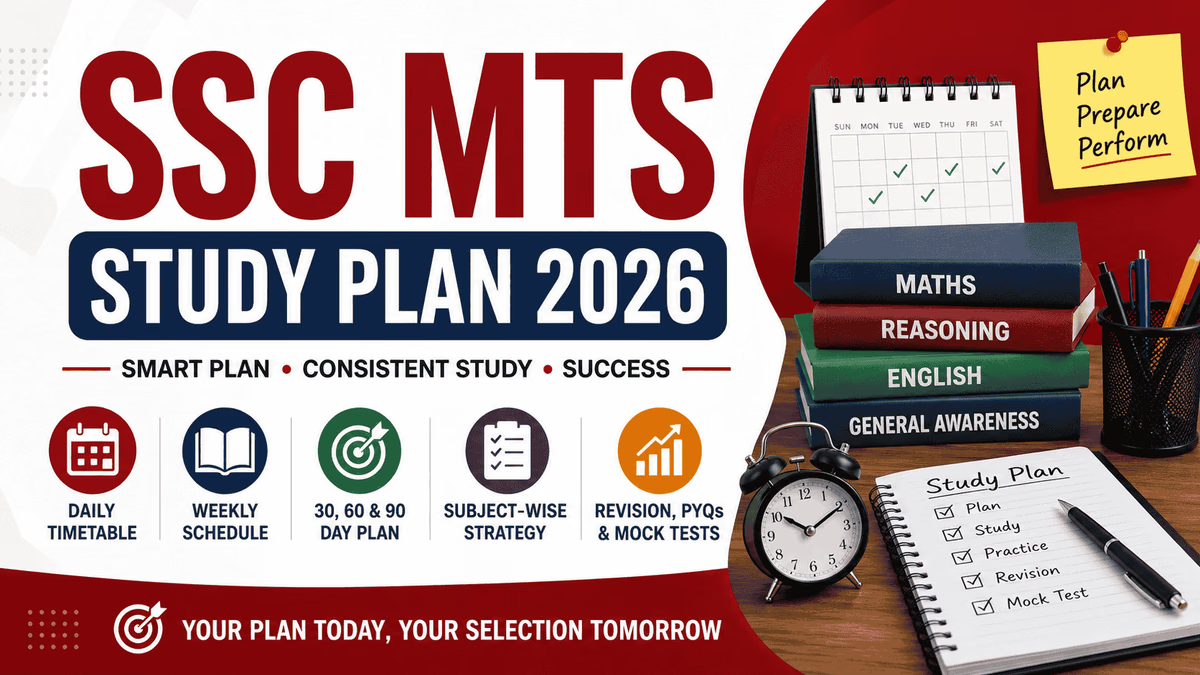
SSC MTS Study Plan 2026 is essential for candidates who want to prepare for the Multi-Tasking (Non-Technical) Staff examination in an organised and consistent way. A proper study plan helps aspirants divide their time between Mathematics, Reasoning, General Awareness and English while also making enough time for previous year questions, mock tests and revision.
Many candidates start SSC MTS preparation with enthusiasm but struggle to maintain a routine. They may spend several days studying only one subject, watch too many lectures, postpone revision, or start mock tests without completing the basic concepts. A well-planned timetable avoids these problems and creates a balanced preparation cycle.
According to the SSC's official 2026–27 examination calendar, the Multi-Tasking (Non-Technical) Staff & Havaldar (CBIC & CBN) Examination, 2026 is listed for the September–November 2026 examination window, with the calendar showing June 2026 as the tentative advertisement month. The SSC website should be checked regularly because the calendar itself is tentative and recruitment details are governed by the applicable official notice.
An SSC MTS study plan is a structured schedule that tells you what to study, when to study it, how much practice to do and when to revise. It converts the large syllabus into manageable daily and weekly targets.
A complete study plan should include:
Without these elements, a timetable may look organised but may not actually improve performance.
SSC MTS preparation covers multiple subjects with different study requirements. Mathematics needs concept clarity and calculation practice, Reasoning requires logical and pattern-based practice, English requires regular grammar and vocabulary work, while General Awareness needs repeated revision.
A structured plan helps prevent one subject from being ignored.
| Without a Study Plan | With a Study Plan |
|---|---|
| Random study | Fixed daily targets |
| One subject gets too much time | Balanced subject rotation |
| Revision gets postponed | Revision is built into the routine |
| PYQs are delayed | PYQs are integrated with learning |
| Progress is difficult to measure | Weekly progress can be tracked |
The study plan should be based on the current examination structure instead of old SSC MTS patterns. In the recent official MTS scheme, the Computer Based Examination for MTS is divided into two mandatory sessions.
| Session | Subjects | Time |
|---|---|---|
| Session-I | Numerical and Mathematical Ability + Reasoning Ability and Problem Solving | 45 minutes |
| Session-II | General Awareness + English Language and Comprehension | 45 minutes |
The recent official MTS examination notice specifies no negative marking in Session-I and one-mark negative marking for each wrong answer in Session-II.
A strong timetable can be built around four simple pillars.
| Pillar | Purpose |
|---|---|
| Study | Learn concepts and understand topics. |
| Practice | Convert knowledge into solving ability. |
| Revision | Retain formulas, rules and facts. |
| Testing | Measure accuracy, speed and preparation level. |
There is no official rule that requires every candidate to study a particular number of hours daily. The right duration depends on your current level, daily responsibilities and time available until the examination.
A better approach is to identify your productive study hours.
| Candidate | Practical Study Target | Main Approach |
|---|---|---|
| Full-Time Aspirant | 6–8 productive hours | Full syllabus + practice + tests |
| College Student | 3–5 productive hours | Daily focused blocks |
| Working Candidate | 2–4 productive hours | High-priority topics + PYQs + revision |
| Beginner | 3–5 hours initially | Build basics first |
These are practical study examples, not official requirements. A shorter timetable that you can follow consistently is more useful than a very long timetable that you abandon after a few days.
Full-time candidates can divide the day into multiple focused blocks and ensure that every subject receives regular attention.
| Time | Subject / Activity | Focus |
|---|---|---|
| 6:30 AM – 8:30 AM | Mathematics | Concepts + practice questions |
| 9:30 AM – 11:00 AM | Reasoning | Topic practice + timed questions |
| 12:00 PM – 1:30 PM | English | Grammar + vocabulary + questions |
| 3:00 PM – 4:30 PM | General Awareness | Static topics + revision |
| 5:30 PM – 6:30 PM | PYQs | Previous year question practice |
| 8:00 PM – 8:45 PM | Revision | Formulas + notes + errors |
The clock timings can be changed. The structure is more important than the exact time.
Working candidates often believe that they need six to eight hours every day to compete effectively. That is not necessarily true. The key is to use shorter sessions efficiently.
A three-hour weekday plan can be structured like this:
| Study Time | Task |
|---|---|
| 45 minutes | Maths or Reasoning |
| 45 minutes | English or General Awareness |
| 45 minutes | PYQs / practice set |
| 45 minutes | Revision / error analysis |
On weekends, additional time can be used for full-length mock tests and detailed revision.
Students can use small study blocks around college hours. The biggest advantage is consistency, not the total number of resources.
A practical routine can be:
During weekends, students can allocate a longer session for mock tests and weekly syllabus revision.
There is no universal percentage that must be followed by every candidate. Your time allocation should depend on your strengths and weaknesses.
For a balanced starting point, you can divide your subject-study time broadly like this:
| Subject | Suggested Priority | What to Include |
|---|---|---|
| Mathematics | High | Concepts + calculations + PYQs |
| Reasoning | High | Patterns + practice + speed |
| English | Regular | Grammar + vocabulary + comprehension |
| General Awareness | Regular | Static topics + current awareness + revision |
If one subject is significantly weaker, temporarily increase its study time until your performance becomes more balanced.
Do not write “study Maths” as your daily target. It is too vague. A better target specifies the exact topic and task.
For example:
Wrong Target: Study Maths for 2 hours.
Better Target: Complete Percentage concepts + solve 30 questions + analyse wrong answers.
Specific targets make it easier to measure whether the day's work was actually completed.
| Day | Mathematics | Reasoning | English | GA |
|---|---|---|---|---|
| Monday | Percentage | Analogy | Articles | History |
| Tuesday | Ratio | Series | Pronouns | Geography |
| Wednesday | Average | Coding-Decoding | Tenses | Science |
| Thursday | Profit & Loss | Directions | Prepositions | Civics |
| Friday | Simple Interest | Problem Solving | Vocabulary | Economics |
| Saturday | Mixed Practice | Mixed Practice | PYQs | Revision |
| Sunday | Mock Test + Detailed Analysis + Weekly Revision | |||
Every week should have three types of targets:
1. Completion Target: Which chapters or topics should be completed?
2. Practice Target: How many quality questions, PYQs or tests should be solved?
3. Revision Target: Which older topics need to be revised?
This three-part method prevents the common problem of completing new chapters while forgetting previously studied material.
A 30-day study plan can be especially useful for candidates who already understand the basics and want an intensive preparation cycle.
Focus on important concepts across all four subjects.
Reduce passive learning and increase question-solving.
Shift towards mock tests and error correction.
Candidates with approximately two months can distribute the preparation more comfortably.
| Period | Focus |
|---|---|
| Days 1–20 | Concept building + topic-wise practice |
| Days 21–40 | PYQs + mixed practice + sectional tests |
| Days 41–50 | Full-length mocks + weak-area correction |
| Days 51–60 | Final revision + targeted practice |
Revision should not be treated as a separate activity that starts only after the syllabus is complete.
Include a short revision block every day. Review:
Short daily revision sessions make weekly and final revision easier.
A revision notebook should contain only information that deserves repeated review.
| Subject | What to Record |
|---|---|
| Maths | Formulas, shortcuts and repeated mistakes |
| Reasoning | Difficult patterns and approaches |
| English | Grammar rules and confusing vocabulary |
| GA | Important facts and difficult-to-remember information |
Whenever you make an important mistake in practice or a test, record it briefly.
Subject: Mathematics
Topic: Percentage
Mistake: Calculation error
Correct Method: Review percentage conversion
Revision: Re-solve after 3–7 days
Do not fill the notebook with complete solutions. Keep it compact enough to revise quickly.
At the end of each day, spend two minutes checking whether your planned tasks were actually completed.
| Daily Task | Status |
|---|---|
| Maths topic completed | ☐ |
| Reasoning practice completed | ☐ |
| English practice completed | ☐ |
| GA studied / revised | ☐ |
| PYQs solved | ☐ |
| Errors reviewed | ☐ |
| Daily revision completed | ☐ |
A common problem among competitive-exam aspirants is creating a timetable with too many tasks.
For example, a timetable that includes multiple books, several YouTube classes, current affairs PDFs, daily quizzes, numerous mock tests and multiple revision targets may look impressive but may be difficult to maintain.
A practical study plan should have:
A good daily routine should contain both new learning and revision.
For example:
40%: New concepts
30%: Question practice
20%: Revision
10%: Error analysis / planning
These percentages are only a sample framework. As your syllabus approaches completion, shift more time from new learning toward practice and revision.
Mock tests should be introduced gradually.
| Preparation Stage | Test Type |
|---|---|
| Early | Topic-wise quizzes |
| Middle | Sectional tests |
| Advanced | Full-length mocks |
| Final Phase | Regular mocks + analysis |
The important thing is not how many tests you take, but whether your analysis is improving your next performance.
Once every week, stop following the routine for a short period and review your progress.
Ask yourself:
Based on the answers, adjust the following week's timetable.
Missing one study day does not mean that the entire plan has failed. Avoid trying to complete all missed work in one extremely long session.
Instead:
A study plan should support consistency, not create unnecessary pressure.
Learn
↓
Practise
↓
Solve PYQs
↓
Revise
↓
Test
↓
Analyse
↓
Improve
A practical SSC MTS Study Plan 2026 should divide preparation into manageable daily and weekly targets while keeping all four subjects active. The plan should include concepts, regular practice, PYQs, revision and tests rather than focusing only on syllabus completion.
Full-time aspirants can use longer study blocks, while working candidates and students can build shorter but consistent sessions. Regardless of your available hours, the most important factor is that the timetable should be realistic enough to follow for a long period.
Use specific daily targets, maintain a revision notebook, record important mistakes and review your weekly progress. As the examination approaches, gradually shift your focus from learning new material to PYQs, mock tests, revision, accuracy and time management.
Note: The SSC examination calendar is tentative and dates or other examination details may change. Candidates should regularly check the official Staff Selection Commission website and the latest applicable notification for their examination cycle.
After creating a basic daily routine, the next step is to make the SSC MTS Study Plan 2026 more specific. A timetable becomes much more effective when each study session has a clear subject, topic and practice target.
SSC MTS preparation should not be based only on the number of hours studied. Candidates should also monitor what they studied, how many questions they solved, how accurately they answered them and what needs revision.
The Staff Selection Commission's 2026–27 tentative calendar lists the Multi-Tasking (Non-Technical) Staff & Havaldar Examination, 2026 with the Computer Based Examination tentatively scheduled for September to November 2026. The calendar is tentative, so candidates should follow the latest official SSC notice for final dates and instructions. :contentReference[oaicite:0]{index=0}
The four major areas require different preparation methods. A balanced study plan should therefore allocate dedicated time to each subject.
| Subject | Main Focus | Daily Activity |
|---|---|---|
| Mathematics | Concepts, calculations and practice | Concept + questions + PYQs |
| Reasoning | Logic and question patterns | Topic practice + timed sets |
| English | Grammar, vocabulary and comprehension | Grammar + vocabulary + questions |
| General Awareness | Static knowledge and current awareness | Study + short notes + revision |
Mathematics requires consistent practice. Reading formulas without solving questions is not enough. Your timetable should therefore combine concept learning with question practice.
Beginners can use a gradual sequence that starts with basic arithmetic and then moves to application-based topics.
| Stage | Topics |
|---|---|
| Basic Arithmetic | Integers, whole numbers, decimals, fractions, LCM and HCF |
| Percentage-Based | Percentage, ratio and proportion, average |
| Commercial Arithmetic | Profit and loss, discount, simple interest |
| Application Topics | Time and work, distance and time |
| Other Areas | Geometry, data interpretation, square and square roots |
These areas are drawn from the recent official SSC MTS syllabus. Candidates should match their final checklist with the latest notification applicable to their cycle. :contentReference[oaicite:1]{index=1}
A 90-minute Mathematics block can be organised as follows:
20 minutes: Learn or revise the concept
40 minutes: Solve practice questions
20 minutes: Solve selected PYQs
10 minutes: Review mistakes and formulas
This approach ensures that every session produces both learning and measurable practice.
Reasoning can improve considerably through regular practice because many questions are based on recognisable patterns and logical relationships.
These areas reflect the broad categories included in the recent SSC MTS syllabus. :contentReference[oaicite:2]{index=2}
Instead of studying many topics on the same day, choose one or two related areas and practise them properly.
| Study Block | Activity |
|---|---|
| 15 minutes | Learn the pattern |
| 30 minutes | Basic and moderate questions |
| 20 minutes | Previous year questions |
| 15 minutes | Timed mixed set |
| 10 minutes | Mistake review |
English should be included in the timetable every day, even if the daily session is relatively short. Regular exposure is particularly useful for vocabulary and grammar retention.
The recent official syllabus broadly covers vocabulary, grammar, sentence structure, synonyms and antonyms, correct usage and comprehension. :contentReference[oaicite:3]{index=3}
| Duration | Activity |
|---|---|
| 20 minutes | Grammar concept / rule revision |
| 15 minutes | Vocabulary revision |
| 20 minutes | Practice questions |
| 15 minutes | PYQs |
| 10 minutes | Review difficult words and mistakes |
Instead of memorising a large list once, divide vocabulary into smaller groups.
This makes vocabulary preparation more manageable and gives you multiple opportunities to recall the words.
General Awareness needs a different timetable because the information is broad and retention depends heavily on repeated revision.
The recent MTS syllabus includes Social Studies such as History, Geography, Art and Culture, Civics and Economics, along with General Science and Environmental Studies at the prescribed level. :contentReference[oaicite:4]{index=4}
| Day | General Awareness Focus |
|---|---|
| Monday | History |
| Tuesday | Geography |
| Wednesday | General Science |
| Thursday | Civics / Polity |
| Friday | Economics |
| Saturday | Art, Culture & Environment |
| Sunday | Full weekly revision |
Alongside the main topic, keep a small amount of time for current-awareness revision using a reliable, recent source appropriate to the examination period.
A candidate with approximately six productive hours can use a timetable such as the following:
| Study Hours | Activity |
|---|---|
| 90 minutes | Mathematics |
| 75 minutes | Reasoning |
| 60 minutes | English |
| 75 minutes | General Awareness |
| 60 minutes | PYQs / test |
| 30 minutes | Revision and error analysis |
The breaks between study blocks should be adjusted according to your concentration and personal routine.
Candidates who have four productive hours can still create a balanced routine.
| Duration | Task |
|---|---|
| 60 minutes | Maths / Reasoning |
| 60 minutes | English / General Awareness |
| 60 minutes | PYQs / sectional practice |
| 60 minutes | Revision + weak-topic practice |
Alternate subjects throughout the week so that both Maths and Reasoning receive sufficient practice, while English and General Awareness remain active every day.
For candidates with very limited time, the key is prioritisation.
40 minutes: Maths / Reasoning
30 minutes: English / GA
30 minutes: PYQs
20 minutes: Revision
On one day, Maths can receive the longer block and on another day Reasoning can receive it. This allows limited study time to be distributed over the week.
PYQs should be integrated into the timetable rather than treated as a final-stage activity.
| Day | PYQ Activity |
|---|---|
| Monday | Mathematics PYQs |
| Tuesday | Reasoning PYQs |
| Wednesday | English PYQs |
| Thursday | GA PYQs |
| Friday | Mixed PYQs |
| Saturday | Weak-topic PYQs |
| Sunday | PYQ revision + test analysis |
A study plan should not only record what you studied. It should also record what went wrong.
After practice, maintain a simple mistake log.
| Date | Subject | Mistake | Correction |
|---|---|---|---|
| ____ | Maths | Calculation error | Revised method |
| ____ | English | Grammar error | Rule revision |
| ____ | Reasoning | Wrong pattern | Pattern practice |
Review this log at the end of each week. Repeated errors should be given extra preparation time.
Sunday or another weekly review day should be used to measure progress instead of simply repeating the normal timetable.
Review:
Then make small changes to the next week's timetable.
As preparation progresses, mock tests should occupy a larger part of the schedule. However, mock tests should not completely replace learning and revision.
A balanced progression looks like this:
| Stage | Study | Practice | Testing |
|---|---|---|---|
| Beginning | High | High | Low |
| Middle | Moderate | High | Moderate |
| Final Stage | Low | High | High |
Your study plan should include performance tracking. A high number of attempts is not necessarily useful if accuracy is poor.
For practice purposes, calculate:
For example, if you attempt 50 questions and answer 42 correctly:
Accuracy = (42 ÷ 50) × 100 = 84%
Keeping this record over several tests can help you determine whether your preparation is improving.
Not every candidate needs exactly the same timetable. Your weak areas should influence the allocation of study time.
| Situation | Suggested Change |
|---|---|
| Maths is weak | Add a daily practice block and revise fundamentals. |
| Reasoning is slow | Use timed mixed sets. |
| English accuracy is low | Increase grammar and PYQ revision. |
| GA retention is poor | Increase short-note revision frequency. |
Good targets should be specific and measurable.
| Weak Target | Better Target |
|---|---|
| Study Maths | Complete Percentage + solve 30 questions |
| Do Reasoning | Series + 25 questions + 10 timed PYQs |
| Study English | Revise one grammar topic + vocabulary + practice |
| Study GK | Complete one History topic + revise old notes |
Backlog is common during long-term preparation. The solution is not to keep adding more and more study hours.
First divide the backlog into:
Then combine one backlog item with the current day's planned work. Avoid postponing the current schedule for several days just to finish old tasks.
Beginners should not try to follow an advanced aspirant's timetable from the first day.
During the initial weeks, focus on:
Step 1: Understand the syllabus
Step 2: Learn basic concepts
Step 3: Solve easy questions
Step 4: Introduce PYQs
Step 5: Start sectional tests
Step 6: Move towards full-length mocks
Gradually increase the difficulty and time pressure as your accuracy improves.
Repeat candidates should begin by analysing their previous preparation instead of automatically repeating the same timetable.
Ask:
Use the answers to redesign the timetable around actual weaknesses.
| Task | Target | Completed |
|---|---|---|
| Maths Topics | ____ | ☐ |
| Reasoning Topics | ____ | ☐ |
| English Topics | ____ | ☐ |
| GA Topics | ____ | ☐ |
| PYQs | ____ | ☐ |
| Mock Tests | ____ | ☐ |
| Revision Sessions | ____ | ☐ |
A good SSC MTS Study Plan 2026 should be specific enough to tell you what to do each day but flexible enough to adjust when your performance changes.
Use dedicated study blocks for Mathematics, Reasoning, English and General Awareness. Add PYQs to your weekly routine, maintain an error notebook and review your performance regularly. As your preparation progresses, gradually increase timed practice and mock tests.
The most effective timetable is not necessarily the longest one. It is the timetable that you can follow consistently while improving your knowledge, accuracy and speed.
SSC MTS Study Plan Formula
Learn → Practise → Solve PYQs → Revise → Test → Analyse → Improve
Note: SSC's 2026–27 calendar is tentative and lists the MTS & Havaldar Examination, 2026 for September–November 2026. Candidates should check the latest official SSC notification for final dates, scheme and instructions. :contentReference[oaicite:5]{index=5}
A successful SSC MTS Study Plan 2026 should not only tell you what to study today. It should also show how your preparation will progress over several weeks. A long-term plan helps you complete the syllabus, practise questions, revise repeatedly and gradually move towards mock-test based preparation.
Many aspirants make a timetable for one day but do not have a weekly or monthly structure. As a result, some topics remain incomplete while already studied topics are forgotten. A long-term plan solves this problem by dividing preparation into different stages.
A long-term SSC MTS study plan can be divided into three major phases:
| Phase | Main Focus | Goal |
|---|---|---|
| Phase 1 | Concept Building | Understand the syllabus and strengthen basics |
| Phase 2 | Practice + PYQs | Improve solving ability and speed |
| Phase 3 | Tests + Revision | Build exam readiness and consistency |
These phases can be adjusted according to the time you have available and your existing preparation level.
Candidates with around three months can divide the preparation into nine smaller blocks of ten days each or into three monthly phases.
The first month should focus on understanding the syllabus and building the basic concepts.
The objective is not to finish the maximum number of chapters. The objective is to create a strong base for the next stage.
The second month should contain more question-solving than passive learning.
At this stage, begin paying attention to the time taken for each question.
The final month should focus increasingly on testing and correction.
A two-month plan requires more focused preparation. Candidates should avoid spending too much time making notes or watching long lectures when practice is needed.
| Period | Main Goal | Activities |
|---|---|---|
| Days 1–15 | Concepts | Basic topics + chapter practice |
| Days 16–30 | Syllabus Completion | Important topics + PYQs |
| Days 31–45 | Practice | Mixed sets + sectional tests |
| Days 46–55 | Testing | Mock tests + analysis |
| Days 56–60 | Final Revision | Short notes + weak areas + selected PYQs |
A 30-day study plan is more suitable for candidates who already have some familiarity with the syllabus.
Focus on weak concepts and high-priority topics. Avoid spending too much time on areas where your performance is already strong.
Increase PYQ practice and sectional tests. Start mixing questions from multiple topics instead of studying only chapter-wise.
Give priority to mock tests, error analysis, revision notes and repeated weak areas.
During the final 15 days, your preparation should become highly targeted.
| Days | Focus |
|---|---|
| Days 1–5 | Weak topics + important formulas + grammar revision |
| Days 6–10 | PYQs + sectional tests + mock practice |
| Days 11–13 | Short notes + error notebook + revision |
| Days 14–15 | Light revision + exam strategy + confidence |
Mathematics preparation should be distributed rather than concentrated into one or two days.
| Day | Mathematics Activity |
|---|---|
| Monday | New concept + basic questions |
| Tuesday | Practice + previous topic revision |
| Wednesday | New concept + timed questions |
| Thursday | PYQs |
| Friday | Mixed practice |
| Saturday | Weak-topic practice |
| Sunday | Revision + sectional test |
Reasoning should be practised frequently because familiarity with common patterns can improve speed.
Monday: Series
Tuesday: Analogy + Similarities
Wednesday: Coding-Decoding
Thursday: Directions + Problem Solving
Friday: Non-Verbal Reasoning
Saturday: Mixed Reasoning Practice
Sunday: PYQs + Test
Adjust the order according to your weak topics and the topics you have already completed.
English should ideally appear every day in the timetable, even if the study session is short.
| Day | Focus |
|---|---|
| Monday | Grammar + vocabulary |
| Tuesday | Grammar questions + PYQs |
| Wednesday | Vocabulary + sentence usage |
| Thursday | Grammar revision + practice |
| Friday | Comprehension + vocabulary |
| Saturday | Mixed English practice |
| Sunday | Revision + PYQs |
General Awareness should be studied in small portions and revised frequently.
Keep current-awareness preparation separate from static topics and revise information using a reliable source suitable for the examination period.
A balanced daily timetable should have different types of activities instead of studying one subject continuously.
| Block | Activity | Purpose |
|---|---|---|
| Block 1 | Maths | Concepts + calculations |
| Block 2 | Reasoning | Logic + pattern practice |
| Block 3 | English | Grammar + vocabulary |
| Block 4 | GA | Study + revision |
| Block 5 | PYQs | Exam-style practice |
| Block 6 | Revision | Recall + mistake correction |
Long study sessions are not always productive. Divide your study day into manageable blocks and take short breaks between them.
A typical structure could be:
The purpose is to maintain concentration. Candidates who can focus for longer can extend the blocks, while others can use shorter sessions.
Time is often lost not because of difficult subjects but because of poor study habits.
Keep your study environment as distraction-free as possible and decide the day's targets before beginning the first study session.
Not every candidate should follow the same subject distribution.
Suppose one candidate is strong in Reasoning but weak in Mathematics. Another candidate may have strong Mathematics but weak English. Both should have different schedules.
| Preparation Situation | Timetable Adjustment |
|---|---|
| Weak Maths | Add extra Maths practice on multiple days. |
| Weak Reasoning | Increase pattern and timed-set practice. |
| Weak English | Daily grammar and vocabulary sessions. |
| Weak GA | Increase revision frequency and quiz practice. |
| Strong subject | Maintain through PYQs and periodic tests. |
During revision, not every topic deserves exactly the same amount of time.
Focus more heavily on:
Strong topics still need revision, but they may not require the same amount of daily attention.
A good timetable does not separate PYQs completely from learning. After completing a topic, solve related PYQs.
Concept → Practice Questions → PYQs → Analyse Errors → Revise → Repeat
For example, after studying a Mathematics topic, solve relevant SSC MTS PYQs. In English, solve grammar-based PYQs after revising the relevant rule. In Reasoning, use PYQs to understand the patterns actually used in the examination.
As more of the syllabus becomes familiar, gradually increase the number of timed tests.
| Preparation Stage | Testing Focus |
|---|---|
| Early Stage | Topic-wise quizzes |
| Middle Stage | Sectional tests |
| Advanced Stage | Full-length mocks |
| Final Stage | Regular mocks + detailed analysis |
Do not increase testing simply to produce a large number of scores. Increase it because you are ready to use the results for improvement.
After each mock, divide the questions into categories.
| Category | Meaning | Next Action |
|---|---|---|
| Correct + Fast | Strong area | Maintain |
| Correct + Slow | Speed issue | Timed practice |
| Wrong | Knowledge or accuracy problem | Review and practise |
| Unattempted | Time or difficulty issue | Review question selection |
Both daily and weekly revision are necessary.
Daily Revision: Review what you studied recently, especially formulas, vocabulary, facts and mistakes.
Weekly Revision: Review all important material covered during the week and take a test to check retention.
Your preparation may not always go according to schedule. Some topics may take longer than expected, and some days may be less productive.
When that happens, avoid completely abandoning the timetable.
Instead:
A flexible timetable is more sustainable than a rigid timetable that collapses after one missed target.
| Candidate Level | Main Focus | Priority |
|---|---|---|
| Beginner | Basics + syllabus understanding | Concepts |
| Intermediate | Practice + PYQs | Accuracy + speed |
| Advanced | Mocks + revision | Performance |
| Repeat Candidate | Weak-area correction | Previous mistakes |
At the end of every week, give yourself a simple preparation review.
| Question | Your Answer |
|---|---|
| Did I complete my planned topics? | Yes / No |
| Did I solve enough practice questions? | Yes / No |
| Did I solve PYQs? | Yes / No |
| Did I revise older topics? | Yes / No |
| Did I analyse my mistakes? | Yes / No |
| Which subject needs more time? | ____________ |
Week 1–4: Build Concepts
↓
Week 5–8: Increase Practice
↓
Week 9–10: PYQs + Sectional Tests
↓
Week 11: Mock Tests + Error Correction
↓
Week 12: Final Revision
The number of weeks can be extended or compressed according to the examination schedule and your preparation level.
☐ Syllabus divided into manageable topics
☐ Daily timetable created
☐ Weekly targets prepared
☐ Mathematics practice scheduled regularly
☐ Reasoning practice scheduled regularly
☐ English included every week
☐ General Awareness revised frequently
☐ PYQs included in the routine
☐ Mock tests gradually introduced
☐ Error notebook maintained
☐ Weekly progress reviewed
☐ Weak subjects receiving extra attention
A strong SSC MTS Study Plan 2026 should evolve with your preparation. In the beginning, spend more time understanding concepts. Once the basics are clear, increase question practice and PYQs. In the final stage, focus heavily on mock tests, error analysis, revision and time management.
A 90-day plan provides enough room for gradual preparation, while a 60-day or 30-day plan requires more prioritisation. Regardless of the available time, the basic cycle remains the same: learn, practise, revise, test and improve.
Do not judge your progress only by the number of hours studied. Measure completed topics, questions solved, accuracy, mock performance and repeated mistakes. These indicators give a much clearer picture of your actual preparation.
SSC MTS Study Plan Success Formula
Daily Discipline + Topic-Wise Targets + PYQs + Revision + Mock Tests + Error Analysis
A well-designed SSC MTS Study Plan 2026 should not remain limited to syllabus completion. Once the major topics have been covered, candidates need to focus on revision, previous year questions, mock tests, time management, accuracy and correction of weak areas.
This stage is where preparation starts becoming examination-oriented. Candidates who have studied the syllabus but do not revise properly may struggle to recall formulas, rules and factual information. Similarly, candidates who take mock tests without analysing their performance may continue repeating the same mistakes.
Revision is one of the most important parts of competitive-exam preparation. Candidates often spend most of their available time learning new topics and postpone revision until the end.
This creates a common problem: the candidate remembers recently studied topics but forgets concepts completed several weeks earlier.
A better study plan includes revision from the first week itself.
| Revision Type | What to Review |
|---|---|
| Daily Revision | Recently studied concepts, formulas, vocabulary and facts |
| Weekly Revision | All major topics covered during the week |
| Monthly Revision | Previously completed syllabus + weak areas |
| Final Revision | Short notes, PYQs, formulas, errors and important facts |
You can organise revision using a simple repeated cycle. After learning a topic, revisit it several times rather than studying it only once.
Day 1: Learn the topic
Day 2: Quick revision
Day 4: Solve practice questions
Day 7: Revise + test yourself
Day 14: Review important points again
The exact intervals can be adjusted according to your memory and preparation level. The main objective is to revisit important information multiple times.
A good SSC MTS study plan can become much easier to manage when your notes are divided according to purpose.
| Notebook | Purpose | Content |
|---|---|---|
| Formula / Rule Notebook | Quick revision | Maths formulas, grammar rules, Reasoning methods |
| General Awareness Notes | Fact revision | Important facts, concepts and difficult information |
| Error Notebook | Mistake correction | Wrong answers, repeated errors and corrections |
Keep these notebooks short and practical. The purpose is to make revision faster, not to create another full textbook.
Previous Year Questions (PYQs) should be included from the middle stage of preparation itself.
Use them in three ways:
PYQs are useful because they help candidates become familiar with the style and application of SSC questions. They also help identify areas that require additional practice.
Whenever a PYQ creates difficulty, make a small entry in your error log.
| Field | Example |
|---|---|
| Subject | Maths |
| Topic | Profit and Loss |
| Type of Mistake | Formula confusion |
| Correct Approach | Review CP, SP and percentage relationship |
| Revised On | ________ |
Mock tests help candidates understand how well their preparation works under time pressure. But mock tests are valuable only when they are properly analysed.
Use the following progression:
| Preparation Stage | Recommended Testing |
|---|---|
| Beginning | Topic quizzes |
| Middle | Sectional tests |
| Advanced | Full-length mocks |
| Final Phase | Regular mocks + detailed analysis |
Do not take multiple tests in one day merely to increase the count. In many cases, one well-analysed test is more useful than several tests taken casually.
After completing a mock test, divide your questions into four categories.
| Question Type | What It Indicates | Action |
|---|---|---|
| Correct + Fast | Strong area | Maintain through revision |
| Correct + Slow | Speed issue | Practise timed sets |
| Wrong | Knowledge or accuracy problem | Identify exact cause |
| Unattempted | Time, difficulty or selection problem | Review question strategy |
This analysis tells you exactly what should change in the next study cycle.
Your mock score is useful, but it should not be the only thing recorded.
Track:
This gives you a more detailed understanding of your performance.
Time management should be practised before the actual examination. Candidates who solve every question without a time limit may find it difficult to adjust when working under exam pressure.
Introduce timing gradually:
Stage 1: Solve questions without a timer.
Stage 2: Set a relaxed time limit.
Stage 3: Practise mixed questions under stricter timing.
Stage 4: Attempt sectional tests.
Stage 5: Attempt full-length tests under examination conditions.
This helps speed develop gradually without sacrificing accuracy.
During practice, mark questions that take unusually long to solve.
Then ask why:
The answer determines the correct improvement method.
The recent official SSC MTS examination scheme includes one-mark negative marking for each wrong answer in Session-II. Session-II covers General Awareness and English Language and Comprehension. Therefore, accuracy and sensible question selection are particularly important in this session. ([ssc.gov.in](https://ssc.gov.in/api/attachment/uploads/masterData/NoticeBoards/NoticeOfMTSNT_20240627.pdf?utm_source=chatgpt.com))
During practice, candidates should avoid developing the habit of making random guesses simply to increase attempts.
Instead, practise identifying:
If Mathematics is a weak area, increase the frequency of practice rather than simply increasing the number of books.
A weekly improvement cycle can be:
| Day | Activity |
|---|---|
| Day 1 | Learn weak concept |
| Day 2 | Basic questions |
| Day 3 | Mixed questions |
| Day 4 | PYQs |
| Day 5 | Timed practice |
| Day 6 | Error revision |
| Day 7 | Topic test |
Reasoning performance can improve through regular exposure to common question patterns.
Use a cycle of:
Concept → Examples → Practice → PYQs → Timed Set → Error Review
Do not move too quickly from one topic to another. Make sure you understand the reasoning behind a pattern before increasing speed.
English can be improved by making short daily sessions part of your study plan.
A typical session can contain:
Maintain a list of grammar rules and words that you repeatedly get wrong. Revision of your personal mistakes is often more useful than repeatedly revising topics you already know well.
General Awareness requires a strong revision cycle because factual information can be forgotten quickly when there is a long gap between study and revision.
Use three layers:
Layer 1: Learn the topic.
Layer 2: Create short notes.
Layer 3: Revise through quizzes and PYQs.
Keep static General Awareness and current-awareness preparation organised separately so that revision remains manageable.
Long study hours are not automatically productive. Study efficiency can improve when every session has one clear purpose.
Before starting a session, define:
For example:
This is more measurable than simply writing “Mathematics” in the timetable.
Candidates who struggle with concentration can divide longer sessions into focused periods.
A simple structure is:
The timing can be adjusted according to individual concentration levels. The important point is to keep breaks intentional instead of allowing them to become long periods of distraction.
Mobile phones can significantly reduce study efficiency when notifications interrupt study blocks.
During focused study sessions:
This allows your study blocks to remain genuinely productive.
Many aspirants repeatedly change books, teachers, PDFs or test platforms because they believe another resource may be better.
This often creates duplicate work and reduces revision time.
| Situation | Better Approach |
|---|---|
| Multiple Maths books | Choose one main source + PYQs |
| Multiple English sources | Use one grammar source + practice |
| Too many current-affairs PDFs | Use one reliable source and revise it |
| Many mock platforms | Use a manageable test routine |
A low mock-test score does not automatically mean that your preparation is poor. It is a diagnostic signal.
After a low score, check:
Then make one or two targeted changes to the study plan instead of completely changing your strategy.
A backlog should be controlled before it becomes overwhelming.
Divide pending work into three groups:
Priority 1: Important syllabus topics that must be completed.
Priority 2: Practice and PYQs that support completed topics.
Priority 3: Extra material that can be attempted only if time permits.
Do not stop your current study schedule for several days just to finish every old task.
A weekly revision structure can look like this:
| Day | Revision Focus |
|---|---|
| Monday | Maths formulas + recent chapter |
| Tuesday | Reasoning patterns + PYQs |
| Wednesday | English rules + vocabulary |
| Thursday | General Awareness revision |
| Friday | Mixed weak-topic revision |
| Saturday | PYQs + sectional tests |
| Sunday | Mock test + complete analysis |
In addition to the weekly review, candidates should conduct a broader review at the end of every month.
| Parameter | Review |
|---|---|
| Syllabus Completion | What percentage of planned topics are complete? |
| PYQ Progress | How many relevant PYQs were solved? |
| Mock Performance | Is accuracy and score improving? |
| Weak Topics | Which topics still need attention? |
| Revision | Are old topics being retained? |
Plan
↓
Study
↓
Practise
↓
Solve PYQs
↓
Take a Test
↓
Analyse Errors
↓
Revise Weak Areas
↓
Update the Plan
This cycle allows the timetable to improve along with your performance instead of remaining fixed throughout the preparation period.
☐ Daily timetable prepared
☐ Weekly targets prepared
☐ Topic-wise study targets defined
☐ Mathematics practice scheduled
☐ Reasoning practice scheduled
☐ English practised regularly
☐ General Awareness revised frequently
☐ PYQs included in the routine
☐ Error notebook maintained
☐ Revision notebook maintained
☐ Sectional tests included
☐ Full-length mock tests included at the appropriate stage
☐ Mock-test analysis completed
☐ Weak topics identified
☐ Weekly progress reviewed
The most effective SSC MTS Study Plan 2026 is not simply a timetable showing how many hours you should sit with your books. It is a complete preparation system that combines learning, practice, PYQs, revision, testing and performance analysis.
Use your daily timetable to complete specific topics, your weekly plan to maintain consistency, and your monthly review to identify areas that need improvement. As your preparation progresses, gradually reduce passive learning and increase question practice, PYQs, mock tests and revision.
Remember that every candidate has a different starting level. The ideal study plan is therefore the one that matches your available time and adjusts according to your strengths and weaknesses.
SSC MTS Study Plan Formula
Plan Smart → Study Consistently → Practise Daily → Revise Regularly → Test Yourself → Analyse → Improve
Note: SSC examination schedules, schemes and instructions may be revised through official notifications. Candidates should always follow the latest official SSC notice applicable to their examination cycle. The SSC official website is the appropriate source for final recruitment and examination updates. ([ssc.gov.in](https://ssc.gov.in/?utm_source=chatgpt.com))
The final stage of the SSC MTS Study Plan 2026 is about making your preparation exam-ready. By this stage, candidates should focus less on collecting new material and more on revision, previous year questions, mock tests, accuracy, time management and correction of weak areas.
A study plan becomes truly useful when it helps you identify what needs to be improved before the examination. Completing the syllabus is important, but remembering what you studied and applying it correctly under time pressure is equally important.
Revision should become more important as the examination approaches. At this stage, candidates should avoid repeatedly reading entire books from the beginning. Instead, use short notes, formulas, PYQs and an error notebook.
Your final revision should cover:
The purpose of final revision is quick recall and confidence, not learning everything from zero again.
Candidates with approximately one month remaining can divide their time into four revision stages.
| Period | Main Focus |
|---|---|
| Days 1–7 | Weak topics + concept revision |
| Days 8–15 | PYQs + sectional tests |
| Days 16–23 | Full-length mocks + analysis |
| Days 24–30 | Final revision + targeted practice |
This is a flexible framework. Candidates who have already completed multiple revisions can spend more time on mock tests and weak areas.
| Days | Preparation Focus |
|---|---|
| Days 1–5 | Weak topics, formulas, grammar and important notes |
| Days 6–9 | PYQs and timed sectional practice |
| Days 10–12 | Mock tests + detailed mistake analysis |
| Days 13–14 | Error notebook + short notes + selected PYQs |
| Day 15 | Light revision and exam-readiness preparation |
Mathematics revision should focus on formulas, calculation methods and question patterns that you have already practised.
Prepare a compact revision list for areas such as:
After revising a formula, solve a few questions. This prevents revision from becoming a purely memorisation-based exercise.
Reasoning revision should focus on recognising common patterns quickly.
Revise topics such as:
During final practice, mix different topics together. This helps you practise recognising the correct approach rather than knowing in advance what type of question is coming.
English should be revised through short and repeated study sessions.
| Area | Revision Focus |
|---|---|
| Grammar | Important rules and frequently made errors |
| Vocabulary | Previously learned words and confusing pairs |
| Sentence Usage | Correct usage and practice questions |
| Comprehension | Short passages and question practice |
Do not spend your final days trying to learn a massive number of new vocabulary words. Revise the words you have already studied and practise them through questions.
General Awareness needs repeated revision because factual information can be forgotten when there are long gaps between study sessions.
Use concise notes and revise them repeatedly rather than reading multiple sources.
Your final revision can be divided into:
History: Important events, personalities and major facts
Geography: Important locations, concepts and factual information
Science: Basic concepts and important facts
Civics: Important constitutional and governance concepts
Economics: Basic terms and concepts
Culture & Environment: Important facts and short notes
For current awareness, use a recent and reliable source suitable for your examination period and focus on revision rather than collecting many separate lists.
Mock tests are important because they help candidates practise under time pressure and evaluate their preparation.
However, taking a mock test is only half of the process. Analysis after the test is equally important.
After every test, review:
| Performance | What It Means | Action |
|---|---|---|
| Correct + Fast | Strong area | Maintain through revision |
| Correct + Slow | Speed needs improvement | Timed practice |
| Wrong | Concept or accuracy problem | Review and practise |
| Unattempted | Time / difficulty / selection issue | Improve question selection |
This system transforms mock tests from simple score-generating exercises into tools for improvement.
If your score is not improving, simply taking more tests may not solve the problem.
First identify the reason for the low score.
| Problem | Possible Solution |
|---|---|
| Too many wrong answers | Improve concepts and accuracy |
| Too many questions left | Improve speed and question selection |
| Maths takes too long | Practise calculations and standard methods |
| English accuracy is low | Revise grammar and practise PYQs |
| GA retention is poor | Increase short-note revision frequency |
The recent official SSC MTS examination scheme provides one-mark negative marking for each wrong answer in Session-II. Session-II covers General Awareness and English Language and Comprehension. Therefore, candidates need to practise careful question selection and accuracy. ([ssc.gov.in](https://ssc.gov.in/api/attachment/uploads/masterData/NoticeBoards/NoticeOfMTSNT_20240627.pdf?utm_source=chatgpt.com))
Do not develop a habit of attempting questions randomly just to increase the number of attempts.
Time management should be practised during mock tests and sectional tests before the examination.
A candidate should learn to distinguish between questions that can be solved quickly and questions that require more time.
During practice, identify:
This helps you develop a personal question-selection strategy.
One difficult question should not consume the time required for several manageable questions.
During practice, train yourself to move forward when a question is taking too long. You can return to it later when appropriate.
The week before the examination should be used for consolidation.
| Activity | Final Week Focus |
|---|---|
| Mathematics | Formulas + selected PYQs + weak areas |
| Reasoning | Mixed practice + important patterns |
| English | Grammar + vocabulary + PYQs |
| GA | Short notes + repeated revision |
| Mock Tests | Selected tests + complete analysis |
Avoid making dramatic changes to your preparation during the final week.
The day before the exam should be used for light revision and preparation rather than an exhausting study marathon.
Review:
Also check the latest examination instructions and make sure the documents and other items required by the official instructions are ready.
On the examination day, your goal is to execute the strategy you have practised.
Before starting:
The recent SSC MTS scheme divides the Computer Based Examination into two sessions, each with a 45-minute duration under the standard timing provision. Session-I covers Numerical and Mathematical Ability and Reasoning Ability and Problem Solving, while Session-II covers General Awareness and English Language and Comprehension. ([ssc.gov.in](https://ssc.gov.in/api/attachment/uploads/masterData/NoticeBoards/NoticeOfMTSNT_20240627.pdf?utm_source=chatgpt.com))
An examination may feel difficult because of unfamiliar questions, lengthy calculations or unexpected topic combinations.
If that happens, do not panic immediately.
Focus on:
The difficulty of the paper is experienced by all candidates appearing for that shift, so your objective should be to maximise your own performance rather than predict an expected score during the examination.
Consistency is easier when your daily targets are realistic.
Instead of writing “I will study for 10 hours every day,” define achievable tasks such as:
✓ One Mathematics topic
✓ One Reasoning topic
✓ English grammar + vocabulary
✓ One General Awareness topic
✓ PYQ practice
✓ Daily revision
Complete the most important tasks first. This makes the study plan easier to maintain even on less productive days.
Missing one day should not cause your entire timetable to collapse.
When you miss a day:
A sustainable study plan should have enough flexibility to handle occasional disruptions.
Candidates who start late should focus on priority rather than trying to study everything equally.
| Priority | Focus |
|---|---|
| Priority 1 | Core syllabus concepts |
| Priority 2 | Important PYQs |
| Priority 3 | Weak-topic practice |
| Priority 4 | Mock tests and analysis |
| Priority 5 | Additional low-priority material |
Do not let the size of the syllabus create panic. Divide your remaining days into practical targets.
Repeat candidates should not automatically follow the exact same preparation approach they used previously.
Start by analysing what went wrong earlier.
Your new plan should directly target these weaknesses.
| Mock | Score | Accuracy | Main Problem | Improvement Step |
|---|---|---|---|---|
| Mock 1 | _____ | _____ | _____ | _____ |
| Mock 2 | _____ | _____ | _____ | _____ |
| Mock 3 | _____ | _____ | _____ | _____ |
| Mock 4 | _____ | _____ | _____ | _____ |
There is no fixed number of hours required for every candidate. Choose a realistic schedule according to your available time and focus on productive study, regular practice and revision.
Yes. A candidate with limited time can use focused sessions, prioritise important topics, practise PYQs regularly and use weekends for longer practice and testing.
A 30-day plan can provide a focused revision and practice structure, especially for candidates who already have basic knowledge. Candidates starting from zero may require a longer preparation period.
PYQs are highly useful for understanding SSC-style questions and identifying recurring concepts. They should be included throughout preparation rather than saved only for the final days.
There is no requirement to take a full mock every day. Take tests according to your preparation level and spend sufficient time analysing them.
Identify the reasons behind wrong answers, revise weak concepts, practise similar questions and avoid careless attempts. In Session-II, where the recent official scheme includes negative marking, accuracy is especially important. ([ssc.gov.in](https://ssc.gov.in/api/attachment/uploads/masterData/NoticeBoards/NoticeOfMTSNT_20240627.pdf?utm_source=chatgpt.com))
No. Beginners should spend more time on basic concepts, while experienced candidates can allocate more time to PYQs, mock tests, revision and weak-area improvement.
Use short notes and repeated revision. Combine static General Awareness study with quizzes and PYQs, and use a reliable recent source for current-awareness preparation.
Analyse the test instead of panicking. Identify whether the issue is knowledge, accuracy, speed or question selection and then modify the study plan accordingly.
Candidates should check the official Staff Selection Commission website and the latest notification applicable to their examination cycle. SSC's 2026–27 calendar is tentative, so final dates and applicable instructions should be verified from official SSC updates. ([ssc.gov.in](https://ssc.gov.in/api/attachment/uploads/masterData/ExamCalendar/Tentative_Calendar2026_27_08012026.pdf?utm_source=chatgpt.com))
☐ Official syllabus checked
☐ Current exam structure understood
☐ Daily timetable prepared
☐ Weekly targets prepared
☐ Mathematics concepts completed
☐ Reasoning topics practised
☐ English grammar and vocabulary revised
☐ General Awareness notes prepared
☐ PYQs solved
☐ Sectional tests attempted
☐ Full-length mocks attempted
☐ Mock-test analysis completed
☐ Error notebook maintained
☐ Weak topics revised
☐ Final revision schedule completed
☐ Exam-day strategy practised
Plan
↓
Study the Concepts
↓
Practise Questions
↓
Solve PYQs
↓
Revise
↓
Take Mock Tests
↓
Analyse Mistakes
↓
Improve Weak Areas
↓
Repeat Consistently
The best SSC MTS Study Plan 2026 is one that converts a large syllabus into small, manageable and measurable tasks. Start with a realistic daily timetable, divide your week between all four subjects, integrate PYQs and gradually increase testing.
As the examination gets closer, shift your attention from completing new topics towards revision, mock tests, error analysis, accuracy and time management. Your formula notebook, short notes and error log should become increasingly important during the final phase.
Do not compare your timetable with another candidate's schedule. Your ideal study plan depends on your starting level, available hours, strong subjects and weak areas. The important thing is to follow your plan consistently and adjust it using actual performance data.
With disciplined preparation, regular practice and continuous revision, you can build a much stronger foundation for the SSC MTS examination.
Get structured guidance and exam-focused preparation resources for SSC MTS and other competitive examinations.
Disclaimer: This article is intended for educational and preparation purposes. Examination dates, patterns, rules, eligibility conditions and other recruitment details may be revised by the Staff Selection Commission. Candidates should always verify the latest official notification and instructions on the official SSC website before making examination-related decisions. ([ssc.gov.in](https://ssc.gov.in/?utm_source=chatgpt.com))