


Download the App & Start Learning
- Expert Faculty Guidance
- Updated Study Material
- Mock Tests & Practice Quiz
- Live Doubt Solving Sessions
- Exam-Oriented Preparation
- Motivation & Success Strategy
Katara Academy

9/5/2026
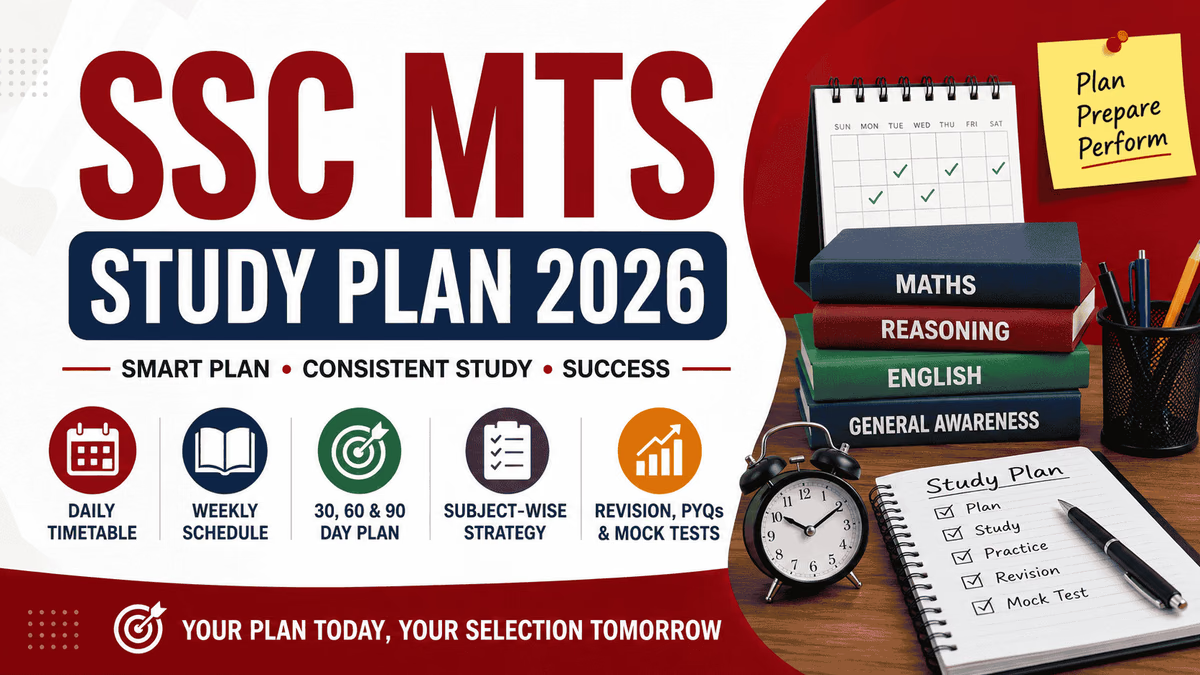
SSC MTS Time Table 2026 is useful for candidates who want to prepare for the Multi-Tasking (Non-Technical) Staff examination with a fixed and manageable daily routine. A proper timetable helps aspirants divide their study time between Mathematics, Reasoning, English and General Awareness while also making room for PYQs, revision and mock tests.
Many candidates start preparation without deciding what they will study each day. They may spend too much time on one subject, postpone revision or leave General Awareness and English for the end. A subject-wise and time-based timetable can make preparation more organised and help maintain consistency.
SSC's official 2026–27 examination calendar lists the Multi-Tasking (Non-Technical) Staff & Havaldar (CBIC & CBN) Examination, 2026 with the Computer Based Examination tentatively scheduled for September to November 2026. The calendar is tentative, so candidates should follow the latest SSC notice for final examination dates and applicable instructions. :contentReference[oaicite:0]{index=0}
An SSC MTS timetable is a structured daily and weekly schedule that divides your available time among different preparation activities. It tells you what to study, when to study it, how much practice to do and when to revise.
A complete timetable should include:
The timetable should also be flexible enough to work for full-time aspirants, college students, working candidates and beginners.
Competitive-exam preparation involves many subjects and resources. Without a fixed routine, candidates may repeatedly study their favourite subject and avoid difficult areas.
| Problem Without a Timetable | Benefit of a Timetable |
|---|---|
| Random study | Fixed daily targets |
| Important topics get postponed | Topics are distributed systematically |
| Revision is forgotten | Revision becomes part of the routine |
| PYQs are delayed | PYQs are integrated into preparation |
| Progress is unclear | Progress can be tracked weekly |
Your timetable should be based on the current examination structure. The recent official SSC MTS scheme divides the Computer Based Examination into two mandatory sessions.
| Session | Subjects | Duration |
|---|---|---|
| Session-I | Numerical and Mathematical Ability + Reasoning Ability and Problem Solving | 45 minutes |
| Session-II | General Awareness + English Language and Comprehension | 45 minutes |
The recent official MTS scheme specifies that Session-I has no negative marking, while Session-II carries one-mark negative marking for each wrong answer. :contentReference[oaicite:1]{index=1}
There is no official rule that every candidate must study a specific number of hours every day. The ideal study time depends on your responsibilities, current level and available preparation period.
A practical reference is:
| Candidate Type | Practical Study Time | Priority |
|---|---|---|
| Full-Time Aspirant | 6–8 productive hours | Full preparation + testing |
| College Student | 3–5 productive hours | Focused daily blocks |
| Working Candidate | 2–4 productive hours | Priority topics + PYQs |
| Beginner | 3–5 productive hours initially | Concept building |
These are suggested frameworks, not mandatory requirements. A consistent four-hour routine is more useful than an unrealistic twelve-hour timetable that cannot be maintained.
Full-time candidates can use multiple focused study blocks throughout the day.
| Time | Activity | Focus |
|---|---|---|
| 6:30 AM – 8:00 AM | Mathematics | Concept + practice |
| 9:00 AM – 10:30 AM | Reasoning | Topic practice + timed questions |
| 11:30 AM – 12:30 PM | English | Grammar + vocabulary |
| 2:30 PM – 4:00 PM | General Awareness | Static topics + revision |
| 5:00 PM – 6:00 PM | PYQs | Mixed previous year questions |
| 8:00 PM – 8:45 PM | Revision | Formulas + notes + mistakes |
Change the clock times according to your routine. The important thing is to preserve the structure and order of activities.
Working candidates need a compact and practical routine. Morning and evening sessions can be combined with short revision sessions during available breaks.
| Study Block | Suggested Activity |
|---|---|
| Morning – 45 minutes | Maths or Reasoning |
| Evening – 45 minutes | English or General Awareness |
| Night – 45 minutes | PYQs / practice set |
| Night – 30 minutes | Revision + mistake review |
Use weekends for longer sessions, full-length tests and detailed analysis.
College students can take advantage of shorter but more frequent study sessions.
Morning: 20–30 minutes of vocabulary or General Awareness revision
After College: 60–90 minutes of Maths or Reasoning
Evening: 45–60 minutes of English + PYQs
Night: 20–30 minutes of revision
Weekend time can be used for sectional tests, mock tests and weekly revision.
Beginners should not immediately copy a high-level candidate's timetable. The initial focus should be on understanding concepts and building a regular habit.
| Daily Block | Beginner Focus |
|---|---|
| Block 1 | Maths basics |
| Block 2 | Reasoning concepts |
| Block 3 | English grammar + vocabulary |
| Block 4 | General Awareness |
| Block 5 | Basic practice + revision |
Once the basics improve, add more PYQs, timed practice and sectional tests.
A balanced timetable should give regular exposure to all four subjects.
| Subject | Main Activity | Frequency |
|---|---|---|
| Mathematics | Concepts + calculation + practice | Daily / near-daily |
| Reasoning | Patterns + mixed practice | Daily / near-daily |
| English | Grammar + vocabulary + comprehension | Daily |
| General Awareness | Static topics + current awareness + revision | Daily / regular revision |
If a subject is significantly weaker, temporarily give it an additional study block instead of following a rigid equal-time formula.
Candidates who can study around six productive hours may use the following structure:
| Duration | Task |
|---|---|
| 90 minutes | Mathematics |
| 75 minutes | Reasoning |
| 60 minutes | English |
| 75 minutes | General Awareness |
| 60 minutes | PYQs / sectional practice |
| 30 minutes | Revision + error analysis |
Four productive hours can also be used effectively when the routine is focused.
60 minutes: Mathematics / Reasoning
60 minutes: English / General Awareness
60 minutes: PYQs / Practice
60 minutes: Revision + Weak Topics
Alternate the first two blocks throughout the week so that Maths and Reasoning both receive sufficient attention.
For candidates with very limited time, prioritisation becomes extremely important.
40 minutes: Maths or Reasoning
30 minutes: English or General Awareness
30 minutes: PYQs
20 minutes: Revision
Use weekends for deeper study and longer tests.
A weekly timetable should rotate subjects so that no section is ignored.
| Day | Main Focus | Additional Task |
|---|---|---|
| Monday | Maths + English | Vocabulary revision |
| Tuesday | Reasoning + GA | PYQs |
| Wednesday | Maths + Reasoning | Timed practice |
| Thursday | English + GA | Revision |
| Friday | Maths + English | Topic test |
| Saturday | Mixed Practice | Weak areas |
| Sunday | Mock Test + Analysis + Weekly Revision | |
Instead of writing only the subject name, assign a specific topic and outcome to every session.
This makes the timetable measurable and helps you know whether the day's work was actually completed.
Your daily timetable should fit inside a broader monthly strategy.
| Month / Stage | Main Focus |
|---|---|
| Stage 1 | Concept building and syllabus coverage |
| Stage 2 | Practice and chapter-wise PYQs |
| Stage 3 | Mixed practice and sectional tests |
| Stage 4 | Full-length mocks and revision |
Previous year questions should not be reserved only for the final weeks. Once a topic is sufficiently understood, solve relevant PYQs.
A useful weekly distribution is:
Revision should not be postponed until the end of the month.
At the end of each day, spend some time revising:
Mock tests should be added gradually according to your preparation level.
| Preparation Stage | Testing Focus |
|---|---|
| Beginner | Topic quizzes |
| Intermediate | Sectional tests |
| Advanced | Full-length mock tests |
| Final Stage | Regular mocks + complete analysis |
Set aside a dedicated weekly session to review mistakes from the previous seven days.
Classify your mistakes into:
| Mistake Type | Action |
|---|---|
| Concept mistake | Revise the concept |
| Calculation mistake | Practise calculations |
| Reading mistake | Slow down and read carefully |
| Speed problem | Timed practice |
| Careless mistake | Improve attention and checking habits |
Use a simple weekly tracker to measure whether your timetable is working.
| Parameter | Target | Actual |
|---|---|---|
| Study Hours | _____ | _____ |
| Topics Completed | _____ | _____ |
| PYQs Solved | _____ | _____ |
| Tests Attempted | _____ | _____ |
| Weak Areas Improved | _____ | _____ |
A study timetable should be flexible enough to handle occasional interruptions.
If you miss a study day:
One missed day is less damaging than completely abandoning the routine because of the missed target.
Study
↓
Practise
↓
Solve PYQs
↓
Revise
↓
Take Tests
↓
Analyse Mistakes
↓
Improve
An effective SSC MTS Time Table 2026 should be realistic, subject-balanced and easy to follow. Your daily routine should include Mathematics, Reasoning, English and General Awareness along with question practice, PYQs and revision.
Full-time aspirants can use longer study blocks, while students and working candidates can use shorter focused sessions. The number of hours may vary, but the basic preparation cycle should remain consistent.
Use a weekly review to check whether your timetable is producing progress. If one subject is weak, give it additional time. As the examination approaches, gradually increase timed practice, PYQs, mock tests and revision.
The objective is not simply to complete a timetable. The objective is to build a routine that steadily improves your knowledge, accuracy, speed, confidence and exam readiness.
Note: The SSC 2026–27 examination calendar is tentative and currently lists the MTS & Havaldar Examination, 2026 for September–November 2026. Examination dates, scheme and other instructions may change through official updates. Candidates should always check the latest SSC notification and official website for final information. :contentReference[oaicite:2]{index=2}
खाली **SSC MTS Time Table 2026 – Part 2** आहे. हा Part 1 चा seamless continuation आहे आणि **next part / teaser / CTA** ठेवलेला नाही.
Creating an SSC MTS Time Table 2026 is not only about deciding how many hours to study. A useful timetable should tell you exactly which subject to study, which topic to cover, how much practice to complete, when to revise and how to evaluate your progress.
Because SSC MTS preparation includes Mathematics, Reasoning, English and General Awareness, candidates need a balanced routine. Giving too much time to one subject while ignoring another can create an uneven preparation level.
The SSC 2026–27 tentative calendar lists the Multi-Tasking (Non-Technical) Staff & Havaldar Examination, 2026 with the Computer Based Examination tentatively scheduled for September to November 2026. Candidates should continue to verify the final examination schedule and applicable instructions through the latest official SSC notification.
Every candidate has a different level of preparation. Therefore, there is no compulsory equal-time formula for every subject.
A good starting framework is to give Mathematics and Reasoning regular practice because both require problem-solving practice, while English and General Awareness should receive consistent revision.
| Subject | Suggested Focus | Main Activity |
|---|---|---|
| Mathematics | High | Concepts + calculations + practice + PYQs |
| Reasoning | High | Patterns + practice + timed sets |
| English | Regular | Grammar + vocabulary + PYQs |
| General Awareness | Regular | Static topics + revision + current awareness |
If one subject is considerably weaker, increase its study time temporarily and reduce time from stronger areas only enough to maintain them.
Mathematics should appear frequently in the timetable because improvement depends on both conceptual understanding and repeated question practice.
The recent SSC MTS syllabus covers fundamental arithmetic and mathematical concepts such as integers and whole numbers, LCM and HCF, decimals and fractions, percentage, ratio and proportion, averages, work and time, simple interest, profit and loss, discount, distance and time, geometry-related topics, data interpretation and square and square roots.
| Time | Task |
|---|---|
| 20 minutes | Concept / formula revision |
| 35 minutes | Practice questions |
| 20 minutes | Previous year questions |
| 15 minutes | Mistake review and formula notes |
Monday: Percentage / Ratio
Tuesday: Average / Fractions / Decimals
Wednesday: Profit, Loss / Discount
Thursday: Simple Interest / Time and Work
Friday: Distance and Time / related arithmetic practice
Saturday: Geometry / Data Interpretation / other pending topics
Sunday: Mixed Maths questions + sectional test
The exact order can be changed according to your preparation level.
Reasoning is best prepared through regular problem-solving. The syllabus includes areas such as alpha-numeric series, coding-decoding, analogy, directions, similarities and differences, jumbling, problem solving, non-verbal reasoning, age calculations, calendar and clock.
| Duration | Activity |
|---|---|
| 15 minutes | Learn the question pattern |
| 30 minutes | Topic-wise questions |
| 20 minutes | PYQ practice |
| 15 minutes | Timed mixed set |
| 10 minutes | Error review |
Once your accuracy becomes stable, gradually introduce stricter time limits.
English should be part of the timetable almost every day because vocabulary and grammar improve through regular revision.
The SSC MTS syllabus includes vocabulary, grammar, sentence structure, synonyms and antonyms, correct usage and comprehension.
| Duration | Activity |
|---|---|
| 20 minutes | Grammar rule / concept |
| 15 minutes | Vocabulary revision |
| 20 minutes | Practice questions |
| 15 minutes | PYQs |
| 10 minutes | Revision of mistakes |
Monday: Articles + vocabulary
Tuesday: Pronouns + practice
Wednesday: Tenses + PYQs
Thursday: Prepositions + vocabulary
Friday: Subject-Verb Agreement + practice
Saturday: Mixed grammar + comprehension
Sunday: English PYQ revision + test
General Awareness should not be studied only before the examination. It needs repeated exposure and revision.
The recent SSC MTS syllabus broadly covers Social Studies including History, Geography, Art and Culture, Civics and Economics, along with General Science and Environmental Studies at the prescribed level.
| Day | Focus Area | Additional Task |
|---|---|---|
| Monday | History | Revise old notes |
| Tuesday | Geography | Practice questions |
| Wednesday | Science | Quick quiz |
| Thursday | Civics / Polity | PYQs |
| Friday | Economics | Revision |
| Saturday | Culture & Environment | Short notes |
| Sunday | Weekly Revision | Quiz + PYQs |
For current awareness, use one reliable and recent source suitable for the examination period instead of collecting information from many unrelated sources.
Full-time candidates who can devote around eight productive study hours can use a structure like this:
| Time | Activity |
|---|---|
| 6:30 – 8:00 AM | Mathematics |
| 8:30 – 10:00 AM | Reasoning |
| 11:00 AM – 12:00 PM | English |
| 1:30 – 3:00 PM | General Awareness |
| 4:00 – 5:00 PM | PYQs |
| 6:00 – 7:00 PM | Weak Subject |
| 8:00 – 8:45 PM | Revision + Error Analysis |
Breaks, meals and personal responsibilities should be adjusted according to individual needs.
Candidates with around five productive hours can use a compact routine:
75 minutes: Mathematics
60 minutes: Reasoning
60 minutes: English
60 minutes: General Awareness
45 minutes: PYQs / test
20 minutes: Revision
On days when a mock test is scheduled, replace the PYQ block with the test and use a separate session for analysis.
A three-hour routine can work for students and working candidates who have limited availability.
| Time Allocation | Focus |
|---|---|
| 45 minutes | Maths / Reasoning |
| 45 minutes | English / GA |
| 45 minutes | PYQs / Practice |
| 45 minutes | Revision / Weak Topic |
Rotate the subjects across different days so that the same subject does not always occupy the same block.
Even with only two hours, a candidate can maintain regular preparation by focusing on high-value activities.
40 minutes: Maths / Reasoning
30 minutes: English / General Awareness
30 minutes: PYQs
20 minutes: Revision
Use weekends for longer practice sessions and mock tests.
There is no universal rule stating that all candidates must study in the morning. Choose the time when you can concentrate most effectively.
Morning sessions can be useful for Mathematics or Reasoning if you prefer difficult problem-solving tasks when your mind is fresh.
Evening sessions can be used for English, General Awareness, PYQs or revision if these subjects require less intensive calculation.
However, personal concentration matters more than a fixed “morning versus evening” rule.
Your timetable should gradually shift towards revision as preparation progresses.
| Preparation Stage | New Study | Practice + Revision |
|---|---|---|
| Early Stage | High | Moderate |
| Middle Stage | Moderate | High |
| Final Stage | Low | Very High |
A short PYQ session can be more valuable than adding another long lecture to the schedule.
After studying a topic, solve relevant previous year questions and record mistakes.
This creates a connection between what you learn and how SSC asks questions.
Set aside 10–20 minutes each day to review mistakes.
Classify them as:
Different mistakes require different solutions. A conceptual mistake needs study, while a careless mistake may require a better checking habit.
Sunday or another weekly review day should be used differently from normal study days.
A good weekly review can include:
| Activity | Purpose |
|---|---|
| Mock / Sectional Test | Measure performance |
| Test Analysis | Identify mistakes |
| Weak Topic Review | Correct problem areas |
| Weekly Revision | Retain important concepts |
| Next Week Planning | Set realistic targets |
The best targets are measurable.
| Vague Target | Measurable Target |
|---|---|
| Study Maths | Complete Average + 30 questions |
| Study Reasoning | Series + 25 questions + 10 PYQs |
| Study English | Tenses + 20 grammar questions + vocabulary revision |
| Study GK | One History topic + 15-minute revision |
Breaks should be used intentionally. A short break can help you return to the next study session with better concentration.
A practical structure is:
Avoid allowing short breaks to become long social-media sessions that disrupt the entire timetable.
If Mathematics is your weakest subject, give it additional time without completely ignoring the other sections.
Maths: 90–120 minutes
Reasoning: 60 minutes
English: 45 minutes
GA: 45–60 minutes
Revision / PYQs: 30 minutes
Once Mathematics becomes more comfortable, redistribute some of this extra time to testing and revision.
If English or General Awareness is your weaker area, increase the frequency of short sessions instead of using one extremely long session once a week.
For example:
Frequent revision helps maintain continuity.
As the examination approaches, the structure of the timetable should change.
| Stage | Main Timetable Focus |
|---|---|
| Beginning | Concept learning |
| Middle | Practice + PYQs |
| Advanced | Sectional tests + mixed practice |
| Final Stage | Mocks + revision + error correction |
☐ Mathematics studied regularly
☐ Reasoning practised regularly
☐ English revised daily or near-daily
☐ General Awareness revised regularly
☐ PYQs solved
☐ At least one test completed
☐ Test mistakes analysed
☐ Weak topics identified
☐ Formula / revision notes updated
☐ Next week's targets prepared
Concept Learning
↓
Question Practice
↓
PYQs
↓
Revision
↓
Testing
↓
Error Analysis
↓
Improvement
A successful SSC MTS Time Table 2026 should be built around your actual available time and preparation level. There is no benefit in copying another candidate's timetable if you cannot follow it consistently.
Keep Mathematics and Reasoning practice regular, include English frequently, revise General Awareness consistently and integrate PYQs into your normal routine. Use weekly tests and error analysis to identify what needs additional attention.
As preparation progresses, gradually move from concept-heavy study towards practice, PYQs, mock tests and revision. This creates a timetable that evolves with your preparation instead of remaining fixed from the first day until the examination.
SSC MTS Time Table Formula
Fixed Routine + Subject Balance + Daily Practice + PYQs + Revision + Tests = Effective Preparation
An effective SSC MTS Time Table 2026 should gradually change as the examination approaches. In the beginning, candidates need more time for concept learning. After completing the major topics, the timetable should give greater importance to practice, PYQs, revision, mock tests, error analysis and time management.
A common mistake is to continue using the same timetable throughout preparation. A schedule that works during the foundation stage may not be suitable during the final revision stage. Therefore, candidates should regularly review their progress and adjust the timetable according to their preparation level.
Your timetable should change according to your preparation stage.
| Stage | Main Focus | Timetable Priority |
|---|---|---|
| Foundation | Concept building | Study + basic practice |
| Practice | Questions + PYQs | Practice + revision |
| Testing | Sectional + full tests | Testing + analysis |
| Final Revision | Retention + exam readiness | Revision + mocks + weak areas |
During the final preparation stage, every subject should have a clear revision routine. Instead of repeatedly reading entire books, revise from short notes, marked questions, formulas, PYQs and your error notebook.
| Subject | Final Revision Focus |
|---|---|
| Mathematics | Formulas, important methods, PYQs and weak chapters |
| Reasoning | Question patterns, mixed practice and difficult areas |
| English | Grammar rules, vocabulary, PYQs and comprehension |
| General Awareness | Short notes, important facts and repeated revision |
The exact amount of time required for each subject should depend on your performance. Weak subjects deserve more focused revision than already strong areas.
A candidate with approximately 30 days remaining can use a structured four-stage plan.
| Days | Main Focus | Activities |
|---|---|---|
| 1–7 | Weak Topics | Concept revision + targeted practice |
| 8–15 | PYQs | Subject-wise PYQs + sectional tests |
| 16–23 | Mock Tests | Full tests + analysis |
| 24–27 | Revision | Notes + formulas + error notebook |
| 28–30 | Final Preparation | Selected PYQs + light tests + revision |
The final 15 days should focus heavily on recall, accuracy and confidence.
Days 1–5: Weak topics + important formulas + grammar revision
Days 6–9: PYQs + timed sectional practice
Days 10–12: Full-length mocks + analysis
Days 13–14: Error notebook + short notes + selected revision
Day 15: Light revision + exam preparation
Avoid adding large amounts of new study material during this stage unless it addresses an important gap.
Mathematics should be revised through a combination of formulas and practice questions.
Use the first part of the session for formulas and concepts, followed by question practice.
During the final stage, prioritise questions and topics where you repeatedly make mistakes or take too much time.
Reasoning should be practised through mixed sets rather than only reading concepts.
Focus on:
Take timed sets after accuracy becomes stable. The objective is to recognise the required pattern quickly and avoid unnecessary steps.
English can be revised through short daily sessions.
| Activity | Suggested Time |
|---|---|
| Grammar revision | 20–25 minutes |
| Vocabulary revision | 15–20 minutes |
| Practice questions | 20–25 minutes |
| PYQs / comprehension | 15–20 minutes |
Give additional attention to grammar rules and vocabulary that you repeatedly get wrong.
General Awareness should be revised more frequently as the examination approaches.
Use a rotation such as:
For current awareness, use a reliable recent preparation source and focus on revision rather than continuously collecting new information.
Mock tests should become an increasingly important part of your timetable once the basic syllabus is covered.
| Preparation Stage | Testing Method |
|---|---|
| Beginning | Topic quizzes |
| Middle | Sectional tests |
| Advanced | Full-length mocks |
| Final Stage | Regular mocks + detailed analysis |
After a mock test, reserve time for analysis. Do not immediately start another test without reviewing the previous one.
Step 1: Check total score.
Step 2: Check correct and wrong answers.
Step 3: Identify slow questions.
Step 4: Identify repeated mistakes.
Step 5: Revise weak topics.
Step 6: Apply the correction in the next test.
Accuracy should be tracked throughout preparation. A simple calculation is:
For example, if you attempt 50 questions and answer 42 correctly, your accuracy is 84%.
Do not focus only on increasing attempts. First make sure that the number of avoidable mistakes is decreasing.
The recent official SSC MTS scheme applies one-mark negative marking for each wrong answer in Session-II. Session-II covers General Awareness and English Language and Comprehension. Therefore, accuracy and sensible question selection deserve special attention during preparation. ([ssc.gov.in](https://ssc.gov.in/api/attachment/uploads/masterData/NoticeBoards/NoticeOfMTSNT_20240627.pdf?utm_source=chatgpt.com))
During mock tests, practise avoiding guesses when you have insufficient confidence. Use your test analysis to identify whether wrong answers come from poor knowledge, misreading or unnecessary risk-taking.
Time management cannot be developed by simply reading tips. It should be practised repeatedly.
Use this progression:
This gradual approach allows speed to improve without sacrificing accuracy.
Some questions can consume a large amount of time. During practice, mark such questions and identify why they were difficult.
Possible reasons include:
Each reason requires a different solution. Do not simply solve the same question repeatedly without understanding the underlying problem.
| Day | Main Focus |
|---|---|
| Day 1 | Maths formulas + selected PYQs |
| Day 2 | Reasoning patterns + mixed practice |
| Day 3 | English grammar + vocabulary |
| Day 4 | General Awareness short notes + revision |
| Day 5 | Mock test + detailed analysis |
| Day 6 | Weak areas + error notebook |
| Day 7 | Light revision + examination preparation |
The day before the examination should be used for light revision rather than an exhausting study marathon.
Review:
Also check the latest examination instructions and keep the documents and other required items ready according to the official instructions.
The recent SSC MTS scheme divides the Computer Based Examination into two mandatory sessions of 45 minutes each under the standard timing provision. Session-I covers Numerical and Mathematical Ability and Reasoning Ability and Problem Solving, while Session-II covers General Awareness and English Language and Comprehension. ([ssc.gov.in](https://ssc.gov.in/api/attachment/uploads/masterData/NoticeBoards/NoticeOfMTSNT_20240627.pdf?utm_source=chatgpt.com))
This means candidates should become comfortable working under short, focused time blocks during mock-test practice.
During the examination:
An unexpected paper can affect confidence. Instead of panicking, follow the strategy practised during mock tests.
Focus on:
The objective is not to predict the paper's difficulty in advance. The objective is to execute your preparation properly when you see the actual questions.
☐ Maths practice completed
☐ Reasoning practice completed
☐ English revision completed
☐ General Awareness studied/revised
☐ PYQs solved
☐ Mistakes reviewed
☐ Short revision completed
This simple checklist can help you maintain consistency without making the timetable complicated.
| Task | Status |
|---|---|
| Daily timetable created | ☐ |
| Weekly plan created | ☐ |
| Mathematics revision scheduled | ☐ |
| Reasoning practice scheduled | ☐ |
| English revision scheduled | ☐ |
| General Awareness revision scheduled | ☐ |
| PYQs included | ☐ |
| Sectional tests included | ☐ |
| Mock tests included | ☐ |
| Mock-test analysis scheduled | ☐ |
| Error notebook maintained | ☐ |
| Final revision planned | ☐ |
Plan Your Day
↓
Study the Topic
↓
Practise Questions
↓
Solve PYQs
↓
Revise
↓
Take Tests
↓
Analyse Mistakes
↓
Improve the Next Day
A successful SSC MTS Time Table 2026 should evolve throughout your preparation. During the foundation stage, focus on concepts. During the middle stage, increase practice and PYQs. In the advanced stage, introduce more timed tests. During the final stage, prioritise revision, mock analysis, accuracy and exam-day readiness.
The most important part of a timetable is not the number of hours written on paper. It is whether the schedule helps you complete meaningful tasks consistently. Your timetable should help you know what to study, what to practise, what to revise and what to improve.
Use your weekly and monthly performance to make small adjustments. Give additional time to weak subjects, continue maintaining strong areas through practice and avoid unnecessary resource switching.
With a disciplined routine, regular PYQ practice, proper revision and continuous testing, your SSC MTS preparation can become more organised and exam-focused.
SSC MTS Time Table Success Formula
Consistency + Smart Time Distribution + PYQs + Revision + Mock Tests + Error Analysis = Strong Exam Preparation
Note: SSC examination schedules, schemes and instructions may be revised through official notices. Candidates should always check the latest notification applicable to their examination cycle and follow the official Staff Selection Commission website for final information.
A well-planned SSC MTS Time Table 2026 should help you manage your preparation from the first day until the examination. A good timetable is not simply a list of study hours. It should include subject-wise learning, question practice, previous year questions, revision, mock tests, error analysis and time management.
As the examination approaches, the purpose of the timetable changes. During the early stage, more time is required for concepts. During the middle stage, practice and PYQs become more important. In the final stage, revision, mock tests, accuracy and exam readiness should receive greater attention.
Candidates with approximately one month remaining can divide their timetable into four stages.
| Days | Main Focus | Activities |
|---|---|---|
| 1–7 | Weak Topics | Concept revision + targeted practice |
| 8–15 | PYQs | Subject-wise PYQs + sectional tests |
| 16–23 | Mock Tests | Full-length tests + analysis |
| 24–30 | Final Revision | Short notes + formulas + error notebook |
Do not try to cover every possible resource during these 30 days. Use the material you have already studied and concentrate on strengthening it.
The final two weeks should be highly focused and should avoid unnecessary resource switching.
Days 1–3: Mathematics and Reasoning revision + selected PYQs
Days 4–6: English grammar + vocabulary + PYQs
Days 7–9: General Awareness notes + quizzes + revision
Days 10–12: Full-length mocks + detailed analysis
Days 13–14: Error notebook + formulas + weak topics
Day 15: Light revision and exam-readiness preparation
| Day | Main Revision | Additional Work |
|---|---|---|
| Day 1 | Maths formulas | Important PYQs |
| Day 2 | Reasoning patterns | Mixed practice |
| Day 3 | English grammar | Vocabulary revision |
| Day 4 | General Awareness | Short notes + quiz |
| Day 5 | Mock Test | Complete analysis |
| Day 6 | Weak Areas | Error notebook |
| Day 7 | Light revision | Exam preparation |
During the final stage, Mathematics should focus on formulas, common methods and questions that you have already practised.
Review:
After formula revision, solve selected questions to make sure you can apply the formula correctly.
Reasoning revision should focus on recognising question patterns quickly.
Give attention to:
Use mixed practice sets during the final stage so that you have to identify the correct method yourself.
English should be revised in short, repeated sessions.
| Area | Revision Focus |
|---|---|
| Grammar | Frequently forgotten rules |
| Vocabulary | Previously studied words and confusing words |
| Sentence Usage | Practice questions and PYQs |
| Comprehension | Short passages and question practice |
Avoid spending the final few days attempting to memorise a massive new vocabulary list. Revise what you have already studied.
General Awareness should be revised through concise notes and repeated recall.
Divide your notes into:
History: Important events and personalities
Geography: Key locations and concepts
Science: Basic concepts and important facts
Civics: Important constitutional and governance concepts
Economics: Basic terms and concepts
Culture & Environment: Important facts and notes
For current-awareness material, use a recent and reliable source appropriate to the examination period and prioritise revision.
PYQs should remain an important part of the timetable even during the final revision period.
Use them to:
Do not simply memorise PYQ answers. Understand the method or concept behind each question.
Mock tests should be taken under conditions that resemble the actual examination as closely as practical.
After completing a test, analyse:
| Mock | Score | Accuracy | Main Weakness | Improvement |
|---|---|---|---|---|
| Mock 1 | _____ | _____ | _____ | _____ |
| Mock 2 | _____ | _____ | _____ | _____ |
| Mock 3 | _____ | _____ | _____ | _____ |
| Mock 4 | _____ | _____ | _____ | _____ |
Speed should be improved gradually rather than by rushing through every question.
Use this progression:
Step 1: Solve accurately without pressure.
Step 2: Introduce a comfortable time limit.
Step 3: Practise mixed questions under stricter timing.
Step 4: Take sectional tests.
Step 5: Attempt full-length practice tests.
This helps candidates improve speed while reducing careless mistakes.
A good timetable should also include practice for deciding which questions deserve immediate attention.
During practice, classify questions as:
The goal is to prevent one difficult question from consuming time that could be used for several manageable questions.
The recent official SSC MTS scheme provides one-mark negative marking for each wrong answer in Session-II. Session-II covers General Awareness and English Language and Comprehension. This makes careful question selection and accuracy particularly important in that session. ([ssc.gov.in](https://ssc.gov.in/api/attachment/uploads/masterData/NoticeBoards/NoticeOfMTSNT_20240627.pdf?utm_source=chatgpt.com))
During mock tests, practise avoiding unnecessary guesses and identify the types of questions where you tend to make careless errors.
The day before the examination should be focused on light revision and preparation.
Revise:
Avoid starting large new chapters unless absolutely necessary. Keep your preparation calm and organised.
The recent official SSC MTS scheme divides the Computer Based Examination into two mandatory sessions, with each session having 45 minutes under the standard timing provision. Session-I contains Numerical and Mathematical Ability and Reasoning Ability and Problem Solving, while Session-II contains General Awareness and English Language and Comprehension. ([ssc.gov.in](https://ssc.gov.in/api/attachment/uploads/masterData/NoticeBoards/NoticeOfMTSNT_20240627.pdf?utm_source=chatgpt.com))
On examination day:
Sometimes a paper can appear more difficult than expected. The most important thing is not to panic.
Focus on questions that you can solve confidently and avoid wasting excessive time on unfamiliar problems.
Remember that your preparation strategy should help you make rational decisions even when the paper is not exactly what you expected.
Candidates who start their preparation late should use a priority-based timetable.
| Priority | Focus |
|---|---|
| 1 | Core syllabus concepts |
| 2 | Important PYQs |
| 3 | Weak-topic practice |
| 4 | Mock tests and analysis |
| 5 | Additional low-priority resources |
Limited time makes prioritisation more important. Avoid spending most of your time collecting resources.
Repeat candidates should analyse their previous preparation before building the new timetable.
Identify:
Then give these areas additional time in the new timetable.
There is no fixed number of hours required for every candidate. Choose a realistic schedule according to your responsibilities and preparation level. Productive and consistent study is more important than simply increasing the number of hours.
Yes. Candidates with limited time can use focused study sessions, prioritise important topics, practise PYQs and use weekends for longer practice and testing.
Not necessarily. However, all four subjects should receive regular attention throughout the week. English and General Awareness often benefit from frequent shorter sessions, while Mathematics and Reasoning require repeated practice.
Topic quizzes can be started early, followed by sectional tests and then full-length mocks as your preparation becomes stronger.
PYQs are highly useful for understanding SSC-style questions, practising concepts and identifying recurring question patterns. They should form an important part of the preparation schedule.
No. The timetable should evolve. Early preparation should be concept-focused, while later preparation should contain more PYQs, mock tests, revision and error analysis.
Analyse wrong answers, identify repeated mistakes, revise weak topics and practise similar questions. Taking more mocks without analysing them may not lead to consistent improvement.
Resume the timetable as soon as possible. Carry forward only the most important missed task and avoid creating an unrealistic backlog.
Yes. Completing the syllabus and remembering it under examination conditions are different things. Regular revision helps maintain recall of formulas, grammar rules, vocabulary and General Awareness facts.
Use the official Staff Selection Commission website and the latest notification applicable to your examination cycle. SSC's examination calendar is tentative, so final dates and instructions should always be verified through official updates.
☐ Daily timetable prepared
☐ Weekly timetable prepared
☐ Mathematics practice scheduled
☐ Reasoning practice scheduled
☐ English included regularly
☐ General Awareness included regularly
☐ PYQs included in the schedule
☐ Revision included every week
☐ Error notebook maintained
☐ Sectional tests included
☐ Full-length mock tests included
☐ Mock tests analysed
☐ Weak areas identified
☐ Final revision planned
☐ Exam-day strategy practised
Plan
↓
Study
↓
Practise
↓
Solve PYQs
↓
Revise
↓
Take Tests
↓
Analyse
↓
Improve
A successful SSC MTS Time Table 2026 is a structured system that helps you manage your complete preparation. It should contain daily study, subject-wise practice, PYQs, revision, mock tests, error analysis and time-management practice.
There is no single timetable that is perfect for every candidate. A full-time aspirant can follow longer study blocks, while a college student or working candidate can use shorter sessions. What matters is that your routine remains realistic and consistent.
As the examination gets closer, shift your focus from learning large amounts of new material towards revision, PYQs, mock tests, accuracy and exam-day preparation. Use your mock-test performance to decide which areas need additional attention.
Do not compare your timetable with another candidate's schedule. Build a routine around your own available hours, preparation level and weak areas. A simple timetable followed consistently is far more useful than a complicated timetable that is abandoned after a few days.
Get structured guidance and exam-focused preparation resources for SSC MTS and other competitive examinations.
Disclaimer: This article is intended for educational and preparation purposes. SSC may revise examination dates, schemes, instructions or other recruitment-related details. Candidates should always verify the latest official notification and instructions on the Staff Selection Commission website before making examination-related decisions.