



Download the App & Start Learning
- Expert Faculty Guidance
- Updated Study Material
- Mock Tests & Practice Quiz
- Live Doubt Solving Sessions
- Exam-Oriented Preparation
- Motivation & Success Strategy
Katara Academy

8/11/2026
Delhi Police Constable 2026
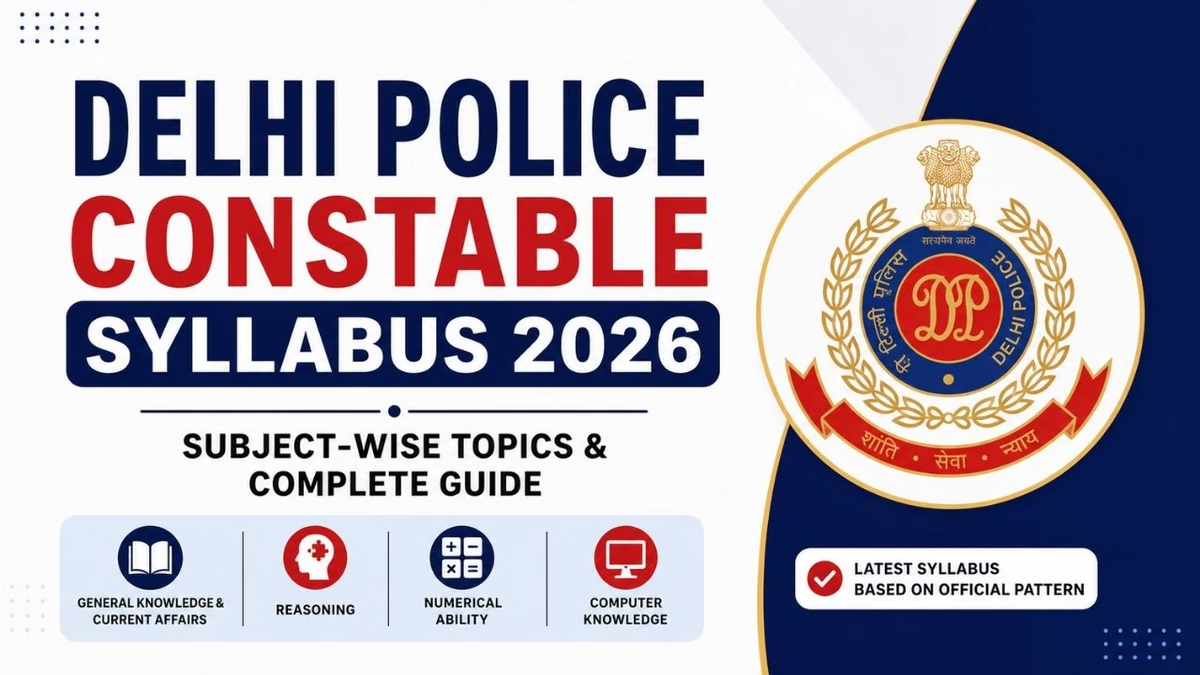
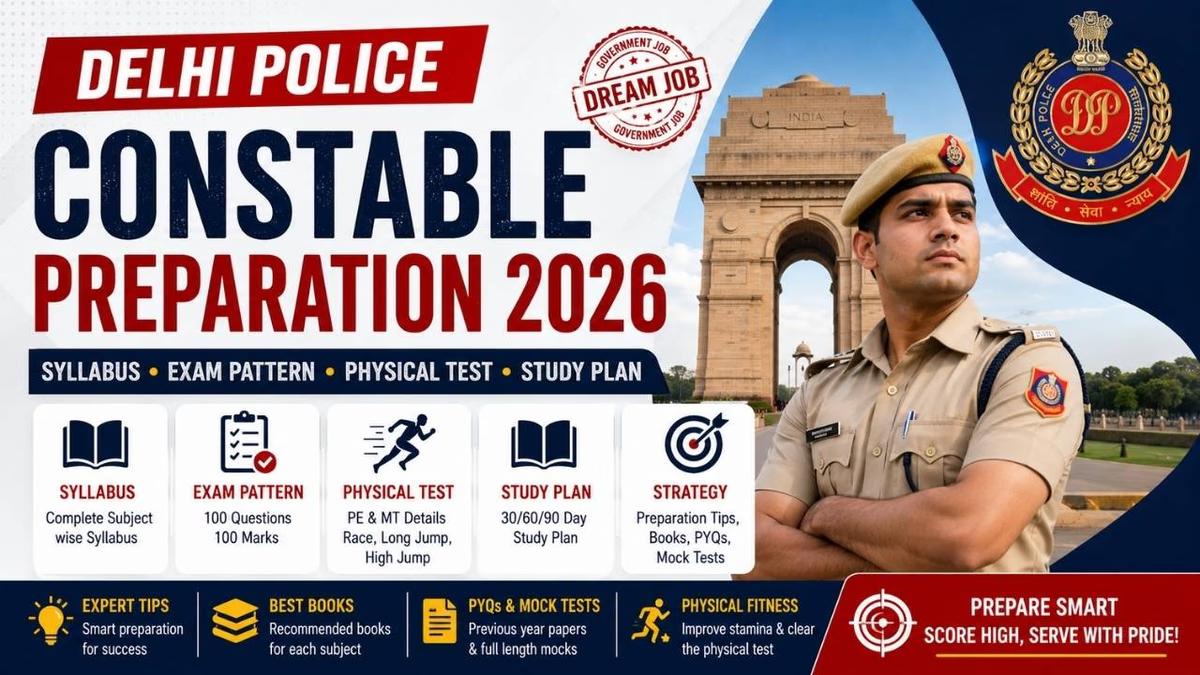
Understanding the syllabus is the first step toward effective Delhi Police Constable Preparation 2026. Candidates need to know exactly which subjects to study, which topics deserve greater attention and how to combine syllabus coverage with previous year questions, mock tests and revision. This complete guide explains the Delhi Police Constable Syllabus 2026 subject-wise and provides a practical approach to covering the examination syllabus systematically.
Important Update:
The syllabus and examination pattern for a new recruitment cycle should always be verified from the latest official SSC notification. The subject-wise details discussed in this guide are based on the latest available Delhi Police Constable (Executive) examination framework and are intended to help candidates begin their preparation in a structured way.
The Delhi Police Constable examination is conducted through a competitive recruitment process in which candidates are assessed through a Computer-Based Examination followed by subsequent qualifying stages as prescribed in the recruitment notice. For written examination preparation, the major areas include General Knowledge and Current Affairs, Reasoning, Numerical Ability, and Computer Fundamentals and related topics.
A good syllabus-based strategy prevents candidates from wasting time on topics that are not relevant to the examination. It also makes revision easier because every subject can be divided into smaller sections. Candidates should first complete the fundamentals, then practise topic-wise questions, solve previous year questions and finally move towards full-length mock tests.
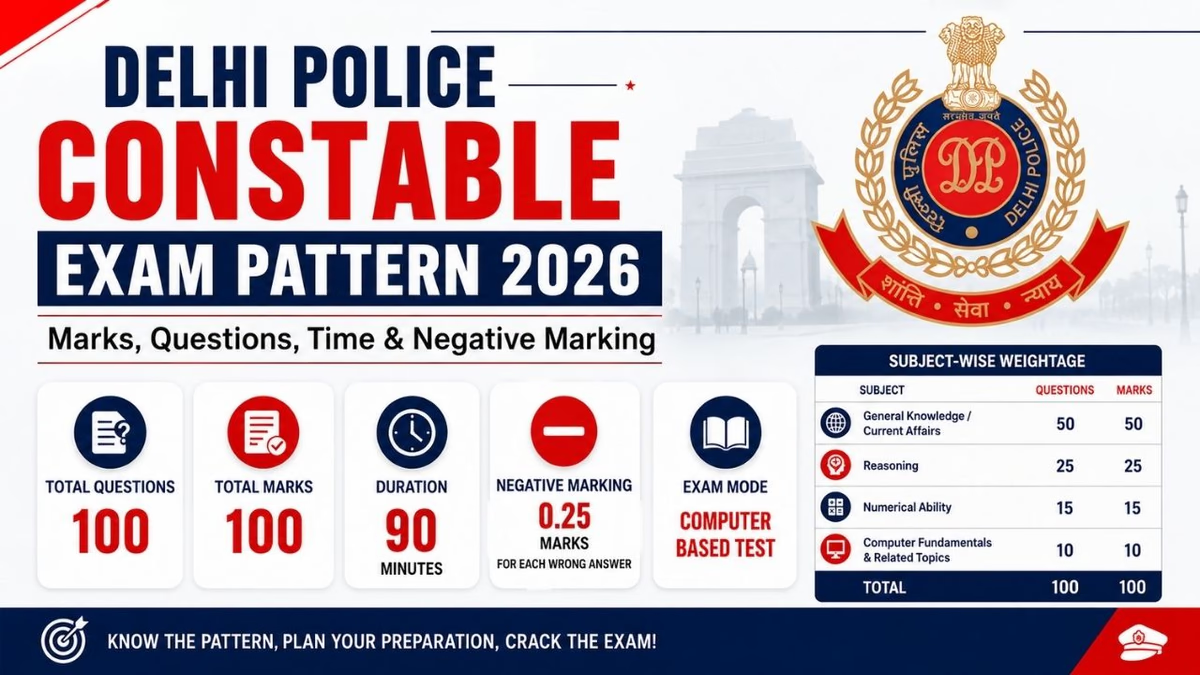
| Subject | Latest Available Weightage | Preparation Focus |
|---|---|---|
| General Knowledge & Current Affairs | 50 Questions | Static GK + Current Affairs + General Awareness |
| Reasoning | 25 Questions | Logical, Verbal & Non-Verbal Reasoning |
| Numerical Ability | 15 Questions | Basic Arithmetic & Calculation Practice |
| Computer Fundamentals | 10 Questions | Computer Basics + MS Office + Internet |
| Total | 100 Questions | Complete Computer-Based Examination |
Note: The weightage above follows the latest available examination framework used as the preparation reference. Candidates should verify the final pattern from the notification applicable to the recruitment year.
The written examination syllabus can be divided into four broad sections. Each section requires a different preparation approach. General Knowledge needs regular revision, Reasoning requires practice, Numerical Ability needs conceptual clarity and calculation speed, while Computer Knowledge can be covered through focused revision of basic concepts.
General Knowledge and Current Affairs is the most important section from the perspective of the latest available examination weightage. Candidates should not treat this subject as a last-minute topic because it covers a wide range of static and dynamic information.
The syllabus includes general awareness, current events, everyday observations and questions related to India and neighbouring countries. Important areas include Sports, History, Culture, Geography, Indian Economy, General Polity, Indian Constitution and Scientific Research.
History preparation should cover the major periods of Indian history and important events, personalities and developments. Candidates should focus on understanding the sequence of events and revising important factual information regularly.
| Area | What to Study |
|---|---|
| Ancient India | Indus Valley Civilization, Vedic Period, major kingdoms, religions and important developments. |
| Medieval India | Major dynasties, administrative systems, cultural developments and important rulers. |
| Modern India | British rule, important movements, freedom struggle, major personalities and independence. |
| Important Events | Important dates, movements, battles, agreements and historical milestones. |
Geography questions can cover both physical and human geography. For Delhi Police Constable preparation, candidates should give special attention to India because questions related to Indian rivers, mountains, climate, soils, agriculture, states, important locations and geographical features are useful for competitive examinations.
Indian Polity is another important area of General Awareness. Candidates should understand the basic structure of the Indian Constitution and the functioning of major constitutional institutions.
Candidates do not need to study Economics at an advanced level for this examination. The focus should be on basic economic concepts, important national economic developments and commonly used terminology.
| Topic | Preparation Focus |
|---|---|
| Basic Economic Terms | GDP, inflation, unemployment, income and related concepts. |
| Banking | Basic banking terminology and financial institutions. |
| Government Schemes | Important government initiatives and their objectives. |
| Budget & Economy | Important economic announcements and current developments. |
General Science questions generally reward candidates who understand basic concepts rather than memorizing highly advanced scientific information. Focus on everyday applications of Physics, Chemistry and Biology along with important scientific developments.
Current Affairs should be studied consistently because information changes regularly. Instead of trying to memorize everything, candidates should focus on important national and international events, government initiatives, awards, sports, appointments, defence developments, science and technology and major reports or events relevant to India.
Delhi Police Constable 2026
Understanding the syllabus is the first step toward effective Delhi Police Constable Preparation 2026. Candidates need to know exactly which subjects to study, which topics deserve greater attention and how to combine syllabus coverage with previous year questions, mock tests and revision. This complete guide explains the Delhi Police Constable Syllabus 2026 subject-wise and provides a practical approach to covering the examination syllabus systematically.
Important Update:
The syllabus and examination pattern for a new recruitment cycle should always be verified from the latest official SSC notification. The subject-wise details discussed in this guide are based on the latest available Delhi Police Constable (Executive) examination framework and are intended to help candidates begin their preparation in a structured way.
The Delhi Police Constable examination is conducted through a competitive recruitment process in which candidates are assessed through a Computer-Based Examination followed by subsequent qualifying stages as prescribed in the recruitment notice. For written examination preparation, the major areas include General Knowledge and Current Affairs, Reasoning, Numerical Ability, and Computer Fundamentals and related topics.
A good syllabus-based strategy prevents candidates from wasting time on topics that are not relevant to the examination. It also makes revision easier because every subject can be divided into smaller sections. Candidates should first complete the fundamentals, then practise topic-wise questions, solve previous year questions and finally move towards full-length mock tests.
| Subject | Latest Available Weightage | Preparation Focus |
|---|---|---|
| General Knowledge & Current Affairs | 50 Questions | Static GK + Current Affairs + General Awareness |
| Reasoning | 25 Questions | Logical, Verbal & Non-Verbal Reasoning |
| Numerical Ability | 15 Questions | Basic Arithmetic & Calculation Practice |
| Computer Fundamentals | 10 Questions | Computer Basics + MS Office + Internet |
| Total | 100 Questions | Complete Computer-Based Examination |
Note: The weightage above follows the latest available examination framework used as the preparation reference. Candidates should verify the final pattern from the notification applicable to the recruitment year.
The written examination syllabus can be divided into four broad sections. Each section requires a different preparation approach. General Knowledge needs regular revision, Reasoning requires practice, Numerical Ability needs conceptual clarity and calculation speed, while Computer Knowledge can be covered through focused revision of basic concepts.
General Knowledge and Current Affairs is the most important section from the perspective of the latest available examination weightage. Candidates should not treat this subject as a last-minute topic because it covers a wide range of static and dynamic information.
The syllabus includes general awareness, current events, everyday observations and questions related to India and neighbouring countries. Important areas include Sports, History, Culture, Geography, Indian Economy, General Polity, Indian Constitution and Scientific Research.
History preparation should cover the major periods of Indian history and important events, personalities and developments. Candidates should focus on understanding the sequence of events and revising important factual information regularly.
| Area | What to Study |
|---|---|
| Ancient India | Indus Valley Civilization, Vedic Period, major kingdoms, religions and important developments. |
| Medieval India | Major dynasties, administrative systems, cultural developments and important rulers. |
| Modern India | British rule, important movements, freedom struggle, major personalities and independence. |
| Important Events | Important dates, movements, battles, agreements and historical milestones. |
Geography questions can cover both physical and human geography. For Delhi Police Constable preparation, candidates should give special attention to India because questions related to Indian rivers, mountains, climate, soils, agriculture, states, important locations and geographical features are useful for competitive examinations.
Indian Polity is another important area of General Awareness. Candidates should understand the basic structure of the Indian Constitution and the functioning of major constitutional institutions.
Candidates do not need to study Economics at an advanced level for this examination. The focus should be on basic economic concepts, important national economic developments and commonly used terminology.
| Topic | Preparation Focus |
|---|---|
| Basic Economic Terms | GDP, inflation, unemployment, income and related concepts. |
| Banking | Basic banking terminology and financial institutions. |
| Government Schemes | Important government initiatives and their objectives. |
| Budget & Economy | Important economic announcements and current developments. |
General Science questions generally reward candidates who understand basic concepts rather than memorizing highly advanced scientific information. Focus on everyday applications of Physics, Chemistry and Biology along with important scientific developments.
Current Affairs should be studied consistently because information changes regularly. Instead of trying to memorize everything, candidates should focus on important national and international events, government initiatives, awards, sports, appointments, defence developments, science and technology and major reports or events relevant to India.
Knowing the syllabus is only the first step. The next challenge is completing every topic efficiently and retaining the information until the examination. A subject-wise strategy helps candidates divide their preparation time properly and identify weak areas before they become a problem in mock tests.
The best approach is to combine concept learning, topic-wise practice, previous year questions, revision and mock tests. Candidates should avoid spending the entire preparation period only reading study material. Every completed topic should be followed by practice questions and periodic revision.
General Knowledge has a broad syllabus, so candidates should divide it into smaller sections. Attempting to memorize thousands of facts without understanding the subject structure can make revision difficult. Instead, prepare static General Knowledge topic by topic and maintain separate notes for Current Affairs.
Current Affairs should be studied as a continuous process. Candidates should focus on important events rather than attempting to remember every piece of daily news. The objective is to identify information that is relevant to competitive examinations.
| Current Affairs Area | What to Focus On |
|---|---|
| National Affairs | Major government decisions, national developments and important events. |
| International Affairs | Major international events, organizations and important developments involving India. |
| Awards | Important national and international awards and recipients. |
| Appointments | Important appointments and changes in major institutions. |
| Sports | Major tournaments, winners, records and important sporting achievements. |
| Science & Technology | Major discoveries, missions, technologies and scientific developments. |
| Defence | Major defence exercises, developments and security-related events. |
Reasoning can become a scoring section when candidates develop familiarity with common patterns. The key is consistent practice. Candidates should not spend excessive time trying to memorize solutions because the same concept can appear in different forms.
Numerical Ability requires both conceptual understanding and calculation speed. Candidates who know the formula but take too much time to solve a question may still struggle in a competitive examination. Therefore, preparation should gradually move from concept learning to timed practice.
| Stage | What to Do |
|---|---|
| Stage 1 | Understand basic formulas and concepts. |
| Stage 2 | Solve basic questions without time pressure. |
| Stage 3 | Practise mixed questions from completed topics. |
| Stage 4 | Solve timed numerical sets. |
| Stage 5 | Analyse errors and revise weak concepts. |
Computer Knowledge has a focused syllabus compared with General Awareness. Candidates should therefore avoid spending excessive time on advanced computer concepts that are outside the prescribed preparation areas. Basic concepts, terminology and common applications should receive priority.
Candidates should avoid setting an unrealistic target of completing the entire syllabus in a few days. A better approach is to divide the syllabus into study blocks and set weekly completion targets. Every week should contain new learning as well as revision of previously completed topics.
| Day / Period | Primary Task | Additional Task |
|---|---|---|
| Monday | New GK Topic | Reasoning Practice |
| Tuesday | Numerical Ability | Current Affairs Revision |
| Wednesday | Reasoning | Computer Practice |
| Thursday | GK / Static GK | Numerical Practice |
| Friday | Numerical Ability | Reasoning Practice |
| Saturday | Mixed Practice | Current Affairs |
| Sunday | Weekly Revision | Sectional / Mock Test |
Candidates with around two months available can divide the preparation into three phases: syllabus completion, intensive practice and revision. This gives more time for concept building than a short-term preparation plan.
| Phase | Days | Main Objective |
|---|---|---|
| Phase 1 | 1–25 | Complete major concepts and syllabus topics. |
| Phase 2 | 26–45 | Topic-wise practice and previous year questions. |
| Phase 3 | 46–60 | Revision, mock tests and weak-area improvement. |
A 90-day preparation period provides enough time to build fundamentals, practise questions and revise the complete syllabus multiple times. Candidates should use the first part of the preparation for learning, the middle period for practice and the final period for testing and revision.
Month 1 → Learn the Syllabus
Month 2 → Practise the Syllabus
Month 3 → Revise + Test the Syllabus
Revision should begin from the first week itself. Waiting until the entire syllabus is completed can result in forgetting topics studied earlier. A simple revision cycle can help candidates retain information more effectively.
A simple tracker can help candidates know which topics are completed, which topics require revision and which areas still need practice. Mark a topic as complete only after studying it and solving a reasonable number of questions.
| Subject | Study | Practice | Revision |
|---|---|---|---|
| General Knowledge | ☐ | ☐ | ☐ |
| Current Affairs | ☐ | ☐ | ☐ |
| Reasoning | ☐ | ☐ | ☐ |
| Numerical Ability | ☐ | ☐ | ☐ |
| Computer Knowledge | ☐ | ☐ | ☐ |
Previous year questions are an important part of syllabus-based preparation. They help candidates understand how individual topics are converted into actual examination questions. Instead of solving PYQs only during the final stage, candidates should start using them after completing the basic concepts of each topic.
Mock tests should be used to measure preparation quality rather than simply to obtain a high score. A candidate may score poorly in an early mock test, but the analysis of that test can reveal exactly which subjects and topics require improvement.
| Preparation Stage | Recommended Test | Main Objective |
|---|---|---|
| Beginning | Topic Tests | Check concept understanding |
| Middle | Sectional Tests | Improve speed and accuracy |
| Final Stage | Full-Length Mock Tests | Build examination strategy |
The latest available examination framework provided a fixed time limit for the Computer-Based Examination. Therefore, syllabus completion alone is not enough. Candidates must also practise solving questions within the available time.
During practice, candidates should gradually reduce the time taken for familiar question types while protecting accuracy. The objective should not be to solve every question as quickly as possible. Instead, candidates should learn to identify easy, moderate and time-consuming questions.
The latest available examination framework included negative marking for incorrect answers. This makes accuracy an important part of preparation. Candidates should therefore avoid developing a habit of randomly selecting options simply to increase the number of attempts.
A daily routine should balance learning, practice and revision. The exact number of study hours can vary according to the candidate's schedule, but every major section should receive regular attention.
| Study Block | Suggested Activity |
|---|---|
| Session 1 | General Knowledge / Static GK |
| Session 2 | Reasoning Practice |
| Session 3 | Numerical Ability |
| Session 4 | Current Affairs + Computer Revision |
| Final Session | Revision + Error Notebook + Practice Questions |
The schedule should be adjusted according to individual availability. Consistency is more important than following an identical timetable every day.
Candidates should remember that recruitment preparation is not limited to the written examination. The selection process includes subsequent stages as prescribed in the official recruitment notice, including physical and medical requirements. Therefore, physical fitness should be developed alongside academic preparation rather than postponed until after the written examination.
Before moving into the final stage of preparation, candidates should review the entire syllabus and identify any remaining gaps. The following checklist can be used to evaluate readiness.
| Area | Completed? |
|---|---|
| General Knowledge syllabus | ☐ |
| Current Affairs revision | ☐ |
| Reasoning syllabus | ☐ |
| Numerical Ability syllabus | ☐ |
| Computer Knowledge syllabus | ☐ |
| Previous Year Questions | ☐ |
| Mock Test Practice | ☐ |
| Weak Topic Revision | ☐ |
| Physical Preparation | ☐ |
Recruitment details such as vacancies, dates, eligibility conditions, examination pattern, syllabus, physical standards and selection stages can change from one recruitment cycle to another. Candidates should always read the latest official SSC notification before submitting an application or making final preparation decisions.
The written examination syllabus covers General Knowledge and Current Affairs, Reasoning, Numerical Ability and Computer Fundamentals and related topics in the latest available examination framework. Candidates should verify the final syllabus from the official notification for the applicable recruitment cycle.
In the latest available examination framework used for preparation reference, General Knowledge and Current Affairs had the highest weightage. Candidates should still prepare all sections because every subject contributes to the overall score.
The difficulty depends on a candidate's academic foundation and preparation level. The syllabus contains familiar areas from General Awareness, Reasoning, basic Mathematics and Computer Knowledge. Consistent practice and revision can make the syllabus more manageable.
Start by reading the official syllabus and dividing it into subject-wise topics. Complete basic concepts first, practise questions after each topic, solve previous year questions and gradually introduce sectional and full-length mock tests.
Current Affairs are an important part of General Awareness. Candidates should study major national and international events, awards, appointments, sports, science and technology, government initiatives and other examination-relevant developments regularly.
Divide the syllabus into weekly targets, prioritise high-weightage areas, avoid unnecessary resources and combine learning with practice. A short daily revision session can also prevent previously completed topics from being forgotten.
Yes. Physical preparation should be started early and continued consistently. Candidates should check the latest official recruitment notice for the exact physical requirements applicable to their recruitment cycle.
The Delhi Police Constable Syllabus 2026 provides a clear roadmap for written examination preparation. Candidates should focus on General Knowledge and Current Affairs, Reasoning, Numerical Ability and Computer Knowledge while also preparing for the physical stages prescribed by the recruitment authority.
The most effective preparation is not based on studying for long hours without direction. Instead, candidates should follow a structured cycle of learn → practise → revise → test → analyse → improve. Complete the syllabus systematically, solve previous year questions, take mock tests and maintain an error notebook throughout preparation.
Finally, recruitment rules can change, so candidates should verify the latest official notification for the applicable recruitment cycle before relying on specific dates, vacancies, eligibility requirements, examination details or physical standards.
A clear syllabus, regular practice and consistent revision can make your preparation more organised and effective. Build your foundation, practise previous year questions, analyse mock tests and stay updated with official recruitment announcements.