




Download the App & Start Learning
- Expert Faculty Guidance
- Updated Study Material
- Mock Tests & Practice Quiz
- Live Doubt Solving Sessions
- Exam-Oriented Preparation
- Motivation & Success Strategy
Katara Academy

8/11/2026
Delhi Police Constable 2026
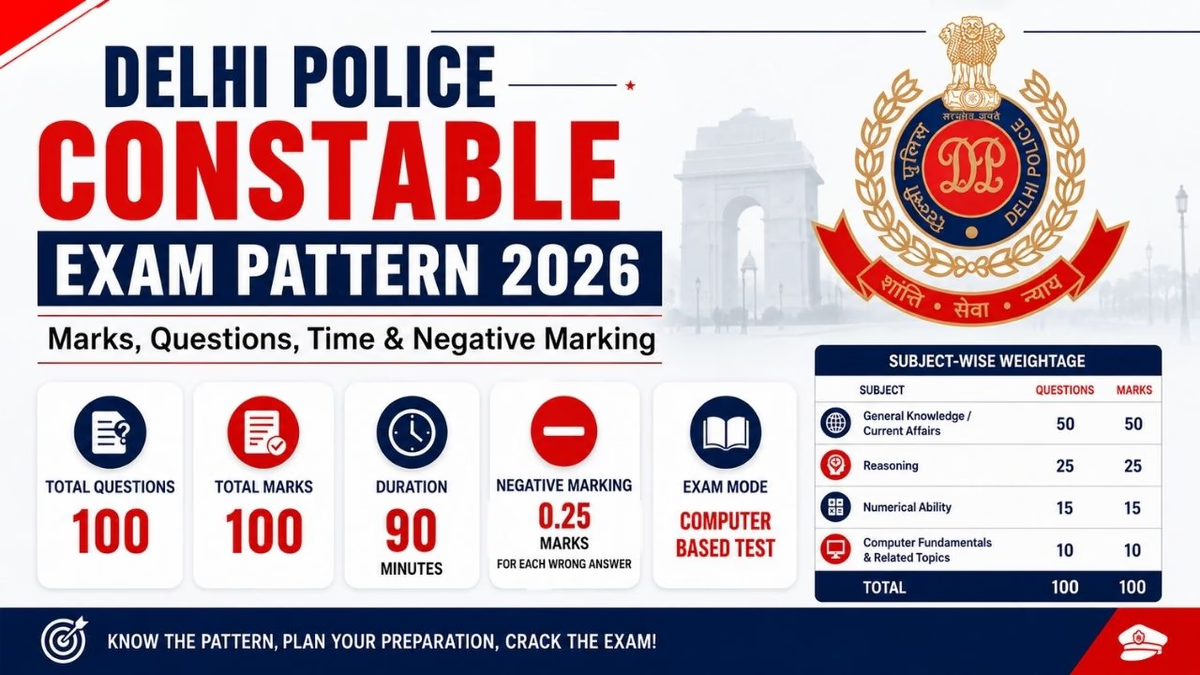
Understanding the Delhi Police Constable Exam Pattern 2026 is essential before starting serious preparation. Knowing the number of questions, marks, examination duration, subject-wise weightage and negative marking helps candidates create a practical strategy instead of preparing without a clear target.
Important Update:
The latest available SSC notice for Constable (Executive) Male and Female in Delhi Police Examination, 2025 provides the current reference framework for the Computer-Based Examination. The CBE consisted of 100 objective-type questions carrying 100 marks, with 90 minutes allowed and 0.25 marks deducted for every wrong answer. Candidates preparing for the 2026 cycle should verify the final official notification when it is released.
The Staff Selection Commission conducts the recruitment examination for Constable (Executive) Male and Female in Delhi Police. In the latest available 2025 notice, the recruitment process consisted of a Computer-Based Examination, followed by the Physical Endurance and Measurement Test and Medical Examination for shortlisted candidates. The CBE marks are important for determining merit, while the PE&MT is qualifying in nature. :contentReference[oaicite:0]{index=0}
For candidates, the most important part of the written examination is understanding how the 100 marks are distributed. The latest available pattern gives the highest weightage to General Knowledge/Current Affairs, followed by Reasoning, Numerical Ability and Computer Fundamentals and related topics. :contentReference[oaicite:1]{index=1}
| Part | Subject | Questions | Marks |
|---|---|---|---|
| Part A | General Knowledge / Current Affairs | 50 | 50 |
| Part B | Reasoning | 25 | 25 |
| Part C | Numerical Ability | 15 | 15 |
| Part D | Computer Fundamentals, MS Excel, MS Word, Communication, Internet, WWW & Web Browsers | 10 | 10 |
| Total | All Sections | 100 | 100 |
Source: Latest available SSC Constable (Executive) Male and Female in Delhi Police Examination notice. The final 2026 pattern should be checked in the official notification for that recruitment cycle. :contentReference[oaicite:2]{index=2}
These details are based on the latest available official SSC notice for the Delhi Police Constable (Executive) examination. The notice states that the question paper is objective-type and multiple-choice, contains 100 questions for 100 marks, is conducted in English and Hindi, and is of Matriculation level. :contentReference[oaicite:3]{index=3}
The latest available examination pattern provides 90 minutes for the Computer-Based Examination. With 100 questions to be attempted within that period, candidates need to develop a balance between speed and accuracy. :contentReference[oaicite:4]{index=4}
The average-time calculation is only a preparation reference. Candidates do not need to spend the same amount of time on every question. A better strategy is to move quickly through questions that are familiar and return to questions that require more thought, subject to the actual test interface and examination instructions.
The latest available SSC notice prescribes 1 mark for each correct question, because the paper contains 100 questions carrying 100 marks. It also specifies a negative marking of 0.25 marks for every wrong answer. :contentReference[oaicite:5]{index=5}
| Response | Marks |
|---|---|
| Correct Answer | +1 mark |
| Wrong Answer | -0.25 mark |
| Maximum Score | 100 marks |
For example, if a candidate answers 70 questions correctly and 10 questions incorrectly, the score before considering any other applicable process would be calculated as:
70 × 1 − 10 × 0.25 = 67.5 marks
This example shows why candidates should not focus only on the number of attempts. Accuracy is equally important. A controlled attempt strategy can be more useful than answering questions randomly.
The latest available SSC notice states that the Computer-Based Examination is conducted in Hindi and English only. Candidates should therefore practise reading questions comfortably in the language they intend to use during the examination. :contentReference[oaicite:6]{index=6}
The latest available SSC notice specifies that the question paper is of Matriculation level. This means candidates should build strong fundamentals instead of assuming that advanced-level concepts are required for the written examination. :contentReference[oaicite:7]{index=7}
However, a basic syllabus does not automatically make the examination easy. Since the recruitment is competitive, candidates need to solve questions accurately within the available time and perform well compared with other applicants.
The subject-wise distribution is one of the most important parts of the Delhi Police Constable Exam Pattern 2026. According to the latest available official pattern, General Knowledge/Current Affairs accounts for half of the written paper, while Reasoning contributes 25%, Numerical Ability 15% and Computer Knowledge 10%. :contentReference[oaicite:8]{index=8}
| Subject | Questions | Marks | Share of Paper |
|---|---|---|---|
| General Knowledge / Current Affairs | 50 | 50 | 50% |
| Reasoning | 25 | 25 | 25% |
| Numerical Ability | 15 | 15 | 15% |
| Computer Knowledge | 10 | 10 | 10% |
The weightage does not mean that candidates should completely ignore the lower-weightage sections. Every mark contributes to the overall CBE score. However, the distribution can help candidates decide how much preparation time should be allocated to each area.
This is a preparation recommendation based on the official weightage, not an official ranking issued by SSC.
Official-source reference: SSC Constable (Executive) Male and Female in Delhi Police Examination, 2025 notice. :contentReference[oaicite:9]{index=9}
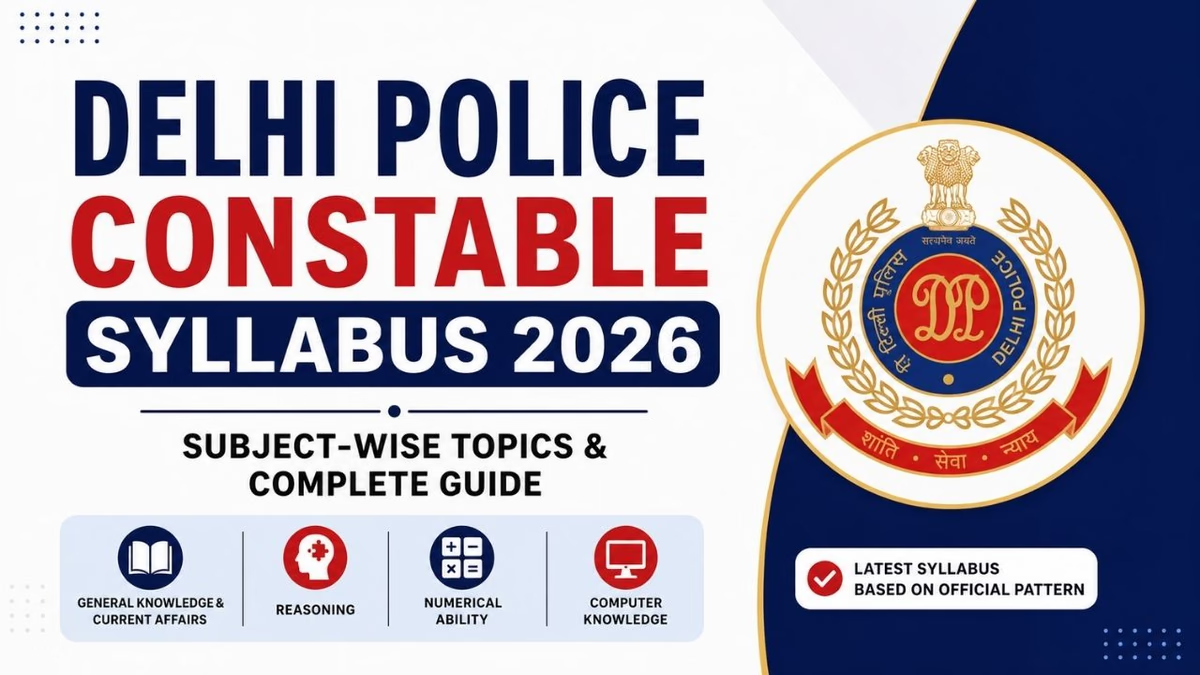
The Delhi Police Constable Exam Pattern 2026 should be understood subject by subject because each section carries a different number of questions and marks. The latest available SSC framework allocates half of the Computer-Based Examination to General Knowledge and Current Affairs, while the remaining marks are divided among Reasoning, Numerical Ability and Computer Knowledge. Candidates should use this distribution when planning their preparation, while checking the final notification applicable to their recruitment cycle. :contentReference[oaicite:0]{index=0}
| Subject | Questions | Marks | Percentage |
|---|---|---|---|
| General Knowledge / Current Affairs | 50 | 50 | 50% |
| Reasoning | 25 | 25 | 25% |
| Numerical Ability | 15 | 15 | 15% |
| Computer Fundamentals & Related Topics | 10 | 10 | 10% |
| Total | 100 | 100 | 100% |
General Knowledge and Current Affairs is the largest section of the latest available Delhi Police Constable written examination pattern. With 50 questions carrying 50 marks, this section represents half of the paper. Candidates therefore need a consistent General Awareness strategy rather than treating GK as a secondary subject.
The syllabus broadly covers areas such as History, Geography, Indian Polity, Economy, General Science, Culture, Sports, Scientific Research and current events. Preparation should combine static GK with regularly updated current affairs.
Since General Knowledge has the highest weightage, candidates should allocate a significant portion of their preparation time to this section. However, reading alone is not enough. Every topic should be followed by MCQ practice so that candidates learn how information is converted into examination questions.
The Reasoning section contains 25 questions for 25 marks in the latest available pattern. Compared with General Knowledge, Reasoning has a smaller number of questions, but it can become a scoring section when candidates develop sufficient familiarity with common question types.
Reasoning questions generally reward candidates who can recognise patterns quickly. The objective should therefore be to build both accuracy and speed. Start with basic examples, understand the logic behind each topic and then solve progressively larger question sets.
| Preparation Stage | Focus |
|---|---|
| Concept Building | Understand the basic pattern of each topic. |
| Topic Practice | Solve multiple questions from one topic. |
| Mixed Practice | Combine different reasoning topics. |
| Timed Practice | Improve speed without reducing accuracy. |
Numerical Ability contributes 15 questions and 15 marks in the latest available examination pattern. The section is based on basic arithmetic concepts, making fundamental preparation especially important.
The most effective way to prepare Numerical Ability is to combine formula revision with question practice. Candidates should first understand the concept, then solve basic questions and finally practise mixed questions under a time limit.
Computer Knowledge accounts for 10 questions and 10 marks in the latest available pattern. Although it has the lowest number of questions among the four sections, it should not be ignored because focused preparation can help candidates cover the prescribed areas efficiently.
Candidates can cover Computer Knowledge through short but regular study sessions. Prepare one topic at a time and revise important terminology through objective questions. Since the syllabus is comparatively focused, repeated revision can help improve retention.
Understanding the marking scheme allows candidates to evaluate their mock-test performance correctly. Under the latest available framework, each correct answer carries one mark and each incorrect answer attracts a deduction of 0.25 marks.
Final CBE Score = Correct Answers − (Incorrect Answers × 0.25)
Suppose a candidate attempts 80 questions, answers 72 correctly and gets 8 wrong.
72 − (8 × 0.25) = 70 marks
Now consider a candidate who attempts 90 questions, answers 70 correctly and gets 20 wrong.
70 − (20 × 0.25) = 65 marks
The examples demonstrate why candidates should not judge their performance only by the number of attempted questions. A controlled attempt strategy with strong accuracy is important when negative marking applies.
There is no single attempt number that guarantees success because the required score depends on factors such as vacancies, category, candidate performance and the applicable recruitment cycle. Instead of chasing a fixed number of attempts, candidates should focus on maximising correct answers while controlling negative marks.
| Question Type | Recommended Approach |
|---|---|
| Easy & Familiar | Attempt confidently and avoid unnecessary overthinking. |
| Moderate | Attempt after identifying the correct method and estimated time. |
| Time-Consuming | Skip temporarily and return if time permits. |
| Uncertain / Guess | Consider the risk of negative marking before answering. |
The ideal section order varies from candidate to candidate. A strategy that works for one student may not work for another. The best way to determine the order is to test different combinations during mock examinations and compare both score and time consumption.
These are practice combinations, not official instructions. Select the order that gives you the best combination of accuracy, speed and confidence.
Since the latest available pattern provides 90 minutes for 100 questions, candidates should practise completing the entire paper within the prescribed duration. The exact time allocation should depend on individual strengths, but a structured approach can prevent one section from consuming too much time.
| Stage | Approx. Practice Allocation | Objective |
|---|---|---|
| First Pass | Majority of easy questions | Collect confident marks quickly. |
| Second Pass | Moderate questions | Solve questions requiring more thought. |
| Final Review | Remaining time | Review marked questions where appropriate. |
The table is a preparation framework, not an official section-wise time limit. The examination provides an overall time limit rather than requiring candidates to spend a fixed number of minutes on each subject.
Mock tests should replicate the structure of the actual examination as closely as possible. Candidates should attempt full-length tests with the same overall time limit and then analyse the result subject by subject.
A useful mock-test record can show whether your score is improving because of better knowledge, better accuracy or faster solving. This information can then be used to adjust the preparation schedule.
For current recruitment information, candidates should consult the official Staff Selection Commission notice board and the notification applicable to the relevant examination cycle. :contentReference[oaicite:1]{index=1}
Understanding the Delhi Police Constable Selection Process 2026 is just as important as understanding the Computer-Based Examination. Candidates should prepare with the complete recruitment process in mind instead of focusing only on the written test. In the latest available Constable (Executive) Male and Female examination framework, the recruitment involves the Computer-Based Examination conducted by SSC followed by the Physical Endurance & Measurement Test and subsequent medical requirements for candidates who qualify for the relevant stage.
The exact sequence, standards and requirements applicable to a future recruitment cycle must always be checked in the official notification. The latest available SSC notice should therefore be treated as the reference framework rather than a guarantee that every detail will remain unchanged for 2026.
The Computer-Based Examination is the main written assessment in the recruitment process. The latest available pattern contains 100 objective-type questions carrying 100 marks, with a total examination duration of 90 minutes. Since negative marking applies, candidates need to combine knowledge with accuracy and controlled attempts.
The CBE score is particularly important because candidates compete for a limited number of vacancies. A candidate who completes the syllabus but loses marks through unnecessary incorrect attempts may find it difficult to achieve a competitive score. Therefore, the exam pattern should influence not only what candidates study but also how they practise.
| CBE Feature | Latest Available Framework |
|---|---|
| Mode | Computer-Based Examination |
| Questions | 100 |
| Maximum Marks | 100 |
| Duration | 90 minutes |
| Question Type | Objective-Type Multiple-Choice Questions |
| Negative Marking | 0.25 mark for each wrong answer |
Candidates who qualify for the written stage may be required to appear for the Physical Endurance & Measurement Test (PE&MT) conducted by Delhi Police. This stage is different from the Computer-Based Examination because it evaluates physical fitness and prescribed physical standards rather than academic knowledge.
The latest available recruitment framework treats the PE&MT as a qualifying stage. Candidates should therefore begin physical preparation early rather than waiting for the CBE result. The exact physical events and standards can vary according to factors such as gender and age, so aspirants should check the applicable official notification carefully.
Physical requirements are not necessarily identical for every candidate. The latest recruitment rules prescribe different standards according to the applicable category and candidate profile. Aspirants should therefore avoid relying on an unofficial single-number target circulated on social media.
The official notification should be used to verify the exact requirements for running, long jump, high jump, height, chest measurements where applicable, and any permitted relaxations. Candidates belonging to categories receiving specific physical-standard relaxations should check the relevant clauses instead of assuming that the general standard applies to everyone.
Do not prepare according to an old recruitment notice, coaching poster or social-media graphic without checking the applicable SSC notification. Physical standards are recruitment-rule details and should be verified from the official source before planning your final target.
| Feature | Computer-Based Examination | PE&MT |
|---|---|---|
| Main Purpose | Tests academic and general aptitude areas. | Tests physical endurance and applicable measurements. |
| Conducted By | Staff Selection Commission | Delhi Police |
| Nature | Written / Computer-Based | Physical / Qualifying |
| Preparation | Study, practice and mock tests | Running, endurance, strength and physical practice |
Candidates who progress through the required recruitment stages may also have to satisfy the prescribed medical standards. The medical stage is intended to assess whether the candidate meets the applicable fitness and medical requirements for appointment.
Candidates should not rely on informal medical advice or assumptions about what will or will not be accepted. The relevant recruitment notification and medical requirements should be read carefully, particularly when a candidate has a concern about eyesight, physical fitness or another eligibility-related requirement.
Candidates often make the mistake of treating the written examination and physical stage as completely separate goals. A better approach is to prepare for both from the beginning. The CBE requires academic preparation, while the PE&MT requires consistent physical training.
The number of candidates competing, vacancies, category-wise requirements and applicable recruitment rules can influence the final level of competition. Therefore, candidates should not depend on a fixed unofficial “safe score” without considering the relevant recruitment cycle.
A cut-off is not a permanent number. It can change from one examination cycle to another depending on factors such as vacancies, candidate performance, category, difficulty level and other applicable recruitment conditions. This is why candidates should be careful when using previous-year cut-offs to set expectations for a future examination.
Previous-year marks can still be useful for understanding the competitive nature of the examination. However, they should be treated as a reference point rather than a guaranteed qualifying score for the next cycle.
| Factor | Possible Impact on Competition |
|---|---|
| Number of Vacancies | Higher or lower vacancies can affect the level of competition. |
| Paper Difficulty | A relatively easier or harder paper can affect overall scores. |
| Candidate Performance | Overall performance influences competitive marks. |
| Category | Applicable category-wise rules can affect shortlisting. |
When a Computer-Based Examination is conducted in multiple shifts, candidates should pay attention to the normalization provisions mentioned in the relevant SSC notice. The purpose of normalization is to account for differences in the difficulty level of question papers across shifts when the examination is conducted in multiple sessions.
Candidates should not manually apply an unofficial normalization formula to predict their final marks. The applicable method, if any, will be specified by SSC for the relevant examination. For preparation purposes, the important point is to focus on the actual performance in the mock test and not become overly concerned about hypothetical shift comparisons.
Do not compare your raw mock-test score directly with another candidate's score from a different test series or difficulty level. Mock-test difficulty can vary significantly. Track your own accuracy, speed and improvement over time.
Knowing the exam pattern is especially useful on the examination day because candidates already understand the structure of the paper. Instead of spending the first few minutes deciding how to approach the test, they can follow a strategy developed through mock-test practice.
The subject-wise weightage can be converted into a practical weekly preparation plan. Since General Knowledge and Current Affairs account for the largest portion of the paper, they should receive regular attention throughout the week. Reasoning and Numerical Ability require repeated practice, while Computer Knowledge can be handled through shorter revision sessions.
| Day | Main Study | Practice / Revision |
|---|---|---|
| Monday | History + Reasoning | Current Affairs MCQs |
| Tuesday | Polity + Numerical Ability | Arithmetic Practice |
| Wednesday | Geography + Reasoning | Reasoning Timed Set |
| Thursday | Science + Computer | Computer MCQs |
| Friday | Economy + Numerical Ability | Arithmetic Timed Set |
| Saturday | Current Affairs + Static GK | Mixed MCQs |
| Sunday | Weekly Revision | Full / Sectional Mock Test |
Candidates preparing for Delhi Police should avoid treating physical training as something that begins only after the written examination. A balanced routine can include academic preparation during focused study periods and physical training at a suitable time of day.
A good preparation strategy should be based on the actual weightage of the examination rather than giving identical study time to every subject. Since General Knowledge and Current Affairs carry the largest share of the paper in the latest available pattern, candidates should give this section regular attention while maintaining consistent practice in Reasoning, Numerical Ability and Computer Knowledge.
The objective should be to complete the syllabus, improve accuracy, increase solving speed and develop the ability to handle the complete paper within the prescribed time. Candidates should regularly move from topic-wise practice to mixed practice and finally to full-length mock tests.
The examination pattern can help candidates decide how to distribute their weekly study time. The following priority structure is a practical preparation recommendation based on the latest available subject-wise weightage.
| Subject | Weightage | Preparation Focus |
|---|---|---|
| General Knowledge & Current Affairs | 50% | Daily study, current affairs, static GK, revision and MCQs. |
| Reasoning | 25% | Concepts, pattern recognition, timed practice and PYQs. |
| Numerical Ability | 15% | Formula revision, arithmetic practice and calculation speed. |
| Computer Knowledge | 10% | Basic concepts, terminology and objective questions. |
Candidates with limited preparation time can divide the month into three stages. The purpose of this plan is not to prescribe a compulsory timetable but to show how the examination pattern can be converted into a structured preparation cycle.
| Days | Main Focus | Practice |
|---|---|---|
| 1–10 | Build fundamentals in all four subjects. | Topic-wise MCQs |
| 11–20 | Complete remaining major topics. | PYQs + sectional tests |
| 21–25 | Revision and weak-topic improvement. | Mixed question sets |
| 26–30 | Full revision and exam simulation. | Full-length mocks |
Mock tests should gradually become more similar to the actual examination. Early in preparation, candidates can use topic-wise and sectional tests. Once most of the syllabus is complete, full-length tests should become an important part of preparation.
| Preparation Stage | Test Type | Purpose |
|---|---|---|
| Beginning | Topic Tests | Check concept clarity. |
| Middle | Sectional Tests | Improve speed and accuracy. |
| Final Stage | Full-Length Tests | Simulate the complete examination. |
Previous year questions can help candidates understand the practical application of the syllabus. They show the type of information, reasoning patterns, arithmetic concepts and computer terminology that may be tested.
Negative marking changes the way candidates should approach the paper. The goal is not simply to attempt as many questions as possible. Candidates should try to maximise the number of correct answers while reducing avoidable mistakes.
The final phase should focus on revision rather than collecting new study material. Candidates should revise their short notes, important Current Affairs, formulas, frequently repeated reasoning concepts and Computer terminology. Mock tests should be used to maintain speed and confidence.
The latest available examination pattern contains 100 objective-type questions for a total of 100 marks. Candidates should verify the final 2026 notification for the applicable recruitment cycle.
The latest available framework provides 90 minutes for the Computer-Based Examination.
Yes. The latest available examination framework specifies a deduction of 0.25 marks for each incorrect answer.
General Knowledge and Current Affairs carry the highest weightage in the latest available pattern, with 50 questions for 50 marks.
The latest available SSC notice specifies the Computer-Based Examination as being of Matriculation level.
Practise full-length papers within the 90-minute limit used in the latest available pattern. Attempt familiar questions first, avoid spending too long on difficult questions and keep negative marking in mind when deciding whether to attempt uncertain questions.
Yes. Candidates should begin physical preparation early and verify the exact physical standards and events from the latest official recruitment notification.
The previous pattern is useful for preparation until the next notification is released, but it should not be treated as a guarantee. SSC can modify recruitment details, so candidates should always check the latest official notification.
Understanding the Delhi Police Constable Exam Pattern 2026 gives candidates a clear idea of how to organise their preparation. The latest available pattern includes 100 objective questions carrying 100 marks, a 90-minute examination duration and negative marking of 0.25 marks for each wrong answer.
General Knowledge and Current Affairs carry the largest share of the paper, followed by Reasoning, Numerical Ability and Computer Knowledge. Candidates should use this distribution to plan their study time while ensuring that no section is completely ignored.
The most effective preparation approach combines syllabus completion, previous year questions, mock tests, revision, accuracy improvement and time management. Physical preparation should also continue alongside written preparation because the recruitment process includes subsequent physical and medical requirements as prescribed by the applicable rules.
Most importantly, candidates should verify all recruitment-specific details from the latest official SSC notification before making final decisions about eligibility, examination pattern, vacancies, physical standards, dates or selection procedures.
Know the exam pattern, follow the syllabus, practise regularly and measure your progress through mock tests. A structured preparation strategy can help you approach the examination with greater confidence.