

Download the App & Start Learning
- Expert Faculty Guidance
- Updated Study Material
- Mock Tests & Practice Quiz
- Live Doubt Solving Sessions
- Exam-Oriented Preparation
- Motivation & Success Strategy
Katara Academy

8/11/2026
Delhi Police Head Constable AWO/TPO 2026
The Delhi Police Head Constable AWO/TPO 2026 recruitment is an important opportunity for candidates interested in technical and communication-related police roles. AWO stands for Assistant Wireless Operator, while TPO stands for Tele-Printer Operator. The recruitment is conducted through the Staff Selection Commission in coordination with Delhi Police.
Important 2026 Update:
The latest available recruitment notice is for the Head Constable (AWO/TPO) in Delhi Police Examination, 2025. Its Computer-Based Examination was scheduled for January 2026, and SSC subsequently published result-related updates in 2026. Therefore, this article uses the latest available official recruitment framework as the preparation reference for aspirants looking ahead to the 2026 cycle. Candidates should verify the fresh SSC notification when the next recruitment notice is officially released.
The Staff Selection Commission conducts the open competitive examination for recruitment to the post of Head Constable {Assistant Wireless Operator (AWO)/Tele-Printer Operator (TPO)} in Delhi Police. According to the latest official recruitment notice, candidates from all parts of India are eligible to apply, and the Computer-Based Examination is conducted by SSC on a pan-India basis. The CBE is conducted in English and Hindi. :contentReference[oaicite:0]{index=0}
This post is different from the Delhi Police Head Constable (Ministerial) recruitment. AWO/TPO is specifically associated with wireless communication and tele-printer-related functions, and the eligibility requirements include a technical or science-and-mathematics educational background. Candidates should therefore read the educational qualification and computer proficiency requirements carefully before planning their application.
The latest recruitment framework also includes a Computer-Based Examination followed by the applicable Physical Endurance & Measurement Test (PE&MT), skill/trade-related tests, document verification and medical examination. The exact requirements applicable to a future recruitment cycle should always be checked from the official notification.
The above details are based on the latest available official SSC Head Constable (AWO/TPO) recruitment notice. :contentReference[oaicite:1]{index=1}
Vacancies are reported by Delhi Police to the Staff Selection Commission and may be revised during the recruitment process. The original 2025 notification listed tentative vacancies, and SSC later issued a revised vacancy notice in February 2026. Candidates should therefore distinguish between the vacancies mentioned in the original notification and the latest revised vacancy position. :contentReference[oaicite:2]{index=2}
According to the revised vacancy notice, the total number of vacancies became 443, consisting of 297 vacancies for Male candidates and 146 vacancies for Female candidates. The Commission also clarified that vacancies are published as reported by Delhi Police and that SSC does not determine the total number of vacancies or their category-wise segregation. :contentReference[oaicite:3]{index=3}
| Category | Male | Female | Total |
|---|---|---|---|
| Open | 226 | 132 | 358 |
| Departmental | 29 | 14 | 43 |
| Ex-Servicemen | 42 | — | 42 |
| Total | 297 | 146 | 443 |
Latest revised vacancy figures for the 2025 recruitment were published by SSC on 25 February 2026. :contentReference[oaicite:4]{index=4}
The Head Constable AWO/TPO post is designed for communication and technical responsibilities within Delhi Police. The abbreviations AWO and TPO refer to Assistant Wireless Operator and Tele-Printer Operator respectively. Because the role has a technical communication component, the recruitment framework specifies educational and computer-proficiency requirements in addition to the general conditions applicable to the post.
Candidates considering this recruitment should understand that the selection process is not limited to a written examination. The latest official framework includes physical assessment, prescribed skill or trade testing, document verification and medical examination. Therefore, preparation should cover academic subjects as well as the relevant practical and physical requirements.
The latest official recruitment notice places the post of Head Constable (AWO/TPO) in Pay Level-4 of the pay matrix, with a basic pay range of ₹25,500 to ₹81,100. The post is classified as a Group 'C' position. :contentReference[oaicite:5]{index=5}
Pay Level: Level-4
₹25,500 – ₹81,100
Group 'C'
The actual salary received by an employee can differ from basic pay because government employees may receive applicable allowances and deductions according to the rules in force. Candidates should not interpret the pay-matrix range as the monthly in-hand salary.
Eligibility is one of the most important parts of the recruitment because candidates must satisfy the prescribed nationality, age, educational and professional requirements. For the latest available 2025 recruitment, the official notice specified that the candidate must be an Indian citizen and must meet the prescribed age and educational conditions. :contentReference[oaicite:6]{index=6}
Candidates preparing for a future recruitment cycle should use these requirements as a reference but must verify the fresh notification before applying. A change in the crucial date, age calculation or qualification requirement can affect eligibility.
According to the latest available official notification, the candidate must be a citizen of India. Candidates should keep appropriate identity and eligibility documents ready as required during the recruitment process. :contentReference[oaicite:7]{index=7}
For the 2025 recruitment, the prescribed age limit was 18 to 27 years as on 1 July 2025. The notification specified that candidates should have been born not earlier than 2 July 1998 and not later than 1 July 2007. The applicable age date for a future recruitment cycle may be different, so candidates should check the new notification rather than carrying forward these dates unchanged. :contentReference[oaicite:8]{index=8}
| Category | Latest Available Age Relaxation |
|---|---|
| SC / ST | Up to 5 years |
| OBC | Up to 3 years |
| Ex-Servicemen | As per applicable Government rules |
| Eligible Sportsmen / Sportswomen | Up to 5 years under specified conditions |
Additional age relaxations are available in specified cases, including certain departmental candidates and eligible widows/divorced women/women judicially separated from their husbands who have not remarried. Candidates should refer to the applicable official notification for the complete conditions. :contentReference[oaicite:9]{index=9}
The educational requirement is particularly important for AWO/TPO because the post has a technical orientation. According to the latest available official notice, candidates must satisfy one of the specified educational routes.
The qualification must have been acquired by the prescribed closing date of the online application. Candidates shortlisted for document verification are required to produce the relevant original educational documents as proof of their qualification. :contentReference[oaicite:10]{index=10}
Computer proficiency is an additional professional requirement for the post. The latest official notification describes this as a qualifying requirement. Candidates should therefore not treat it as an optional skill that can be ignored after the written examination.
Candidates should begin practising computer operation well before the skill stage. Speed should be developed gradually while maintaining accuracy. The objective is not merely to type quickly but also to become comfortable with the basic computer operations specified in the recruitment framework. :contentReference[oaicite:11]{index=11}
| Eligibility Requirement | Latest Available Requirement |
|---|---|
| Nationality | Indian Citizen |
| Age | 18–27 years for the 2025 recruitment reference |
| Educational Qualification | 10+2 with Science & Mathematics OR specified NTC qualification |
| Computer Proficiency | Qualifying computer operation and English word-processing test |
| Physical Requirements | Must satisfy applicable PE&MT standards |
The eligibility details above are based on the latest available official SSC Head Constable (AWO/TPO) Examination, 2025 notice. They are provided as a preparation reference for 2026 aspirants. Candidates must verify the age cut-off date, educational qualification, vacancies, physical standards, computer proficiency requirements and other conditions from the next official SSC notification before applying.
Official reference: Staff Selection Commission, Head Constable (AWO/TPO) in Delhi Police Examination, 2025 notice and subsequent vacancy/result updates. :contentReference[oaicite:12]{index=12}
The Delhi Police Head Constable AWO/TPO Exam Pattern 2026 is important for candidates because the written examination covers five different areas: General Awareness, General Science, Mathematics, Reasoning and Computer Fundamentals. The latest available official recruitment framework for the 2025 examination, whose Computer-Based Examination was conducted in January 2026, prescribed a 100-question, 100-mark Computer-Based Examination. The final answer-key notice confirms that SSC conducted the CBE for this recruitment and declared its result on 29 May 2026. :contentReference[oaicite:0]{index=0}
Candidates preparing for the next recruitment should use this pattern as the latest available reference, but the final pattern for any fresh 2026 notification should always be checked against the new SSC notice.
| Part | Subject | Questions | Marks |
|---|---|---|---|
| Part A | General Awareness | 20 | 20 |
| Part B | General Science | 25 | 25 |
| Part C | Mathematics | 25 | 25 |
| Part D | Reasoning | 20 | 20 |
| Part E | Computer Fundamentals, MS Excel, MS Word, Communication, Internet, WWW & Web Browsers | 10 | 10 |
| Total | All Sections | 100 | 100 |
The subject-wise distribution above reflects the latest available examination pattern for the Head Constable AWO/TPO recruitment. :contentReference[oaicite:1]{index=1}
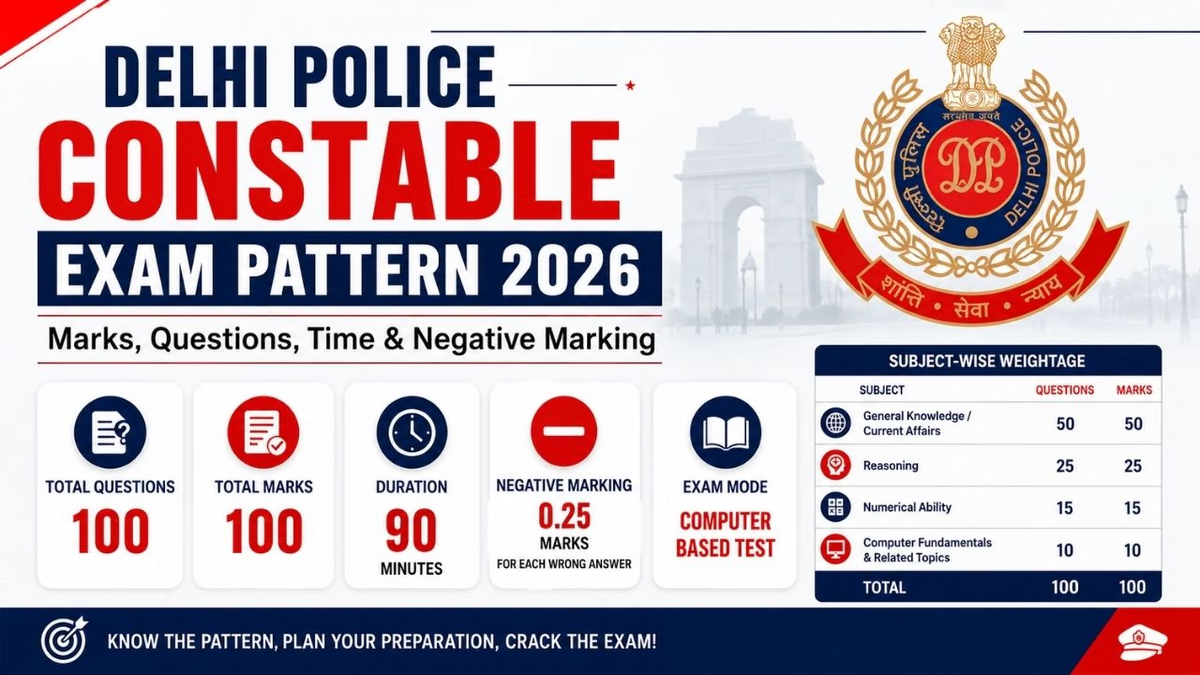
The Computer-Based Examination is based on 100 questions carrying 100 marks, with an examination duration of 90 minutes in the latest available pattern. This means candidates need to develop both subject knowledge and the ability to solve questions efficiently within a limited time. :contentReference[oaicite:2]{index=2}
The latest available examination references for the Head Constable AWO/TPO CBE indicate that there is no negative marking for wrong answers. This makes the attempt strategy different from examinations where marks are deducted for incorrect responses. Candidates should nevertheless read the instructions displayed during the actual examination because the applicable instructions for a future recruitment cycle will be governed by the official SSC notice.
General Awareness carries 20 questions for 20 marks in the latest available pattern. This section tests a candidate's awareness of important facts, events and developments related to India and the wider world.
General Awareness requires regular revision because a large amount of information can be forgotten when it is studied only once. Candidates should combine static GK with current affairs and practise objective questions after completing each topic.
General Science is one of the most important sections in the Head Constable AWO/TPO examination because it carries 25 questions for 25 marks. Candidates should focus on fundamental concepts of Physics, Chemistry and Biology rather than trying to study highly advanced scientific theories.
The science section is particularly relevant for this recruitment because the educational qualification itself requires Science and Mathematics at the 10+2 level or the specified technical qualification. Candidates with a Science background may therefore find it easier to build a strong foundation, while candidates should still revise the complete prescribed scope.
Candidates should first revise school-level fundamentals and then move towards objective question practice. Creating chapter-wise notes for formulas, definitions, scientific terms and important facts can make final revision easier.
Mathematics contributes 25 questions and 25 marks in the latest available CBE pattern. This makes it one of the two largest sections along with General Science.
Mathematics is a practice-based subject. Candidates should not rely only on reading formulas. Every formula should be followed by sufficient question practice so that the candidate can recognise when and how to use it.
The Reasoning section contains 20 questions for 20 marks. Reasoning can become a scoring section when candidates learn the underlying patterns and practise enough questions to improve their speed.
Start with easy topics and learn the standard approach used to solve each question type. Once the concept is clear, increase the number of questions and introduce time limits. The final goal should be to identify familiar patterns quickly during the examination.
The Computer section contains 10 questions for 10 marks. The latest available pattern specifically includes Computer Fundamentals, MS Excel, MS Word, Communication, Internet, World Wide Web and Web Browsers.
Candidates should combine theoretical knowledge with basic practical familiarity. Since the recruitment also includes computer proficiency requirements at a later stage, regular computer practice can be useful beyond the written examination.
The subject-wise distribution shows where candidates should place their preparation emphasis. General Science and Mathematics carry the highest individual weightage, with 25 marks each. General Awareness and Reasoning carry 20 marks each, while Computer Knowledge contributes 10 marks.
| Subject | Marks | Share of Paper | Priority |
|---|---|---|---|
| General Awareness | 20 | 20% | High |
| General Science | 25 | 25% | Very High |
| Mathematics | 25 | 25% | Very High |
| Reasoning | 20 | 20% | High |
| Computer | 10 | 10% | Scoring |
There is no requirement to spend an equal amount of time on every section. Candidates should use mock tests to identify the section order that works best for them. The important objective is to complete the paper efficiently while leaving enough time to review unanswered questions.
Because the latest available pattern has no negative marking for wrong answers, candidates can use the final round strategically. However, time should not be wasted on a single difficult question when several other questions remain unanswered.
Mock tests should be used throughout preparation rather than only during the final week. In the beginning, sectional tests can help identify weak topics. Once the syllabus is substantially complete, candidates should start taking complete 100-question tests under the 90-minute limit.
| Preparation Stage | Recommended Test | Main Objective |
|---|---|---|
| Beginning | Topic Tests | Concept clarity |
| Middle | Sectional Tests | Speed and accuracy |
| Advanced | Full-Length Tests | Complete exam simulation |
Simply taking a mock test does not guarantee improvement. Candidates should analyse every incorrect and unattempted question and identify the reason behind the mistake.
The exam pattern in this article is based on the latest available Head Constable (AWO/TPO) recruitment framework. SSC declared the CBE result for the 2025 examination on 29 May 2026 and later uploaded the final answer keys, question papers, response sheets and marks on 16 June 2026. Candidates preparing for a future recruitment should verify any revised pattern from the fresh official notification. :contentReference[oaicite:3]{index=3}
The Delhi Police Head Constable AWO/TPO Selection Process 2026 is not limited to the Computer-Based Examination. Candidates who qualify at the required stage have to go through the subsequent physical, skill, document and medical requirements prescribed for the recruitment. The latest available SSC recruitment cycle for Head Constable (AWO/TPO) had its Computer-Based Examination from 15 January to 22 January 2026, and SSC declared the CBE result on 29 May 2026. :contentReference[oaicite:0]{index=0}
For candidates preparing for a future recruitment cycle, the latest available process can be used as a preparation framework. However, the exact sequence, standards and qualifying requirements should always be checked in the fresh SSC notification and Delhi Police notices when issued.
The Computer-Based Examination is the written stage of the recruitment. In the latest available pattern, the examination consists of 100 objective questions carrying 100 marks and is conducted within a 90-minute duration. The paper covers General Awareness, General Science, Mathematics, Reasoning and Computer Fundamentals with related computer topics.
The CBE is conducted by the Staff Selection Commission. Candidates should therefore prepare for all five sections rather than focusing only on technical subjects. The official result write-up confirms that the CBE for the 2025 recruitment was conducted between 15 January and 22 January 2026. :contentReference[oaicite:1]{index=1}
| Subject | Questions | Marks |
|---|---|---|
| General Awareness | 20 | 20 |
| General Science | 25 | 25 |
| Mathematics | 25 | 25 |
| Reasoning | 20 | 20 |
| Computer Fundamentals & Related Topics | 10 | 10 |
After the written stage, shortlisted candidates are required to participate in the Physical Endurance & Measurement Test (PE&MT) according to the applicable recruitment rules. This stage evaluates physical endurance and prescribed physical measurements.
Delhi Police has published recruitment notices relating to the PE&MT for the 2025 Delhi Police examinations, including Head Constable AWO/TPO. This confirms that physical-stage activities continue after the written examination for the applicable recruitment process. :contentReference[oaicite:2]{index=2}
Candidates should build a routine that gradually develops endurance, speed and overall physical fitness. The objective is to reach the prescribed standard safely and consistently rather than trying to achieve maximum performance in a very short period.
| Training Area | Preparation Focus |
|---|---|
| Running | Build endurance gradually and practise at a consistent pace. |
| Strength | Develop basic lower-body and core strength. |
| Mobility | Include suitable warm-up and mobility exercises. |
| Recovery | Allow adequate rest and avoid excessive training. |
The AWO/TPO recruitment has an important skill-oriented component because the post is associated with communication and computer-related functions. Candidates should therefore prepare for the prescribed skill or trade requirements in addition to the written examination and physical test.
The latest recruitment framework includes a computer proficiency requirement. Candidates should become comfortable with basic computer operations and English word processing before reaching the relevant stage.
The latest available eligibility framework specifies 1,000 key depressions in 15 minutes for the English word-processing requirement. Candidates should practise typing regularly instead of attempting to build speed immediately before the skill test.
Candidates who progress through the required stages have to establish their eligibility through the prescribed documents. Document verification is important because the information entered in the application must be supported by valid certificates and records.
The exact document list can vary according to the recruitment cycle and candidate category. Candidates should follow the document-verification instructions issued for their examination.
Medical examination is another important stage of the recruitment process. Candidates who reach this stage must satisfy the medical standards applicable to the post. Medical requirements should not be assumed from another Delhi Police recruitment because different posts can have different conditions.
Candidates should carefully read the medical requirements specified in the applicable recruitment notification and follow the instructions provided by the recruiting authorities.
Final selection is governed by the recruitment rules and the conditions specified in the official notification. Candidates should therefore avoid relying on a simplified formula such as “written marks alone decide selection.” Different stages have different purposes, and qualifying requirements must be satisfied wherever applicable.
A successful preparation plan should cover three areas together: the CBE syllabus, physical fitness and computer proficiency. Candidates who prepare only for the written test may later have insufficient time to build the required physical or typing skills.
| Area | What to Do | Frequency |
|---|---|---|
| Written Exam | Study syllabus + practise MCQs + PYQs. | Daily |
| Current Affairs | Read and revise important events. | Daily |
| Physical Training | Build endurance and overall fitness gradually. | Regularly |
| Typing | Practise English word processing and accuracy. | Regularly |
| Mock Tests | Attempt timed CBE simulations. | Weekly |
Delhi Police's recruitment page currently carries notices relating to the 2025 recruitment cycle, including PE&MT-related updates. Candidates should monitor the official SSC and Delhi Police recruitment pages for the latest stage-wise instructions and future notifications. :contentReference[oaicite:3]{index=3}
A successful preparation strategy for the Delhi Police Head Constable AWO/TPO 2026 examination should cover more than the written test. Candidates need to prepare for the Computer-Based Examination while also developing the physical fitness, computer proficiency and skill requirements applicable to the recruitment. The latest official recruitment framework shortlisted candidates from the CBE for PE&MT, after which Delhi Police conducted the required Skill/Trade Tests, document verification and medical examination. :contentReference[oaicite:0]{index=0}
The best approach is therefore to begin all major areas early. Candidates should not wait for the CBE result before starting physical training or computer practice. Regular preparation gives enough time to improve weak areas without creating unnecessary pressure close to the later stages.
The latest available examination pattern gives the highest individual weightage to General Science and Mathematics, with 25 questions each. General Awareness and Reasoning contribute 20 questions each, while Computer Fundamentals and related topics contribute 10 questions. Candidates can use this distribution to decide how much time to devote to each subject.
| Subject | Questions | Preparation Priority | Main Focus |
|---|---|---|---|
| General Science | 25 | Very High | Physics, Chemistry, Biology and everyday science. |
| Mathematics | 25 | Very High | Arithmetic, algebra, geometry, mensuration and calculation practice. |
| General Awareness | 20 | High | Static GK and current affairs. |
| Reasoning | 20 | High | Logical and non-verbal reasoning practice. |
| Computer | 10 | Scoring | Fundamentals, MS Word, Excel, Internet and web browsers. |
A consistent daily routine is more useful than studying for long hours only on selected days. Candidates can divide their preparation into focused sessions covering the major written subjects and then reserve additional time for physical and computer practice.
| Session | Focus | Suggested Activity |
|---|---|---|
| Session 1 | Science / Mathematics | Concept study + practice questions |
| Session 2 | General Awareness | Current affairs + static GK revision |
| Session 3 | Reasoning / Computer | MCQs + timed practice |
| Fitness Session | Physical preparation | Gradual endurance and fitness training |
| Skill Session | Computer / Typing | English typing and basic computer operations |
The routine is a suggested preparation framework. Candidates can adjust the duration of each session according to their educational background, available time and current preparation level.
Mock tests help candidates understand whether their preparation is translating into actual examination performance. The latest available CBE framework has 100 questions and 90 minutes, so full-length practice should eventually reproduce this structure.
Computer proficiency is an important part of the AWO/TPO recruitment framework. The latest available notification specifies English word processing of 1,000 key depressions in 15 minutes. Candidates should therefore start practising early and improve speed without sacrificing accuracy.
Candidates should not wait until they are shortlisted for the later stage to begin typing practice. Developing keyboard familiarity gradually is much easier than trying to increase speed immediately before the test.
The official recruitment framework states that candidates within the required CBE merit range are shortlisted for PE&MT. The PE&MT is conducted by Delhi Police, and the schedule and centres are communicated through the prescribed recruitment process. :contentReference[oaicite:1]{index=1}
Candidates should prepare according to the exact physical standards applicable to their category and recruitment cycle. Avoid relying on an old social-media graphic or an unofficial coaching list because physical requirements are recruitment-specific.
Candidates should keep their educational and eligibility documents organised well before document verification. The recruitment notice states that collection and verification of documents are carried out by Delhi Police. :contentReference[oaicite:2]{index=2}
| Document | Purpose |
|---|---|
| Class 10 Certificate | Age and educational record |
| 10+2 Certificate / Marksheet | Educational qualification |
| NTC Certificate, if applicable | Technical qualification route |
| Category Certificate, if applicable | Reservation / category claim |
| Identity Documents | Identity verification |
The final list of documents should be checked against the instructions issued for the relevant recruitment stage.
AWO stands for Assistant Wireless Operator and TPO stands for Tele-Printer Operator.
The latest available pattern contains 100 objective questions carrying 100 marks.
The latest available examination pattern provides 90 minutes for the Computer-Based Examination.
The latest available examination pattern indicates no negative marking for incorrect answers. Candidates should nevertheless check the instructions in the official notification applicable to their examination.
The latest available pattern includes General Awareness, General Science, Mathematics, Reasoning and Computer Fundamentals with related topics.
Yes. Candidates shortlisted from the CBE are required to appear for the applicable PE&MT. The latest recruitment framework states that PE&MT is conducted by Delhi Police. :contentReference[oaicite:3]{index=3}
The latest available recruitment framework specifies English word processing of 1,000 key depressions in 15 minutes as part of the computer proficiency requirement.
The latest official recruitment notice states that candidates within the CBE merit range equal to 20 times the number of vacancies in each category are shortlisted for PE&MT. :contentReference[oaicite:4]{index=4}
The Delhi Police Head Constable AWO/TPO 2026 recruitment requires a balanced preparation strategy. The written examination tests General Awareness, General Science, Mathematics, Reasoning and Computer Fundamentals, while later stages assess physical fitness, computer proficiency and other prescribed requirements.
Candidates should give special attention to General Science and Mathematics because they carry the highest individual weightage in the latest available CBE pattern. At the same time, General Awareness and Reasoning require regular practice, and Computer Knowledge should not be ignored.
Preparation should continue beyond the written examination. Regular typing practice, basic computer-operation practice and physical training can help candidates remain ready for the subsequent stages. The official recruitment framework confirms that PE&MT, Skill/Trade Tests, document verification and detailed medical examination are handled through the later stages of the recruitment. :contentReference[oaicite:5]{index=5}
Finally, candidates should rely on the latest official SSC and Delhi Police notices for vacancies, dates, eligibility, physical standards, skill requirements and selection rules. The 2025 recruitment cycle has already progressed through the CBE in January 2026 and subsequent shortlisting updates, so aspirants preparing for a future cycle should treat those details as the latest available reference rather than assuming that every condition will remain unchanged. :contentReference[oaicite:6]{index=6}
Build your preparation around the complete recruitment process. Complete the syllabus, practise questions, take mock tests, improve typing and computer skills, and maintain physical fitness from the beginning.