






Download the App & Start Learning
- Expert Faculty Guidance
- Updated Study Material
- Mock Tests & Practice Quiz
- Live Doubt Solving Sessions
- Exam-Oriented Preparation
- Motivation & Success Strategy
Katara Academy

10/12/2026
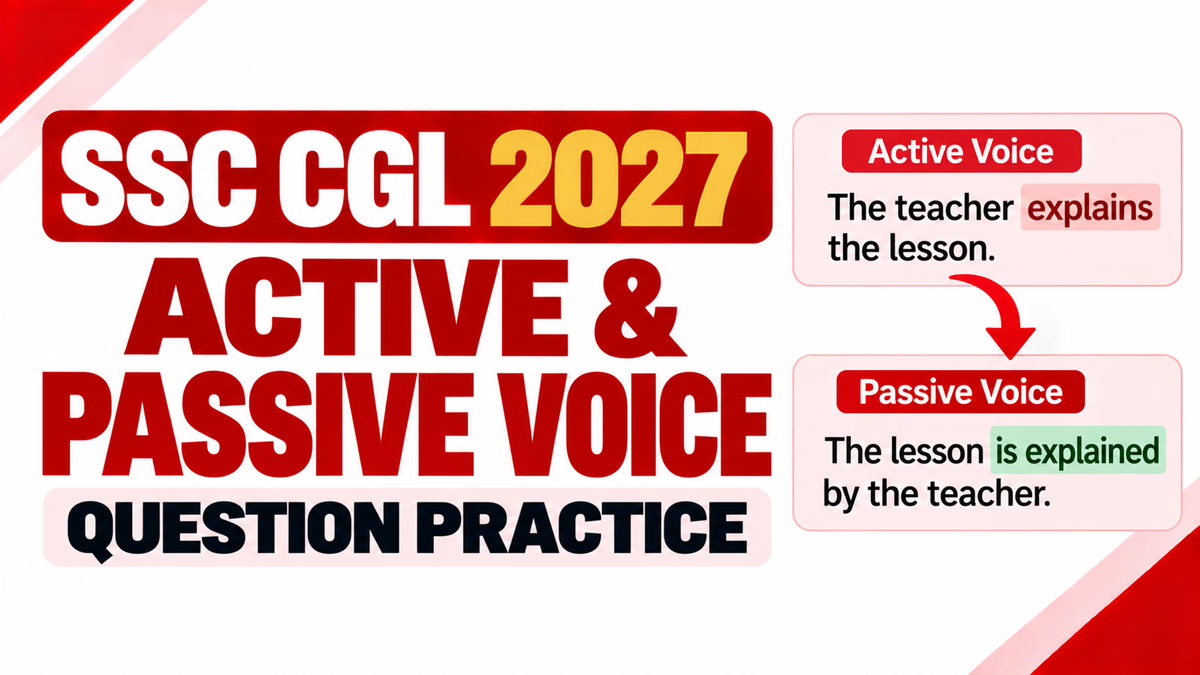
Active and Passive Voice is an important topic in English grammar for SSC CGL 2027. Questions on voice transformation test your understanding of sentence structure, tenses, helping verbs and the relationship between the subject and the object. Learning the rules of active and passive voice can help you solve grammar questions more accurately in SSC CGL Tier 1 and Tier 2.
In this article, you will learn the basic concepts, tense-wise transformation rules, important examples, common mistakes and practice MCQs with answers for SSC CGL 2027 English preparation.
In active voice, the subject performs the action expressed by the verb. The sentence focuses on the person or thing doing the action.
Structure: Subject + Verb + Object
Examples:
In these sentences, Riya, the teacher and the police perform the actions.
In passive voice, the sentence focuses on the person or thing receiving the action. The object of an active sentence generally becomes the subject of the passive sentence.
Basic Structure: Object + appropriate form of be + Past Participle (V3) + by + Agent
Examples:
The agent introduced by by can be omitted when it is unknown, unimportant or obvious from the context.
Understanding tense patterns is essential for solving voice transformation questions. Study the following structures and examples.
Active: Subject + V1/V1-s or es + Object
Passive: Object + am/is/are + V3
Active: She cleans the room.
Passive: The room is cleaned by her.
Active: Subject + am/is/are + V-ing + Object
Passive: Object + am/is/are + being + V3
Active: They are repairing the road.
Passive: The road is being repaired by them.
Active: Subject + has/have + V3 + Object
Passive: Object + has/have + been + V3
Active: He has completed the project.
Passive: The project has been completed by him.
Active: Subject + V2 + Object
Passive: Object + was/were + V3
Active: The manager approved the proposal.
Passive: The proposal was approved by the manager.
Active: Subject + was/were + V-ing + Object
Passive: Object + was/were + being + V3
Active: The workers were painting the wall.
Passive: The wall was being painted by the workers.
Active: Subject + had + V3 + Object
Passive: Object + had + been + V3
Active: She had submitted the form.
Passive: The form had been submitted by her.
Active: Subject + will + V1 + Object
Passive: Object + will + be + V3
Active: The company will launch the product.
Passive: The product will be launched by the company.
Active: Subject + will have + V3 + Object
Passive: Object + will have been + V3
Active: They will have completed the work by Monday.
Passive: The work will have been completed by Monday.
Important note: Continuous perfect forms and future continuous forms can produce lengthy passive constructions and are generally less common in basic exam exercises. Focus first on the standard patterns above and follow the exact sentence given in the question.
Modal verbs include can, could, may, might, must, should and ought to. When converting a sentence containing a modal verb into passive voice, use modal + be + V3.
Structure: Object + Modal + be + V3
Examples:
Common mistake: Do not use V2 after a modal verb in a passive construction. The correct structure is modal + be + V3.
When changing a question into passive voice, retain the interrogative meaning and use the correct helping verb at the beginning of the sentence.
Examples:
Active: Does she write letters?
Passive: Are letters written by her?
Active: Did the police arrest the suspect?
Passive: Was the suspect arrested by the police?
Active: Has he completed the task?
Passive: Has the task been completed by him?
Active: Who wrote this poem?
Passive: By whom was this poem written?
Active: When will they announce the results?
Passive: When will the results be announced?
For questions beginning with who, what, when, why or how, preserve the original question word and construct the rest of the passive sentence correctly.
Imperative sentences express commands, requests, advice or instructions. In many exam-style transformations, an imperative sentence can be changed using let + object + be + V3.
Examples:
Polite requests may also be expressed using structures such as You are requested to follow the instructions, depending on the original sentence and the options provided.
Passive voice generally requires a verb that takes an object. Intransitive verbs, which do not take a direct object, usually cannot be converted into passive voice.
Examples:
These sentences do not have direct objects that can become the subjects of passive constructions.
Exam Tip: Before changing a sentence into passive voice, check whether the verb has an object. Do not force a passive construction where one is not grammatically possible.
Choose the correct passive voice form for each active sentence.
Question 1: The teacher explains the lesson.
Question 2: They are building a new bridge.
Question 3: The police arrested the thief.
Question 4: She has completed the assignment.
Question 5: You must obey the instructions.
Question 6: Did he write this letter?
Question 7: The workers were repairing the road.
Question 8: The company will announce the results tomorrow.
Question 9: Open the window.
Question 10: The baby sleeps peacefully.
1. B) The lesson is explained by the teacher.
The active sentence is in the simple present tense. The passive structure is is + V3.
2. C) A new bridge is being built by them.
The active sentence is in the present continuous tense. Use is being + V3 in the passive voice.
3. B) The thief was arrested by the police.
The active sentence is in the simple past tense. Use was + V3 for the singular subject thief.
4. A) The assignment has been completed by her.
The active sentence is in the present perfect tense. Use has been + V3.
5. B) The instructions must be obeyed by you.
With a modal verb, the passive structure is modal + be + V3.
6. B) Was this letter written by him?
The active question is in the simple past tense. The passive question begins with was, followed by the subject and V3.
7. C) The road was being repaired by the workers.
The active sentence is in the past continuous tense. Use was being + V3.
8. B) The results will be announced by the company tomorrow.
The simple future passive structure is will + be + V3.
9. B) Let the window be opened.
This is a standard exam-style passive transformation of an imperative sentence.
10. C) The sentence cannot normally be changed into passive voice.
The verb sleeps is intransitive in this sentence and does not take a direct object.
Active and Passive Voice is a useful grammar topic for SSC CGL 2027 English preparation. Understanding tense-wise structures, modal verbs, interrogative transformations and imperative sentences can help candidates solve voice questions accurately.
Revise the rules regularly and practise a variety of sentence transformations to improve your confidence in SSC CGL Tier 1 and Tier 2.
