





Download the App & Start Learning
- Expert Faculty Guidance
- Updated Study Material
- Mock Tests & Practice Quiz
- Live Doubt Solving Sessions
- Exam-Oriented Preparation
- Motivation & Success Strategy
Katara Academy

10/12/2026
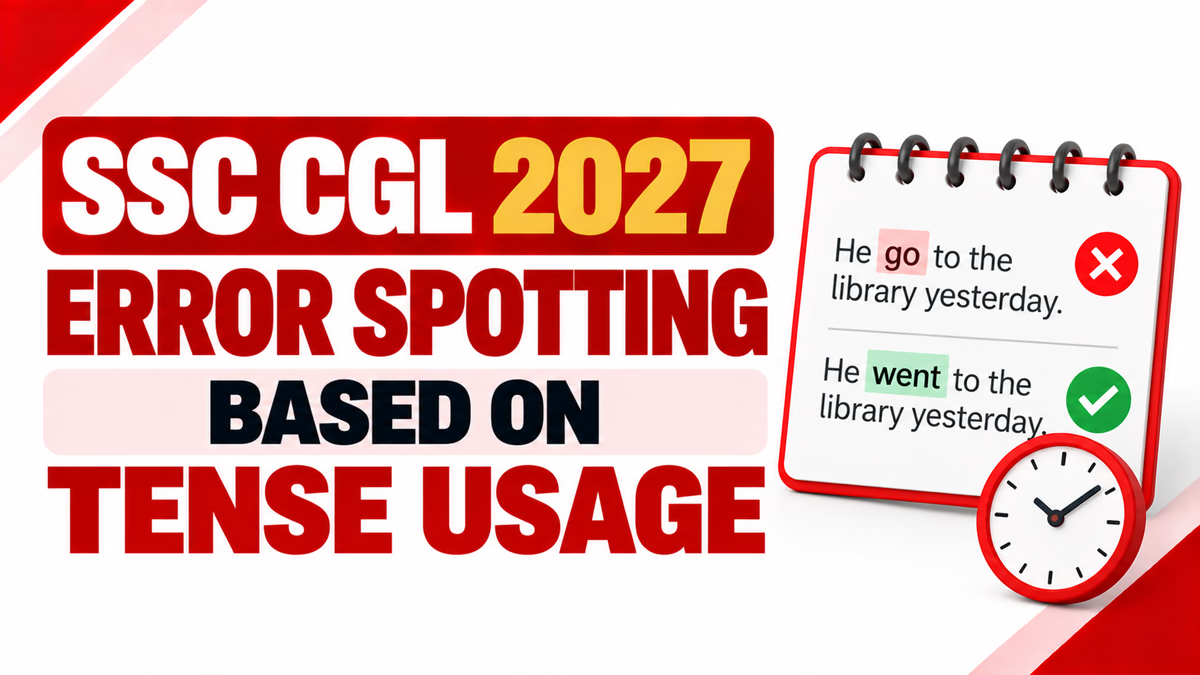
Tense-based error spotting is an important part of English grammar preparation for SSC CGL 2027. These questions test your ability to identify incorrect verb forms, understand the sequence of events and choose the appropriate tense according to the context of a sentence.
Many candidates lose marks because they confuse simple past with present perfect, use the wrong verb form after helping verbs, or fail to maintain tense consistency. Learning the basic rules and practising common error patterns can help you improve accuracy in SSC CGL Tier 1 and Tier 2 English.
In this article, you will learn important tense rules, common mistakes, solved examples, exam shortcuts and practice MCQs with answers.
English grammar commonly classifies tenses into present, past and future, with four forms associated with each time category.
For error spotting, focus on the time expressions, the relationship between actions and the correct structure of the verb.
The simple present tense is used for habits, routines, general truths and repeated actions. With third-person singular subjects such as he, she and it, the main verb generally takes -s or -es.
Structure:
Incorrect: He go to the library every evening.
Correct: He goes to the library every evening.
Incorrect: The sun rise in the east.
Correct: The sun rises in the east.
Example: Identify the error: She do not understand the question.
Correction: She does not understand the question.
Remember that after does or does not, the main verb takes its base form.
The present continuous tense describes an action happening now or around the present time. It uses am, is or are followed by the -ing form of the verb.
Structure: Subject + am/is/are + verb-ing
Incorrect: They is preparing for the examination.
Correct: They are preparing for the examination.
Incorrect: I am study for my test.
Correct: I am studying for my test.
Some verbs that describe states, such as know, believe and understand, are not normally used in continuous forms when they express their usual meanings.
Incorrect: I am knowing the answer.
Correct: I know the answer.
The simple past tense describes completed actions in the past. Regular verbs generally take -ed, while irregular verbs have their own past forms.
Common time expressions: yesterday, last week, two days ago and in 2024.
Incorrect: She did not attended the meeting yesterday.
Correct: She did not attend the meeting yesterday.
Incorrect: He has visited Jaipur last year.
Correct: He visited Jaipur last year.
When did or did not is used, the main verb must be in its base form. A specific, completed past-time expression generally requires the simple past rather than the present perfect.
The present perfect tense connects a past action with the present. It is commonly used for experiences, recent actions and situations that continue into the present.
Structure: Subject + has/have + past participle (V3)
Incorrect: She have completed the assignment.
Correct: She has completed the assignment.
Incorrect: I have saw this movie before.
Correct: I have seen this movie before.
Important distinction:
Do not normally use the present perfect with a finished past-time expression such as yesterday or last year.
The past perfect tense describes an action completed before another past action or past reference point.
Structure: Subject + had + past participle (V3)
Incorrect: The train had left before we reach the station.
Correct: The train had left before we reached the station.
Example: When I arrived at the office, the meeting had already started.
The past perfect helps establish which of two past events happened first. It is not necessary in every sentence containing two past actions; use it when the sequence needs to be made clear.
In many future-time clauses beginning with when, before, after, until, as soon as and if, the simple present is used to refer to a future event.
Incorrect: I will call you when I will reach home.
Correct: I will call you when I reach home.
Incorrect: If it will rain tomorrow, we will stay indoors.
Correct: If it rains tomorrow, we will stay indoors.
The main clause can use will, but the time or condition clause generally uses the simple present when referring to a likely future event.
Since identifies the starting point of an action or situation, while for indicates its duration.
For an action that began in the past and continues now, the present perfect or present perfect continuous is often appropriate.
Incorrect: She is working here since 2022.
Correct: She has been working here since 2022.
Incorrect: I have been waiting since two hours.
Correct: I have been waiting for two hours.
When a sentence describes events in the same time frame, the tense should remain consistent unless the meaning requires a change. A tense change is appropriate when the sentence moves between different time periods.
Incorrect: He entered the room and switches on the light.
Correct: He entered the room and switched on the light.
Incorrect: She studied hard and passes the examination last year.
Correct: She studied hard and passed the examination last year.
However, a sentence can correctly use different tenses when the actions belong to different time periods.
Example: She works in Pune now, but she lived in Mumbai last year.
Modal verbs such as can, could, may, might, must, should and will are followed by the base form of the main verb.
Incorrect: He can speaks English fluently.
Correct: He can speak English fluently.
Incorrect: You should to follow the instructions.
Correct: You should follow the instructions.
For past possibility or completed actions, modal structures may use have followed by the past participle.
Example: She should have informed the teacher earlier.
Identify the part of each sentence that contains a grammatical error. Choose option D if the sentence has no error.
Question 1: She do not (A) / understand the instructions (B) / given by the teacher (C) / No error (D).
Question 2: He has completed the assignment (A) / yesterday evening (B) / before leaving the office (C) / No error (D).
Question 3: When she will arrive (A) / at the station (B) / we will receive her (C) / No error (D).
Question 4: They have been waiting (A) / for two hours (B) / outside the examination hall (C) / No error (D).
Question 5: The train had left (A) / before we reach (B) / the railway station (C) / No error (D).
Question 6: She can speaks (A) / three languages fluently (B) / without any difficulty (C) / No error (D).
Question 7: I have known him (A) / for five years (B) / and we are good friends (C) / No error (D).
Question 8: He did not attend (A) / the meeting yesterday (B) / because he was ill (C) / No error (D).
Question 9: If it will rain tomorrow (A) / the match will be cancelled (B) / by the organisers (C) / No error (D).
Question 10: By next month (A) / she will have completed (B) / her training programme (C) / No error (D).
1. A) She do not
Correct sentence: She does not understand the instructions given by the teacher. The singular subject she takes does not.
2. A) He has completed the assignment
Correct sentence: He completed the assignment yesterday evening before leaving the office. A specific completed past-time expression generally takes the simple past.
3. A) When she will arrive
Correct sentence: When she arrives at the station, we will receive her. Use the simple present in this future-time clause.
4. D) No error
The present perfect continuous correctly describes an action that started in the past and continues now. For two hours expresses duration.
5. B) before we reach
Correct sentence: The train had left before we reached the railway station. The second action is also placed in the past.
6. A) She can speaks
Correct sentence: She can speak three languages fluently. A modal verb is followed by the base form of the main verb.
7. D) No error
Have known is the correct present perfect form of know. For five years indicates duration, and the sentence is grammatically correct.
8. D) No error
Did not is correctly followed by the base verb attend. The sentence consistently refers to a past event.
9. A) If it will rain tomorrow
Correct sentence: If it rains tomorrow, the match will be cancelled by the organisers. Use the simple present in this future condition clause.
10. D) No error
Will have completed is the correct future perfect structure for an action expected to be completed before a future deadline.
Tense-based error spotting is a valuable topic for SSC CGL 2027 English preparation. Understanding verb forms, time expressions, tense consistency and the use of helping verbs can help candidates identify grammatical errors more accurately.
Revise these rules regularly and practise a variety of questions to improve your performance in SSC CGL Tier 1 and Tier 2 English.
