





Download the App & Start Learning
- Expert Faculty Guidance
- Updated Study Material
- Mock Tests & Practice Quiz
- Live Doubt Solving Sessions
- Exam-Oriented Preparation
- Motivation & Success Strategy
Katara Academy

10/17/2026
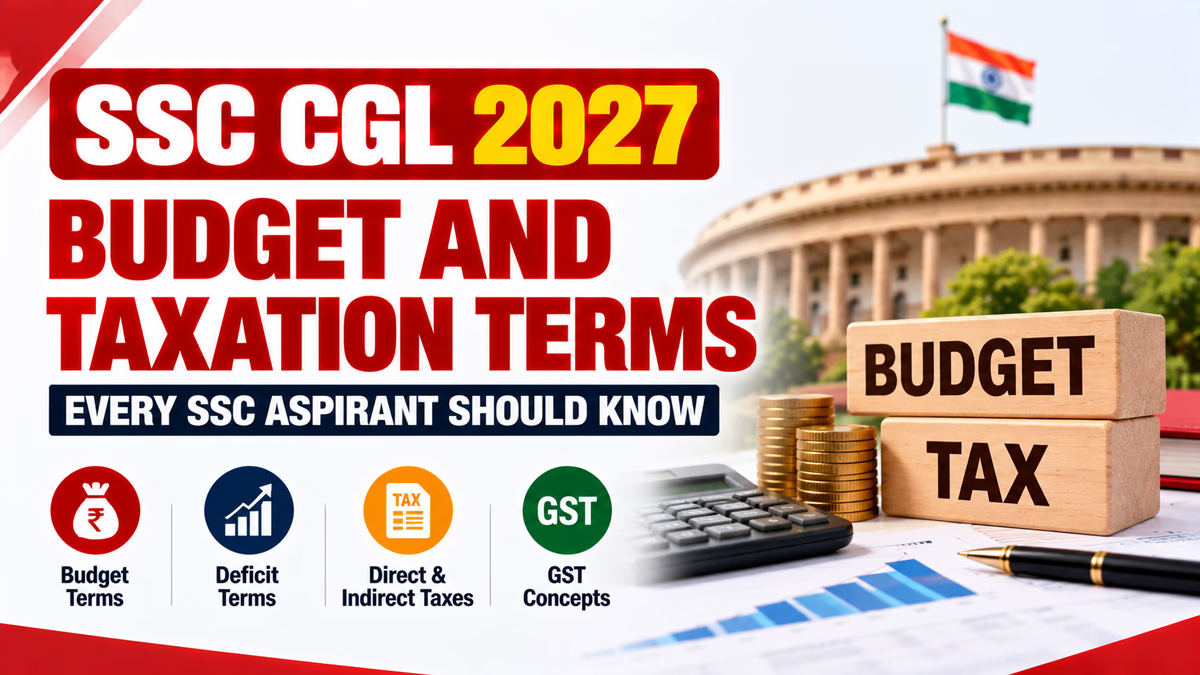
Budget and taxation are important topics in Indian Economy for SSC CGL 2027 and other competitive examinations. Questions may cover the Union Budget, fiscal deficit, revenue receipts, capital expenditure, direct and indirect taxes, GST and basic government finance terminology.
Understanding these terms helps candidates solve General Awareness questions without confusing similar concepts. This guide explains important budget and taxation terms with examples, comparison tables and practice MCQs.
The Union Budget is the Central Government's annual financial statement of estimated receipts and expenditure for a financial year. Article 112 of the Constitution of India refers to this statement as the Annual Financial Statement.
India's financial year runs from 1 April to 31 March. The Union Budget presents the government's plans for revenue collection, expenditure, borrowing and resource allocation.
Revenue receipts are receipts that do not create a liability for the government or reduce its assets. They include tax revenue and non-tax revenue.
Examples: Income tax, GST, customs duties, fees, dividends and interest receipts.
Capital receipts are receipts that either create a liability for the government or reduce its assets.
Examples: Government borrowings, recovery of loans and proceeds from disinvestment.
Revenue expenditure is spending that generally does not create assets or directly reduce liabilities. It includes the routine expenses required for government operations and public services.
Examples: Salaries, pensions, subsidies, interest payments and many operational expenses.
Capital expenditure generally creates assets or reduces liabilities. It can support long-term infrastructure development and improve productive capacity.
Examples: Spending on roads, bridges, rail infrastructure and certain capital investments or loans.
The fiscal deficit represents the excess of total government expenditure over total receipts excluding debt receipts. It indicates how much the government needs to finance through borrowing and other liabilities.
Basic formula:
Fiscal Deficit = Total Expenditure − Total Receipts excluding Debt Receipts
The revenue deficit occurs when revenue expenditure exceeds revenue receipts.
Formula:
Revenue Deficit = Revenue Expenditure − Revenue Receipts
A revenue deficit indicates that revenue receipts are insufficient to meet revenue expenditure.
The primary deficit is the fiscal deficit after subtracting interest payments on past borrowings.
Formula:
Primary Deficit = Fiscal Deficit − Interest Payments
This measure helps assess the current year's fiscal imbalance without including interest costs arising from previous debt.
| Basis | Revenue Receipts | Capital Receipts |
|---|---|---|
| Liability or Assets | Do not create liabilities or reduce assets | Create liabilities or reduce assets |
| Examples | Taxes, fees, dividends | Borrowings, loan recoveries, disinvestment proceeds |
| Tax Revenue | Included | Not included |
| Government Borrowing | Not included | Included |
| Basis | Revenue Expenditure | Capital Expenditure |
|---|---|---|
| General Purpose | Routine operations and services | Asset creation or liability reduction |
| Examples | Salaries, pensions, interest payments | Infrastructure projects and certain capital investments |
| Long-Term Assets | Generally does not create assets directly | Often creates assets or improves productive capacity |
A tax is a compulsory payment imposed by a government under law to finance public expenditure and support public functions. Taxes are commonly classified into direct and indirect taxes.
Direct taxes are generally imposed directly on the income, profits or specified wealth-related bases of persons or entities. The person or entity legally liable for the tax generally bears its burden.
Examples:
Indirect taxes are generally imposed on the supply, sale, manufacture or import of goods and services. Depending on the tax and market conditions, the tax burden may be passed on to consumers through prices.
Examples:
| Basis | Direct Tax | Indirect Tax |
|---|---|---|
| Tax Base | Income or profits, among other specified bases | Supply, sale or import of goods and services, depending on the tax |
| Examples | Income tax, corporate income tax | GST, customs duties |
| Burden | Generally borne by the person or entity liable | May be passed on to consumers |
| Collection | Collected from the person or entity liable under law | Often collected by businesses and remitted to the government |
Goods and Services Tax (GST) is an indirect tax on the supply of goods and services under India's GST framework. It was introduced in India on 1 July 2017.
The constitutional framework for GST was established through the 101st Constitutional Amendment Act, 2016.
A Finance Bill contains legislative proposals relating to taxation and other financial matters announced through the budget process. Its provisions must be considered and enacted through the applicable parliamentary procedure before they become law.
For exam preparation, remember that budget announcements and proposals do not automatically become law merely because they are presented. The relevant legislative process must be completed where required.
The Economic Survey is a government publication that reviews the performance of the Indian economy and discusses major economic developments, challenges and policy issues. It is generally presented before the Union Budget.
For SSC CGL, distinguish the Economic Survey, which analyses economic trends and performance, from the Union Budget, which presents the government's estimated receipts and expenditure.
Tax revenue is income received by the government through taxes such as income tax, GST and customs duties.
Non-tax revenue includes receipts such as fees, fines, dividends from government investments and interest receipts.
Disinvestment refers to the sale of the government's stake in a public sector enterprise or other government-owned investment. Depending on the transaction, it may generate capital receipts.
A subsidy is financial support provided by the government to reduce the cost of certain goods, services or activities, or to support specific policy objectives.
Public debt refers to the government's outstanding borrowings. Interest payments on public debt are an important component of government expenditure.
Which Article of the Constitution refers to the Annual Financial Statement of the Union Government?
A) Article 110
B) Article 112
C) Article 123
D) Article 280
Which of the following is an example of a direct tax?
A) GST
B) Customs duty
C) Income tax
D) IGST
Which deficit is calculated by subtracting interest payments from the fiscal deficit?
A) Revenue deficit
B) Primary deficit
C) Trade deficit
D) Current account deficit
Which of the following is generally classified as capital expenditure?
A) Routine office expenses
B) Salaries
C) Construction of a government highway
D) Pension payments
When was GST introduced in India?
A) 1 April 2016
B) 1 July 2017
C) 1 January 2018
D) 1 April 2019
Which Constitutional Amendment Act established the constitutional framework for GST?
A) 73rd Amendment
B) 86th Amendment
C) 101st Amendment
D) 103rd Amendment
Which of the following is a non-tax revenue receipt?
A) Income tax
B) GST
C) Customs duty
D) Dividend received by the government
Which document reviews the performance and major developments of the Indian economy and is generally presented before the Union Budget?
A) Economic Survey
B) Finance Commission Report only
C) Census Report
D) Election Commission Report
Which tax is generally applicable to inter-state supplies under India's GST framework?
A) SGST only
B) CGST only
C) IGST
D) Property tax
Revenue deficit occurs when:
A) Capital receipts exceed capital expenditure
B) Revenue expenditure exceeds revenue receipts
C) Tax revenue equals non-tax revenue
D) Interest payments become zero
| Question | Correct Answer | Explanation |
|---|---|---|
| 1 | B) Article 112 | Article 112 refers to the Annual Financial Statement. |
| 2 | C) Income tax | Income tax is a direct tax. |
| 3 | B) Primary deficit | Primary deficit equals fiscal deficit minus interest payments. |
| 4 | C) Construction of a government highway | Infrastructure construction generally creates a long-term asset. |
| 5 | B) 1 July 2017 | GST was introduced in India on 1 July 2017. |
| 6 | C) 101st Amendment | The 101st Constitutional Amendment Act established the constitutional framework for GST. |
| 7 | D) Dividend received by the government | Government dividend receipts are classified as non-tax revenue. |
| 8 | A) Economic Survey | The Economic Survey reviews economic performance and developments. |
| 9 | C) IGST | IGST generally applies to inter-state supplies under the GST framework. |
| 10 | B) Revenue expenditure exceeds revenue receipts | This is the definition of revenue deficit. |
Budget and taxation terminology is an important part of Indian Economy for SSC CGL 2027. Candidates should understand government receipts and expenditure, fiscal deficit, taxation categories, GST and the role of the Union Budget and Economic Survey.
Regular revision of definitions, formulas and practice questions can improve accuracy in General Awareness. Stay connected with Katara Academy for more exam-focused Indian Economy notes and SSC CGL preparation resources.