





Download the App & Start Learning
- Expert Faculty Guidance
- Updated Study Material
- Mock Tests & Practice Quiz
- Live Doubt Solving Sessions
- Exam-Oriented Preparation
- Motivation & Success Strategy
Katara Academy

10/16/2026
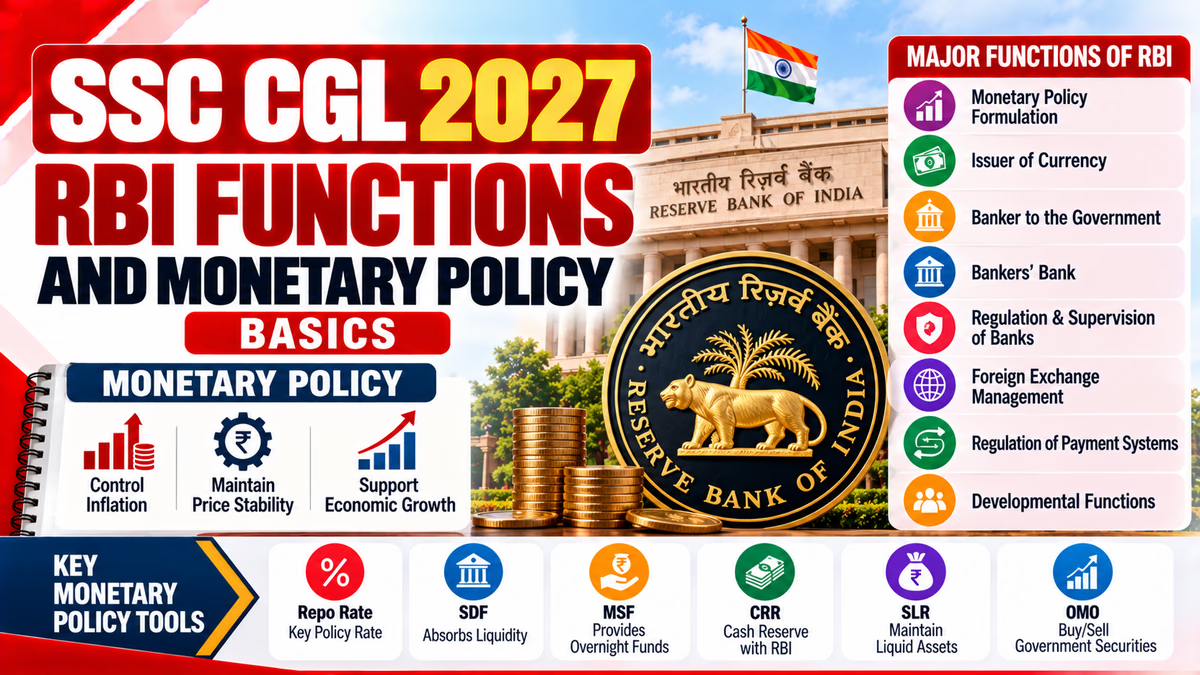
The Reserve Bank of India (RBI) is India's central bank and plays a major role in maintaining monetary and financial stability. Its responsibilities include monetary policy, currency management, regulation of banks, foreign exchange management and oversight of important payment systems.
For SSC CGL 2027, RBI-related questions are important for General Awareness and Indian Economy. Candidates should understand the functions of the RBI, the meaning of monetary policy, key policy rates, the Monetary Policy Committee (MPC) and the difference between monetary and fiscal policy.
The Reserve Bank of India was established on 1 April 1935 under the Reserve Bank of India Act, 1934. It began as a privately owned institution and was nationalised in 1949.
The RBI's central office was initially established in Kolkata and was permanently moved to Mumbai in 1937. Today, the RBI operates as India's central bank and performs functions essential to the country's monetary and financial system.
| Fact | Answer |
|---|---|
| Full Form | Reserve Bank of India |
| Established | 1 April 1935 |
| Governing Law | Reserve Bank of India Act, 1934 |
| Nationalisation | 1949 |
| Headquarters | Mumbai, Maharashtra |
| Main Role | Central bank of India |
| Monetary Policy Committee | Six members |
| Primary Monetary Policy Objective | Price stability while keeping in mind the objective of growth |
The RBI formulates and implements monetary policy to influence interest rates, liquidity and credit conditions in the economy. Its policy decisions aim to maintain price stability while keeping the objective of economic growth in mind.
Changes in policy rates can affect borrowing costs, savings returns, investment decisions and demand for goods and services.
The RBI issues and manages banknotes in India, subject to the legal framework. The Government of India issues the one-rupee note and coins, while the RBI manages their circulation through the banking system.
For examination purposes, remember that the RBI does not issue the one-rupee note; it is issued by the Government of India.
The RBI acts as a banker, agent and adviser to the Central Government and, under the applicable arrangements, state governments. It manages government banking transactions, supports public debt management and provides financial services to governments.
The RBI maintains specified reserves of banks and provides facilities to eligible financial institutions. It supports the smooth functioning of the banking system and can provide liquidity assistance under applicable rules.
The RBI regulates and supervises banks and certain financial institutions under the relevant laws. It establishes regulatory requirements, monitors financial soundness and works to protect the stability of the banking system.
The RBI administers important provisions of the Foreign Exchange Management Act, 1999 (FEMA), and manages aspects of India's foreign exchange reserves and market operations. These responsibilities help support orderly foreign exchange transactions and external stability.
The RBI oversees payment and settlement systems within its legal authority. Reliable payment systems help individuals, businesses, banks and public institutions transfer money securely and efficiently.
The RBI also undertakes developmental initiatives that support financial inclusion, financial literacy, efficient credit delivery and the development of financial markets.
Monetary policy refers to the actions taken by a central bank to influence interest rates, money-market conditions and liquidity in the economy. In India, the RBI uses monetary policy instruments to pursue price stability while keeping economic growth in mind.
When inflationary pressures are high, tighter monetary policy may help moderate demand. When economic activity is weak and inflation conditions permit, an easing of policy may support borrowing and spending.
The Monetary Policy Committee is responsible for determining the policy interest rate required to achieve the inflation target under India's monetary policy framework.
The inflation-targeting framework uses the Consumer Price Index (CPI) as its measure of inflation. The target is notified by the Central Government in consultation with the RBI for the applicable period.
The repo rate is the policy rate associated with the RBI's lending of funds to banks against eligible collateral under the relevant liquidity operations. It is a key signal of the monetary policy stance.
When the repo rate rises, borrowing costs may increase across the economy. When it falls, lending rates may ease, depending on transmission through the financial system.
The Standing Deposit Facility allows the RBI to absorb liquidity from banks without providing collateral. It serves as the floor of the Liquidity Adjustment Facility corridor under the current framework.
The Marginal Standing Facility allows eligible scheduled commercial banks to obtain overnight funds from the RBI against eligible securities, subject to applicable conditions. It is generally positioned above the repo rate in the policy corridor.
The Cash Reserve Ratio is the prescribed percentage of a bank's Net Demand and Time Liabilities that must be maintained as cash balances with the RBI.
A higher CRR can reduce the funds available to banks for lending, while a lower CRR can increase the liquidity available to the banking system, all else being equal.
The Statutory Liquidity Ratio is the prescribed percentage of a bank's Net Demand and Time Liabilities that must be maintained in specified liquid assets, such as cash, gold and eligible unencumbered securities.
Unlike the CRR, which is maintained as cash balances with the RBI, the SLR is maintained by banks in eligible liquid assets under the applicable rules.
Open Market Operations involve the purchase or sale of government securities by the RBI to manage liquidity in the banking system.
The Bank Rate is a rate defined under the RBI framework and is associated with specified lending and rediscounting functions. It is also linked to certain penalty rates under RBI regulations. For exam preparation, distinguish it from the repo rate, which is the key policy rate used in the monetary policy corridor.
| Instrument | Main Purpose | Important Point |
|---|---|---|
| Repo Rate | Signals the monetary policy stance and influences short-term borrowing costs | Key policy rate |
| Standing Deposit Facility | Absorbs liquidity without collateral | Floor of the policy corridor |
| Marginal Standing Facility | Provides overnight funds to eligible banks | Generally above the repo rate |
| CRR | Controls liquidity through cash reserve requirements | Cash balances maintained with RBI |
| SLR | Requires banks to maintain specified liquid assets | Maintained by banks in eligible assets |
| Open Market Operations | Manages banking-system liquidity | Purchase injects; sale absorbs liquidity in general |
| Bank Rate | Rate defined under the RBI framework for specified purposes | Different from the repo rate |
These effects are not automatic. Their size and timing depend on inflation expectations, credit demand, bank funding costs, market conditions and the transmission of monetary policy through the financial system.
| Basis | Monetary Policy | Fiscal Policy |
|---|---|---|
| Primary Institution | Reserve Bank of India | Central Government, with Parliament's role in budgetary matters |
| Main Tools | Policy rates, reserve requirements, liquidity operations and other monetary instruments | Taxation, government expenditure and borrowing |
| Main Focus | Price stability, liquidity and monetary conditions | Public revenue, expenditure, borrowing and broader economic objectives |
| Examples | Changing the repo rate or conducting open market operations | Changing tax provisions or public spending through the budget |
When was the Reserve Bank of India established?
A) 1925
B) 1935
C) 1947
D) 1949
Under which Act was the RBI established?
A) Banking Regulation Act, 1949
B) Reserve Bank of India Act, 1934
C) Companies Act, 2013
D) Foreign Exchange Management Act, 1999
How many members are there in India's Monetary Policy Committee?
A) 4
B) 5
C) 6
D) 8
Which institution issues the one-rupee note in India?
A) Reserve Bank of India
B) State Bank of India
C) Government of India
D) Securities and Exchange Board of India
Which monetary policy instrument requires banks to maintain cash balances with the RBI as a prescribed proportion of their liabilities?
A) SLR
B) CRR
C) OMO
D) Bank Rate
Which instrument involves the purchase and sale of government securities by the RBI?
A) Open Market Operations
B) Fiscal deficit
C) Goods and Services Tax
D) Public expenditure
Which organisation is India's central bank?
A) SEBI
B) NABARD
C) Reserve Bank of India
D) National Stock Exchange
Which Act provides the framework for foreign exchange management in India?
A) RBI Act, 1934
B) FEMA, 1999
C) Indian Contract Act, 1872
D) Competition Act, 2002
Which policy is primarily concerned with taxation and government expenditure?
A) Monetary policy
B) Fiscal policy
C) Exchange-rate policy only
D) Credit rating policy
What is the general effect of an RBI purchase of government securities through open market operations?
A) It generally injects liquidity into the banking system.
B) It always increases the CRR.
C) It directly changes income tax rates.
D) It abolishes the repo rate.
| Question | Correct Answer | Explanation |
|---|---|---|
| 1 | B) 1935 | The RBI began operations on 1 April 1935. |
| 2 | B) Reserve Bank of India Act, 1934 | The Act provided the legal basis for establishing the RBI. |
| 3 | C) 6 | The MPC consists of three RBI representatives and three external members. |
| 4 | C) Government of India | The one-rupee note is issued by the Government of India. |
| 5 | B) CRR | The Cash Reserve Ratio requires banks to maintain specified cash balances with the RBI. |
| 6 | A) Open Market Operations | OMO involves the purchase and sale of government securities by the RBI. |
| 7 | C) Reserve Bank of India | The RBI is India's central bank. |
| 8 | B) FEMA, 1999 | The Foreign Exchange Management Act provides the framework for foreign exchange management. |
| 9 | B) Fiscal policy | Fiscal policy involves government revenue, taxation, expenditure and borrowing. |
| 10 | A) It generally injects liquidity into the banking system. | When the RBI purchases government securities, funds generally flow into the banking system. |
The Reserve Bank of India is central to India's monetary and financial system. For SSC CGL 2027, focus on its history, functions, Monetary Policy Committee, monetary policy instruments and the distinction between monetary and fiscal policy.
Build a strong foundation with these concepts, revise key facts regularly and practise topic-wise questions to improve your General Awareness preparation. Stay connected with Katara Academy for more SSC CGL study notes and competitive exam preparation resources.