



Download the App & Start Learning
- Expert Faculty Guidance
- Updated Study Material
- Mock Tests & Practice Quiz
- Live Doubt Solving Sessions
- Exam-Oriented Preparation
- Motivation & Success Strategy
Katara Academy

10/16/2026
The Constitution of India is a living document that can be amended to address changing social, political and administrative needs. Constitutional amendments are an important topic in Indian Polity for SSC CGL 2027, SSC CHSL and other competitive examinations.
Questions often focus on the year of an amendment, its major provisions, the articles affected and important changes relating to Fundamental Rights, Parliament, elections, local government and the judiciary. This guide covers key constitutional amendments, quick revision tables and practice questions to help aspirants prepare effectively.
A constitutional amendment is a formal change to the Constitution. Article 368 lays down the principal procedure for Parliament to amend the Constitution, although certain constitutional changes are made through other procedures prescribed by the Constitution.
Depending on the subject, an amendment may require a simple majority, a special majority in Parliament, or a special majority along with ratification by at least half of the state legislatures.
Certain provisions can be changed by a simple majority of members present and voting in Parliament. Such changes are generally not treated as amendments under Article 368.
Most amendments under Article 368 require a majority of the total membership of each House of Parliament and a two-thirds majority of members present and voting in each House.
Some amendments affecting federal provisions also require ratification by at least half of the state legislatures. These include specified changes concerning the election of the President, the distribution of legislative powers, representation of states in Parliament and Article 368 itself.
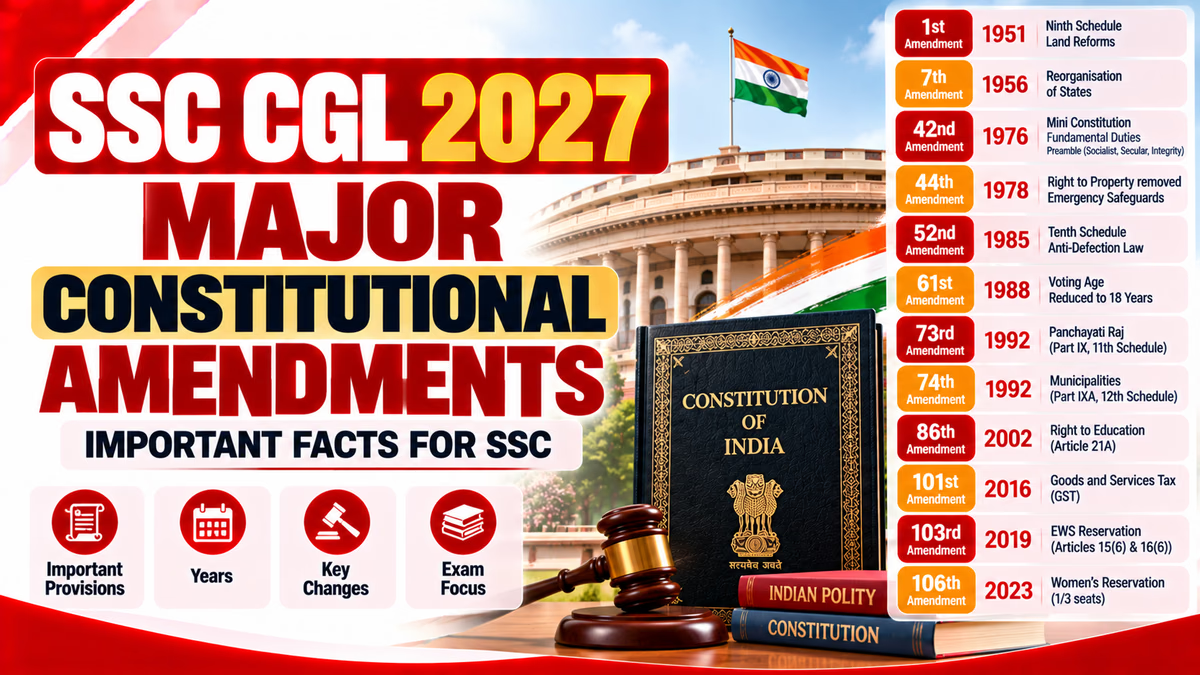
| Amendment | Year | Important Provision |
|---|---|---|
| 1st Amendment | 1951 | Added the Ninth Schedule and made changes concerning restrictions on certain rights and land reform laws. |
| 7th Amendment | 1956 | Implemented major changes to the organisation of states and the constitutional framework for states and Union Territories. |
| 24th Amendment | 1971 | Clarified Parliament's power to amend the Constitution, including Fundamental Rights, subject to constitutional limitations. |
| 42nd Amendment | 1976 | Known as the “Mini Constitution”; added Fundamental Duties and inserted the words Socialist, Secular and Integrity into the Preamble. |
| 44th Amendment | 1978 | Removed the Right to Property from Fundamental Rights and introduced safeguards relating to emergency provisions. |
| 52nd Amendment | 1985 | Added the Tenth Schedule concerning disqualification on grounds of defection. |
| 61st Amendment | 1988 | Reduced the voting age for Lok Sabha and state legislative assembly elections from 21 to 18 years. |
| 69th Amendment | 1991 | Provided a special constitutional framework for the National Capital Territory of Delhi, including Articles 239AA and 239AB. |
| 73rd Amendment | 1992 | Gave constitutional recognition to Panchayati Raj institutions through Part IX and the Eleventh Schedule. |
| 74th Amendment | 1992 | Provided constitutional recognition to municipalities through Part IXA and the Twelfth Schedule. |
| 86th Amendment | 2002 | Introduced Article 21A on education for children aged 6–14 and added a related Fundamental Duty. |
| 91st Amendment | 2003 | Restricted the size of the Council of Ministers and strengthened provisions relating to defection. |
| 97th Amendment | 2011 | Addressed cooperative societies; part of its provisions concerning state cooperative societies was later held invalid by the Supreme Court for lack of required state ratification. |
| 101st Amendment | 2016 | Introduced the constitutional framework for the Goods and Services Tax (GST). |
| 102nd Amendment | 2018 | Gave constitutional status to the National Commission for Backward Classes. |
| 103rd Amendment | 2019 | Enabled up to 10% reservation for Economically Weaker Sections (EWS), subject to constitutional provisions. |
| 104th Amendment | 2020 | Extended reservation of seats for Scheduled Castes and Scheduled Tribes in the Lok Sabha and state legislative assemblies for a further period, while ending the provision for nomination of Anglo-Indian members to these bodies. |
| 105th Amendment | 2021 | Restored the power of states and Union Territories to identify socially and educationally backward classes for their own purposes, subject to the constitutional framework. |
| 106th Amendment | 2023 | Provided for reservation of approximately one-third of seats for women in the Lok Sabha, state legislative assemblies and the Delhi Legislative Assembly, subject to the implementation provisions in the amendment. |
The 42nd Amendment is one of the most frequently discussed constitutional amendments in Indian Polity. It introduced several significant changes during the Emergency period and is popularly known as the “Mini Constitution.”
Important provisions include:
For SSC CGL, remember the connection between the 42nd Amendment, the Preamble and Fundamental Duties.
The 44th Amendment was enacted after the Emergency period and introduced important safeguards in the constitutional framework.
Remember: the Right to Property is now a constitutional right under Article 300A, not a Fundamental Right under Part III.
The 61st Amendment reduced the voting age for elections to the Lok Sabha and state legislative assemblies from 21 years to 18 years. It amended Article 326, which concerns elections based on adult suffrage.
This amendment is a common factual question in competitive examinations because the change is direct and easy to test.
The 73rd and 74th Amendments, both enacted in 1992, strengthened local self-government in rural and urban areas.
The 86th Amendment introduced Article 21A, providing for free and compulsory education for children aged six to fourteen years in the manner determined by law.
It also modified Article 45 and added a Fundamental Duty under Article 51A(k), requiring parents or guardians to provide opportunities for education to children or wards aged six to fourteen years.
The 101st Amendment established the constitutional framework for the Goods and Services Tax (GST). It introduced important changes to the division of taxation powers between the Union and states.
Article 279A provides for the GST Council, which makes recommendations on important GST-related matters. The GST framework brought many indirect taxes into a more integrated system, subject to constitutional provisions and the applicable laws.
The 103rd Amendment enabled reservation of up to 10% for Economically Weaker Sections in specified educational admissions and public employment, subject to constitutional provisions.
It introduced Articles 15(6) and 16(6). The Supreme Court upheld the amendment in 2022.
The 106th Amendment, also known as the Constitution (One Hundred and Sixth Amendment) Act, 2023, provides for reservation of approximately one-third of seats for women in the Lok Sabha, state legislative assemblies and the Delhi Legislative Assembly.
The amendment contains implementation provisions linked to a census and subsequent delimitation exercise. Therefore, the reservation is not automatically applied to the existing seats immediately upon enactment.
| Topic | Amendment to Remember |
|---|---|
| Fundamental Duties | 42nd Amendment, 1976 |
| Right to Property removed from Fundamental Rights | 44th Amendment, 1978 |
| Anti-Defection Law | 52nd Amendment, 1985 |
| Voting age reduced to 18 years | 61st Amendment, 1988 |
| Panchayati Raj | 73rd Amendment, 1992 |
| Municipalities | 74th Amendment, 1992 |
| Right to Education | 86th Amendment, 2002 |
| Goods and Services Tax | 101st Amendment, 2016 |
| EWS reservation | 103rd Amendment, 2019 |
| Women's reservation framework | 106th Amendment, 2023 |
Which Constitutional Amendment Act is popularly known as the “Mini Constitution”?
A) 24th Amendment
B) 42nd Amendment
C) 44th Amendment
D) 52nd Amendment
Which amendment reduced the voting age from 21 years to 18 years?
A) 52nd Amendment
B) 61st Amendment
C) 73rd Amendment
D) 86th Amendment
Which amendment introduced the Anti-Defection Law through the Tenth Schedule?
A) 42nd Amendment
B) 44th Amendment
C) 52nd Amendment
D) 61st Amendment
Which amendment introduced the constitutional framework for GST?
A) 91st Amendment
B) 97th Amendment
C) 101st Amendment
D) 103rd Amendment
Which amendment introduced Article 21A on the Right to Education?
A) 73rd Amendment
B) 74th Amendment
C) 86th Amendment
D) 91st Amendment
Which amendment added the Eleventh Schedule to the Constitution?
A) 42nd Amendment
B) 52nd Amendment
C) 73rd Amendment
D) 74th Amendment
Which amendment is associated with the constitutional framework for the EWS reservation?
A) 86th Amendment
B) 91st Amendment
C) 101st Amendment
D) 103rd Amendment
Which Article provides for the GST Council?
A) Article 263
B) Article 279A
C) Article 300A
D) Article 326
Which amendment removed the Right to Property from the list of Fundamental Rights?
A) 24th Amendment
B) 42nd Amendment
C) 44th Amendment
D) 52nd Amendment
The constitutional framework for reservation of seats for women in the Lok Sabha and state legislative assemblies was introduced by which amendment?
A) 101st Amendment
B) 103rd Amendment
C) 104th Amendment
D) 106th Amendment
| Question | Correct Answer | Explanation |
|---|---|---|
| 1 | B) 42nd Amendment | It made wide-ranging changes and added Fundamental Duties. |
| 2 | B) 61st Amendment | It reduced the voting age to 18 years for Lok Sabha and state assembly elections. |
| 3 | C) 52nd Amendment | It introduced the Tenth Schedule concerning defection. |
| 4 | C) 101st Amendment | It established the constitutional framework for GST. |
| 5 | C) 86th Amendment | It introduced Article 21A on education for children aged six to fourteen years. |
| 6 | C) 73rd Amendment | It added the Eleventh Schedule concerning Panchayats. |
| 7 | D) 103rd Amendment | It enabled the EWS reservation framework through Articles 15(6) and 16(6). |
| 8 | B) Article 279A | It provides for the GST Council. |
| 9 | C) 44th Amendment | It removed the Right to Property from Fundamental Rights; Article 300A now protects it as a constitutional right. |
| 10 | D) 106th Amendment | It introduced the women's reservation framework with implementation provisions. |
Constitutional amendments are an important part of Indian Polity for SSC CGL 2027. Candidates should prioritise the 42nd, 44th, 52nd, 61st, 73rd, 74th, 86th, 101st, 103rd and 106th Amendments, while also understanding the amendment procedure under Article 368.
Regular revision, accurate understanding of constitutional provisions and topic-wise MCQ practice can help improve General Awareness preparation. Stay connected with Katara Academy for more SSC CGL revision notes and competitive exam study resources.