

Download the App & Start Learning
- Expert Faculty Guidance
- Updated Study Material
- Mock Tests & Practice Quiz
- Live Doubt Solving Sessions
- Exam-Oriented Preparation
- Motivation & Success Strategy
Katara Academy

10/16/2026
Parliamentary Committees play an important role in the functioning of the Indian Parliament. They examine bills, review government expenditure, study departmental performance and help Parliament perform its legislative and oversight responsibilities effectively. For SSC CGL 2027, this topic is useful for General Awareness and Indian Polity revision.
Questions on parliamentary committees may cover their types, composition, functions, chairpersons, tenure and the differences between the Public Accounts Committee, Estimates Committee and Committee on Public Undertakings. Understanding these basic concepts can help candidates answer factual questions with greater confidence.
Parliamentary Committees are groups of Members of Parliament formed to examine specific subjects and report their findings to Parliament or the relevant House. Since Parliament has extensive legislative, financial and oversight responsibilities, committees allow detailed examination of matters that may not receive sufficient attention during full House proceedings.
Committees can examine government spending, proposed legislation, departmental policies, public undertakings and issues referred to them. Their reports support parliamentary scrutiny and informed decision-making.
Parliamentary Committees are broadly classified into two major categories:
Standing Committees are permanent or regularly constituted committees that continue to function under established parliamentary rules. Their membership may be reconstituted periodically.
Examples include:
Ad hoc Committees are established for a particular purpose or task. They generally cease to exist after submitting their report or completing the assigned work.
Examples include select committees and joint committees appointed to examine specific bills or investigate particular matters.
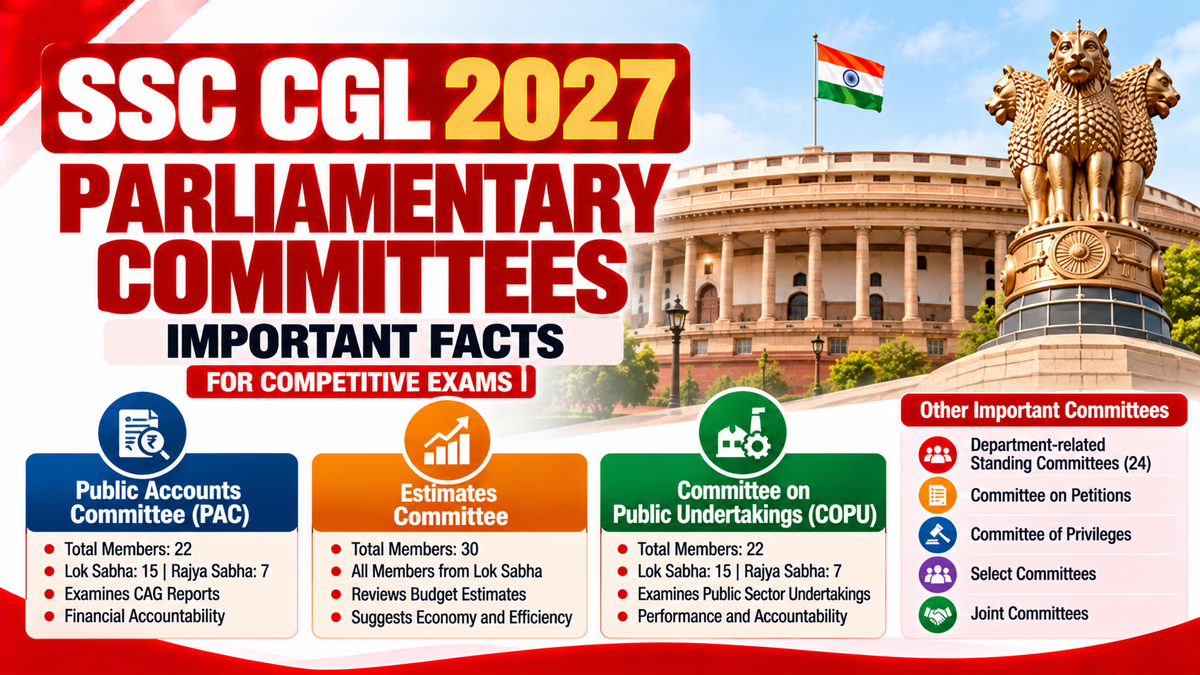
The three major financial committees are the Public Accounts Committee, Estimates Committee and Committee on Public Undertakings. These are especially important for competitive examinations.
The Public Accounts Committee examines government expenditure and reports of the Comptroller and Auditor-General of India (CAG) to determine whether public money has been spent in accordance with parliamentary authorisation and applicable rules.
The chairperson of the PAC is conventionally appointed from the opposition in recent parliamentary practice, although this is not a constitutional requirement.
The Estimates Committee examines budget estimates and suggests improvements in economy, efficiency and administrative organisation. It may recommend alternative policies to improve efficiency and reduce unnecessary expenditure.
For SSC CGL, remember that the Estimates Committee is the largest of the three major financial committees by membership, with 30 members.
The Committee on Public Undertakings examines reports and accounts of specified public sector undertakings and reviews aspects of their performance, management and accountability within its assigned scope.
Its work helps Parliament assess the performance and accountability of public sector undertakings.
| Feature | Public Accounts Committee | Estimates Committee | Committee on Public Undertakings |
|---|---|---|---|
| Total Members | 22 | 30 | 22 |
| Lok Sabha Members | 15 | 30 | 15 |
| Rajya Sabha Members | 7 | 0 | 7 |
| Main Focus | Government expenditure and CAG reports | Budget estimates and administrative efficiency | Public sector undertakings |
| Key Objective | Financial accountability | Economy and efficiency | Performance and accountability of specified undertakings |
Department-related Standing Committees examine the demands for grants of ministries and departments, bills referred to them, annual reports and policy documents within their assigned responsibilities.
There are 24 Department-related Standing Committees. Each committee has 31 members, comprising 21 members from the Lok Sabha nominated by the Speaker and 10 members from the Rajya Sabha nominated by the Chairman of the Rajya Sabha.
These committees help Parliament examine the work of ministries in greater detail. Their reports are generally recommendatory and do not replace the legislative authority of Parliament.
Committees can examine provisions of bills in detail, gather evidence where appropriate and make recommendations for improvements. This can help identify technical or implementation-related issues.
Financial committees examine public expenditure, budget estimates and reports relating to government accounts. Their work supports transparency and accountability in the use of public funds.
Committees scrutinise government departments and specified public undertakings. This helps Parliament review administrative performance and assess whether public policies are being implemented effectively.
Committee proceedings can provide opportunities for detailed discussion and the examination of information from relevant sources. This supports better-informed parliamentary decisions.
Which parliamentary committee examines reports of the Comptroller and Auditor-General of India relating to government expenditure?
A) Estimates Committee
B) Public Accounts Committee
C) Committee on Petitions
D) Committee of Privileges
How many members are there in the Estimates Committee?
A) 15
B) 22
C) 30
D) 31
Which of the following committees consists entirely of Lok Sabha members?
A) Public Accounts Committee
B) Committee on Public Undertakings
C) Estimates Committee
D) Department-related Standing Committees
What is the total membership of the Public Accounts Committee?
A) 20
B) 22
C) 25
D) 30
Which committee primarily examines the performance of specified public sector undertakings?
A) Estimates Committee
B) Committee on Public Undertakings
C) Committee on Petitions
D) Business Advisory Committee
How many Department-related Standing Committees are there in the Indian Parliament?
A) 16
B) 20
C) 24
D) 30
How many members are there in each Department-related Standing Committee?
A) 22
B) 24
C) 30
D) 31
Which committee is associated with recommending improvements in economy and efficiency in government administration?
A) Estimates Committee
B) Committee of Privileges
C) Committee on Petitions
D) Ethics Committee
How many members of the Public Accounts Committee come from the Rajya Sabha?
A) 5
B) 7
C) 10
D) 15
Which statement about parliamentary committee reports is generally correct?
A) Every recommendation automatically becomes law.
B) Committees replace Parliament's legislative authority.
C) Committee reports support scrutiny and are generally recommendatory.
D) Committees can independently amend the Constitution.
| Question | Correct Answer | Explanation |
|---|---|---|
| 1 | B) Public Accounts Committee | The PAC examines government accounts and relevant CAG reports. |
| 2 | C) 30 | The Estimates Committee consists of 30 Lok Sabha members. |
| 3 | C) Estimates Committee | All 30 members are from the Lok Sabha. |
| 4 | B) 22 | The PAC has 15 Lok Sabha members and 7 Rajya Sabha members. |
| 5 | B) Committee on Public Undertakings | It examines specified public sector undertakings and related reports and accounts. |
| 6 | C) 24 | There are 24 Department-related Standing Committees. |
| 7 | D) 31 | Each committee comprises 21 Lok Sabha members and 10 Rajya Sabha members. |
| 8 | A) Estimates Committee | It reviews estimates and recommends improvements in economy and efficiency. |
| 9 | B) 7 | Seven PAC members are drawn from the Rajya Sabha. |
| 10 | C) Committee reports support scrutiny and are generally recommendatory | Committees examine issues and make recommendations; they do not replace Parliament's authority. |
Parliamentary Committees are essential to the legislative, financial and oversight functions of the Indian Parliament. For SSC CGL 2027, focus on the Public Accounts Committee, Estimates Committee, Committee on Public Undertakings and Department-related Standing Committees. Learning their composition and responsibilities, followed by regular MCQ practice, can strengthen your Indian Polity preparation.
Stay connected with Katara Academy for more exam-focused General Awareness notes, Indian Polity revision guides and SSC CGL preparation resources.