





Download the App & Start Learning
- Expert Faculty Guidance
- Updated Study Material
- Mock Tests & Practice Quiz
- Live Doubt Solving Sessions
- Exam-Oriented Preparation
- Motivation & Success Strategy
Katara Academy

10/16/2026
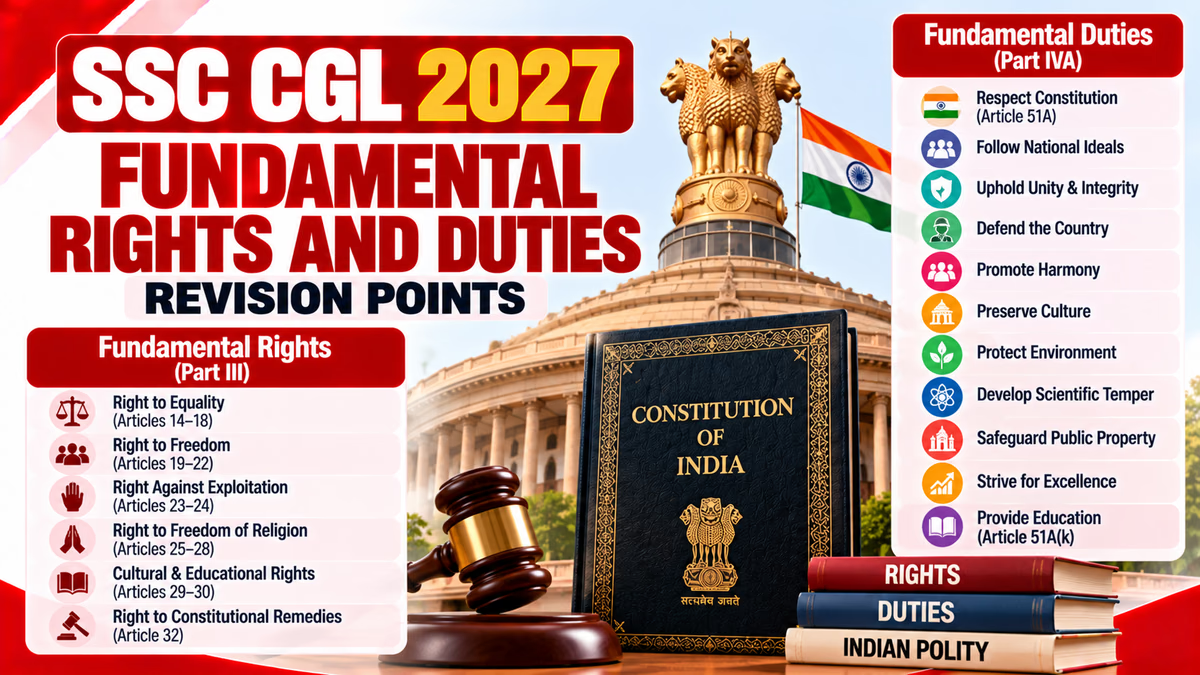
Fundamental Rights and Fundamental Duties are important topics in Indian Polity for SSC CGL 2027 and other competitive examinations. Questions may focus on constitutional articles, amendments, the number of rights and duties, and the difference between enforceable rights and civic responsibilities.
In this article, we will cover the essential constitutional provisions, important facts, key amendments, and practice MCQs to help SSC aspirants revise this topic effectively.
Fundamental Rights are basic rights guaranteed by the Constitution of India. They protect individual liberty, promote equality, and limit arbitrary state action. Most Fundamental Rights are contained in Part III of the Constitution, from Articles 12 to 35.
Originally, the Constitution recognised seven categories of Fundamental Rights. The Right to Property was later removed from the list of Fundamental Rights by the 44th Constitutional Amendment Act, 1978. It is now a constitutional right under Article 300A.
| Fundamental Right | Articles | Key Points for SSC |
|---|---|---|
| Right to Equality | Articles 14–18 | Equality before law, prohibition of discrimination, equality of opportunity in public employment, abolition of untouchability and titles. |
| Right to Freedom | Articles 19–22 | Includes specified freedoms, protections in criminal cases, protection of life and personal liberty, and safeguards concerning arrest and detention. |
| Right Against Exploitation | Articles 23–24 | Prohibits trafficking, forced labour and employment of children below 14 in factories, mines and other hazardous employment as covered by Article 24. |
| Right to Freedom of Religion | Articles 25–28 | Protects freedom of conscience and specified rights relating to religion, subject to constitutional limitations. |
| Cultural and Educational Rights | Articles 29–30 | Protects specified cultural interests and the rights of religious and linguistic minorities to establish and administer educational institutions. |
| Right to Constitutional Remedies | Article 32 | Allows individuals to approach the Supreme Court for enforcement of Fundamental Rights. |
Article 14 guarantees equality before the law and equal protection of the laws to every person within the territory of India. It is an important provision for questions on equality and the rule of law.
Article 15 prohibits discrimination by the State on grounds only of religion, race, caste, sex or place of birth. The Constitution also permits specified special provisions in areas such as the advancement of socially and educationally backward classes, Scheduled Castes, Scheduled Tribes and other constitutionally covered categories.
Article 16 provides equality of opportunity in matters of public employment, subject to the provisions and exceptions contained in the Constitution.
Article 17 abolishes untouchability and forbids its practice in any form. Enforcement of a disability arising from untouchability is an offence punishable according to law.
Article 19 guarantees specified freedoms to citizens, subject to constitutionally permitted reasonable restrictions. These include:
Article 21 states that no person shall be deprived of life or personal liberty except according to procedure established by law. Judicial interpretation has given this provision broad significance in protecting dignity and liberty.
Article 21A provides for free and compulsory education for children aged six to fourteen years in the manner determined by law. It was introduced by the 86th Constitutional Amendment Act, 2002.
Article 23 prohibits trafficking in human beings, begar and other similar forms of forced labour. It is an important article under the Right Against Exploitation.
Article 24 prohibits the employment of children below fourteen years in factories, mines or other hazardous employment covered by the provision.
Article 25 protects freedom of conscience and the right to freely profess, practise and propagate religion, subject to public order, morality, health and the other provisions of Part III.
Article 32 allows individuals to approach the Supreme Court for the enforcement of Fundamental Rights. Dr. B. R. Ambedkar described Article 32 as the “heart and soul” of the Constitution.
Fundamental Duties are civic responsibilities expected of citizens of India. They are listed in Part IVA of the Constitution under Article 51A.
Originally, ten Fundamental Duties were introduced by the 42nd Constitutional Amendment Act, 1976, following the recommendations of the Swaran Singh Committee. The 86th Constitutional Amendment Act, 2002, added the eleventh duty relating to educational opportunities for children aged six to fourteen years.
Article 51A lists the following duties of every citizen of India:
| Basis | Fundamental Rights | Fundamental Duties |
|---|---|---|
| Constitutional Part | Part III | Part IVA |
| Main Articles | Articles 12–35 | Article 51A |
| Purpose | Protect rights and freedoms | Promote civic responsibility |
| Number | Six recognised categories | Eleven duties |
| Applicability | Depends on the specific right; some apply to citizens and others to all persons | Fundamental Duties apply to citizens of India |
| Enforcement | Fundamental Rights can be enforced through constitutional remedies, subject to their provisions | Not directly enforceable in the same manner; specific laws may support related obligations |
| Amendment | Year | Important Provision |
|---|---|---|
| 42nd Amendment | 1976 | Added Fundamental Duties through Part IVA and Article 51A. |
| 44th Amendment | 1978 | Removed the Right to Property from the list of Fundamental Rights; it is now protected under Article 300A. |
| 86th Amendment | 2002 | Introduced Article 21A on education and added the eleventh Fundamental Duty. |
The Supreme Court can issue writs for the enforcement of Fundamental Rights. Understanding the five traditional writs is useful for Indian Polity questions.
Remember that Article 32 concerns the Supreme Court's power to enforce Fundamental Rights, while Article 226 gives High Courts writ jurisdiction for Fundamental Rights and other legal purposes within its scope.
Fundamental Rights are primarily contained in which Part of the Indian Constitution?
A) Part II
B) Part III
C) Part IV
D) Part IVA
Which Article guarantees equality before the law and equal protection of the laws?
A) Article 12
B) Article 14
C) Article 19
D) Article 21
Which Constitutional Amendment Act introduced Fundamental Duties?
A) 24th Amendment Act
B) 42nd Amendment Act
C) 44th Amendment Act
D) 73rd Amendment Act
How many Fundamental Duties are currently listed under Article 51A?
A) 8
B) 10
C) 11
D) 12
Which Article is associated with the Right to Education for children aged six to fourteen years?
A) Article 19
B) Article 21A
C) Article 24
D) Article 32
The Right to Property is currently protected under which Article?
A) Article 14
B) Article 21
C) Article 300A
D) Article 368
Which Article prohibits trafficking in human beings and forced labour?
A) Article 17
B) Article 19
C) Article 23
D) Article 25
Which Article allows individuals to approach the Supreme Court for the enforcement of Fundamental Rights?
A) Article 21
B) Article 32
C) Article 44
D) Article 51A
Which Fundamental Duty concerns the protection and improvement of the natural environment?
A) Article 51A(a)
B) Article 51A(c)
C) Article 51A(g)
D) Article 51A(k)
Which writ is commonly associated with challenging unlawful detention?
A) Mandamus
B) Habeas Corpus
C) Quo Warranto
D) Prohibition
| Question | Correct Answer | Explanation |
|---|---|---|
| 1 | B) Part III | Part III contains the Fundamental Rights provisions. |
| 2 | B) Article 14 | Article 14 guarantees equality before the law and equal protection of the laws. |
| 3 | B) 42nd Amendment Act | The 42nd Amendment Act, 1976, introduced Fundamental Duties. |
| 4 | C) 11 | There are eleven Fundamental Duties under Article 51A. |
| 5 | B) Article 21A | Article 21A provides for free and compulsory education for children aged six to fourteen years. |
| 6 | C) Article 300A | The Right to Property is a constitutional right under Article 300A. |
| 7 | C) Article 23 | Article 23 prohibits trafficking and forced labour. |
| 8 | B) Article 32 | Article 32 provides a constitutional remedy before the Supreme Court for Fundamental Rights enforcement. |
| 9 | C) Article 51A(g) | It concerns protecting and improving the natural environment and showing compassion for living creatures. |
| 10 | B) Habeas Corpus | This writ can be used to challenge unlawful detention. |
Fundamental Rights and Fundamental Duties are essential topics for SSC CGL 2027 Indian Polity preparation. Focus on the constitutional articles, the six categories of Fundamental Rights, the eleven Fundamental Duties, important amendments and the five writs. Regular revision and topic-wise practice can help you answer direct factual questions more confidently.
Stay connected with Katara Academy for more exam-oriented Indian Polity notes, General Awareness revision material and SSC CGL preparation resources.