






Download the App & Start Learning
- Expert Faculty Guidance
- Updated Study Material
- Mock Tests & Practice Quiz
- Live Doubt Solving Sessions
- Exam-Oriented Preparation
- Motivation & Success Strategy
Katara Academy

10/16/2026
The Indian Constitution is one of the most important topics in General Awareness for SSC CGL and other competitive examinations. Questions may cover constitutional articles, amendments, fundamental rights, duties, and schedules. Understanding the schedules of the Indian Constitution helps candidates revise important facts and answer direct questions more confidently.
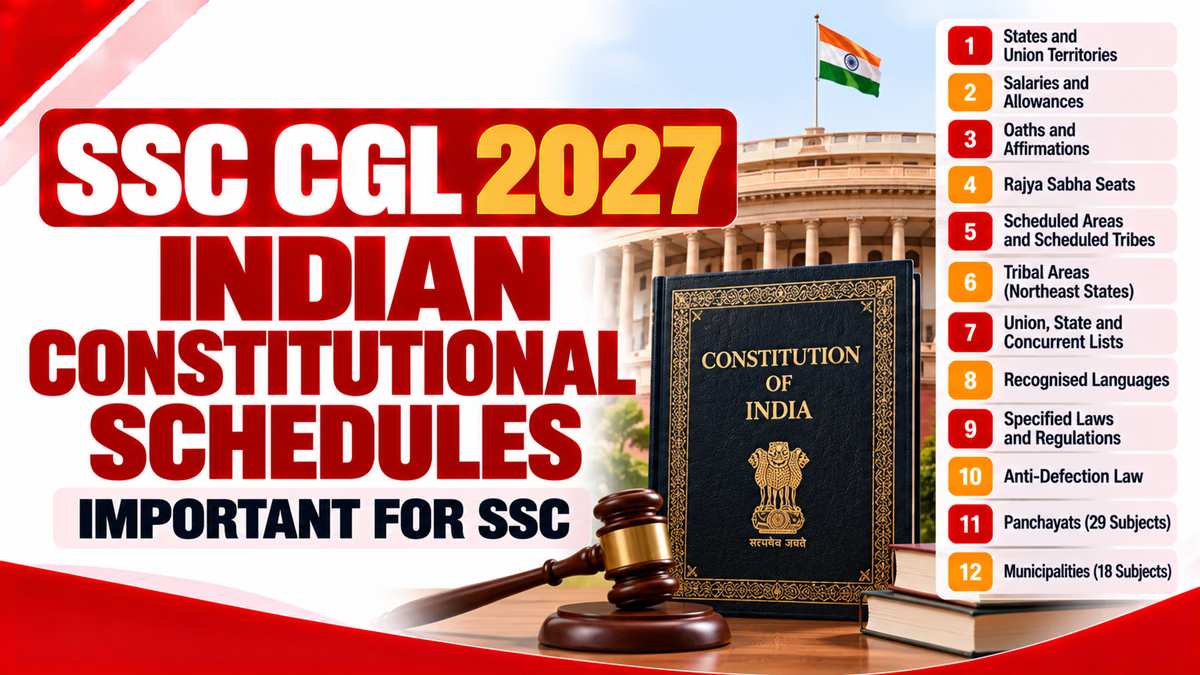
There are currently 12 Schedules in the Constitution of India. Each schedule deals with specific constitutional provisions, ranging from the names of states and Union Territories to the allocation of Rajya Sabha seats, recognised languages, anti-defection rules, and the responsibilities of local bodies.
Schedules are supplementary parts of the Constitution that provide detailed lists, classifications, and provisions related to its articles. They help organise constitutional information and explain how certain provisions are applied.
Originally, the Constitution of India had 8 Schedules when it came into force on 26 January 1950. Amendments subsequently added four more schedules, bringing the total to 12.
| Schedule | Subject | Important Facts for SSC |
|---|---|---|
| First Schedule | States and Union Territories | Lists the states and Union Territories of India and their territorial details. |
| Second Schedule | Salaries, allowances and privileges | Contains provisions concerning the emoluments and related matters of specified constitutional authorities. |
| Third Schedule | Oaths and affirmations | Provides forms of oaths and affirmations for specified constitutional offices. |
| Fourth Schedule | Allocation of Rajya Sabha seats | Deals with the allocation of seats in the Council of States among states and certain Union Territories. |
| Fifth Schedule | Scheduled Areas and Scheduled Tribes | Deals with the administration and control of Scheduled Areas and Scheduled Tribes in states other than the areas covered by the Sixth Schedule. |
| Sixth Schedule | Tribal areas in four northeastern states | Provides special arrangements for the administration of tribal areas in Assam, Meghalaya, Tripura and Mizoram. |
| Seventh Schedule | Division of legislative powers | Contains the Union List, State List and Concurrent List. |
| Eighth Schedule | Recognised languages | Lists 22 constitutionally recognised languages. |
| Ninth Schedule | Specified laws and regulations | Originally introduced to address challenges to certain land reform laws; its legal protection is subject to constitutional limitations and judicial review. |
| Tenth Schedule | Anti-defection provisions | Deals with disqualification of members of Parliament and state legislatures on grounds of defection, subject to its provisions. |
| Eleventh Schedule | Panchayats | Lists 29 subjects that may be devolved to Panchayats under the constitutional framework. |
| Twelfth Schedule | Municipalities | Lists 18 functional subjects associated with municipalities. |
The First Schedule contains the names of the states and Union Territories of India along with their territorial descriptions. It is associated with Article 1 and the constitutional description of the territory of India.
For SSC examinations, remember that the First Schedule is related to states and Union Territories, while Article 3 provides the constitutional procedure for forming new states and altering the areas, boundaries or names of existing states, subject to its requirements.
The Second Schedule covers specified provisions relating to salaries, allowances and other matters concerning certain constitutional officeholders. These include provisions concerning the President, Governors, presiding officers of legislatures, judges of the Supreme Court and High Courts, and the Comptroller and Auditor-General of India.
The Third Schedule contains prescribed forms of oaths and affirmations for specified constitutional offices and responsibilities. It is useful to distinguish the Second Schedule, which concerns emoluments and related matters, from the Third Schedule, which concerns oaths and affirmations.
The Fourth Schedule deals with the allocation of seats in the Rajya Sabha, also known as the Council of States. The allocation among states and certain Union Territories is governed by the constitutional framework.
Exam tip: If a question asks which schedule concerns the allocation of seats in the Rajya Sabha, the correct answer is the Fourth Schedule.
The Fifth Schedule deals with the administration and control of Scheduled Areas and Scheduled Tribes in states other than the tribal areas covered by the Sixth Schedule.
The Sixth Schedule provides special arrangements for the administration of specified tribal areas in Assam, Meghalaya, Tripura and Mizoram. These arrangements include autonomous district and regional councils under the constitutional provisions.
Quick revision: Fifth Schedule relates to Scheduled Areas and Scheduled Tribes under its framework, while the Sixth Schedule specifically covers designated tribal areas in four northeastern states.
The Seventh Schedule is one of the most frequently tested schedules in Indian Polity. It divides legislative subjects into three lists that help define the distribution of legislative powers between Parliament and state legislatures.
Article 246 is particularly relevant to the distribution of legislative powers in relation to these lists. Candidates should also remember that constitutional provisions, including Article 254, address conflicts between certain central and state laws concerning Concurrent List subjects.
The Eighth Schedule lists 22 languages recognised under the Constitution. It is an important area for static General Awareness questions.
The 22 languages are:
Assamese, Bengali, Bodo, Dogri, Gujarati, Hindi, Kannada, Kashmiri, Konkani, Maithili, Malayalam, Manipuri, Marathi, Nepali, Odia, Punjabi, Sanskrit, Santali, Sindhi, Tamil, Telugu and Urdu.
Four languages—Bodo, Dogri, Maithili and Santali—were added through the 92nd Constitutional Amendment Act, 2003, which came into effect in 2004. The spelling of Oriya in the constitutional schedule was changed to Odia by the 96th Constitutional Amendment Act, 2011.
The Ninth Schedule was added by the First Constitutional Amendment Act, 1951. It was initially associated with protecting certain laws, particularly land reform measures, from challenges based on specified constitutional rights.
However, inclusion in the Ninth Schedule does not provide absolute immunity from judicial review. In the landmark I.R. Coelho judgment delivered in 2007, the Supreme Court clarified that laws placed in the Ninth Schedule after 24 April 1973 may be reviewed if they damage the basic structure of the Constitution through violations of protected fundamental rights.
For examination preparation, remember the First Amendment Act, 1951, and the connection between the Ninth Schedule and specified laws and regulations.
The Tenth Schedule deals with disqualification on grounds of defection. It was added by the 52nd Constitutional Amendment Act, 1985, commonly associated with the Anti-Defection Law.
Its provisions apply to members of Parliament and state legislatures. They address circumstances in which a member may be disqualified for voluntarily giving up membership of a political party or voting or abstaining contrary to a party direction, subject to the conditions and exceptions in the Schedule.
The 91st Constitutional Amendment Act, 2003, made significant changes to the anti-defection framework, including removing the earlier provision that protected splits by one-third of a legislative party.
The Eleventh Schedule was added by the 73rd Constitutional Amendment Act, 1992. It contains 29 subjects that may be devolved to Panchayats under the constitutional framework.
These subjects include agriculture, minor irrigation, animal husbandry, rural housing, drinking water, roads, rural electrification, poverty alleviation programmes and education-related matters.
The Eleventh Schedule is associated with Part IX of the Constitution and Article 243G, which concerns the powers, authority and responsibilities of Panchayats.
The Twelfth Schedule was added by the 74th Constitutional Amendment Act, 1992. It lists 18 functional subjects associated with municipalities and urban local governance.
Important subjects include urban planning, regulation of land use, roads and bridges, water supply, public health, sanitation, fire services, urban forestry, slum improvement and urban poverty alleviation.
The Twelfth Schedule is associated with Part IXA and Article 243W of the Constitution.
| Amendment Act | Year | Key Fact |
|---|---|---|
| First Amendment | 1951 | Added the Ninth Schedule. |
| 52nd Amendment | 1985 | Added the Tenth Schedule concerning anti-defection. |
| 73rd Amendment | 1992 | Added the Eleventh Schedule concerning Panchayats. |
| 74th Amendment | 1992 | Added the Twelfth Schedule concerning Municipalities. |
| 92nd Amendment | 2003 | Added Bodo, Dogri, Maithili and Santali to the Eighth Schedule. |
| 96th Amendment | 2011 | Changed the name of the language listed as Oriya to Odia in the Eighth Schedule. |
Test your understanding of the constitutional schedules with the following multiple-choice questions.
How many Schedules are currently included in the Constitution of India?
A) 8
B) 10
C) 12
D) 14
Which Schedule contains the Union List, State List and Concurrent List?
A) Fifth Schedule
B) Seventh Schedule
C) Eighth Schedule
D) Tenth Schedule
Which Schedule deals with the allocation of seats in the Rajya Sabha?
A) First Schedule
B) Second Schedule
C) Fourth Schedule
D) Sixth Schedule
Which Schedule contains the 22 languages recognised under the Constitution?
A) Sixth Schedule
B) Seventh Schedule
C) Eighth Schedule
D) Ninth Schedule
The Anti-Defection Law is contained in which Schedule?
A) Ninth Schedule
B) Tenth Schedule
C) Eleventh Schedule
D) Twelfth Schedule
Which Schedule is associated with Panchayats and lists 29 subjects?
A) Fourth Schedule
B) Eighth Schedule
C) Eleventh Schedule
D) Twelfth Schedule
Which Schedule lists 18 functional subjects associated with Municipalities?
A) Fifth Schedule
B) Ninth Schedule
C) Tenth Schedule
D) Twelfth Schedule
Which Constitutional Amendment Act added the Ninth Schedule?
A) First Amendment Act, 1951
B) 42nd Amendment Act, 1976
C) 52nd Amendment Act, 1985
D) 73rd Amendment Act, 1992
The Sixth Schedule provides special administrative arrangements for specified tribal areas in which group of states?
A) Maharashtra, Gujarat, Rajasthan and Goa
B) Assam, Meghalaya, Tripura and Mizoram
C) Punjab, Haryana, Himachal Pradesh and Uttarakhand
D) Bihar, Jharkhand, Odisha and Chhattisgarh
Which Constitutional Amendment Act added the Tenth Schedule?
A) 44th Amendment Act, 1978
B) 52nd Amendment Act, 1985
C) 61st Amendment Act, 1988
D) 86th Amendment Act, 2002
| Question | Correct Answer | Explanation |
|---|---|---|
| 1 | C) 12 | The Constitution currently contains 12 Schedules. |
| 2 | B) Seventh Schedule | It contains the Union, State and Concurrent Lists. |
| 3 | C) Fourth Schedule | It deals with the allocation of Rajya Sabha seats. |
| 4 | C) Eighth Schedule | It lists 22 constitutionally recognised languages. |
| 5 | B) Tenth Schedule | It contains the Anti-Defection Law provisions. |
| 6 | C) Eleventh Schedule | It lists 29 subjects associated with Panchayats. |
| 7 | D) Twelfth Schedule | It lists 18 functional subjects associated with Municipalities. |
| 8 | A) First Amendment Act, 1951 | The Ninth Schedule was introduced by the First Amendment. |
| 9 | B) Assam, Meghalaya, Tripura and Mizoram | These four states have specified tribal areas covered by the Sixth Schedule. |
| 10 | B) 52nd Amendment Act, 1985 | The 52nd Amendment added the Tenth Schedule. |
Use short revision sessions and practise MCQs regularly. Creating a one-page chart of all 12 schedules and their associated constitutional amendments can make last-minute revision easier.
The Schedules of the Indian Constitution are an important part of Indian Polity for SSC CGL 2027. Candidates should learn the subject of each schedule, its key provisions and the major constitutional amendments associated with it. Special attention should be given to the Seventh, Eighth, Ninth, Tenth, Eleventh and Twelfth Schedules because they cover frequently studied topics such as legislative powers, languages, specified laws, anti-defection and local governance.
Revise these facts consistently, attempt topic-wise questions and review mistakes to strengthen your General Awareness preparation. Stay connected with Katara Academy for more exam-focused study material and SSC CGL preparation resources.