


Download the App & Start Learning
- Expert Faculty Guidance
- Updated Study Material
- Mock Tests & Practice Quiz
- Live Doubt Solving Sessions
- Exam-Oriented Preparation
- Motivation & Success Strategy
Katara Academy

10/15/2026
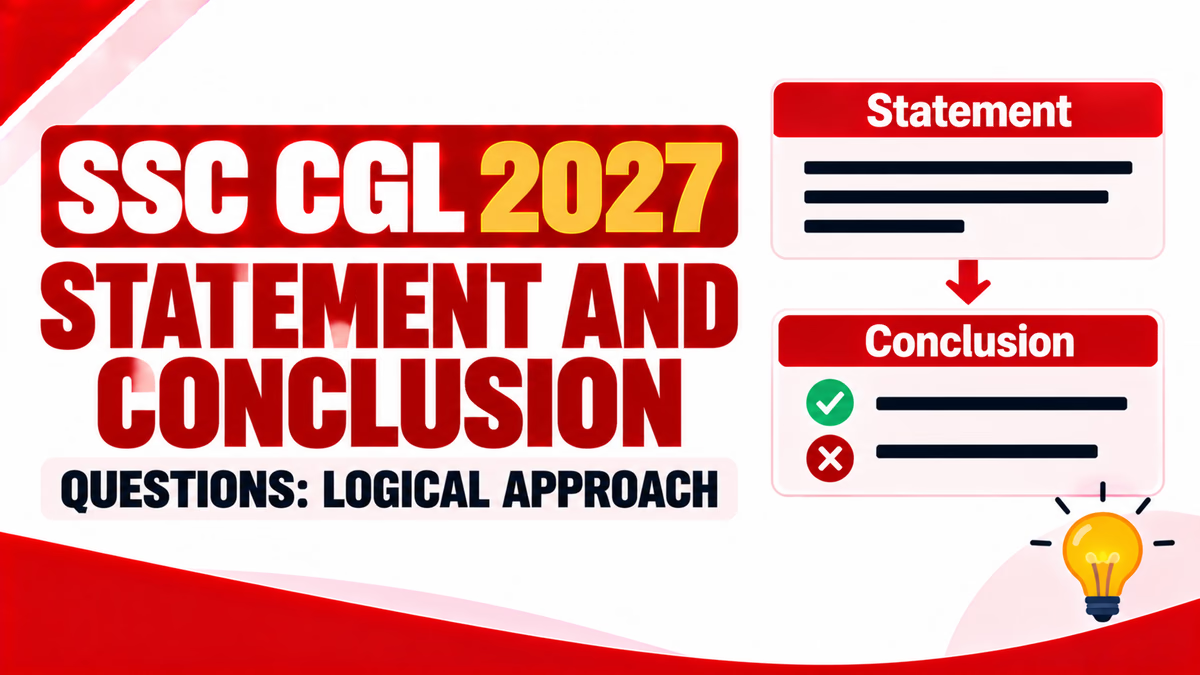
Statement and Conclusion is an important topic in the General Intelligence and Reasoning section of the SSC CGL examination. These questions test a candidate's ability to understand a given statement and identify conclusions that logically follow from the information provided. Success depends on careful reading, objective thinking, and avoiding assumptions that are not supported by the statement.
For SSC CGL 2027 preparation, candidates should learn how to identify relevant information, distinguish facts from assumptions, evaluate logical implications, and eliminate incorrect options. This guide explains the basic concepts, step-by-step solving methods, practice MCQs with answers, and useful preparation strategies.
In these questions, a statement provides certain information, facts, or conditions. One or more conclusions are then presented, and candidates must decide which conclusions logically follow from the statement.
A conclusion follows when it is supported by the given information and does not require an unsupported assumption.
Example:
Statement: All employees must carry their identity cards while entering the office.
Conclusion: Employees are required to carry identity cards when entering the office.
Answer: The conclusion follows.
Explanation: The conclusion directly expresses the requirement stated in the original statement.
Remember that a conclusion must be evaluated according to the information provided in the question, not according to personal beliefs or outside knowledge.
Do not introduce additional facts that are not mentioned in the statement. A conclusion may sound reasonable in real life but still fail to follow logically from the information given.
Example:
Statement: The library remains open until 8 PM.
Conclusion: Every student visits the library before 8 PM.
Result: The conclusion does not follow. The statement tells us the library's closing time but does not establish that every student visits it.
Pay attention to words such as all, some, only, must, may, always, and never. These words can change the meaning of a statement and determine whether a conclusion is justified.
Read these words carefully before selecting an answer. A small change in wording can change whether a conclusion follows.
A fact is information explicitly provided by the statement. An assumption is something that a reader adds without sufficient evidence.
Statement: The company introduced an online training programme for its employees.
Conclusion: Every employee has completed the training programme.
Result: The conclusion does not follow. Introducing a programme does not prove that every employee has completed it.
A common mistake is to select a conclusion that makes a stronger claim than the statement supports.
Statement: Some candidates prefer studying in the morning.
Conclusion: All candidates prefer studying in the morning.
Result: The conclusion does not follow because information about some candidates cannot establish the preference of every candidate.
When a question contains two conclusions, test each one separately. One conclusion may follow while the other does not. Do not assume that both conclusions must have the same result.
These topics may appear similar, but they test different reasoning skills.
| Statement and Conclusion | Statement and Assumption |
|---|---|
| Checks what logically follows from the statement. | Checks what is implicitly taken for granted. |
| Focuses on logical implications. | Focuses on the underlying basis of a statement or action. |
| Asks whether a conclusion is supported. | Asks whether an assumption is necessary or implicit. |
For this topic, focus on what the statement establishes and whether the proposed conclusion is supported by that information.
A useful shortcut is to ask yourself: “Can I prove this conclusion using only the statement?” If the answer is no, the conclusion should not be accepted as a definite result.
Attempt the following practice MCQs before checking the answers. These are illustrative practice questions prepared for revision and are not presented as official previous-year questions.
Statement: All applicants must submit the completed application form before the deadline.
Conclusion I: Applicants are required to submit the completed form before the deadline.
Conclusion II: Every applicant has already submitted the form.
A) Only conclusion I follows
B) Only conclusion II follows
C) Both conclusions follow
D) Neither conclusion follows
Correct Answer: A) Only conclusion I follows
Explanation: Conclusion I directly reflects the requirement. The statement does not confirm that every applicant has already submitted the form, so conclusion II does not follow.
Statement: The school has introduced additional mathematics classes for students who need extra practice.
Conclusion I: Some students may need additional mathematics practice.
Conclusion II: Every student has failed mathematics.
A) Only conclusion I follows
B) Only conclusion II follows
C) Both conclusions follow
D) Neither conclusion follows
Correct Answer: A) Only conclusion I follows
Explanation: The additional classes are intended for students who need more practice, supporting the existence of such a group. Nothing in the statement establishes that every student has failed mathematics.
Statement: Some employees work from home on Fridays.
Conclusion I: At least some employees work from home on Fridays.
Conclusion II: All employees work from home on Fridays.
A) Only conclusion I follows
B) Only conclusion II follows
C) Both conclusions follow
D) Neither conclusion follows
Correct Answer: A) Only conclusion I follows
Explanation: Conclusion I restates the information provided. The word “some” does not establish that every employee works from home on Fridays.
Statement: The road was closed because repair work was being carried out.
Conclusion I: Repair work was the stated reason for the road closure.
Conclusion II: The road will remain closed for the next seven days.
A) Only conclusion I follows
B) Only conclusion II follows
C) Both conclusions follow
D) Neither conclusion follows
Correct Answer: A) Only conclusion I follows
Explanation: The statement explicitly gives repair work as the reason for the closure. It does not specify how long the closure will continue.
Statement: Candidates who score at least 60 marks qualify for the next round.
Conclusion I: A candidate scoring 65 marks qualifies for the next round.
Conclusion II: A candidate scoring 55 marks cannot qualify under the stated rule.
A) Only conclusion I follows
B) Only conclusion II follows
C) Both conclusions follow
D) Neither conclusion follows
Correct Answer: C) Both conclusions follow
Explanation: A score of 65 meets the stated minimum of 60. A score of 55 does not meet this qualifying condition, so the candidate does not qualify under the rule described in the statement.
Statement: Several students participated in the science exhibition.
Conclusion I: At least some students participated in the exhibition.
Conclusion II: Every student participated in the exhibition.
A) Only conclusion I follows
B) Only conclusion II follows
C) Both conclusions follow
D) Neither conclusion follows
Correct Answer: A) Only conclusion I follows
Explanation: “Several students” confirms that a group of students participated. It does not establish that all students took part.
Statement: All visitors must register at the reception desk before entering the laboratory.
Conclusion I: Registration is required before visitors enter the laboratory.
Conclusion II: Every visitor has entered the laboratory.
A) Only conclusion I follows
B) Only conclusion II follows
C) Both conclusions follow
D) Neither conclusion follows
Correct Answer: A) Only conclusion I follows
Explanation: The statement establishes a registration requirement. It does not say that every visitor has entered the laboratory.
Statement: The city plans to construct more public parks in residential areas.
Conclusion I: The city intends to increase the number of public parks in residential areas.
Conclusion II: Every residential area will have a park next year.
A) Only conclusion I follows
B) Only conclusion II follows
C) Both conclusions follow
D) Neither conclusion follows
Correct Answer: A) Only conclusion I follows
Explanation: The statement directly expresses the city's plan. It does not guarantee that every residential area will have a park or specify that the construction will be completed next year.
Consistent practice can help candidates recognise logical relationships and avoid unsupported conclusions. Start with simple statements and gradually practise questions involving conditions, requirements, plans, and multiple conclusions.
During mock tests, avoid spending too much time on one difficult question. Apply the same logical checklist consistently and return to challenging questions if time permits.
These questions provide a statement and one or more conclusions. Candidates must determine which conclusions are logically supported by the given information.
Read the statement carefully, identify the main information, test each conclusion independently, and reject conclusions that require unsupported assumptions.
No. Use the information provided in the statement and the logical relationship between the statement and the proposed conclusion.
A common mistake is accepting a conclusion because it sounds reasonable, even though the statement does not provide enough information to prove it.
Start with 10–15 questions daily and increase your practice as your accuracy and speed improve. Review mistakes regularly.
Statement and conclusion questions require careful reading, objective analysis, and the ability to separate supported information from assumptions. For SSC CGL 2027, focus on understanding key words, evaluating each conclusion independently, and avoiding claims that go beyond the statement.
Regular practice, timed exercises, and review of incorrect answers can help you strengthen your reasoning skills. Continue preparing with Katara Academy to build confidence for competitive examinations.