






Download the App & Start Learning
- Expert Faculty Guidance
- Updated Study Material
- Mock Tests & Practice Quiz
- Live Doubt Solving Sessions
- Exam-Oriented Preparation
- Motivation & Success Strategy
Katara Academy

10/15/2026
Syllogism is an important topic in the General Intelligence and Reasoning section of the SSC CGL examination. These questions test a candidate's ability to analyse statements and determine whether a conclusion logically follows from the given information. Venn diagrams are one of the simplest methods for understanding relationships between different groups.
For SSC CGL 2027 preparation, candidates should understand universal and particular statements, positive and negative relationships, overlapping groups, and possibility-based conclusions. This guide explains the basic rules of syllogism, the Venn diagram method, solved examples, and practice MCQs with answers.
Syllogism is a logical reasoning topic in which candidates are given two or more statements followed by conclusions. The task is to determine which conclusions follow logically from the statements.
Example:
Statements:
Conclusion: All roses are plants.
Answer: The conclusion follows.
Explanation: If every rose belongs to the group of flowers, and every flower belongs to the group of plants, then every rose must also belong to the group of plants.
The most important rule is to use only the information given in the statements. Do not rely on personal knowledge or assumptions about the real world.
This statement means that every member of group A belongs to group B. However, it does not automatically mean that every member of B belongs to A.
Example: All doctors are educated people.
This means every doctor belongs to the group of educated people. It does not establish that all educated people are doctors.
This statement means that groups A and B have no members in common.
Example: No square is a circle.
The two groups do not overlap according to the statement.
This statement means that at least one member belongs to both groups A and B.
Example: Some students are athletes.
This confirms that at least one student is an athlete. It does not mean that all students are athletes.
This statement means that at least one member of group A does not belong to group B.
Example: Some books are not novels.
At least one book lies outside the group of novels. The statement does not tell us that all books are non-novels.
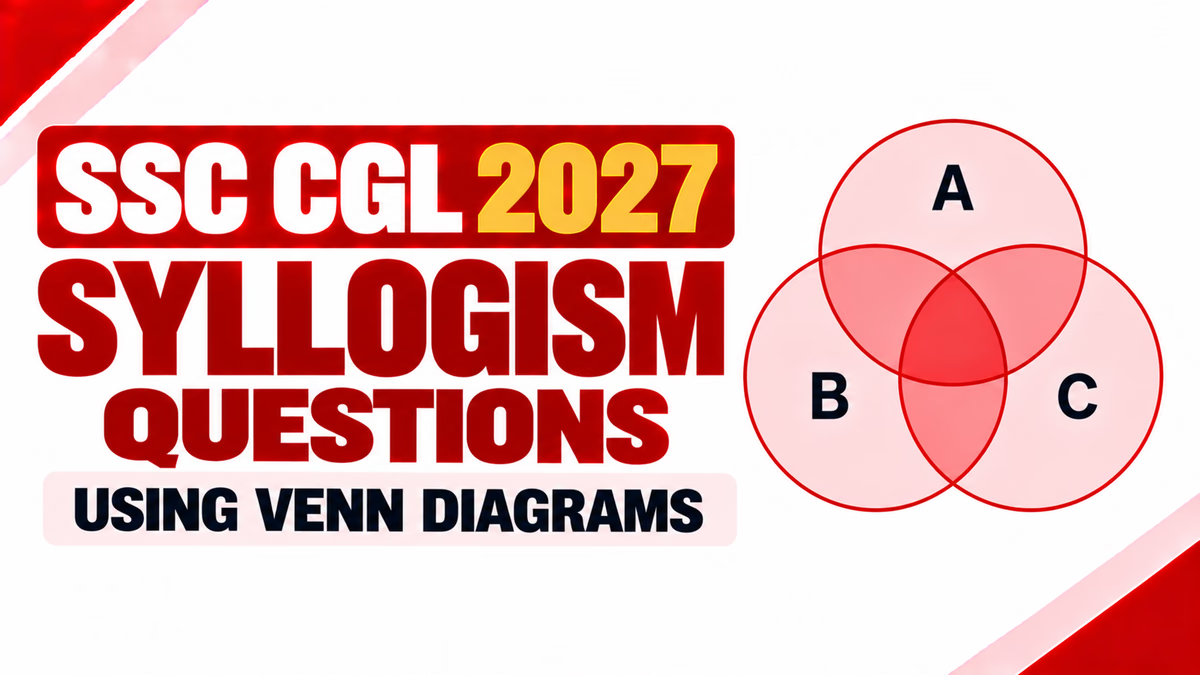
A Venn diagram represents groups as circles. The position and overlap of the circles help show whether a conclusion follows from the statements.
For universal statements such as “All A are B,” the diagram does not necessarily establish that group A exists. Be careful not to infer existence unless it is provided or follows from another statement.
A definite conclusion must be true in every valid arrangement of the groups that satisfies the statements. A possibility conclusion is accepted when at least one valid arrangement makes it true without contradicting the statements.
Example:
Statement: All cats are animals.
Conclusion I: All animals are cats.
Conclusion II: Some animals are cats.
Conclusion I does not follow because the statement does not say that all animals are cats. Conclusion II requires care: in traditional examination syllogism, universal statements are generally treated as not establishing existence on their own. Therefore, without an additional existence statement, “Some animals are cats” cannot be guaranteed from the universal statement alone.
Always follow the convention used in the question and avoid assuming existence from a statement that does not establish it.
Attempt these practice MCQs before checking the explanations. These are illustrative practice questions for revision and are not presented as official previous-year questions.
Statements:
Conclusions:
A) Only conclusion I follows
B) Only conclusion II follows
C) Both conclusions follow
D) Neither conclusion follows
Correct Answer: A) Only conclusion I follows
Explanation: Every pen belongs to the group of stationery items, and every stationery item belongs to the group of useful items. Therefore, all pens are useful items. The reverse relationship in conclusion II is not established.
Statements:
Conclusions:
A) Only conclusion I follows
B) Only conclusion II follows
C) Both conclusions follow
D) Neither conclusion follows
Correct Answer: A) Only conclusion I follows
Explanation: Since no apple is a vegetable and all carrots are vegetables, carrots cannot be apples. However, the first statement does not say that every vegetable is an apple-free group only by reversing its wording; it does imply that apples and vegetables do not overlap, so conclusion II also follows. Therefore, the correct answer is C) Both conclusions follow.
Statements:
Conclusions:
A) Only conclusion I follows
B) Only conclusion II follows
C) Both conclusions follow
D) Neither conclusion follows
Correct Answer: A) Only conclusion I follows
Explanation: The teachers who are writers must also be readers because all writers are readers. Therefore, some teachers are readers. The statements do not establish that every teacher is a reader.
Statements:
Conclusions:
A) Only conclusion I follows
B) Only conclusion II follows
C) Both conclusions follow
D) Neither conclusion follows
Correct Answer: A) Only conclusion I follows
Explanation: “Some pens are blue” means that some blue items are pens. However, the statements do not establish that pencils cannot be blue; they only establish that pencils and pens do not overlap.
Statements:
Conclusions:
A) Only conclusion I follows
B) Only conclusion II follows
C) Both conclusions follow
D) Neither conclusion follows
Correct Answer: B) Only conclusion II follows
Explanation: The first statement directly establishes conclusion II. The expensive electronic devices may or may not include laptops, so conclusion I does not necessarily follow.
Statements:
Conclusions:
A) Only conclusion I follows
B) Only conclusion II follows
C) Both conclusions follow
D) Neither conclusion follows
Correct Answer: A) Only conclusion I follows
Explanation: Conclusion I repeats the first statement and therefore follows. The second statement only says that all athletes are fit; it does not establish that all students are athletes or fit.
Statements:
Conclusions:
A) Only conclusion I follows
B) Only conclusion II follows
C) Both conclusions follow
D) Neither conclusion follows
Correct Answer: A) Only conclusion I follows
Explanation: All doctors belong to the group of graduates, and no graduate is illiterate. Therefore, no doctor is illiterate. The reverse relationship in conclusion II is not established.
Statements:
Conclusion: Some roses being stones is a possibility.
A) The possibility follows
B) The possibility does not follow
Correct Answer: B) The possibility does not follow
Explanation: All roses are flowers, and no flower can be a stone. Therefore, roses cannot overlap with stones, making the stated possibility impossible.
A structured practice routine can help candidates develop a better understanding of syllogism questions. Begin with simple universal statements and gradually practise combinations involving “some,” “no,” and possibility-based conclusions.
Syllogism is a logical reasoning topic in which candidates evaluate conclusions based on relationships stated between groups.
Venn diagrams visually represent group relationships. They help candidates identify inclusion, exclusion, and overlap between categories.
No. “All A are B” means that every member of A belongs to B. It does not establish that every member of B belongs to A.
A definite conclusion must hold in every valid arrangement of the groups. A possible conclusion is accepted if at least one valid arrangement satisfies it without contradicting the statements.
Start with 10–15 questions daily and increase the number as your understanding, speed, and accuracy improve.
Syllogism questions become easier when candidates understand statement types and use Venn diagrams to represent group relationships. For SSC CGL 2027, focus on universal and particular statements, positive and negative relationships, and the difference between definite and possible conclusions.
Practise regularly, evaluate each conclusion independently, and avoid assumptions that are not supported by the statements. Continue preparing with Katara Academy to strengthen your reasoning skills for competitive examinations.