






Download the App & Start Learning
- Expert Faculty Guidance
- Updated Study Material
- Mock Tests & Practice Quiz
- Live Doubt Solving Sessions
- Exam-Oriented Preparation
- Motivation & Success Strategy
Katara Academy

10/15/2026
Direction Sense is an important topic in the General Intelligence and Reasoning section of the SSC CGL examination. These questions test a candidate's ability to understand directions, track movement, calculate distances, and determine the final position of a person or object. With a simple diagram and a systematic approach, many direction-based questions can be solved quickly and accurately.
For SSC CGL 2027 preparation, candidates should understand the four main directions, the four intermediate directions, left and right turns, shortest-distance calculations, and questions involving multiple movements. This guide explains the basic concepts, diagram shortcuts, solved examples, and practice MCQs with answers.
Direction Sense questions describe the movement of a person or object in one or more directions. Candidates must determine the final direction, distance from the starting point, or position relative to another location.
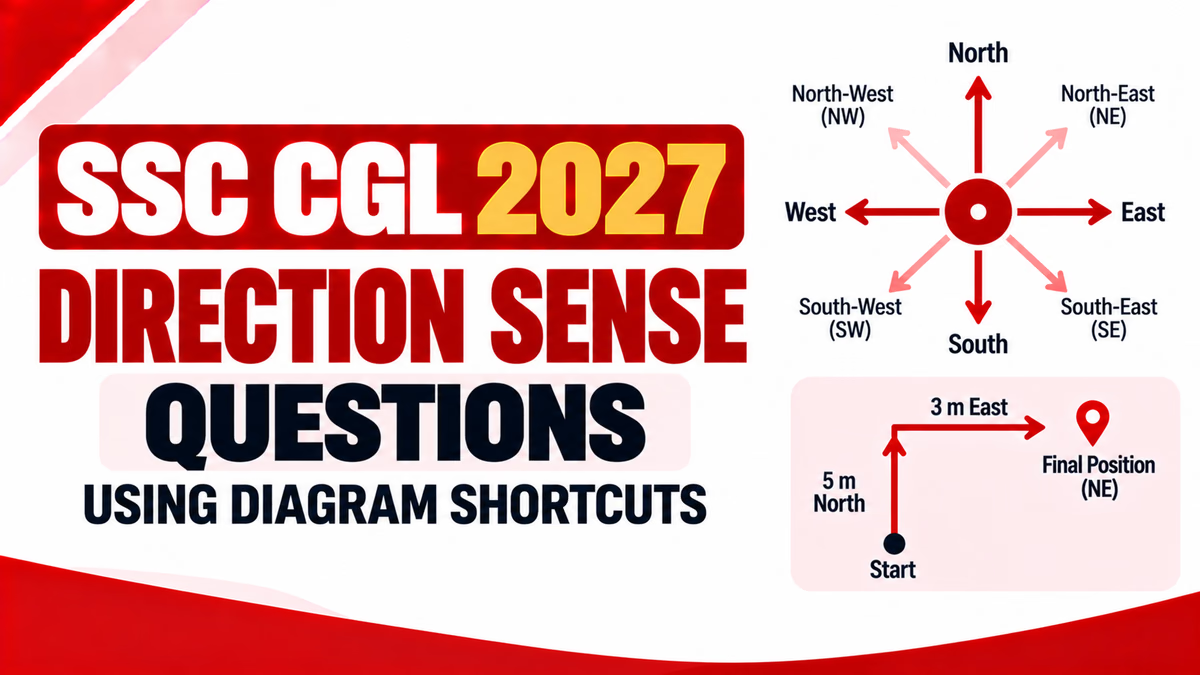
For example, if a person walks 5 metres north and then 3 metres east, the person finishes in the north-east direction relative to the starting point.
The most effective approach is to draw a small direction diagram and mark every movement in sequence. This reduces confusion when a question contains several turns.
The four main directions are North, South, East, and West. Remember the standard arrangement before solving direction-based problems.
                 NORTH
                   ↑
                   |
       WEST  ←-----+-----→  EAST
                   |
                   ↓
                 SOUTH
North is at the top, South is at the bottom, East is on the right, and West is on the left. Keeping this arrangement consistent makes it easier to track movement.
The four intermediate directions lie between the main directions.
For example, a person who finishes north of the starting point and east of it is in the north-east direction. The diagram helps identify the correct direction without relying on guesswork.
Left and right turns depend on the direction in which a person is currently facing. A left turn does not always mean moving west, and a right turn does not always mean moving east.
| Facing Direction | Turn Left | Turn Right |
|---|---|---|
| North | West | East |
| South | East | West |
| East | North | South |
| West | South | North |
Always identify the person's current facing direction before applying a turn. This is especially important when the question includes two or more left or right turns.
Begin by marking the starting point. Draw an arrow for each movement and label the distance. Use the same orientation throughout the question.
Example: A person walks 4 metres north and then 3 metres east.
The person finishes north-east of the starting point. The shortest distance from the starting point is calculated using the Pythagorean theorem:
Shortest distance = √(4² + 3²) = √25 = 5 metres.
North and South movements cancel each other, as do East and West movements. This shortcut is useful when the question includes several movements in opposite directions.
Example: A person walks 8 metres east, 3 metres west, and 2 metres west.
Net movement = 8 − 3 − 2 = 3 metres east.
Therefore, the person is 3 metres east of the starting point.
When a question describes turns, first determine the direction the person is facing after each turn. Then record the distance travelled in that direction.
For example, if a person faces north and turns right, the person faces east. If the person then turns right again, the person faces south.
If the final position forms a right-angled triangle with the starting point, use the Pythagorean theorem:
Shortest distance = √(horizontal distance² + vertical distance²)
This method is useful when the final position differs in both horizontal and vertical directions.
Try the following practice MCQs before checking the answers. These are illustrative practice questions for revision and are not presented as official previous-year questions.
A person walks 5 metres north and then 5 metres east. In which direction is the person from the starting point?
A) North-West
B) South-East
C) North-East
D) South-West
Correct Answer: C) North-East
Explanation: The person moves north and then east. The final position is both north and east of the starting point, so the direction is north-east.
A person walks 10 metres east and then 4 metres west. How far is the person from the starting point?
A) 4 metres
B) 6 metres
C) 10 metres
D) 14 metres
Correct Answer: B) 6 metres
Explanation: The opposite movements cancel. Net distance = 10 − 4 = 6 metres east.
A person is facing north and turns right. Which direction is the person facing now?
A) West
B) South
C) East
D) North
Correct Answer: C) East
Explanation: When facing north, a right turn leads to the east.
A person faces east, turns left, and then turns left again. Which direction is the person facing?
A) North
B) South
C) East
D) West
Correct Answer: D) West
Explanation: From east, a left turn leads to north. A second left turn leads from north to west.
A person walks 6 metres north and then 8 metres east. What is the shortest distance from the starting point?
A) 10 metres
B) 12 metres
C) 14 metres
D) 16 metres
Correct Answer: A) 10 metres
Explanation: The movements form a right-angled triangle. Shortest distance = √(6² + 8²) = √100 = 10 metres.
A person walks 7 metres south and then 4 metres north. Where is the person relative to the starting point?
A) 3 metres north
B) 3 metres south
C) 11 metres south
D) At the starting point
Correct Answer: B) 3 metres south
Explanation: The person walks 7 metres south and returns 4 metres north. Net movement = 7 − 4 = 3 metres south.
A person is facing south and turns left. Which direction is the person facing?
A) East
B) West
C) North
D) South
Correct Answer: A) East
Explanation: When facing south, a left turn leads to the east.
A person walks 4 metres east, 3 metres north, and 4 metres west. Where is the person relative to the starting point?
A) 3 metres north
B) 3 metres south
C) 4 metres east
D) At the starting point
Correct Answer: A) 3 metres north
Explanation: The 4-metre east and 4-metre west movements cancel each other. The remaining movement is 3 metres north.
Regular practice can help candidates improve their accuracy and speed in direction sense questions. Start with basic movements and gradually practise questions involving multiple turns and shortest-distance calculations.
Direction sense questions test the ability to track movements, understand turns, identify final directions, and calculate distances between positions.
Draw a simple direction diagram, track every movement in order, cancel opposite movements, and use distance formulas when required.
Remember the standard direction map and identify the person's current facing direction before applying each turn.
If the horizontal and vertical movements form a right-angled triangle, use the Pythagorean theorem: shortest distance = √(horizontal distance² + vertical distance²).
Start with 10–15 questions daily and gradually increase practice as your speed and accuracy improve.
Direction sense questions become easier when candidates use a consistent direction map, track every turn, and simplify opposite movements. For SSC CGL 2027, practise basic directions, intermediate directions, left and right turns, and shortest-distance calculations regularly.
With systematic diagram practice and regular revision, aspirants can improve their reasoning accuracy and solve direction-based questions with greater confidence. Continue practising with Katara Academy to strengthen your preparation for competitive examinations.