

Download the App & Start Learning
- Expert Faculty Guidance
- Updated Study Material
- Mock Tests & Practice Quiz
- Live Doubt Solving Sessions
- Exam-Oriented Preparation
- Motivation & Success Strategy
Katara Academy

10/14/2026
Blood relation is an important topic in the General Intelligence and Reasoning section of the SSC CGL examination. These questions test a candidate's ability to understand family relationships and determine how two or more people are related to each other. A clear understanding of family structures and the use of simple diagrams can make these questions easier to solve.
For SSC CGL 2027 preparation, candidates should learn common relationship terms, understand generation levels, practise family-tree diagrams, and solve questions involving coded relationships. This guide explains the basic concepts, step-by-step solving methods, practice MCQs with answers, and useful preparation tips.
Blood relation questions describe relationships between family members. Candidates must use the information provided to identify a person's father, mother, brother, sister, son, daughter, uncle, aunt, cousin, or another relative.
Example: A is the brother of B. B is the sister of C. How is A related to C?
Answer: Brother
Explanation: A and B are siblings, and B and C are siblings. Therefore, A and C are also siblings. Since A is male, A is C's brother.
The key to solving these questions is to connect the relationships carefully rather than guessing from a single sentence.
Before solving blood relation questions, revise the meanings of commonly used relationship terms.
Pay attention to the exact wording of a question. Terms such as maternal uncle and paternal uncle provide additional information about which side of the family is involved.
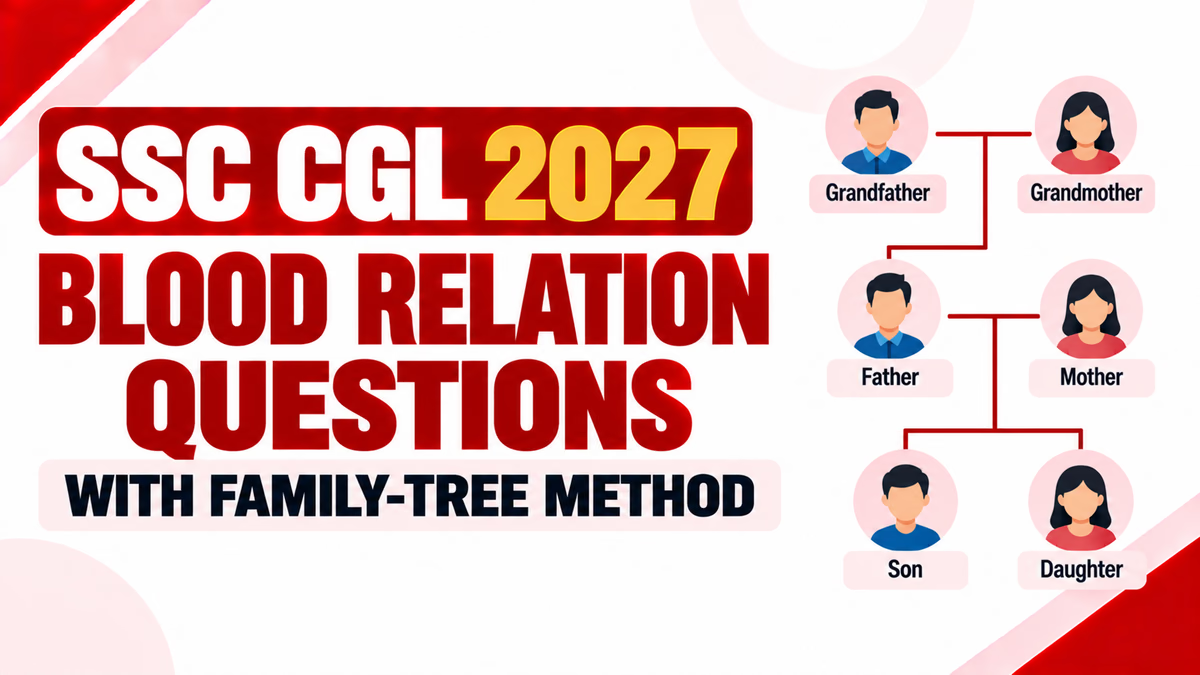
The family-tree method is a visual technique used to represent relationships between family members. Instead of keeping every relationship in memory, candidates draw a simple diagram showing generations, parent-child connections, and siblings.
A basic family tree can be represented as follows:
       Grandfather ── Grandmother
                 |
          ----------------
          |              |
        Father          Uncle
          |
     -------------
     |           |
   Son         Daughter
In this illustration, the son and daughter are siblings. Their father and uncle are also siblings, while the grandfather and grandmother belong to the generation above them.
When drawing a family tree, keep each generation on a separate level. This makes it easier to distinguish parents, children, grandparents, and other relatives.
For short questions, you may solve the relationship mentally. For questions involving several people or multiple generations, drawing a family tree can reduce confusion and prevent mistakes.
If A is the father of B, A is one generation above B. If B is the father of C, then A is C's grandfather.
Example: P is the mother of Q, and Q is the father of R. How is P related to R?
Answer: Grandmother.
Brothers and sisters belong to the same generation. If two people share the same parents, they are siblings. However, a question must provide enough information before you can conclude that two people are siblings.
Maternal relationships are connected to a person's mother, while paternal relationships are connected to a person's father.
Some questions include relationships formed through marriage, such as a brother-in-law, sister-in-law, father-in-law, or mother-in-law. Read these questions carefully and distinguish relationships by blood from relationships by marriage.
Attempt the following practice MCQs before checking the answers. These are illustrative practice questions for revision and are not presented as official previous-year questions.
A is the brother of B. B is the sister of C. How is A related to C?
A) Father
B) Brother
C) Uncle
D) Cousin
Correct Answer: B) Brother
Explanation: A and B are siblings, and B and C are siblings. Therefore, A is C's brother.
P is the mother of Q. Q is the father of R. How is P related to R?
A) Aunt
B) Sister
C) Grandmother
D) Mother
Correct Answer: C) Grandmother
Explanation: P is Q's mother, and Q is R's father. Therefore, P is R's grandmother.
R is the brother of S. S is the mother of T. How is R related to T?
A) Father
B) Maternal uncle
C) Paternal uncle
D) Grandfather
Correct Answer: B) Maternal uncle
Explanation: S is T's mother, and R is S's brother. Therefore, R is T's maternal uncle.
A is the father of B. B is the sister of C. How is A related to C?
A) Uncle
B) Brother
C) Father
D) Grandfather
Correct Answer: C) Father
Explanation: B and C are siblings. Since A is B's father, A is also C's father in the stated family relationship.
M is the daughter of N. N is the son of P. How is P related to M?
A) Father or Mother
B) Uncle or Aunt
C) Grandfather or Grandmother
D) Brother or Sister
Correct Answer: C) Grandfather or Grandmother
Explanation: N is M's parent, and P is N's parent. Therefore, P is M's grandparent. The gender of P is not specified.
X is the sister of Y. Y is the son of Z. How is X related to Z?
A) Daughter
B) Mother
C) Aunt
D) Grandmother
Correct Answer: A) Daughter
Explanation: X and Y are siblings. Since Y is Z's son, X is also Z's child. As X is female, X is Z's daughter.
K is the brother of L. L is the mother of M. How is K related to M?
A) Paternal uncle
B) Maternal uncle
C) Brother
D) Grandfather
Correct Answer: B) Maternal uncle
Explanation: L is M's mother, and K is L's brother. Therefore, K is M's maternal uncle.
A is the mother of B. B is the mother of C. How is A related to C?
A) Aunt
B) Sister
C) Grandmother
D) Daughter
Correct Answer: C) Grandmother
Explanation: A is B's mother, and B is C's mother. Therefore, A is C's grandmother.
Regular practice can help candidates recognise family relationships more quickly and accurately. Begin with direct relationships and gradually progress to questions involving several family members.
After each practice session, review incorrect answers and identify where the relationship chain became confusing. Focus on understanding the logic rather than memorising answers.
Blood relation questions test the ability to identify relationships between family members using statements about parents, children, siblings, grandparents, uncles, aunts, and other relatives.
The family-tree method is a diagram-based technique that represents family members and their connections. It helps candidates visualise generations and trace relationships step by step.
Identify the reference person, note gender information, arrange generations, draw a simple family tree when necessary, and trace the relationship carefully.
Maternal relationships are connected to a person's mother and her side of the family. Paternal relationships are connected to a person's father and his side of the family.
Start with 10–15 questions daily and gradually increase practice according to your accuracy and speed. Review mistakes regularly to strengthen your understanding.
Blood relation questions become easier when candidates understand family terminology, identify generation levels, and trace connections systematically. For SSC CGL 2027, the family-tree method can be especially useful for questions involving several people or multiple generations.
Practise regularly, verify each relationship, and learn from mistakes to improve your reasoning skills. Continue preparing with Katara Academy to build confidence for competitive examinations.