





Download the App & Start Learning
- Expert Faculty Guidance
- Updated Study Material
- Mock Tests & Practice Quiz
- Live Doubt Solving Sessions
- Exam-Oriented Preparation
- Motivation & Success Strategy
Katara Academy

10/14/2026
Coding-Decoding is an important topic in the General Intelligence and Reasoning section of the SSC CGL examination. These questions test a candidate's ability to identify patterns used to transform letters, words, or numbers into codes. Letter position logic is one of the most useful techniques for solving these questions quickly and accurately.
For SSC CGL 2027 preparation, candidates should understand alphabet positions, forward and backward letter shifts, reverse alphabet patterns, and combinations of coding rules. This guide explains the basic concepts, solving methods, practice questions with answers, and common mistakes to avoid.
Coding-Decoding is a reasoning topic in which a word, letter, or number is transformed according to a specific rule. Candidates must identify the rule and apply it to another word or sequence to determine the correct answer.
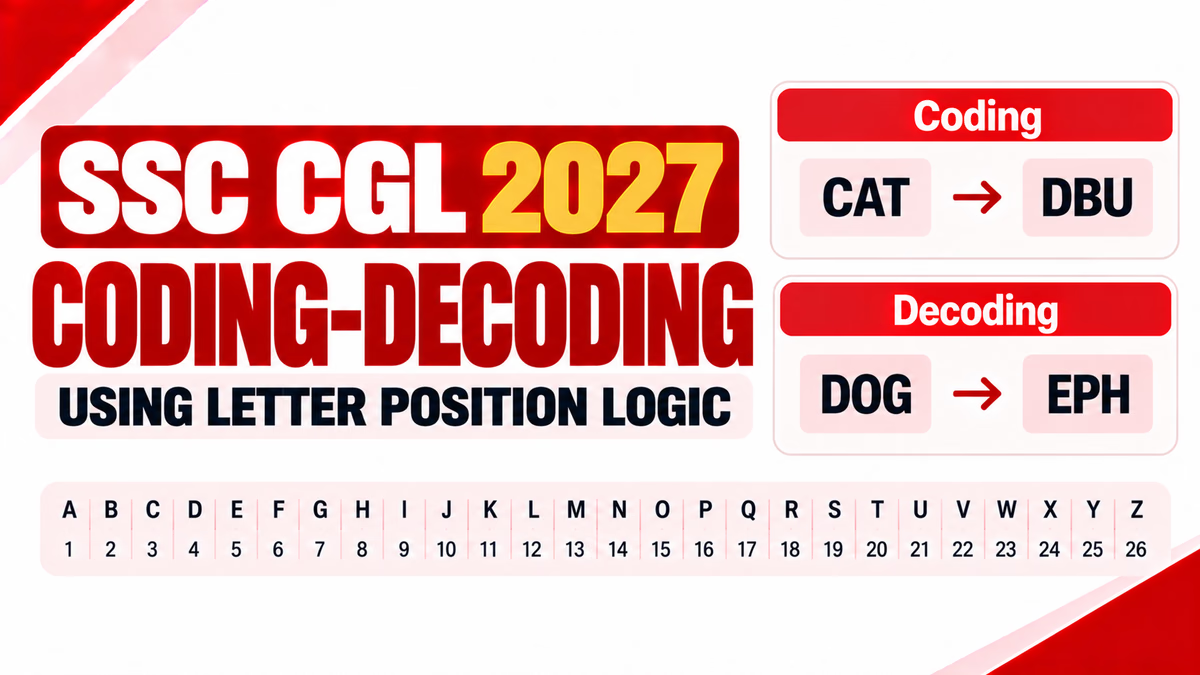
Example: If CAT is coded as DBU, how will DOG be coded using the same rule?
Answer: EPH
Explanation: Each letter moves one position forward in the English alphabet.
Applying the same rule to DOG gives D → E, O → P, and G → H. Therefore, the code is EPH.
Understanding alphabet positions is essential for solving letter-based coding questions. Memorising the positions from A = 1 to Z = 26 can reduce calculation time during the examination.
| Letter | Position | Letter | Position |
|---|---|---|---|
| A | 1 | N | 14 |
| B | 2 | O | 15 |
| C | 3 | P | 16 |
| D | 4 | Q | 17 |
| E | 5 | R | 18 |
| F | 6 | S | 19 |
| G | 7 | T | 20 |
| H | 8 | U | 21 |
| I | 9 | V | 22 |
| J | 10 | W | 23 |
| K | 11 | X | 24 |
| L | 12 | Y | 25 |
| M | 13 | Z | 26 |
For quick revision, remember the positions of key letters such as E = 5, J = 10, O = 15, T = 20, and Y = 25. These checkpoints can help you estimate the positions of nearby letters.
In this type, each letter moves forward by a fixed number of positions in the alphabet.
Example: If PEN is coded as QFO, how will BOOK be coded?
Answer: CPPL
Explanation: Each letter moves one position forward: B → C, O → P, O → P, and K → L.
In backward-shift coding, each letter moves a fixed number of positions backwards.
Example: If FDW is coded using a shift of one letter backwards, what is the code?
Answer: ECV
Explanation: F → E, D → C, and W → V. Each letter moves one position backwards.
Reverse alphabet coding replaces each letter with its opposite letter in the alphabet. In this system, A corresponds to Z, B to Y, C to X, and so on.
Example: How is CAT coded using reverse alphabet positions?
Answer: XZG
Explanation: C → X, A → Z, and T → G.
One useful relationship is that the position numbers of opposite letters add up to 27. For example, A is at position 1 and Z is at position 26.
Some questions use different shifts for consecutive letters. For example, the first letter may move one position forward, the second two positions forward, and the third three positions forward.
Example: If ABC is coded using shifts of +1, +2, and +3 respectively, the code is BDF.
Always examine each letter separately when the same shift does not explain the complete code.
In this type, letters are replaced by their alphabetical positions or numbers derived from those positions.
Example: If BAD is represented by 2-1-4, how is CAB represented?
Answer: 3-1-2
Explanation: C is the third letter, A is the first letter, and B is the second letter in the alphabet.
Do not assume that every coding question uses a simple forward shift. Always verify the rule against the complete example before applying it to a new word.
Attempt the following practice MCQs before checking the answers. These are illustrative practice questions for revision, not claims of official previous-year questions.
If CAT is coded as DBU, how will DOG be coded using the same rule?
A) EPH
B) EOG
C) FPH
D) EPG
Correct Answer: A) EPH
Explanation: Each letter moves one position forward. D → E, O → P, and G → H. Therefore, DOG becomes EPH.
If MANGO is coded by moving each letter one position backwards, what is the code?
A) LZMFN
B) LZMFP
C) NZOHP
D) KZMFN
Correct Answer: A) LZMFN
Explanation: M → L, A → Z, N → M, G → F, and O → N. Therefore, MANGO becomes LZMFN.
If A is coded as Z, B as Y, and C as X, how will DOG be coded?
A) WLT
B) WLT?
C) WLT
Correct Answer: WLT
Explanation: D corresponds to W, O corresponds to L, and G corresponds to T under reverse alphabet coding. Therefore, DOG becomes WLT.
If A = 1, B = 2, C = 3, and so on, what is the code for BAD?
A) 2-1-4
B) 1-2-4
C) 2-4-1
D) 4-1-2
Correct Answer: A) 2-1-4
Explanation: B is the second letter, A is the first, and D is the fourth. Hence, BAD is represented by 2-1-4.
If PEN is coded as QFO, how will SUN be coded using the same rule?
A) TVO
B) TMO
C) RVM
D) UVO
Correct Answer: A) TVO
Explanation: Each letter moves one position forward: S → T, U → V, and N → O. Therefore, SUN becomes TVO.
Using reverse alphabet coding, what is the code for BAT?
A) YZG
B) XZG
C) YZG?
D) ZYG
Correct Answer: A) YZG
Explanation: B corresponds to Y, A corresponds to Z, and T corresponds to G. Therefore, BAT becomes YZG.
If ABC is coded as BDF using shifts of +1, +2, and +3 respectively, how will DEF be coded using the same pattern?
A) EGI
B) EGH
C) FGI
D) EHI
Correct Answer: A) EGI
Explanation: D + 1 = E, E + 2 = G, and F + 3 = I. Therefore, DEF becomes EGI.
If each letter is replaced by its alphabetical position, what is the code for SUN?
A) 19-21-14
B) 20-21-14
C) 19-20-14
D) 19-21-15
Correct Answer: A) 19-21-14
Explanation: S is the 19th letter, U is the 21st letter, and N is the 14th letter. Therefore, SUN is coded as 19-21-14.
A regular practice routine can help candidates improve their coding-decoding skills and solve letter-based questions more confidently.
Begin with simple letter shifts before progressing to mixed and multi-step coding patterns. Regular revision will help you recognise familiar rules without unnecessary calculations.
Coding-decoding is a reasoning topic in which letters, words, or numbers are transformed according to a particular rule. Candidates identify the rule and apply it to solve the question.
Practise writing the alphabet with positions from 1 to 26. Revise key checkpoints such as E = 5, J = 10, O = 15, T = 20, and Y = 25.
Reverse alphabet coding replaces each letter with its opposite letter in the alphabet. For example, A corresponds to Z, B to Y, and C to X.
Compare the original word with the coded word, identify the letter shifts, verify the rule across the entire example, and apply it systematically to the new word.
Start with 10–15 questions per day. Increase your practice gradually as your accuracy and solving speed improve.
Coding-decoding questions based on letter position logic can be approached systematically by understanding alphabet positions, forward and backward shifts, reverse alphabet pairs, and changing letter patterns. For SSC CGL 2027, regular practice and careful verification are essential for improving speed and accuracy.
Continue practising reasoning questions with Katara Academy to strengthen your preparation for competitive examinations.