





Download the App & Start Learning
- Expert Faculty Guidance
- Updated Study Material
- Mock Tests & Practice Quiz
- Live Doubt Solving Sessions
- Exam-Oriented Preparation
- Motivation & Success Strategy
Katara Academy

10/14/2026
Number and letter series questions are an important part of the General Intelligence and Reasoning section of the SSC CGL examination. These questions test a candidate's ability to recognise patterns, identify relationships, and predict the next item in a sequence. Some questions follow simple patterns, while others combine multiple rules, making pattern recognition especially important.
For SSC CGL 2027 preparation, aspirants should practise different series types, including number series, letter series, alternating patterns, square and cube patterns, and mixed-operation sequences. This guide explains common series patterns, practical solving techniques, practice MCQs, and useful preparation tips.
A series is a sequence of numbers, letters, or symbols arranged according to a particular rule. Candidates must identify the rule and determine the missing or next item in the sequence.
Example: 2, 4, 6, 8, ?
Answer: 10
Explanation: Each number increases by 2. Therefore, the next number is 8 + 2 = 10.
In mixed-pattern questions, the sequence may use more than one operation or alternate between two different rules. Candidates should check the entire sequence instead of assuming that every series follows a simple addition pattern.
In an arithmetic series, the difference between consecutive numbers remains constant.
Example: 7, 12, 17, 22, ?
Answer: 27
Explanation: Each term increases by 5. Therefore, 22 + 5 = 27.
When solving a number series, calculate the differences between consecutive terms first. This is often the quickest way to identify a basic pattern.
Some series use multiplication or division instead of a fixed difference. The same operation may be applied repeatedly, or the multiplier may change according to a rule.
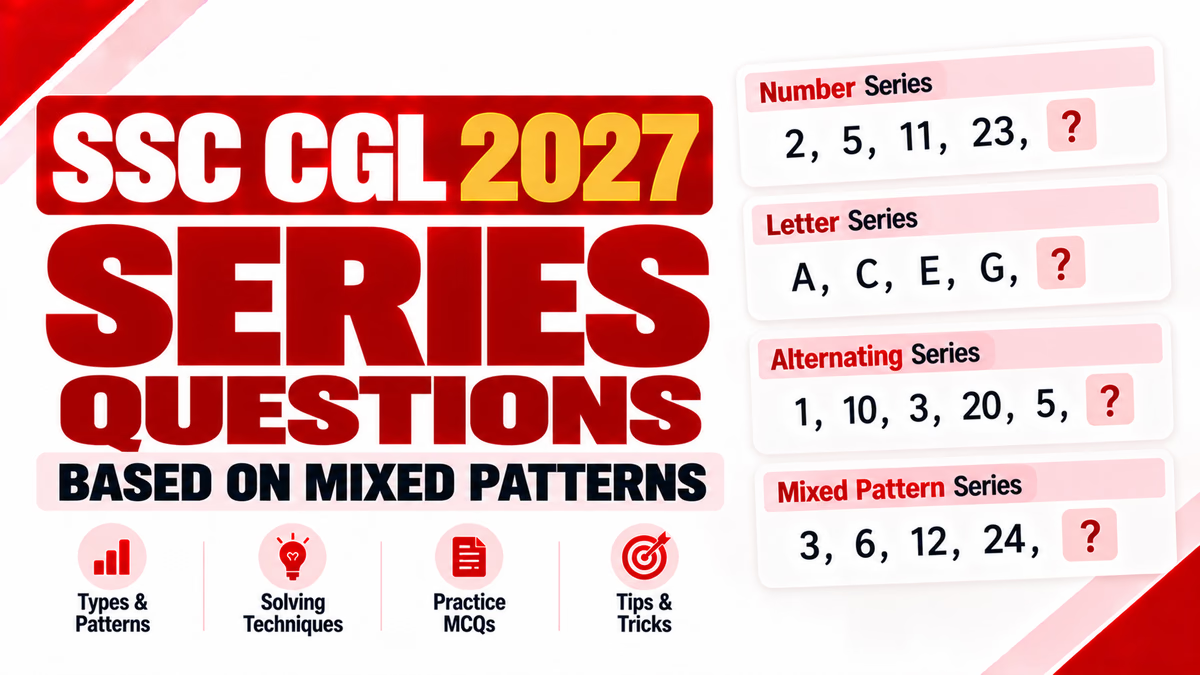
Example: 3, 6, 12, 24, ?
Answer: 48
Explanation: Each term is multiplied by 2. Therefore, 24 × 2 = 48.
If the ratios between consecutive terms are not constant, check for changing multipliers or a combination of multiplication and addition.
Square and cube series use numbers raised to powers. Recognising common squares and cubes can help candidates solve questions quickly.
Example: 1, 4, 9, 16, 25, ?
Answer: 36
Explanation: The terms are the squares of consecutive positive integers: 1², 2², 3², 4², and 5². The next term is 6² = 36.
Revise common squares, cubes, and their differences as part of your daily reasoning practice.
An alternating series contains two interwoven patterns. One set of terms may follow one rule, while the remaining terms follow another.
Example: 2, 10, 4, 20, 6, 30, ?
Answer: 8
Explanation: The odd-position terms are 2, 4, 6, 8, increasing by 2. The even-position terms are 10, 20, 30, increasing by 10. Therefore, the seventh term is 8.
When a single rule does not explain the sequence, separate the odd-position and even-position terms and examine them independently.
Mixed-operation series combine operations such as addition, multiplication, or subtraction. The operations may change from one step to the next.
Example: 2, 5, 11, 23, 47, ?
Answer: 95
Explanation: Each term is obtained by multiplying the previous term by 2 and adding 1.
For mixed patterns, test simple combinations of operations and verify that the same rule works for every transition.
Letter series questions use alphabet positions to create a sequence. Candidates may need to identify forward or backward shifts, increasing gaps, or alternating letter movements.
Example: A, C, E, G, ?
Answer: I
Explanation: Each letter moves two positions forward in the alphabet. After G, the next letter is I.
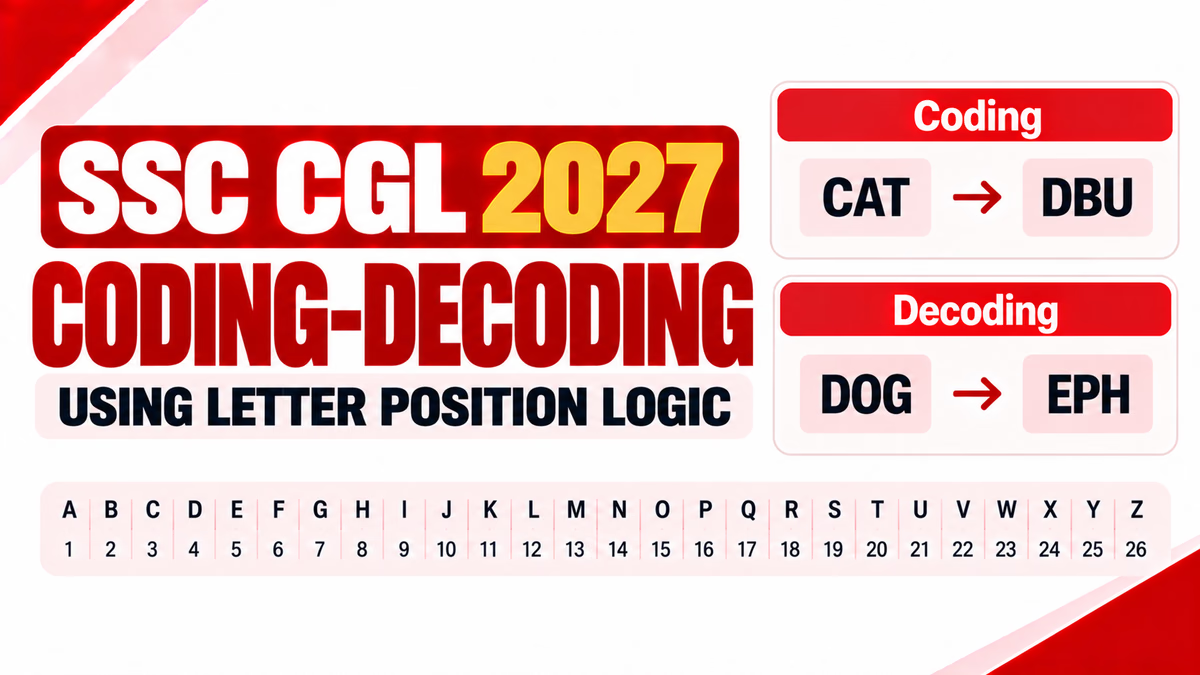
Remember the alphabet positions from A = 1 to Z = 26. For backward movements, count in reverse and check whether the sequence wraps around from A to Z.
Attempt the following practice MCQs before checking the explanations. These are illustrative practice questions created for revision and are not represented as official previous-year questions.
Find the next number: 5, 10, 15, 20, ?
A) 22
B) 25
C) 30
D) 35
Correct Answer: B) 25
Explanation: Each term increases by 5. Therefore, 20 + 5 = 25.
Find the missing number: 4, 8, 16, 32, ?
A) 48
B) 56
C) 64
D) 72
Correct Answer: C) 64
Explanation: Each number is multiplied by 2. Therefore, 32 × 2 = 64.
Find the next number: 4, 9, 16, 25, 36, ?
A) 42
B) 45
C) 49
D) 64
Correct Answer: C) 49
Explanation: The terms are 2², 3², 4², 5², and 6². The next term is 7² = 49.
Find the next number: 1, 10, 3, 20, 5, 30, ?
A) 6
B) 7
C) 35
D) 40
Correct Answer: B) 7
Explanation: The odd-position terms are 1, 3, 5, 7, increasing by 2. The even-position terms are 10, 20, 30, increasing by 10.
Find the next number: 3, 7, 15, 31, ?
A) 47
B) 55
C) 63
D) 65
Correct Answer: C) 63
Explanation: Each term is multiplied by 2 and then increased by 1. Therefore, 31 × 2 + 1 = 63.
Find the next letter: B, D, F, H, ?
A) I
B) J
C) K
D) L
Correct Answer: B) J
Explanation: Each letter moves two positions forward. The letter after H with the same gap is J.
Find the next number: 2, 5, 10, 17, 26, ?
A) 35
B) 36
C) 37
D) 39
Correct Answer: C) 37
Explanation: The differences are 3, 5, 7, and 9. The next difference is 11. Therefore, 26 + 11 = 37.
Find the next number: 6, 11, 21, 41, ?
A) 61
B) 71
C) 81
D) 91
Correct Answer: C) 81
Explanation: Each term is multiplied by 2 and then reduced by 1: 6 × 2 − 1 = 11, 11 × 2 − 1 = 21, and 21 × 2 − 1 = 41. Therefore, 41 × 2 − 1 = 81.
A structured practice routine can help candidates become more confident with series questions. Begin with simple patterns and gradually move to mixed and alternating sequences.
After every practice session, review the questions you answered incorrectly. Understanding why a pattern works is more valuable than memorising only the final answer.
Series questions require candidates to identify a logical pattern in a sequence of numbers, letters, or other items and determine the missing or next term.
A mixed-pattern series uses a combination of operations or rules, such as multiplication followed by addition, or two alternating sequences.
Start with consecutive differences, check multiplication and division, look for squares and cubes, and test alternating patterns when necessary.
Letter series are a useful part of reasoning preparation. Candidates should practise alphabet positions, forward and backward shifts, and increasing letter gaps.
Start with 10–15 questions per day and increase the number as your speed and accuracy improve. Review mistakes regularly and practise under timed conditions.
Series questions require logical thinking, careful observation, and the ability to recognise mathematical or alphabetical patterns. For SSC CGL 2027, practise arithmetic, multiplication, square and cube, alternating, mixed-operation, and letter series questions regularly.
By learning a systematic solving method and reviewing mistakes, aspirants can improve their reasoning skills and approach series questions with greater confidence. Continue practising with Katara Academy to strengthen your competitive examination preparation.