



Download the App & Start Learning
- Expert Faculty Guidance
- Updated Study Material
- Mock Tests & Practice Quiz
- Live Doubt Solving Sessions
- Exam-Oriented Preparation
- Motivation & Success Strategy
Katara Academy

10/14/2026
Classification is an important topic in the General Intelligence and Reasoning section of the SSC CGL examination. These questions assess a candidate's ability to identify similarities, differences, and logical relationships among words, numbers, letters, or figures. In most questions, four options are given, and candidates must identify the item that does not belong to the same group as the others.
For SSC CGL 2027, learning common classification patterns and practising different question types can help aspirants improve their speed and accuracy. This guide explains the types of classification questions, practical solving techniques, common mistakes, and practice MCQs with answers.
Classification questions require candidates to group items according to a common property or identify the item that differs from the remaining options. The relationship may be based on meaning, category, mathematical properties, alphabet positions, spelling, or visual characteristics.
Example: Apple, Mango, Banana, Carrot
Answer: Carrot
Explanation: Apple, mango, and banana are commonly classified as fruits, whereas carrot is a vegetable. Therefore, carrot is the odd one out in this set.
The main objective is to find a clear rule that connects three options while distinguishing the fourth.
Word classification questions are based on the meanings, categories, functions, or characteristics of words. Candidates need to identify the word that does not share the common relationship.
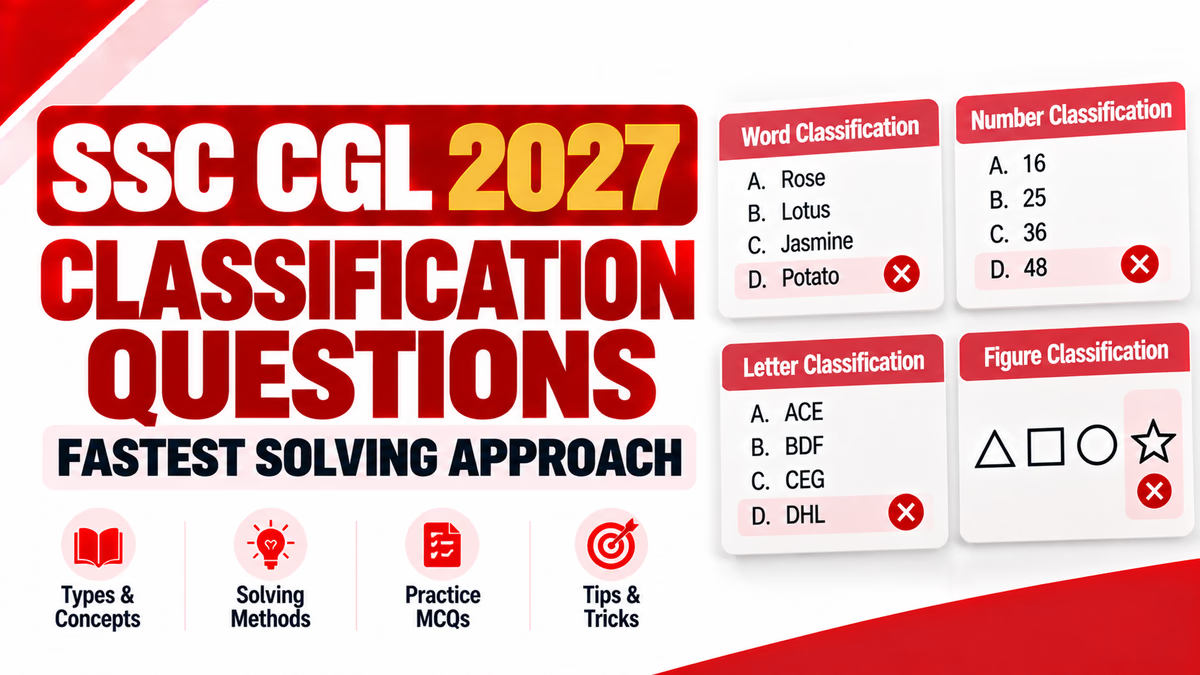
Example: Rose, Lotus, Jasmine, Potato
Answer: Potato
Explanation: Rose, lotus, and jasmine are flowers. Potato is a vegetable, so it does not belong to the same group.
Common word classification patterns include animals and plants, professions, tools, body parts, places, food items, and synonyms or antonyms.
Number classification questions require candidates to compare numerical properties and identify the number that follows a different rule. Common patterns involve odd and even numbers, prime numbers, squares, cubes, divisibility, and arithmetic relationships.
Example: 16, 25, 36, 48
Answer: 48
Explanation: The numbers 16, 25, and 36 are perfect squares: 4², 5², and 6². The number 48 is not a perfect square.
Always check whether a simple mathematical property explains most of the options before attempting complicated calculations.
Letter classification questions test alphabet knowledge and letter-position patterns. Candidates may need to identify letters that have different positions, sequences, or relationships.
Example: ACE, BDF, CEG, DHL
Answer: DHL
Explanation: In ACE, BDF, and CEG, the letters move forward by two positions each time. The sequence DHL does not follow the same pattern.
Remember the alphabet positions from A = 1 to Z = 26. This makes it easier to compare letter groups quickly.
Figure classification questions use shapes, symbols, diagrams, or visual patterns. The odd figure may differ in the number of sides, orientation, symmetry, shading, or arrangement of elements.
To solve these questions, compare one property at a time. Check the shape, number of components, direction, size, and position of elements. Avoid judging figures only by their overall appearance.
A useful technique is to explain the relationship in one sentence. For example, “These three numbers are prime numbers, but this one is composite.” If the explanation fits the options consistently, you may have found the correct classification rule.
Try the following practice questions before reading the explanations. These are illustrative practice MCQs, not claims of official previous-year questions.
Choose the odd one out.
A) Tiger
B) Lion
C) Leopard
D) Cow
Correct Answer: D) Cow
Explanation: Tiger, lion, and leopard are wild cats. Cow is a domesticated farm animal and does not belong to the same group.
Choose the number that does not belong to the group.
A) 9
B) 16
C) 25
D) 30
Correct Answer: D) 30
Explanation: The first three numbers are perfect squares: 3² = 9, 4² = 16, and 5² = 25. The number 30 is not a perfect square.
Choose the odd letter group.
A) ACE
B) BDF
C) CEG
D) DFG
Correct Answer: D) DFG
Explanation: In ACE, BDF, and CEG, the letters advance by two positions. In DFG, the first-to-second shift is two positions, but the second-to-third shift is only one position.
Identify the odd number.
A) 11
B) 13
C) 17
D) 21
Correct Answer: D) 21
Explanation: 11, 13, and 17 are prime numbers. The number 21 is composite because it is divisible by 3 and 7.
Choose the item that does not belong to the group.
A) January
B) March
C) July
D) Monday
Correct Answer: D) Monday
Explanation: January, March, and July are months of the year. Monday is a day of the week.
Choose the odd one out.
A) 8
B) 27
C) 64
D) 100
Correct Answer: D) 100
Explanation: 8 = 2³, 27 = 3³, and 64 = 4³. These are perfect cubes. The number 100 is not a perfect cube.
Which option is different from the others?
A) Square
B) Triangle
C) Circle
D) Rectangle
Correct Answer: C) Circle
Explanation: A square, triangle, and rectangle are polygons with straight sides. A circle has a curved boundary and no straight sides.
Choose the odd one out.
A) 14
B) 21
C) 28
D) 32
Correct Answer: D) 32
Explanation: 14, 21, and 28 are multiples of 7. The number 32 is not a multiple of 7.
Consistent practice is one of the most effective ways to improve classification-solving skills. Begin with basic word and number questions before moving to letter and figure classification.
Track your accuracy during practice. If you repeatedly make mistakes in number classification, revise the underlying mathematical properties. If word questions are difficult, improve your understanding of categories and vocabulary.
Classification is a reasoning topic in which candidates identify an item that differs from the remaining options based on a logical property or relationship.
Practise word, number, letter, and figure classification questions. Each type requires a different approach to identifying common properties and differences.
Scan all the options, look for a simple common property, verify the odd item, and avoid unnecessary calculations or assumptions.
Classification is a useful reasoning topic to include in your SSC CGL preparation. Practising it can strengthen pattern recognition and logical comparison skills.
You can start with 10–15 questions daily and adjust the number according to your accuracy, speed, and preparation needs.
Classification questions test the ability to identify a common property and recognise the item that does not fit. For SSC CGL 2027, focus on word categories, numerical properties, alphabet patterns, and figure-based relationships. Regular practice, careful verification, and analysis of mistakes can help you improve both speed and accuracy.
Continue practising reasoning questions with Katara Academy to strengthen your preparation for competitive examinations.