



Download the App & Start Learning
- Expert Faculty Guidance
- Updated Study Material
- Mock Tests & Practice Quiz
- Live Doubt Solving Sessions
- Exam-Oriented Preparation
- Motivation & Success Strategy
Katara Academy

10/14/2026
Analogy is an important topic in the General Intelligence and Reasoning section of the SSC CGL examination. Analogy questions test a candidate's ability to identify relationships between words, numbers, letters, or symbols. With regular practice and a clear understanding of common patterns, candidates can solve these questions accurately and save valuable examination time.
For SSC CGL 2027 preparation, aspirants should understand the different types of analogy questions, learn how to identify relationships quickly, and practise questions of varying difficulty levels. This guide explains word analogy, number analogy, useful solving techniques, common mistakes, and practice questions with answers.
An analogy question presents a relationship between two items and asks candidates to identify another pair with a similar relationship. The relationship may be based on meaning, function, category, mathematical operations, or a numerical pattern.
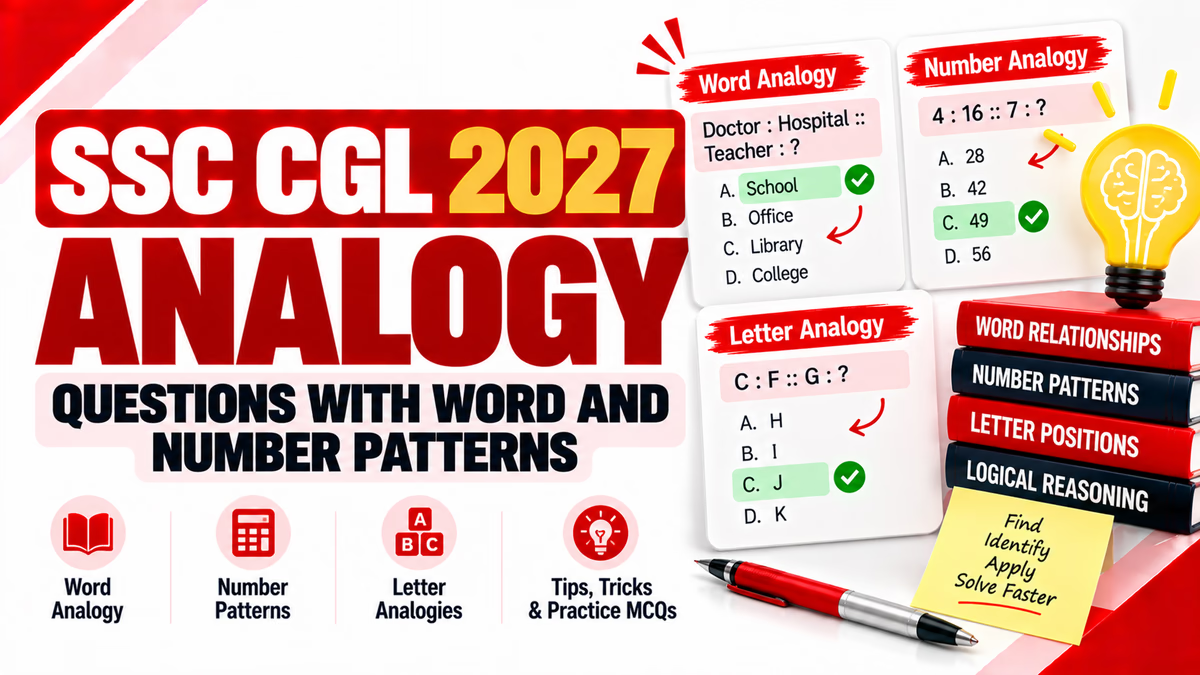
For example:
Doctor : Hospital :: Teacher : ?
A doctor generally works in a hospital, while a teacher generally works in a school. Therefore, the correct answer is School.
The key to solving analogy questions is to identify the exact relationship in the first pair and apply the same relationship to the second pair.
Word analogy questions test the relationship between two words. These relationships may involve synonyms, antonyms, professions, objects, places, functions, or categories.
Example: Bird : Nest :: Lion : ?
Answer: Den
Explanation: A nest is a place where a bird lives, and a den is a place associated with a lion.
Common word relationships include:
Number analogy questions require candidates to identify a mathematical relationship between two numbers and apply it to another pair. Common patterns include multiplication, division, addition, subtraction, squares, cubes, and combinations of operations.
Example: 4 : 16 :: 7 : ?
Answer: 49
Explanation: The first number is squared to obtain the second number: 4 × 4 = 16. Similarly, 7 × 7 = 49.
Common numerical relationships include:
Letter analogy questions are based on the positions of letters in the English alphabet. Candidates should remember that A = 1, B = 2, C = 3, and so on, up to Z = 26.
Example: C : F :: G : ?
Answer: J
Explanation: C moves three positions forward to reach F. Applying the same pattern, G moves three positions forward to reach J.
Some questions may use backward positions, alternate letters, or different shifts for different letters. Check the complete pattern before selecting an option.
Using a clear relationship statement prevents confusion between options that appear similar but do not have the same logical connection.
Avoid selecting an answer simply because one operation works for a single pair. Confirm that the rule is logically consistent with the complete question.
Attempt the following questions before checking the answers. These are practice questions designed to help you understand common analogy patterns; they are not presented as official previous-year questions.
Book : Reading :: Fork : ?
A) Drawing
B) Eating
C) Sleeping
D) Running
Correct Answer: B) Eating
Explanation: A book is used for reading, while a fork is used for eating.
Calf : Cow :: Foal : ?
A) Goat
B) Horse
C) Sheep
D) Deer
Correct Answer: B) Horse
Explanation: A calf is the young one of a cow, and a foal is the young one of a horse.
6 : 36 :: 9 : ?
A) 18
B) 27
C) 72
D) 81
Correct Answer: D) 81
Explanation: The second number is the square of the first number. Therefore, 9² = 81.
5 : 15 :: 8 : ?
A) 16
B) 24
C) 32
D) 40
Correct Answer: B) 24
Explanation: The second number is obtained by multiplying the first number by 3. Therefore, 8 × 3 = 24.
D : G :: K : ?
A) M
B) N
C) O
D) P
Correct Answer: B) N
Explanation: D moves three positions forward to reach G. Similarly, K moves three positions forward to reach N.
Eye : Seeing :: Ear : ?
A) Smelling
B) Hearing
C) Speaking
D) Touching
Correct Answer: B) Hearing
Explanation: The eye is associated with seeing, while the ear is associated with hearing.
3 : 12 :: 5 : ?
A) 20
B) 25
C) 30
D) 35
Correct Answer: A) 20
Explanation: The second number is four times the first number. Therefore, 5 × 4 = 20.
A : C :: F : ?
A) G
B) H
C) I
D) J
Correct Answer: B) H
Explanation: A moves two positions forward to reach C. Applying the same shift, F moves two positions forward to reach H.
To improve analogy-solving ability, include a short reasoning practice session in your daily study routine. Start with basic word and number relationships, then progress to mixed and more challenging questions.
During mock tests, focus on solving familiar patterns quickly without sacrificing accuracy. Your personal practice results can help you decide which analogy types need more revision.
Analogy is a reasoning topic in which candidates identify a relationship between two items and apply the same relationship to another pair of words, numbers, letters, or symbols.
Aspirants should practise word analogy, number analogy, letter analogy, and questions involving functions, categories, mathematical operations, and alphabet positions.
Identify the relationship in the given pair, express it in a simple sentence or mathematical rule, and test the same relationship against the answer options.
No. Analogy questions can test vocabulary, logical relationships, alphabet positions, numerical operations, and other forms of pattern recognition.
Practise different analogy types daily, revise common patterns, solve timed exercises, and review mistakes regularly. Combine topic-wise practice with full-length reasoning mock tests.
Analogy questions can become easier to solve when candidates understand the relationship between the given items instead of relying on guesswork. For SSC CGL 2027, focus on word relationships, numerical operations, alphabet positions, and consistent practice. Review every mistake and gradually improve your solving speed through timed exercises and mock tests.
Keep practising with Katara Academy to strengthen your reasoning concepts and build confidence for competitive examinations.