




Download the App & Start Learning
- Expert Faculty Guidance
- Updated Study Material
- Mock Tests & Practice Quiz
- Live Doubt Solving Sessions
- Exam-Oriented Preparation
- Motivation & Success Strategy
Katara Academy

10/13/2026
Sentence Improvement is an important English practice topic for candidates preparing for SSC CGL 2027 and other competitive examinations. These questions test your ability to identify grammatical errors, improve sentence structure and select the most appropriate expression without changing the original meaning.
To solve sentence improvement questions accurately, candidates should understand subject-verb agreement, tenses, articles, prepositions, pronouns, conjunctions and parallel structure. Regular practice with grammar rules and multiple-choice questions can help you recognise incorrect constructions and choose the best alternative.
In this article, Katara Academy covers essential sentence improvement rules, solved examples, common mistakes and practice MCQs with explanations to support your SSC CGL 2027 English preparation.
Sentence improvement is a type of English grammar exercise in which a part of a sentence is underlined or highlighted. Candidates must select the alternative that makes the sentence grammatically correct, clearer or more appropriate while preserving its intended meaning.
Depending on the question, the original phrase may contain an error in tense, subject-verb agreement, preposition, article, pronoun, word order or idiomatic usage.
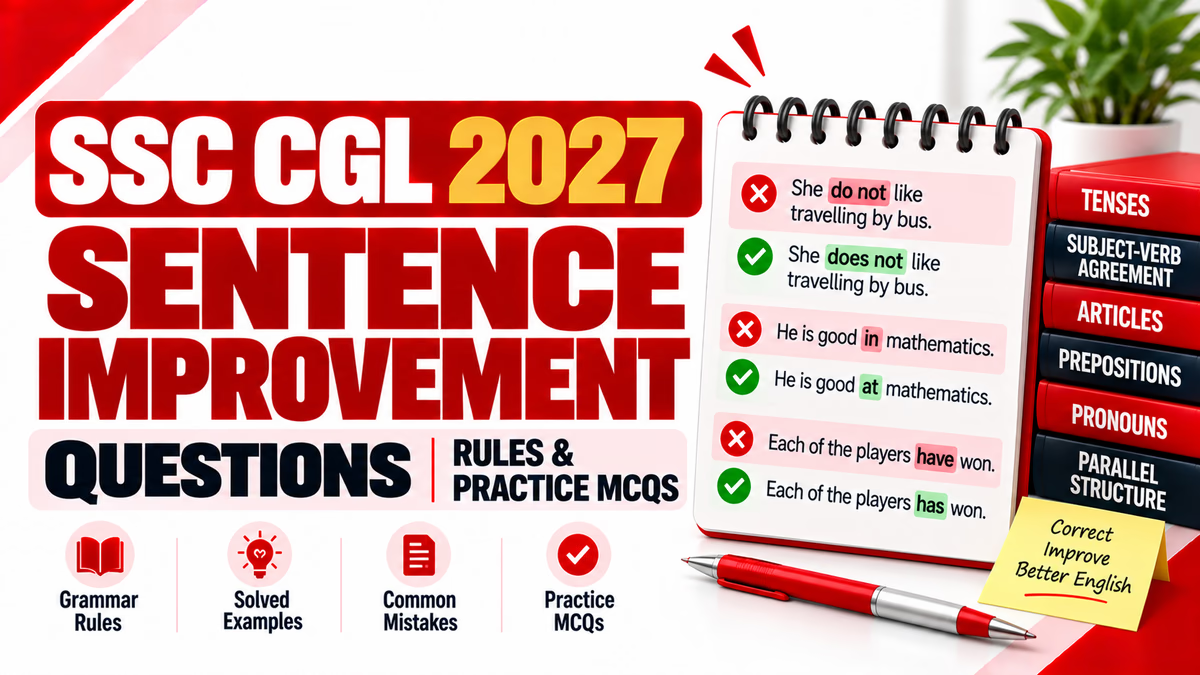
Example: She do not like travelling by bus.
Incorrect phrase: do not
Correct phrase: does not
Improved sentence: She does not like travelling by bus.
The subject "she" is singular, so the sentence requires "does not" rather than "do not". The meaning remains unchanged.
Use a systematic approach instead of choosing an option simply because it sounds natural.
Read the entire sentence to understand its meaning. The error may become clear only when you consider the relationship between different parts of the sentence.
Check the subject and verb, tense, pronouns, articles, prepositions and sentence structure. Look for the specific part that needs correction.
Once you identify the likely error, apply the appropriate grammar rule. For example, a singular subject generally requires a singular verb in the simple present tense.
Read each alternative carefully. Some options may correct one error but introduce another. Eliminate choices that are grammatically incorrect or change the intended meaning.
Insert the selected alternative into the sentence and read it again. Confirm that the final sentence is grammatically correct, clear and consistent with the original meaning.
The verb must agree with its subject in number and person.
Incorrect: Each of the students have submitted the assignment.
Correct: Each of the students has submitted the assignment.
"Each" is singular in this construction, so it takes "has". Do not let a plural noun near the subject distract you from the actual grammatical subject.
The tense should match the time and context of the action. Avoid unnecessary tense changes within a sentence.
Incorrect: She completed the work and goes home.
Correct: She completed the work and went home.
Both actions occurred in the past, so the past tense is appropriate for both verbs.
Use "a" before a singular countable noun beginning with a consonant sound, "an" before a singular countable noun beginning with a vowel sound, and "the" when referring to something specific or identifiable.
Incorrect: He is an university student.
Correct: He is a university student.
"University" begins with a /juː/ sound, so "a" is correct.
Some verbs, adjectives and expressions require particular prepositions. Learn these combinations through examples.
Incorrect: She is good in mathematics.
Correct: She is good at mathematics.
Other useful combinations include interested in, depend on, belong to, capable of and insist on.
A pronoun should clearly refer to the intended noun and fit the sentence grammatically.
Incorrect: Every candidate must bring their admit card, according to a traditional singular-pronoun exercise.
Improved formal alternative: Every candidate must bring his or her admit card.
In modern English, singular "they" is also widely accepted. In an examination question, follow the context and the grammar convention being tested rather than assuming every use of singular "they" is incorrect.
Make comparisons between logically equivalent people, things or qualities. Avoid incomplete or misleading comparisons.
Incorrect: The population of Pune is greater than Mumbai.
Correct: The population of Pune is greater than that of Mumbai.
"That" refers to the population, making the comparison logically complete.
When items appear in a series or are connected by a conjunction, maintain a consistent grammatical structure.
Incorrect: She enjoys reading, writing and to paint.
Correct: She enjoys reading, writing and painting.
All three activities use the same grammatical form.
Conditional sentences express a condition and its result. The verb forms should match the type of condition being described.
Incorrect: If I will have time, I will help you.
Correct: If I have time, I will help you.
In a standard first conditional sentence, the present simple is generally used in the "if" clause and "will" in the main clause.
In standard formal English, avoid using two negative forms when only one is intended.
Incorrect: I do not know nothing about the matter.
Correct: I do not know anything about the matter.
Avoid unnecessary words that repeat the same meaning.
Incorrect: We must return back before sunset.
Correct: We must return before sunset.
"Return" already conveys the idea of going back, so "back" is unnecessary in this sentence.
The following examples demonstrate how grammar rules can be applied to examination-style questions.
Example 1: Neither of the two answers are correct.
Improved sentence: Neither of the two answers is correct.
Explanation: In traditional competitive-exam grammar, "neither" is treated as singular in this construction and takes "is".
Example 2: He has been working here since five years.
Improved sentence: He has been working here for five years.
Explanation: Use "for" with a duration and "since" with a starting point.
Example 3: The teacher explained me the answer.
Improved sentence: The teacher explained the answer to me.
Explanation: The standard construction is "explain something to someone".
Example 4: She is senior than me.
Improved sentence: She is senior to me.
Explanation: "Senior" is generally followed by "to", not "than".
Example 5: Hardly had I reached the station than the train arrived.
Improved sentence: Hardly had I reached the station when the train arrived.
Explanation: The standard paired construction is "hardly ... when".
Example 6: He prefers tea than coffee.
Improved sentence: He prefers tea to coffee.
Explanation: The verb "prefer" commonly uses the construction "prefer one thing to another".
Example 7: The furniture in these rooms are expensive.
Improved sentence: The furniture in these rooms is expensive.
Explanation: "Furniture" is an uncountable noun and takes a singular verb in standard English.
Example 8: No sooner did the bell ring when the students left.
Improved sentence: No sooner did the bell ring than the students left.
Explanation: The standard paired construction is "no sooner ... than".
Choose the most appropriate replacement for the bold part of each sentence. If the sentence is already correct, select the option that indicates no improvement is needed.
Q1. Each of the players have received a certificate.
Q2. She has been preparing for the examination since three months.
Q3. He is good in solving mathematical problems.
Q4. The teacher asked the students to complete the assignment and submitting it by Monday.
Q5. If he will study regularly, he will improve his performance.
Q6. She prefers reading novels than watching television.
Q7. The information provided by the officer were useful.
Q8. He is one of the best students which have participated in the competition.
Q9. No sooner had the meeting started when the power went out.
Q10. The new policy will effect the performance of the organisation.
Q11. She is senior than her colleague.
Q12. The committee have taken its decision.
Sentence improvement questions become easier when you understand grammar rules and apply them systematically. Focus on subject-verb agreement, tense consistency, prepositions, articles, pronouns, comparisons and parallel structure. Practise with examples, review your errors and check whether the improved sentence preserves the original meaning.
Consistent practice can help you build grammatical accuracy and confidence for SSC CGL 2027. Combine sentence improvement exercises with vocabulary, comprehension and other English topics for balanced preparation.
Keep learning with Katara Academy and strengthen your English grammar for SSC CGL 2027.