Download the App & Start Learning
- Expert Faculty Guidance
- Updated Study Material
- Mock Tests & Practice Quiz
- Live Doubt Solving Sessions
- Exam-Oriented Preparation
- Motivation & Success Strategy
Katara Academy

10/13/2026
Reading comprehension is an important part of English preparation for SSC CGL 2027. It tests a candidate's ability to understand a passage, identify the main idea, locate relevant information, interpret vocabulary and draw logical conclusions. Many candidates know English grammar but struggle with comprehension because they spend too much time rereading the passage or selecting answers without sufficient evidence.
The solution is to develop a structured reading approach. Instead of reading every sentence repeatedly, learn to identify the purpose of the passage, recognise keywords, understand question types and eliminate unsupported options. This article explains practical strategies, common mistakes and practice questions to help you improve reading accuracy and speed.
Reading comprehension is the ability to understand written information and interpret its meaning accurately. In competitive examinations, candidates are usually given a passage followed by questions based on the information it contains.
These questions may ask you to identify the central idea, understand a specific detail, infer an unstated conclusion, interpret a word in context or determine the author's attitude.
For example, if a passage explains how regular exercise improves physical fitness and concentration, the main idea is likely to be the benefits of regular exercise. A question about one specific benefit, however, may require you to locate a particular sentence in the passage.
Remember that the correct answer must be supported by the passage. Your personal opinion or outside knowledge should not replace the information provided by the author.
Understanding the type of question helps you decide where to focus your attention.
| Question Type | What It Tests | Useful Approach |
|---|---|---|
| Main idea | The central message of the passage | Identify the topic and the author's overall point. |
| Specific information | A stated fact or detail | Locate keywords from the question in the passage. |
| Inference | A conclusion supported by the text | Combine relevant clues without making unsupported assumptions. |
| Vocabulary in context | The meaning of a word as used in the passage | Read the surrounding sentence and understand the context. |
| Author's tone | The writer's attitude towards the subject | Notice descriptive words, criticism, praise or neutral reporting. |
| Title selection | The best summary of the passage | Choose a title that covers the whole passage, not just one detail. |
| True or false statement | Whether a statement agrees with the passage | Check the exact wording and avoid options that change the meaning. |
Before reading the passage in detail, briefly look at the questions if the examination format permits it. Identify whether they ask about the main idea, a specific fact, vocabulary or an inference. This helps you know what information to look for.
Read the passage once at a steady pace. Focus on the topic, the author's purpose and the relationship between the paragraphs. Avoid stopping at every unfamiliar word unless it prevents you from understanding the overall message.
Look for names, dates, figures, repeated concepts and distinctive terms mentioned in the questions. These details can help you locate the relevant part of the passage quickly.
The correct option may express the passage's meaning using different words. For example, a passage may say that a plan "reduced expenses", while an option says that it "lowered costs". Both expressions communicate the same idea.
Remove options that contradict the passage, introduce information that is not mentioned or make a claim that is too broad. Pay attention to words such as "always", "never", "only" and "all", which can make an option stronger than the passage supports.
An inference is a conclusion that follows from the available information. It should be logically supported by the passage even if it is not stated word for word. Avoid choosing an option merely because it sounds reasonable in real life.
If time permits, revisit questions where two options seemed similar. Confirm that the selected option matches the passage and answers the question directly.
Keywords are useful because they guide you towards the relevant information. However, the same word may not appear in the passage and the answer option, so focus on meaning as well as exact wording.
Example: A passage states, "Although online learning offers flexibility, some students find it difficult to remain motivated without a fixed schedule."
The word "although" signals a contrast. The sentence recognises a benefit of online learning while also highlighting a challenge. An option claiming that online learning has no disadvantages would therefore be incorrect.
You do not need to know every word in a passage to answer every question correctly. Use the surrounding information to estimate the meaning of an unfamiliar word.
After completing the exercise, record unfamiliar words in a vocabulary notebook and revise their meanings with example sentences.
Reading comprehension requires both accuracy and efficient use of examination time. Your ideal pace will depend on passage length, difficulty and your current reading ability.
Do not follow a rigid time limit for every passage without considering its length and difficulty. Use practice results to develop a realistic strategy for the examination.
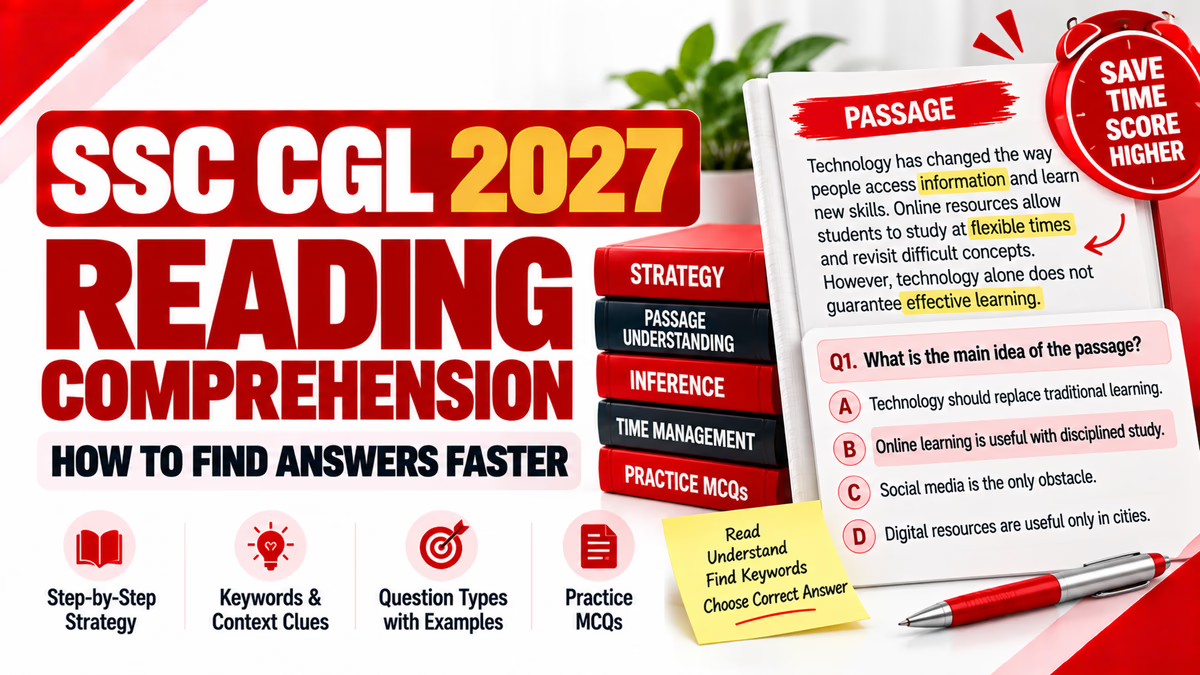
Read the following passage carefully and answer the questions that follow.
Technology has changed the way people access information and learn new skills. Online resources allow students to study at flexible times and revisit difficult concepts whenever necessary. Digital learning can also provide access to educational material for people who live far from major learning centres. However, technology alone does not guarantee effective learning. Students need clear goals, regular practice and the ability to evaluate the reliability of online information. Distractions from social media and frequent notifications can also reduce concentration. A balanced approach that combines digital resources with disciplined study habits can help learners make better use of available opportunities.
Q1. What is the main idea of the passage?
Q2. According to the passage, one benefit of online resources is that students can:
Q3. What can reduce concentration during digital learning?
Q4. The word "reliability" in the passage is closest in meaning to:
Q5. Which conclusion is supported by the passage?
Q6. What does the author suggest about effective learning?
Q7. What is the tone of the passage?
Finding answers faster in reading comprehension requires a combination of careful reading, keyword identification, contextual understanding and logical elimination. Read the passage for its main idea, identify what each question asks, locate relevant evidence and ensure that the selected answer matches the text.
For SSC CGL 2027, practise passages regularly and review the reasons behind incorrect answers. Track your accuracy and time so that you can identify areas requiring improvement. Consistent practice can help you become a more confident and efficient reader.
Keep practising with Katara Academy and strengthen your English preparation for SSC CGL 2027.