

Download the App & Start Learning
- Expert Faculty Guidance
- Updated Study Material
- Mock Tests & Practice Quiz
- Live Doubt Solving Sessions
- Exam-Oriented Preparation
- Motivation & Success Strategy
Katara Academy

10/22/2026
Preparing for a competitive examination involves more than completing the syllabus and attempting practice papers. Candidates also need to understand their performance, identify weak areas and make meaningful improvements. Regular practice becomes more effective when every test is followed by a careful review.
SSC CGL mock analysis helps candidates understand their sectional test performance, identify recurring errors and plan targeted revision. Instead of focusing only on marks, aspirants should examine their accuracy, time management and approach to different question types.
A sectional test focuses on one subject or a specific part of the syllabus. It allows candidates to evaluate individual skills without attempting an entire examination paper.
For example, a Quantitative Aptitude test may reveal calculation difficulties, while an English practice paper can highlight problems with grammar, vocabulary or comprehension.
Subject-wise practice can help you:
Before planning your preparation, review the latest official SSC CGL notification for the applicable syllabus, examination structure and marking scheme.
A final score does not explain everything about your performance. Record a few important indicators after each attempt so you can compare results over time.
| Indicator | What to Review |
|---|---|
| Questions attempted | Total number of questions you answered. |
| Correct responses | Number of answers that were accurate. |
| Incorrect responses | Number of answers that were wrong. |
| Unattempted questions | Questions you left unanswered. |
| Time taken | Total time spent completing the test. |
| Topic-wise results | Areas where you performed well or struggled. |
These records help you recognise patterns. For instance, you might discover that your concepts are clear but your performance drops when you work under time pressure.
Accuracy is an important indicator because a high number of attempts does not necessarily mean that you are answering effectively.
Accuracy (%) = (Correct Answers ÷ Total Questions Attempted) × 100
Suppose you attempt 40 questions and answer 32 correctly.
Accuracy = (32 ÷ 40) × 100 = 80%
This means that 80% of your attempted questions were correct. Review the remaining eight responses and identify why they went wrong.
Consider accuracy alongside speed, question difficulty and the applicable negative-marking rules. Avoid increasing your attempts simply to achieve a higher number if doing so leads to frequent mistakes.
Every incorrect answer offers an opportunity to learn. Instead of reading the solution and immediately moving forward, determine why your original approach failed.
| Mistake Type | Possible Cause | Corrective Action |
|---|---|---|
| Conceptual error | The underlying method was unclear. | Revise the concept and solve basic questions. |
| Calculation error | An arithmetic step was incorrect. | Practise calculations and verify your working. |
| Misreading | An important condition was overlooked. | Read each question carefully before answering. |
| Memory gap | A formula or fact was forgotten. | Use short, regular revision sessions. |
| Time pressure | Too much time was spent on one problem. | Practise efficient methods and question selection. |
| Uncertain guessing | The answer was selected without sufficient reasoning. | Improve elimination skills and assess the risk. |
Classifying mistakes helps you select the right solution instead of repeating the same practice routine without addressing the actual problem.
Review whether your mistakes came from weak concepts, incorrect formulas, lengthy calculations or careless arithmetic.
Reasoning questions often require careful observation and logical thinking. Check whether you misunderstood a pattern, overlooked a condition or selected an inefficient approach.
English practice can reveal weaknesses in grammar, vocabulary, sentence structure and reading comprehension.
For General Awareness, identify whether mistakes occurred because of missing knowledge, confusion between similar facts or uncertain guesses.
Solving questions correctly is important, but spending too long on one problem can affect your overall result. Review questions that consumed more time than expected.
Ask yourself whether the extra time was necessary, whether a shorter method was available and whether you should have moved to another question earlier.
Build a reliable solving method first. Increase your speed gradually through repeated practice rather than rushing and making avoidable errors.
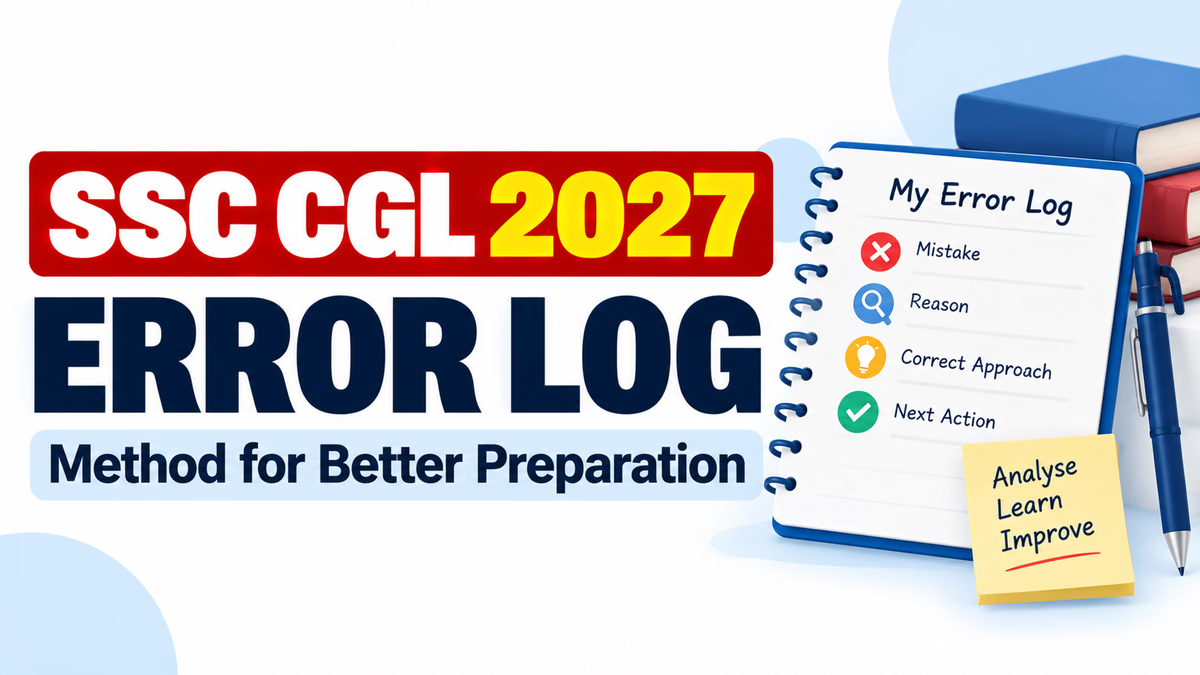
An error log is a notebook or spreadsheet that records mistakes and the actions needed to correct them. It helps you revisit earlier problems instead of forgetting them after each test.
| Date | Topic | Mistake | Corrective Action |
|---|---|---|---|
| 22 October | Percentage | Incorrect calculation | Practise similar problems. |
| 22 October | Grammar | Rule applied incorrectly | Revise the rule and solve exercises. |
| 22 October | Reasoning | Pattern misunderstood | Practise related question types. |
These examples are illustrative. Record your own mistakes and update the log after every practice session.
Reviewing mistakes is useful only when you take action. After each test, select two or three important weaknesses and work on them before your next attempt.
For example, if percentage questions repeatedly cause problems, revise the relevant concepts and solve focused exercises before taking another timed test. This approach helps you measure improvement instead of relying on guesswork.
One test cannot provide a complete picture of your preparation. Compare several reasonably similar tests to identify meaningful performance trends.
The following is an example of how candidates can distribute subject practice and review throughout the week. Adjust it according to your syllabus coverage and available study time.
| Day | Suggested Activity |
|---|---|
| Monday | Take a Quantitative Aptitude test and review mistakes. |
| Tuesday | Revise weak mathematical topics and formulas. |
| Wednesday | Practise Reasoning and analyse incorrect answers. |
| Thursday | Take an English test and revise weak areas. |
| Friday | Review General Awareness questions and knowledge gaps. |
| Saturday | Revisit the error log and practise recurring problem areas. |
| Sunday | Review weekly progress and plan the next week. |
Avoid taking more tests than you can analyse properly. A smaller number of carefully reviewed tests can be more useful than repeated attempts without meaningful revision.
Q1. What is the main purpose of a sectional test?
A. To avoid revision
B. To evaluate a particular subject
C. To replace the official examination
D. To guarantee selection
Answer: B. It helps candidates evaluate their knowledge and skills in one subject.
Q2. A candidate attempts 50 questions and answers 40 correctly. What is the accuracy?
A. 60%
B. 70%
C. 80%
D. 90%
Answer: C. Accuracy = (40 ÷ 50) × 100 = 80%.
Q3. What should you do after making a conceptual mistake?
A. Ignore the question
B. Memorise only the option
C. Review the concept and practise similar questions
D. Stop practising
Answer: C. Addressing the underlying concept helps prevent similar errors.
Q4. What is the purpose of an error log?
A. Recording mistakes and corrective actions
B. Recording only examination dates
C. Replacing the syllabus
D. Guaranteeing a result
Answer: A. It helps candidates track repeated problems and organise revision.
Q5. Why should you review the time spent on individual questions?
A. To avoid answering questions
B. To identify inefficient solving methods
C. To increase errors
D. To ignore difficult topics
Answer: B. Time analysis can reveal where a more efficient approach is needed.
Q6. What is a useful response to repeated grammar errors?
A. Ignore grammar
B. Review the relevant rules and practise
C. Study unrelated facts
D. Stop taking English tests
Answer: B. Targeted revision addresses the source of the mistakes.
Q7. Should preparation quality be judged using only one test?
A. Yes, always
B. No, compare results across multiple tests
C. Only when the score is low
D. Only when the test is short
Answer: B. Several comparable results provide a better indication of progress.
Q8. What should you do after identifying a weak topic?
A. Avoid it permanently
B. Revise the concept and practise targeted questions
C. Delete your notes
D. Attempt unrelated tests only
Answer: B. Focused practice helps address the identified weakness.
Q9. What should be considered when comparing two practice-test scores?
A. Only the test title
B. Test difficulty and comparability
C. The paper colour
D. The candidate's favourite subject
Answer: B. Differences in difficulty can affect scores and should be considered.
Q10. What should follow a test review?
A. No further action
B. A targeted improvement plan
C. Abandoning the subject
D. Repeating the same test without review
Answer: B. Reviewing mistakes should lead to revision, focused practice and progress checks.
Effective test analysis helps candidates understand their current preparation level and identify practical ways to improve. Review your accuracy, classify mistakes, track time management and maintain a record of recurring weaknesses.
Rather than focusing only on the number of tests completed, concentrate on what each attempt teaches you. Consistent practice, targeted revision and regular progress reviews can help you build stronger concepts and make better decisions during the examination.
For the latest syllabus, examination structure and marking rules, consult the official SSC notification applicable to the recruitment cycle.
