
Download the App & Start Learning
- Expert Faculty Guidance
- Updated Study Material
- Mock Tests & Practice Quiz
- Live Doubt Solving Sessions
- Exam-Oriented Preparation
- Motivation & Success Strategy
Katara Academy

10/22/2026
Preparing for a competitive examination involves learning concepts, solving practice questions and revising important topics regularly. However, many candidates continue making the same mistakes because they move from one practice test to another without reviewing their errors.
An error log is a simple but effective way to record incorrect answers, understand their causes and plan targeted revision. Instead of repeatedly studying everything, candidates can use this method to focus on the areas that need the most attention.
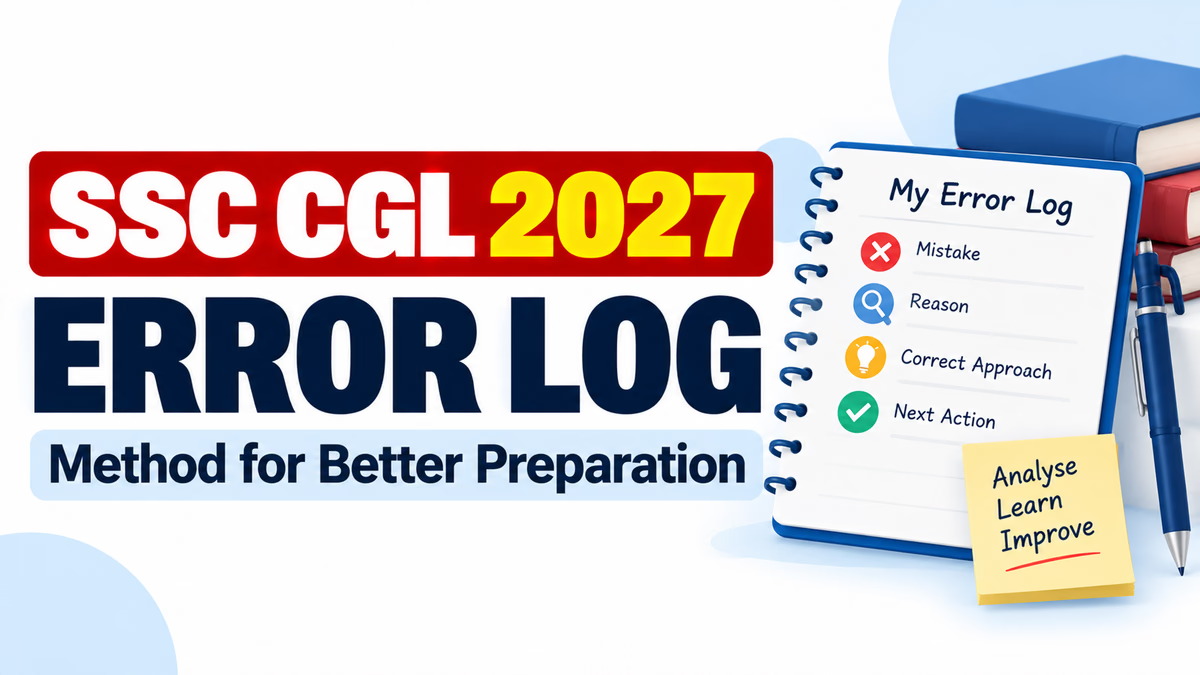
An error log is a notebook, spreadsheet or digital document where you record mistakes made during practice questions, sectional tests and mock examinations.
It should contain more than the question and its correct answer. A useful record explains why the mistake occurred, what you learned from it and what action will help prevent the same error in the future.
Maintaining an error log can help you:
Solving questions is important, but learning from incorrect answers is equally valuable. Without a review system, candidates may forget earlier mistakes and repeat them in future tests.
A well-maintained record turns mistakes into specific learning tasks. For example, if you repeatedly make errors in percentage calculations, you can revise the relevant concepts and practise similar problems instead of revising the entire Quantitative Aptitude syllabus again.
The goal is not to collect as many mistakes as possible. It is to understand each important error and take corrective action.
Keep the format simple so that you can update it after every practice session.
| Column | Information to Record |
|---|---|
| Date | When the mistake was identified. |
| Subject | Quantitative Aptitude, Reasoning, English or General Awareness. |
| Topic | The specific concept or question type involved. |
| Mistake | A brief description of the incorrect response. |
| Reason | Why the error occurred. |
| Correct approach | The concept, rule or method needed to solve it properly. |
| Next action | Revision, additional practice or another review. |
| Review status | Whether the question has been solved correctly again. |
Avoid copying lengthy explanations for every question. Write concise notes that help you remember the key learning point.
Not every incorrect answer has the same cause. Classifying mistakes helps you decide what to do next.
| Mistake Type | Example | Suggested Action |
|---|---|---|
| Conceptual | Applying the wrong mathematical method. | Relearn the concept and solve basic questions. |
| Calculation | Making an arithmetic error. | Practise calculations and verify each step. |
| Memory-related | Forgetting a formula or important fact. | Use spaced revision and short recall exercises. |
| Misreading | Overlooking a condition in the question. | Read carefully and identify the exact requirement. |
| Time management | Spending too long on a single question. | Practise efficient methods and question selection. |
| Guessing | Choosing an option without sufficient reasoning. | Improve elimination skills and assess the risk. |
After identifying the mistake type, choose a corrective action. This makes your revision more focused and measurable.
For mathematics-related questions, record the concept, formula or calculation step that caused the problem.
For example, if you repeatedly make mistakes in profit and loss questions, record whether the issue involves the cost price, selling price, percentage calculation or the interpretation of the question.
Reasoning mistakes may occur because of incorrect pattern recognition, missed conditions or an inefficient solving approach.
For English, keep notes on grammar rules, vocabulary, sentence structure and comprehension mistakes.
General Awareness mistakes often involve forgotten facts, confusion between similar terms or gaps in topic knowledge.
Keep this section brief. The purpose is to make revision easier, not to recreate an entire textbook inside your notebook.
The following example shows how a candidate can turn an incorrect answer into a practical revision task.
| Field | Example Entry |
|---|---|
| Subject | Quantitative Aptitude |
| Topic | Percentage |
| Mistake | Used the wrong base value for a percentage calculation. |
| Reason | Misunderstood what the percentage was calculated from. |
| Correct approach | Identify the reference value before calculating the percentage. |
| Next action | Revise the concept and solve five similar questions. |
| Review status | Reattempt after revision and record the result. |
This is an illustrative example. Your own entries should describe the mistakes you actually make during practice.
Writing down mistakes is only the beginning. You need to revisit them so that the correct method becomes easier to recall.
A practical review routine can include the following:
These intervals are suggestions rather than fixed rules. Adjust the routine according to your available time and how difficult the topic is for you.
Reviewing previous mistakes before another test can help you focus on the areas that need attention. However, avoid spending all your preparation time reading old notes.
Use the results of the new test to update your notes. If the same mistake appears again, investigate whether the concept is still unclear or whether the corrective method needs to change.
A useful error log should be easy to update, simple to review and directly connected to your next revision task.
You can use the following routine alongside your regular study schedule.
| Day | Activity |
|---|---|
| Monday | Record mistakes from recent Quantitative Aptitude practice. |
| Tuesday | Revise reasoning errors and practise similar questions. |
| Wednesday | Review English grammar and vocabulary mistakes. |
| Thursday | Revise General Awareness facts that were forgotten or confused. |
| Friday | Reattempt questions that previously caused difficulty. |
| Saturday | Review recurring mistakes and update their status. |
| Sunday | Evaluate progress and select priorities for the following week. |
This is a flexible example. Adapt it to your preparation level and the amount of time available each day.
Q1. What is the main purpose of an error log?
A. To record only examination dates
B. To identify mistakes and plan corrective action
C. To replace the syllabus
D. To guarantee selection
Answer: B. A mistake log helps candidates understand errors and decide how to correct them.
Q2. What should you record after answering a question incorrectly?
A. Only the question number
B. Only the final score
C. The reason for the error and the corrective action
D. Unrelated study notes
Answer: C. Understanding the cause makes the review more useful.
Q3. What is an appropriate response to a repeated calculation error?
A. Ignore the error
B. Practise calculations and check the working
C. Stop solving mathematics questions
D. Memorise unrelated facts
Answer: B. Targeted practice helps improve calculation accuracy.
Q4. How should candidates handle a forgotten formula?
A. Avoid the topic permanently
B. Record and revise the formula, then practise its application
C. Copy the entire textbook
D. Ignore future mistakes
Answer: B. Revision combined with practice improves recall and application.
Q5. Why should an error log be reviewed regularly?
A. To make the notebook longer
B. To identify unresolved mistakes and check improvement
C. To avoid taking tests
D. To replace all revision materials
Answer: B. Regular review helps candidates monitor progress.
Q6. What should you do if the same mistake occurs again?
A. Delete the entry immediately
B. Investigate the cause and revise the corrective approach
C. Ignore the result
D. Stop studying the subject
Answer: B. Repeated errors may indicate that the underlying issue has not been resolved.
Q7. Which format can be used for an error log?
A. Only a printed textbook
B. A notebook or spreadsheet
C. Only a social media post
D. An examination admit card
Answer: B. Both formats can work if they are easy to maintain and review.
Q8. What should General Awareness notes contain?
A. Unverified facts
B. Concise and verified information about mistakes
C. Only personal opinions
D. Unrelated mathematical formulas
Answer: B. Concise, verified notes support effective revision.
Q9. What is a useful step before another practice test?
A. Ignore all previous errors
B. Revise important weaknesses and practise targeted questions
C. Memorise every solution without understanding it
D. Avoid reviewing performance
Answer: B. Focused revision can help address previously identified problems.
Q10. When can a mistake be marked as resolved?
A. Immediately after copying the answer
B. When the candidate can solve the question correctly and understands the method
C. When the notebook is full
D. When another test is postponed
Answer: B. Understanding and correctly applying the method provides better evidence of improvement.
An error log can make exam preparation more organised by turning incorrect answers into specific learning tasks. Record the cause of each important mistake, revise the relevant concept and practise similar questions before reviewing the result again.
Consistency matters more than creating a complicated system. Keep your notes concise, review them regularly and use the information to guide your next study session. Over time, this approach can help you recognise recurring weaknesses, strengthen understanding and prepare more efficiently for the examination.
For the latest examination syllabus, structure and marking rules, consult the official SSC notification applicable to your recruitment cycle.
