
Download the App & Start Learning
- Expert Faculty Guidance
- Updated Study Material
- Mock Tests & Practice Quiz
- Live Doubt Solving Sessions
- Exam-Oriented Preparation
- Motivation & Success Strategy
Katara Academy

13/11/2026
Time management is one of the most important skills required for SSC CHSL 2027 preparation. Candidates need to solve questions accurately, manage different subjects and complete each section within the available examination time.
Many aspirants prepare all four subjects but struggle to complete questions within the time limit. Some spend too long on Mathematics, while others rush through English or General Awareness. Without a proper time-management strategy, even well-prepared candidates may lose valuable marks.
In this guide, you will learn about SSC CHSL section-wise time allocation, how to use sectional timers, question-selection strategies and practical techniques to improve speed without compromising accuracy.
Before preparing a time-management strategy, understand the examination structure. The SSC CHSL 2027 pattern should be confirmed through the official notification when released.
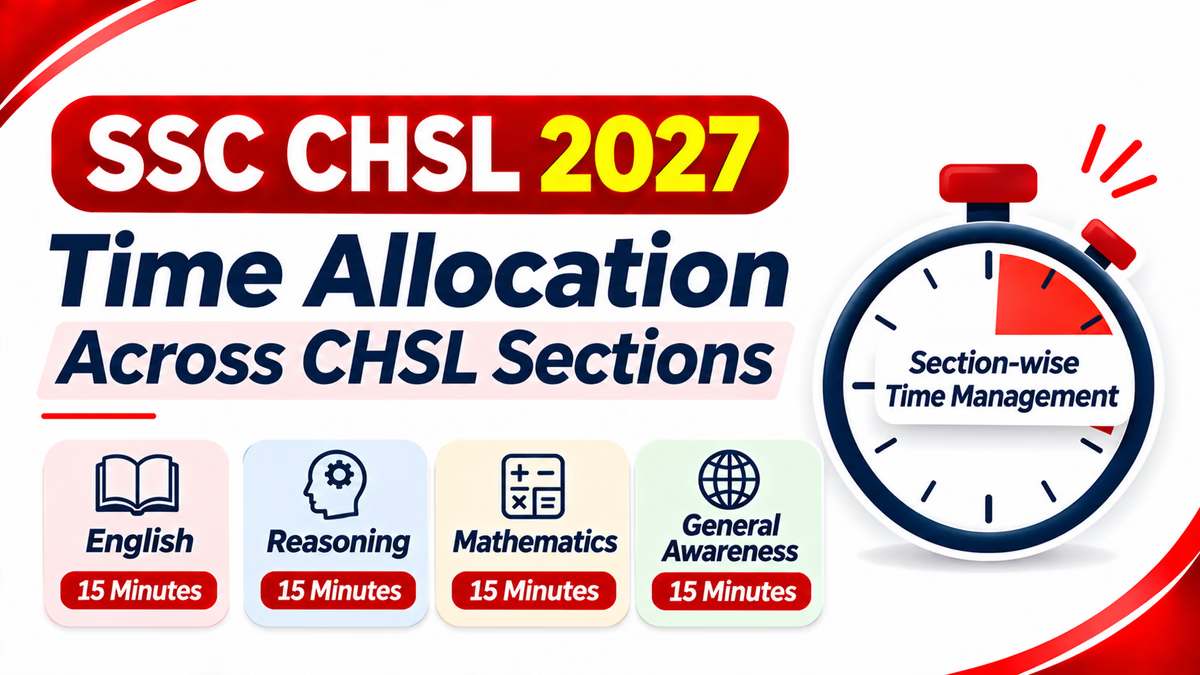
As per the SSC CHSL 2026 notification, Tier-I has four subjects with 25 questions each. The standard examination duration is 60 minutes, with a separate 15-minute sectional timer for each subject.
| Tier-I Subject | Questions | Marks | Section Time |
|---|---|---|---|
| English Language | 25 | 50 | 15 minutes |
| General Intelligence | 25 | 50 | 15 minutes |
| Quantitative Aptitude | 25 | 50 | 15 minutes |
| General Awareness | 25 | 50 | 15 minutes |
| Total | 100 | 200 | 60 minutes |
Important: The 2026 notification specifies 15 minutes for each Tier-I subject. Candidates cannot freely transfer unused time from one section to another. Check the SSC CHSL 2027 notification for the applicable pattern and timing.
Since each subject has a fixed timer in the 2026 pattern, your goal should be to use the available 15 minutes efficiently. The following approach is a suggested practice strategy, not an additional official sectional timer.
English includes grammar, vocabulary, sentence-based questions and reading comprehension. Candidates should avoid spending too much time on one confusing question.
Suggested practice approach:
Time-management tip: Develop the habit of recognising familiar grammar patterns quickly. Avoid repeatedly changing answers without a clear reason.
Reasoning requires logical thinking and pattern recognition. Some questions can be solved quickly, while others may require more time.
Suggested practice approach:
Time-management tip: Improve your ability to recognise common question patterns so that you spend less time understanding familiar formats.
Mathematics can be time-consuming because questions may involve multiple calculations and steps. Candidates should focus on calculation speed, concept clarity and selecting suitable methods.
Suggested practice approach:
Time-management tip: Practise chapter-wise timed question sets. Learn to identify questions that you can solve accurately within a reasonable time.
General Awareness mainly tests knowledge and recall. Candidates who revise regularly can often identify familiar answers quickly.
Suggested practice approach:
Time-management tip: Consistent revision helps you recall information faster during the examination.
Tier-II also requires careful time management. As per the SSC CHSL 2026 examination scheme, the computer-based sections have separate time limits.
| Tier-II Component | Questions | Time |
|---|---|---|
| Mathematical Abilities | 30 | 30 minutes |
| Reasoning and General Intelligence | 30 | 30 minutes |
| English Language and Comprehension | 40 | 40 minutes |
| General Awareness | 20 | 20 minutes |
| Computer Knowledge Test | 15 | 15 minutes |
In the 2026 scheme, Mathematical Abilities and Reasoning have separate 30-minute timers. English and General Awareness have 40-minute and 20-minute allocations respectively. The Computer Knowledge Test has a separate 15-minute duration.
These timings are based on the 2026 notification and should be rechecked against the 2027 notification before using them as final examination instructions.
Practising with a timer helps you become comfortable with the examination environment. Use the following routine during preparation.
Do not focus only on completing all questions. Your priority should be to improve speed while maintaining accuracy.
Good time management is not only about solving questions quickly. It is also about recognising which questions deserve your attention.
Use these simple guidelines:
Remember that the official sectional timer determines when you must move to the next section. Do not assume that you can return to an earlier section unless the examination instructions explicitly allow it.
Use this sample weekly plan to improve your speed and familiarity with sectional timers.
| Day | Practice Activity |
|---|---|
| Monday | English sectional test with a 15-minute timer. |
| Tuesday | Reasoning sectional test with a 15-minute timer. |
| Wednesday | Mathematics sectional test with a 15-minute timer. |
| Thursday | General Awareness timed practice and revision. |
| Friday | Mixed sectional practice and mistake analysis. |
| Saturday | Full Tier-I mock test using the applicable sectional timers. |
| Sunday | Review performance and practise weak topics. |
As your preparation improves, include Tier-II sectional practice according to the applicable examination scheme.
Record your performance after every sectional test. This will help you identify which subjects need more speed practice and which require concept revision.
| Subject | Questions | Attempted | Correct | Time Used |
|---|---|---|---|---|
| English | 25 | 22 | 19 | 15 min |
| Reasoning | 25 | 23 | 21 | 15 min |
| Mathematics | 25 | 19 | 16 | 15 min |
| General Awareness | 25 | 22 | 18 | 15 min |
Note: The figures are illustrative practice data, not official targets or expected scores.
Review the tracker and identify the subjects where you lose marks due to slow calculations, poor recall or repeated mistakes.
Test your understanding of the SSC CHSL time-management strategy.
Q1. According to the SSC CHSL 2026 Tier-I pattern, how much time is allotted to each subject?
A. 10 minutes
B. 12 minutes
C. 15 minutes
D. 20 minutes
Q2. How many questions are included in each Tier-I subject in the 2026 pattern?
A. 20
B. 25
C. 30
D. 40
Q3. What should you do when a question is taking too long?
A. Spend the entire section time on it
B. Make a random guess immediately
C. Move to another question when permitted
D. Stop attempting the section
Q4. Which subject benefits from regular formula and calculation practice?
A. Quantitative Aptitude
B. General Awareness only
C. English only
D. None of these
Q5. What is the main purpose of sectional mock tests?
A. To avoid subject-wise practice
B. To improve speed and accuracy in individual subjects
C. To memorise question positions
D. To avoid full mock tests
Q6. How much time is allotted to Mathematical Abilities in the 2026 Tier-II scheme?
A. 15 minutes
B. 20 minutes
C. 30 minutes
D. 45 minutes
Q7. What should you do before selecting an answer?
A. Read the question carefully
B. Ignore the instructions
C. Select the longest option
D. Guess without checking
Q8. Which activity helps improve General Awareness speed?
A. Avoiding revision
B. Regular factual revision and self-testing
C. Reading only lengthy explanations
D. Skipping practice questions
Q9. Why should you analyse mock-test performance?
A. To identify time-consuming topics and mistakes
B. To increase the number of guesses
C. To avoid sectional practice
D. To ignore weak subjects
Q10. What is the best time-management strategy?
A. Solve every question without checking time
B. Spend equal effort on every question regardless of difficulty
C. Use the section timer wisely and prioritise questions carefully
D. Focus only on speed
1-C | 2-B | 3-C | 4-A | 5-B | 6-C | 7-A | 8-B | 9-A | 10-C
As per the SSC CHSL 2026 notification, each of the four Tier-I subjects has a separate 15-minute sectional timer for standard candidates. Check the 2027 notification for any changes.
The 2026 pattern specifies separate sectional timers. Candidates should not assume that unused time can be transferred between subjects. Follow the examination interface and official instructions.
Revise formulas, practise calculations, solve chapter-wise timed sets and analyse questions that take too long. Focus on accurate methods rather than blindly increasing speed.
Timed practice is useful, but balance it with concept learning and untimed practice. Use sectional tests regularly to become comfortable with the examination duration.
Under the 2026 scheme, English Language and Comprehension has 40 minutes within Tier-II Section-II. Confirm the applicable timing in the latest notification.
Revise facts regularly, practise objective questions and improve recall. Read each question carefully and avoid spending too much time on unfamiliar facts.
No. Combine sectional tests with full-length mock tests, previous year questions, concept revision and mistake analysis for balanced preparation.
Effective time management in SSC CHSL 2027 starts with understanding the examination structure and practising within the actual sectional time limits.
Build your preparation around four important habits:
Remember, good time management is not about rushing through every question. It is about using the available time wisely while maintaining accuracy.
Prepare systematically with Katara Academy. Explore structured courses and learning resources to strengthen your SSC CHSL preparation.