
Download the App & Start Learning
- Expert Faculty Guidance
- Updated Study Material
- Mock Tests & Practice Quiz
- Live Doubt Solving Sessions
- Exam-Oriented Preparation
- Motivation & Success Strategy
Katara Academy

13/11/2026
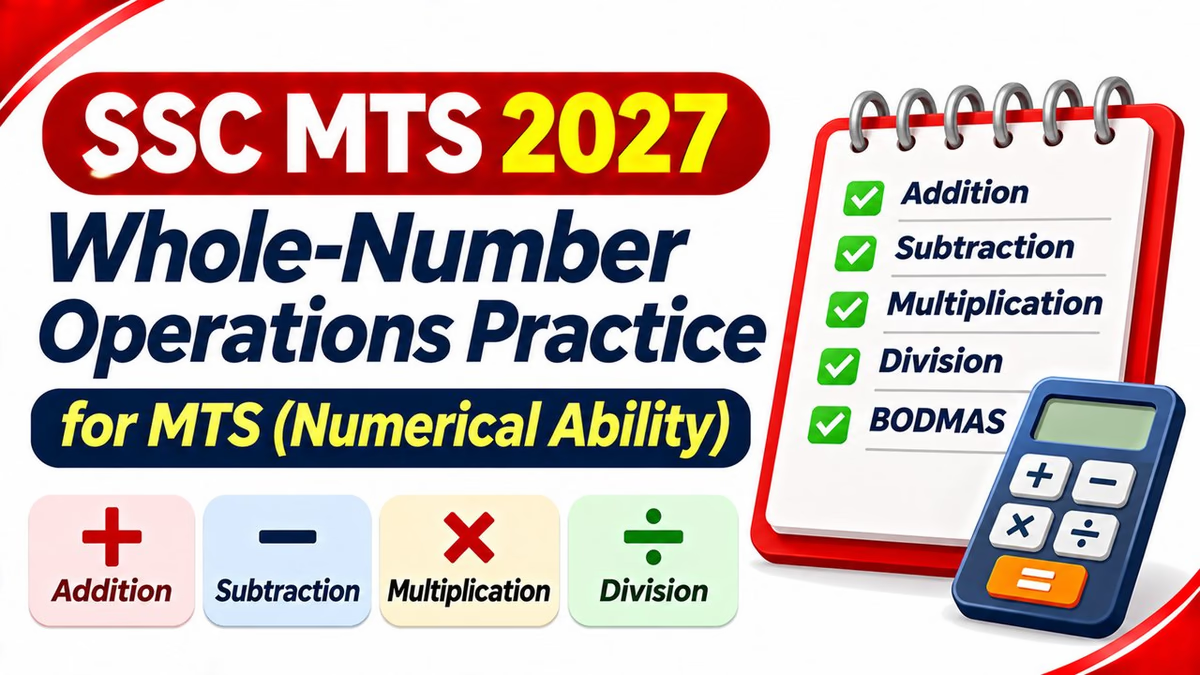
Whole-number operations are an important foundation of Numerical Ability preparation for SSC MTS 2027. Candidates should be comfortable with addition, subtraction, multiplication, division and the correct order of mathematical operations.
Questions based on whole numbers may look simple, but calculation errors, incorrect operation signs and confusion about BODMAS can affect your performance. Regular practice helps improve calculation speed, accuracy and confidence.
In this guide, you will learn the basics of whole numbers, important mathematical properties, operation rules, solved examples and practice questions for SSC MTS Numerical Ability.
Whole numbers are numbers that include zero and all positive counting numbers. They do not include negative numbers, fractions or decimals.
Examples: 0, 1, 2, 3, 4, 5, 6, 7, 8, 9, 10 and so on.
Whole numbers are commonly used in basic arithmetic operations and numerical problem-solving.
Important points:
Addition means combining two or more numbers to find their total.
Example 1:
245 + 378 = 623
Example 2:
1,250 + 2,375 + 1,125 = 4,750
Tips for faster addition:
Practice example:
4,567 + 2,345 = ?
Answer: 6,912
Subtraction is used to find the difference between two numbers. The number from which another number is subtracted is called the minuend, and the number being subtracted is called the subtrahend.
Example 1:
875 − 325 = 550
Example 2:
5,000 − 2,768 = 2,232
Tips for accurate subtraction:
Practice example:
8,450 − 3,275 = ?
Answer: 5,175
Multiplication is repeated addition of the same number. It is useful for solving questions involving equal groups, quantities and repeated values.
Example 1:
25 × 12 = 300
Example 2:
125 × 24 = 3,000
Useful multiplication techniques:
Example using breakdown:
48 × 25 = 48 × (100 ÷ 4) = 4,800 ÷ 4 = 1,200
Division means splitting a number into equal parts or finding how many times one number is contained in another.
Example 1:
144 ÷ 12 = 12
Example 2:
1,250 ÷ 25 = 50
Important division terms:
Division relationship:
Dividend = (Divisor × Quotient) + Remainder
Example:
29 ÷ 5 = 5 remainder 4
29 = (5 × 5) + 4
Remember: Division by zero is undefined. Zero divided by a non-zero number is zero.
Understanding mathematical properties helps candidates simplify calculations and solve numerical questions more efficiently.
| Property | Meaning | Example |
|---|---|---|
| Closure under addition | Sum of two whole numbers is a whole number. | 5 + 7 = 12 |
| Closure under multiplication | Product of two whole numbers is a whole number. | 4 × 6 = 24 |
| Commutative addition | Changing the order does not change the sum. | 8 + 3 = 3 + 8 |
| Commutative multiplication | Changing the order does not change the product. | 5 × 4 = 4 × 5 |
| Associative addition | Grouping does not change the sum. | (2 + 3) + 4 = 2 + (3 + 4) |
| Associative multiplication | Grouping does not change the product. | (2 × 3) × 4 = 2 × (3 × 4) |
| Distributive property | Multiplication distributes over addition. | 3 × (4 + 5) = 3 × 4 + 3 × 5 |
| Additive identity | Adding zero leaves a number unchanged. | 9 + 0 = 9 |
| Multiplicative identity | Multiplying by one leaves a number unchanged. | 9 × 1 = 9 |
Important exam point: Whole numbers are not closed under subtraction or division. For example, 3 − 5 = −2 is not a whole number, and 5 ÷ 2 = 2.5 is not a whole number.
BODMAS helps determine the correct order of operations when an expression contains multiple mathematical operations.
BODMAS stands for:
Important: Multiplication and division have equal priority. Solve them from left to right. Addition and subtraction also have equal priority and are solved from left to right.
24 + 12 ÷ 3 × 2
= 24 + 4 × 2
= 24 + 8
= 32
(18 + 6) ÷ 4 + 5
= 24 ÷ 4 + 5
= 6 + 5
= 11
50 − 12 ÷ 3 × 2
= 50 − 4 × 2
= 50 − 8
= 42
Estimation helps candidates check whether their calculated answers are reasonable. It can also be useful when comparing numerical options.
Technique 1: Rounding
Example: 498 + 302
Approximate calculation: 500 + 300 = 800
Technique 2: Breaking numbers
Example: 36 × 15
= 36 × (10 + 5)
= 360 + 180
= 540
Technique 3: Multiplication by 5
Multiply a number by 10 and divide the result by 2.
Example: 48 × 5 = 480 ÷ 2 = 240
Technique 4: Multiplication by 25
Multiply a number by 100 and divide by 4.
Example: 32 × 25 = 3,200 ÷ 4 = 800
Use these techniques only when they make the calculation easier. Always check the final answer carefully.
Try the following questions to test your understanding of whole-number operations. Attempt each question independently before checking the answer key.
Q1. What is the sum of 4,567 and 2,345?
A. 6,812
B. 6,912
C. 6,922
D. 6,902
Q2. Find the value of 8,450 − 3,275.
A. 5,175
B. 5,275
C. 5,125
D. 5,225
Q3. What is 125 × 24?
A. 2,500
B. 2,750
C. 3,000
D. 3,250
Q4. Find the value of 1,250 ÷ 25.
A. 25
B. 40
C. 45
D. 50
Q5. Simplify: 36 + 24 ÷ 6 × 3.
A. 48
B. 24
C. 30
D. 42
Q6. Which is the smallest whole number?
A. 1
B. −1
C. 0
D. 2
Q7. Which property is shown by 12 + 8 = 8 + 12?
A. Associative property
B. Commutative property
C. Distributive property
D. Closure property
Q8. What is the remainder when 47 is divided by 6?
A. 3
B. 4
C. 5
D. 2
Q9. Which operation is not closed for whole numbers?
A. Addition
B. Multiplication
C. Subtraction
D. Both B and C
Q10. Simplify: (45 + 15) ÷ 5 × 2.
A. 12
B. 18
C. 20
D. 24
Q11. Find the value of 75 × 16.
A. 1,100
B. 1,200
C. 1,250
D. 1,300
Q12. What is the result of 999 + 1,001?
A. 1,900
B. 1,990
C. 2,000
D. 2,100
Q13. Which number is the multiplicative identity for whole numbers?
A. 0
B. 1
C. 2
D. 10
Q14. Find the value of 84 ÷ 7 + 6 × 3.
A. 24
B. 30
C. 36
D. 42
Q15. A shopkeeper has 240 notebooks and arranges them equally into 12 boxes. How many notebooks are placed in each box?
A. 15
B. 18
C. 20
D. 24
| Question | Correct Answer | Explanation |
|---|---|---|
| 1 | B | 4,567 + 2,345 = 6,912 |
| 2 | A | 8,450 − 3,275 = 5,175 |
| 3 | C | 125 × 24 = 3,000 |
| 4 | D | 1,250 ÷ 25 = 50 |
| 5 | A | 36 + 4 × 3 = 48 |
| 6 | C | Zero is the smallest whole number. |
| 7 | B | Changing the order does not change the sum. |
| 8 | A | 47 = 6 × 7 + 5. Correct remainder is 5 (Option C). |
| 9 | C | Subtraction can produce a negative number, which is not a whole number. |
| 10 | D | 60 ÷ 5 × 2 = 12 × 2 = 24 |
| 11 | B | 75 × 16 = 1,200 |
| 12 | C | 999 + 1,001 = 2,000 |
| 13 | B | Multiplying by 1 leaves a number unchanged. |
| 14 | B | 12 + 18 = 30 |
| 15 | C | 240 ÷ 12 = 20 notebooks. |
Whole numbers include zero and all positive counting numbers, such as 0, 1, 2, 3 and so on. They do not include negative numbers, fractions or decimals.
Whole-number operations provide the foundation for arithmetic calculations. Addition, subtraction, multiplication, division and order of operations are useful skills for solving numerical questions.
BODMAS represents Brackets, Orders, Division, Multiplication, Addition and Subtraction. It helps determine the correct order for evaluating mathematical expressions.
Yes. Zero is the smallest whole number and is the additive identity.
No. Subtracting a larger whole number from a smaller whole number can produce a negative number, which is not a whole number.
Practise multiplication tables, basic arithmetic, number breakdown methods and BODMAS questions regularly. Focus on accuracy before trying to increase speed.
Start with basic operations, understand mathematical properties, practise BODMAS expressions and solve mixed numerical questions under timed conditions. Review incorrect answers to identify calculation mistakes.
Whole-number operations form an important foundation for SSC MTS 2027 Numerical Ability preparation. Candidates should develop a clear understanding of addition, subtraction, multiplication, division, mathematical properties and BODMAS.
Practise calculations regularly, learn to identify common errors and solve mixed questions to improve speed and accuracy. A strong understanding of basic operations can also support preparation for other arithmetic topics.
Strengthen your Numerical Ability with Katara Academy. Explore structured learning resources and courses to support your competitive examination preparation.
