.avif)

Download the App & Start Learning
- Expert Faculty Guidance
- Updated Study Material
- Mock Tests & Practice Quiz
- Live Doubt Solving Sessions
- Exam-Oriented Preparation
- Motivation & Success Strategy
Katara Academy

23/11/2026
Symbol classification questions are a type of reasoning question in which candidates must identify the symbol, group or combination that does not belong to the same category as the others. These questions test your ability to observe visual patterns and compare symbols quickly.
In SSC GD reasoning, symbol-based classification may involve the number of symbols, their arrangement, repetition, direction, shape or a combination of these features. The key is to compare all options systematically instead of selecting an answer based on appearance alone.
When solving symbol classification questions, check these features in order:
Usually, one option breaks a common rule followed by the remaining three. Identify that rule before finalising your answer.
Try each question yourself before reading the explanation. Focus on identifying the common property shared by three options.
Choose the odd group:
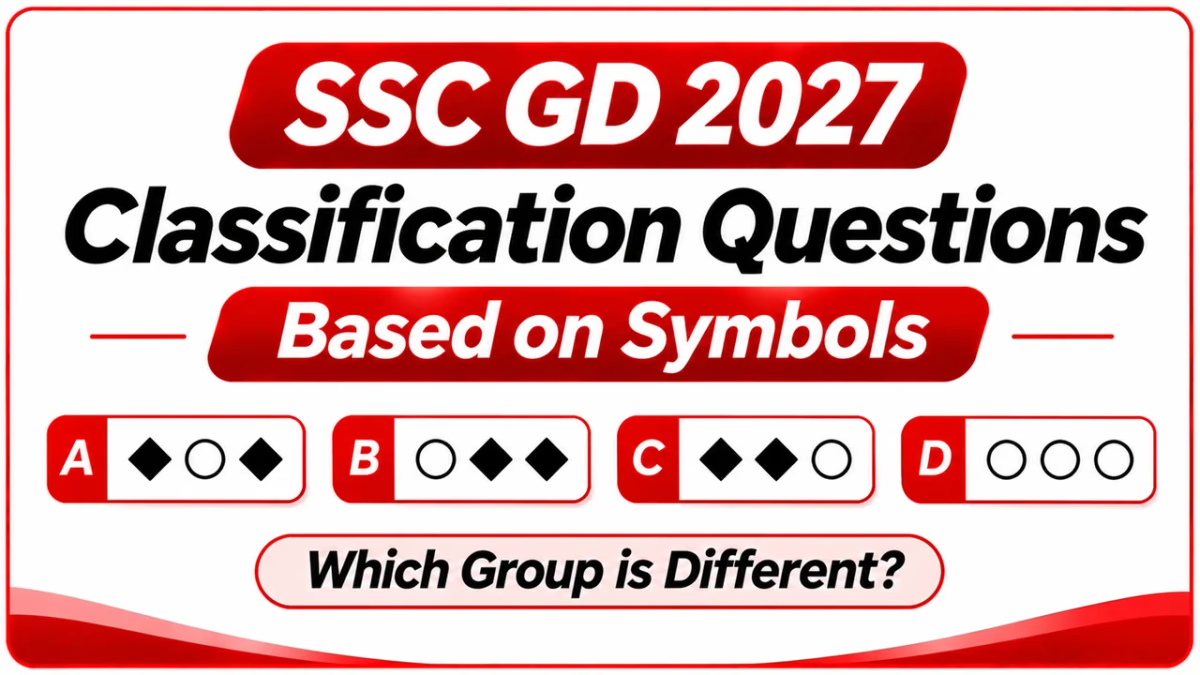
A) ◆ ○ ◆ B) ○ ◆ ◆ C) ◆ ◆ ○ D) ○ ○ ○
A) ↑ → ↓ B) ← ↑ → C) ↓ ← ↑ D) ↑ ↑ ↑
Which group is different from the others?
A) + − + B) − + + C) + + − D) + − −
Identify the group that does not follow the same symbol-count pattern.
A) ▲ ○ □ B) □ ○ ▲ C) ○ ▲ □ D) ▲ ▲ □
Find the odd group.
A) ○ △ □ B) △ □ ○ C) □ ○ △ D) ○ □ △
Which option does not follow the same arrangement pattern?
A) ★ ★ ☆ B) ☆ ★ ★ C) ★ ☆ ★ D) ☆ ☆ ☆
Select the odd group based on the number of filled star symbols.
A) ↑ → ↓ B) → ↓ ↑ C) ↓ ↑ → D) ↑ ↑ →
Identify the group that breaks the common rule.
A) ◇ ◆ ◇ B) ◆ ◇ ◇ C) ◇ ◇ ◆ D) ◆ ◆ ◆
Choose the odd group based on the combination of filled and unfilled diamonds.
1. Answer: D) ○ ○ ○
In options A, B and C, there are two diamond symbols and one circle. Option D contains three circles, so its symbol composition is different.
2. Answer: D) ↑ ↑ ↑
Options A, B and C each contain three arrows pointing in different directions. Option D repeats the same upward arrow three times.
3. Answer: D) + − −
Options A, B and C contain two plus signs and one minus sign. Option D contains two minus signs and one plus sign.
4. Answer: D) ▲ ▲ □
Options A, B and C contain three different shapes: a triangle, a circle and a square. Option D repeats the triangle and does not contain a circle.
5. Answer: D) ○ □ △
Options A, B and C follow the same circular order of symbols: circle → triangle → square, with the sequence shifted in position. Option D reverses the relative order of the triangle and square.
6. Answer: D) ☆ ☆ ☆
Options A, B and C each contain two filled stars and one unfilled star. Option D contains no filled stars.
7. Answer: D) ↑ ↑ →
Options A, B and C each contain one upward, one rightward and one downward arrow. Option D repeats the upward direction and does not contain a downward arrow.
8. Answer: D) ◆ ◆ ◆
Options A, B and C contain two unfilled diamonds and one filled diamond. Option D contains three filled diamonds.
These are questions where candidates identify the symbol group that differs from the other options based on a common visual or logical property.
Compare symbol count, shape, repetition, direction and arrangement. Look for one consistent rule that matches three options.
Most basic questions become manageable with regular practice in visual observation and pattern recognition. Some questions may require checking more than one property.
Start with 10–15 questions per day. Review incorrect answers and gradually increase speed as your accuracy improves.
Symbol classification questions require careful observation rather than complicated calculations. By comparing symbol count, direction, shape, repetition and arrangement, you can identify the odd group more confidently.
Practise different symbol combinations regularly, check the logic behind every answer and gradually improve your solving speed for SSC GD 2027 reasoning.
Observe carefully. Find the common rule. Eliminate the odd group.