
Download the App & Start Learning
- Expert Faculty Guidance
- Updated Study Material
- Mock Tests & Practice Quiz
- Live Doubt Solving Sessions
- Exam-Oriented Preparation
- Motivation & Success Strategy
Katara Academy

10/13/2026
Confusing words are an important part of English vocabulary preparation for SSC CGL 2027 and other competitive examinations. Many English words have similar spellings or pronunciations but different meanings and uses. Candidates who understand these differences can improve their accuracy in vocabulary-based questions, sentence correction and reading comprehension.
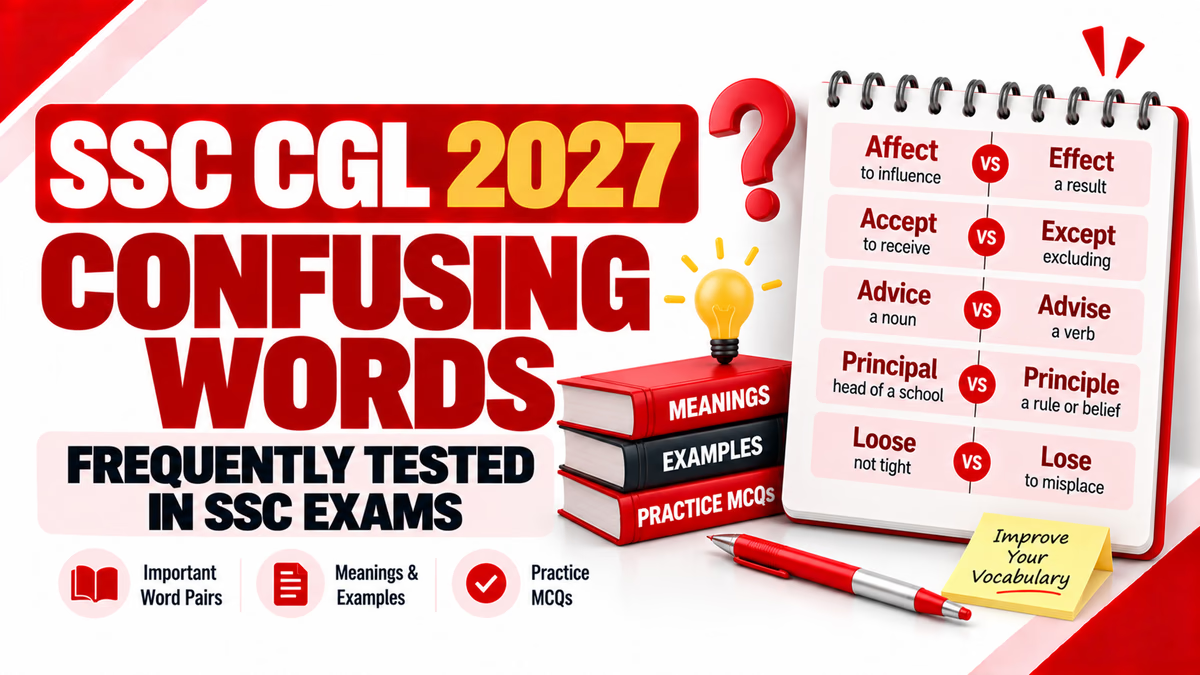
Words such as affect and effect, accept and except, advice and advise, and principal and principle are commonly confused by English learners. The best way to master them is to understand their meanings, study example sentences and practise questions regularly.
In this article, Katara Academy explains frequently confused English words with simple definitions, practical examples, revision strategies and MCQs with answers to support your SSC CGL 2027 preparation.
Confusing words are words that people often mix up because they have similar spellings, similar sounds or closely related meanings. However, their grammatical roles or meanings may be different.
Example: Affect and effect.
Examples:
The difference becomes clear when you study each word in context. For SSC CGL preparation, do not rely only on spelling. Identify the meaning required by the sentence and check the grammatical role of the missing word.
Revise the following word pairs carefully. These examples cover differences in meaning, usage and grammatical function.
| Word Pair | Difference | Example |
|---|---|---|
| Affect / Effect | Affect usually means to influence; effect usually means a result. | Lack of sleep can affect concentration. The effect was noticeable. |
| Accept / Except | Accept means to receive or agree; except means excluding. | I accept your invitation. Everyone came except Rahul. |
| Advice / Advise | Advice is a noun; advise is a verb. | She gave me useful advice. I advise you to revise daily. |
| Principal / Principle | Principal means main or a head of an institution; principle means a rule or belief. | The principal addressed the students. Honesty is an important principle. |
| Compliment / Complement | A compliment is praise; a complement completes or enhances something. | She received a compliment. The sauce complements the dish. |
| Stationary / Stationery | Stationary means not moving; stationery refers to writing materials. | The vehicle remained stationary. I bought stationery for class. |
| Loose / Lose | Loose means not tight; lose means to misplace or fail to win. | This shirt is loose. Do not lose your admit card. |
| Then / Than | Then refers to time or sequence; than is used in comparisons. | Finish your work, then rest. Riya is taller than Neha. |
| Beside / Besides | Beside means next to; besides means in addition to. | He sat beside me. Besides English, she studies reasoning. |
| Its / It's | Its indicates possession; it's means it is or it has. | The dog wagged its tail. It's a useful book. |
| Your / You're | Your indicates possession; you're means you are. | Your answer is correct. You're ready for the test. |
| Weather / Whether | Weather refers to atmospheric conditions; whether introduces alternatives or uncertainty. | The weather is pleasant. I do not know whether he will attend. |
| Quiet / Quite | Quiet means silent or calm; quite means fairly or completely, depending on context. | The room is quiet. The question is quite difficult. |
| Later / Latter | Later means after some time; latter refers to the second of two items mentioned. | I will call you later. Of tea and coffee, I prefer the latter. |
| Allusion / Illusion | An allusion is an indirect reference; an illusion is a misleading appearance or perception. | The poem contains an allusion to history. The mirror created an illusion. |
| Desert / Dessert | A desert is a dry region; dessert is a sweet dish served after a meal. | Camels can survive in the desert. We had fruit for dessert. |
| Personal / Personnel | Personal means private or individual; personnel refers to employees or staff. | This is my personal opinion. The personnel attended the meeting. |
| Economic / Economical | Economic relates to the economy; economical means cost-effective or not wasteful. | The country faces economic challenges. This car is economical to run. |
| Eligible / Illegible | Eligible means qualified; illegible means difficult or impossible to read. | She is eligible for the examination. His handwriting is illegible. |
| Emigrate / Immigrate | Emigrate means to leave a country to live elsewhere; immigrate means to enter another country to live there. | They emigrated from India. They immigrated to Canada. |
Some confusing words differ mainly in their grammatical roles. Understanding these roles can help you eliminate incorrect options in sentence-based questions.
Advice and Advise
"Advice" is a noun, while "advise" is a verb.
Practice and Practise
In traditional British English, "practice" is a noun and "practise" is a verb.
American English commonly uses "practice" for both the noun and the verb.
Its and It's
Your and You're
Whose and Who's
Examples: Whose book is this? Who's attending the class?
Then and Than
Fewer and Less
Between and Among
Examples: The competition is between two teams. She distributed the papers among the students.
Some words look almost identical but have different meanings. Focus on the spelling difference and connect each word with a simple example.
| Word | Meaning | Example |
|---|---|---|
| Breath | Air taken into or released from the lungs | Take a deep breath. |
| Breathe | To take air into and release it from the lungs | Try to breathe slowly. |
| Principal | Main; or head of a school or college | The principal announced the results. |
| Principle | A fundamental rule or belief | Fairness is an important principle. |
| Precede | To come before | A short introduction will precede the lecture. |
| Proceed | To continue or move forward | Please proceed to the next question. |
| Stationary | Not moving | The train remained stationary. |
| Stationery | Writing materials | She purchased stationery for the examination. |
| Adapt | To adjust to new conditions | Students must adapt to a new timetable. |
| Adopt | To take up or accept something; also to legally take a child into one's family | The school adopted a new teaching method. |
| Access | The ability or right to enter or use something | Candidates need access to the portal. |
| Excess | An amount greater than necessary or allowed | Excess sugar may be harmful. |
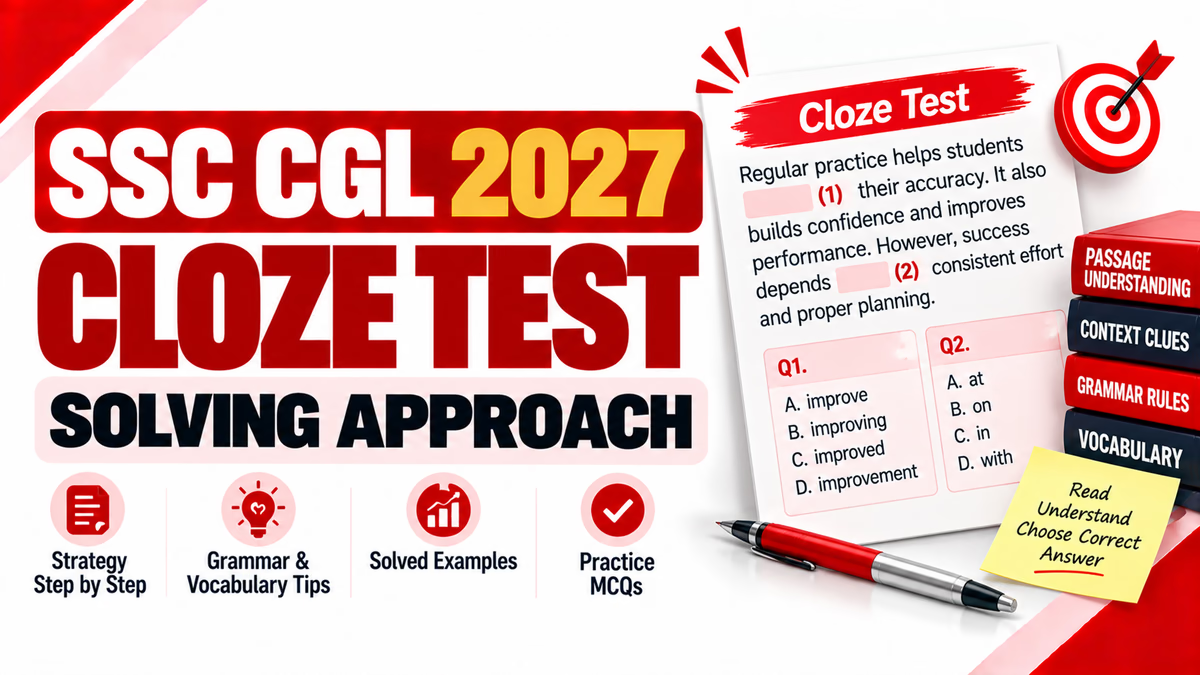
When you encounter a confusing-word question, follow a systematic process rather than selecting an answer based only on how it sounds.
Example: The new timetable had a positive _____ on attendance.
Options: (A) affect (B) effect (C) except (D) advice
Correct answer: Effect. The sentence requires a noun meaning "result".
Use the following revision plan to build accuracy and retain confusing words for longer.
Learn both words at the same time. For example, write "accept = receive" and "except = excluding" on the same revision card.
Create one short sentence for each word. Using a word in your own sentence helps you understand how it works.
Study a manageable number of word pairs daily. Review them the next day and return to difficult pairs after a few days.
Once you understand the meanings, solve mixed MCQs without looking at your notes. This helps you distinguish words when they appear in unfamiliar contexts.
Record the questions you answer incorrectly, the correct word and the reason your original choice was wrong. Revisit this notebook regularly.
Practise confusing words alongside subject-verb agreement, tenses, prepositions, articles and sentence improvement. This develops both vocabulary knowledge and grammatical accuracy.
Choose the most appropriate word to complete each sentence. Try all questions before checking the answer key.
Q1. The heavy rain may _____ the match schedule.
Q2. Everyone attended the meeting _____ Rahul.
Q3. My teacher gave me useful _____ before the examination.
Q4. The school _____ addressed the students.
Q5. Please do not _____ your admit card.
Q6. This is the best book I have read _____ far.
Q7. The car remained _____ near the gate.
Q8. I am not sure _____ the application has been submitted.
Q9. The new software had a positive _____ on productivity.
Q10. The blue curtains _____ the colour of the walls.
Q11. _____ going to be an important examination year for many candidates.
Q12. The students completed the test and _____ reviewed their answers.
Q13. The teacher asked us to take a deep _____ before starting the exercise.
Q14. The candidate is _____ for the scholarship because she meets the requirements.
Q15. Of tea and coffee, I prefer the _____.
Confusing words become easier to master when you understand their meanings, grammatical roles and usage in complete sentences. Focus on frequently confused pairs, practise them in context and review your mistakes regularly.
For SSC CGL 2027, combine vocabulary revision with grammar exercises, reading comprehension and timed MCQs. A consistent routine can help you improve accuracy and become more confident when answering English questions.
Keep learning with Katara Academy and strengthen your English preparation for SSC CGL 2027.
