

Download the App & Start Learning
- Expert Faculty Guidance
- Updated Study Material
- Mock Tests & Practice Quiz
- Live Doubt Solving Sessions
- Exam-Oriented Preparation
- Motivation & Success Strategy
Katara Academy

10/23/2026
Preparing for SSC CGL 2027 requires more than completing the syllabus and taking regular mock tests. Candidates also need to understand which topics are affecting their performance and where additional practice is necessary. Mock-test results provide useful information about accuracy, time management, question selection and conceptual understanding.
Instead of revising every chapter equally, aspirants can use performance data to prioritise topics that need attention. By tracking recurring mistakes and comparing results across multiple tests, candidates can build a more focused and practical revision plan.
Every candidate has different strengths and weaknesses. Some may solve Quantitative Aptitude questions accurately but take too much time, while others may understand the concepts but make mistakes under timed conditions.
Identifying weak chapters helps you:
The objective is not to label a chapter as permanently weak. It is to identify a specific problem, address it through practice and check whether your performance improves.
A final score alone cannot explain why your performance was high or low. After each test, record topic-wise information wherever your mock-test platform provides it.
| Metric | What It Tells You |
|---|---|
| Questions attempted | How many questions you tried in a topic. |
| Correct answers | How many responses were accurate. |
| Incorrect answers | Where mistakes occurred. |
| Accuracy percentage | How reliably you answered attempted questions. |
| Time spent | Whether a topic is consuming too much time. |
| Questions left unattempted | Whether you avoided unfamiliar or time-consuming questions. |
| Error type | Whether the problem involved concepts, calculations, reading or decision-making. |
If your test platform does not provide chapter-wise analytics, review the solutions manually and maintain a simple spreadsheet or notebook.
Accuracy is one of the easiest indicators to calculate from mock-test data.
Accuracy (%) = (Correct Answers ÷ Total Attempted Questions) × 100
Suppose you attempt 20 questions from a chapter and answer 12 correctly.
Accuracy = (12 ÷ 20) × 100 = 60%.
This result suggests that you should review the chapter, particularly if the same pattern appears in later tests. However, do not judge a topic from a very small number of questions alone. A larger sample across multiple tests provides a more useful picture.
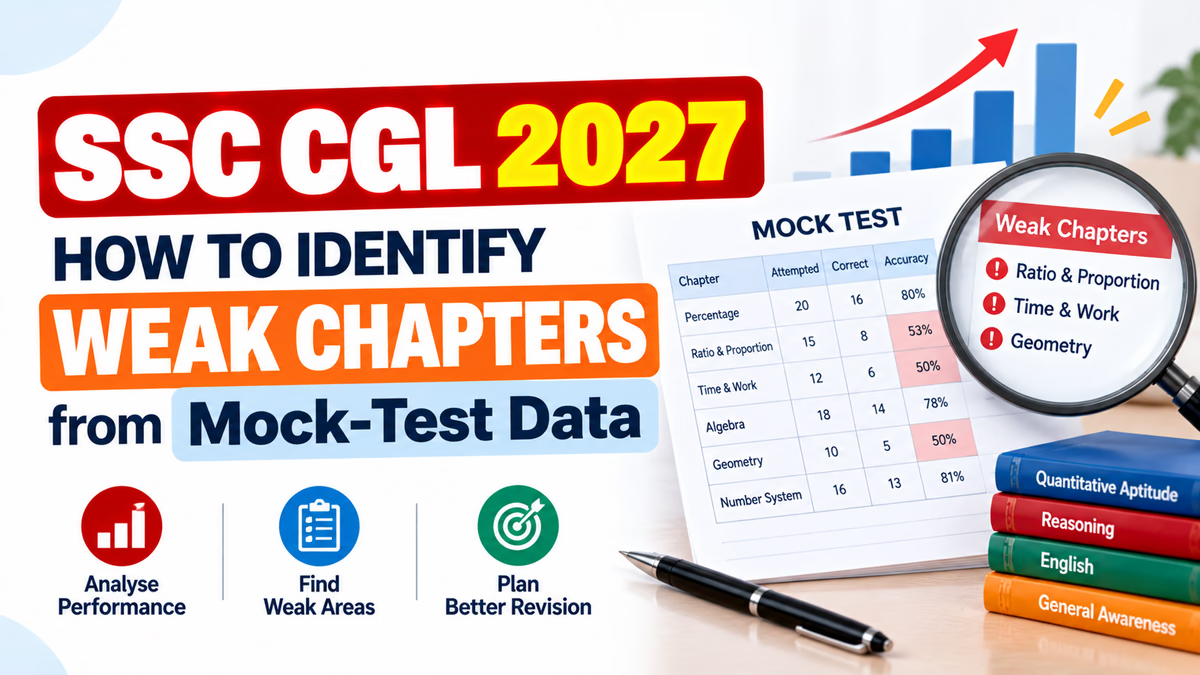
Organise your mock-test results into a table so that weak areas become easier to recognise.
| Chapter | Attempted | Correct | Accuracy | Possible Action |
|---|---|---|---|---|
| Percentage | 20 | 16 | 80% | Continue timed practice. |
| Ratio and Proportion | 15 | 8 | 53.3% | Revise concepts and practise basic questions. |
| Time and Work | 12 | 7 | 58.3% | Review methods and calculation errors. |
| Number System | 18 | 15 | 83.3% | Maintain accuracy and improve speed. |
Note: These figures are illustrative examples, not actual SSC CGL results or official performance benchmarks.
In this example, Ratio and Proportion deserves early attention because its accuracy is comparatively low. Time and Work also needs review. Percentage and Number System may require continued practice rather than a complete restart.
Low scores can have different causes. Identifying the correct cause is essential because each problem requires a different solution.
You do not fully understand the formula, rule or underlying concept needed to solve the question.
What to do: Revisit the relevant concept, study solved examples and practise basic questions before moving to advanced problems.
You understand the method but make arithmetic mistakes, use an incorrect formula or miss a step during the solution.
What to do: Practise step-by-step solutions, check intermediate calculations and maintain an error log.
You can solve the questions correctly but take longer than expected. This may happen because you are unfamiliar with the question type or use an inefficient method.
What to do: Practise short timed sets and compare alternative valid solution methods.
You overlook conditions, misunderstand what a question asks or attempt questions without sufficient confidence.
What to do: Read questions carefully, identify key information and review whether your attempt decisions were appropriate.
Review your performance separately for each section instead of relying only on your overall mock-test score.
Group questions by chapters such as percentages, ratio and proportion, profit and loss, time and work, algebra, geometry and number systems, according to the applicable syllabus.
Review performance across topics such as series, analogy, coding-decoding, classification and other relevant reasoning areas.
Separate your errors into grammar, vocabulary, comprehension and other relevant question types.
Classify mistakes by subject area, such as history, geography, polity, economics, science and current affairs, as applicable to your preparation.
Once you have reviewed your results, organise chapters into three practical priority groups.
| Priority | Typical Signs | Recommended Action |
|---|---|---|
| High | Repeated errors, poor understanding or very low accuracy across several tests. | Relearn concepts and solve basic practice questions. |
| Medium | Reasonable understanding but inconsistent accuracy or slow solving. | Practise targeted questions and review mistakes. |
| Maintenance | Consistent performance with relatively few errors. | Continue revision and occasional timed practice. |
These categories are a personal planning method, not official SSC classifications. Consider the number and difficulty of questions before assigning a priority.
Your weekly plan should give more attention to important weak topics while preserving time for revision of stronger areas.
| Day | Suggested Activity |
|---|---|
| Monday | Revise one high-priority chapter and solve basic questions. |
| Tuesday | Practise topic-wise questions and review mistakes. |
| Wednesday | Work on a second weak chapter. |
| Thursday | Practise timed questions from previously studied topics. |
| Friday | Revise formulas, rules, facts or concepts from your error log. |
| Saturday | Take a sectional test and analyse the results. |
| Sunday | Review progress and adjust the following week's priorities. |
This is an example of a seven-day routine. Adjust it to your current preparation stage, available time and examination schedule.
Revising a chapter does not automatically mean the problem has been solved. You need to check whether the revision has improved your ability to answer questions independently.
Use fresh questions where possible. Repeating answers you already remember may make your performance look better without confirming that you can solve unfamiliar questions.
Q1. What is the main purpose of chapter-wise mock-test analysis?
A. To increase study hours without a plan
B. To identify performance gaps and plan targeted revision
C. To avoid difficult chapters permanently
D. To rely only on the final score
Answer: B. Chapter-wise analysis helps identify areas that need additional practice.
Q2. A candidate attempts 20 questions and answers 12 correctly. What is the accuracy?
A. 50%
B. 55%
C. 60%
D. 65%
Answer: C. Accuracy = (12 ÷ 20) × 100 = 60%.
Q3. A candidate understands a method but repeatedly makes arithmetic mistakes. What should be reviewed first?
A. Only unrelated chapters
B. Calculation steps and execution errors
C. The entire syllabus immediately
D. The number of books purchased
Answer: B. The review should target the actual source of the mistakes.
Q4. Why should performance be compared across several tests?
A. One test always gives a complete picture
B. Multiple tests can reveal recurring patterns
C. It eliminates the need for revision
D. It guarantees a particular score
Answer: B. Repeated observations help distinguish persistent weaknesses from isolated results.
Q5. What is a sensible way to retest a revised chapter?
A. Read only the previous answers
B. Solve fresh questions and review the results
C. Avoid timed practice permanently
D. Memorise the question numbers
Answer: B. Fresh questions provide a better check of independent understanding.
Q6. A chapter has good accuracy but takes too much time. What should the candidate do?
A. Ignore the time taken
B. Stop studying the chapter
C. Practise efficient methods and timed question sets
D. Attempt every question randomly
Answer: C. Targeted timed practice can help improve efficiency while maintaining accuracy.
Q7. What should a candidate do with a chapter that is consistently strong?
A. Never revise it again
B. Maintain performance through periodic practice
C. Spend all study time on it
D. Remove it from the syllabus
Answer: B. Periodic revision helps retain knowledge and skills.
Q8. What is the purpose of an error log?
A. To record mistakes and plan corrective action
B. To collect only correct answers
C. To replace all mock tests
D. To avoid analysing performance
Answer: A. An error log makes recurring problems easier to identify and address.
Mock-test data can help SSC CGL 2027 aspirants make better decisions about revision. By tracking chapter-wise accuracy, time spent, recurring mistakes and improvement after practice, candidates can focus on the areas that need the most attention.
Analyse results regularly, prioritise weak topics, practise with fresh questions and retest your understanding. A structured approach to performance review can make preparation more focused and help you use your study time effectively.
Always refer to the latest official SSC notification for the applicable examination pattern and syllabus.
