






Download the App & Start Learning
- Expert Faculty Guidance
- Updated Study Material
- Mock Tests & Practice Quiz
- Live Doubt Solving Sessions
- Exam-Oriented Preparation
- Motivation & Success Strategy
Katara Academy

10/12/2026
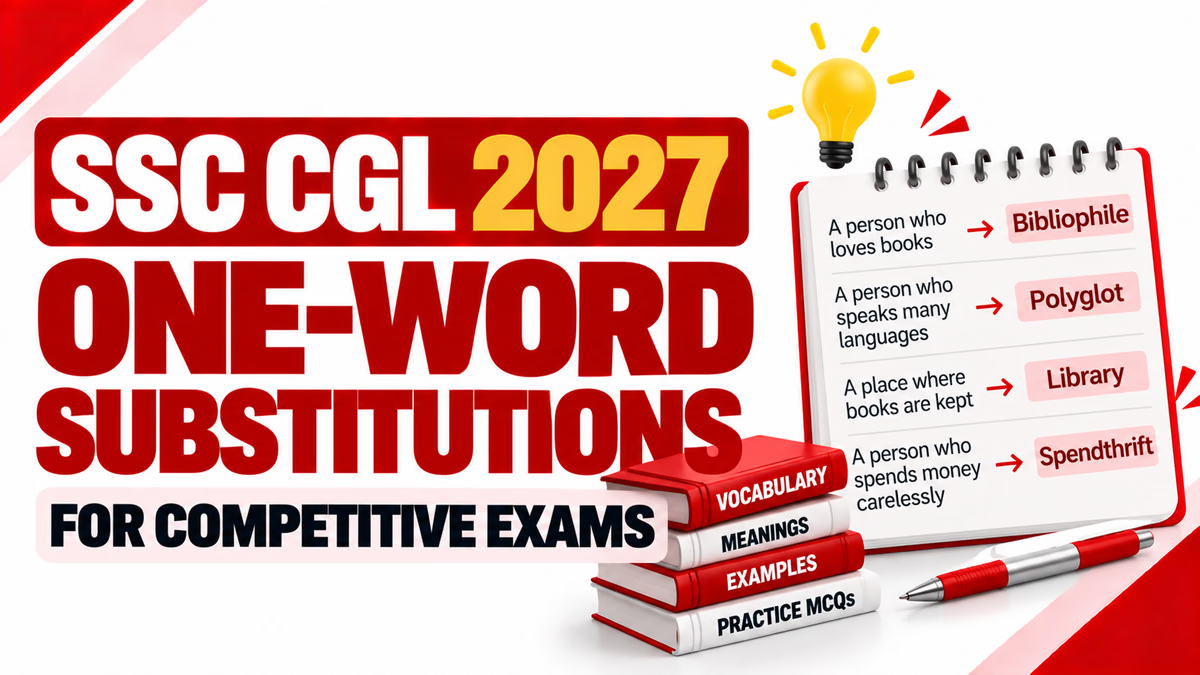
One-word substitution is an important vocabulary topic for candidates preparing for SSC CGL 2027 and other competitive examinations. These questions test your ability to replace a phrase or a group of words with one word that expresses the same meaning. A strong vocabulary helps you solve these questions accurately and also improves your performance in sentence completion, reading comprehension and other English sections.
In this article, you will learn commonly used one-word substitutions, their meanings, examples and practice questions with answers. Revise these words regularly and focus on understanding their meanings instead of memorising them without context.
One-word substitution means replacing a phrase with a single word that conveys the same meaning. Competitive examinations often present a definition or description and ask you to select the most suitable word.
Example: A person who cannot read or write is called an illiterate person.
Here, the phrase "a person who cannot read or write" is replaced by the word "illiterate". Similarly, a person who speaks many languages is called a polyglot.
To answer these questions correctly, identify the key meaning of the phrase, distinguish similar words and check whether the word refers to a person, place, action, quality or concept.
The following words describe people according to their habits, abilities, interests or roles. These are useful for English vocabulary revision.
| Phrase | One-Word Substitution | Example |
|---|---|---|
| A person who cannot read or write | Illiterate | The programme helps illiterate adults learn basic reading skills. |
| A person who speaks many languages | Polyglot | The polyglot can communicate in several languages. |
| A person who loves books | Bibliophile | As a bibliophile, she enjoys collecting novels. |
| A person who hates mankind | Misanthrope | The character is portrayed as a misanthrope. |
| A person who loves mankind | Philanthropist | The philanthropist donated money to support education. |
| A person who looks at the bright side of things | Optimist | An optimist believes that the situation can improve. |
| A person who expects negative outcomes | Pessimist | The pessimist expected the plan to fail. |
| A person who doubts accepted beliefs | Sceptic | The sceptic asked for evidence before accepting the claim. |
| A person who eats too much | Glutton | The story describes a glutton who never feels satisfied. |
| A person who is new to a subject or activity | Novice | The novice needed guidance during the training. |
| A person who is highly skilled in an activity | Expert | The expert explained the difficult concept clearly. |
| A person who offers services without payment | Volunteer | The volunteer helped organise the event. |
Questions about places frequently appear in vocabulary exercises. Learn the differences between the following terms carefully.
| Phrase | One-Word Substitution |
|---|---|
| A place where books are kept for reading or borrowing | Library |
| A place where birds are kept | Aviary |
| A place where bees are kept | Apiary |
| A place where fish are kept | Aquarium |
| A place where weapons are stored | Arsenal |
| A place where coins are made | Mint |
| A place where dead bodies are buried | Cemetery |
| A place where monks live | Monastery |
| A place where orphans live and receive care | Orphanage |
| A place where aircraft are kept and maintained | Hangar |
| A place where historical objects are displayed | Museum |
| A place where astronomical objects are observed | Observatory |
Revision tip: Remember words in related groups. For example, an aviary is associated with birds, an apiary with bees and an aquarium with aquatic life. Grouping vocabulary by topic makes recall easier.
These terms describe systems of government, social structures and political concepts. Learn the exact meaning of each word because several terms may appear similar.
| Phrase | One-Word Substitution | Meaning |
|---|---|---|
| Government by the people | Democracy | A system in which people exercise political power directly or through representatives. |
| Government by a king or queen | Monarchy | A system in which the head of state is a monarch. |
| Government by a small group of people | Oligarchy | Power is held by a small group. |
| Government by one person with absolute power | Autocracy | Supreme authority is concentrated in one ruler. |
| A person who works for the welfare of humanity | Humanitarian | A person concerned with human welfare. |
| A person who believes in equal rights for women | Feminist | A person who supports gender equality. |
| A person who works for the abolition of slavery | Abolitionist | A person who campaigns to end a practice or institution, especially slavery. |
| A person who loves and serves their country | Patriot | A person who demonstrates love and commitment to their country. |
| A person who betrays their country | Traitor | A person who betrays their country or a cause. |
| A person who believes in no government | Anarchist | A person who advocates or supports the absence of government. |
Words related to books, writing and language are commonly useful in vocabulary preparation. Pay attention to the difference between a person who writes a work and the type of work itself.
| Phrase | One-Word Substitution |
|---|---|
| A person who writes books | Author |
| A person who writes poems | Poet |
| A person who writes plays | Playwright |
| A person who compiles a dictionary | Lexicographer |
| A person who writes using another person's name | Pseudonymous writer |
| A short account of a person's life written by another person | Biography |
| The story of a person's life written by that person | Autobiography |
| A book or document written by hand | Manuscript |
| A list of books or sources referred to in a work | Bibliography |
| A speech delivered without preparation | Impromptu |
| A word or phrase that reads the same forwards and backwards | Palindrome |
| The art of beautiful handwriting | Calligraphy |
These words describe personality traits, habits, behaviour or ways of thinking. Understanding the meaning of each term will help you avoid confusing similar options.
| Phrase | One-Word Substitution |
|---|---|
| One who knows everything | Omniscient |
| One who is present everywhere | Omnipresent |
| One who has unlimited power | Omnipotent |
| One who is difficult to please | Fastidious |
| One who spends money carelessly | Spendthrift |
| One who spends very little money | Miser |
| One who is unable to pay debts | Insolvent |
| One who is easily deceived | Gullible |
| One who speaks very little | Taciturn |
| One who talks excessively | Garrulous |
| One who is not easily upset or excited | Phlegmatic |
| One who cannot be corrected or reformed | Incorrigible |
Science and nature vocabulary can also appear in competitive examinations. Revise these definitions to strengthen your understanding of specialised terms.
| Phrase | One-Word Substitution |
|---|---|
| The study of birds | Ornithology |
| The study of insects | Entomology |
| The study of plants | Botany |
| The study of animals | Zoology |
| The study of the Earth and its physical features | Geography |
| The study of fossils and ancient life | Palaeontology |
| The scientific study of earthquakes | Seismology |
| The study of stars, planets and other celestial objects | Astronomy |
| An animal that eats only plants | Herbivore |
| An animal that eats other animals | Carnivore |
| An animal that eats both plants and animals | Omnivore |
| An animal that is active mainly at night | Nocturnal |
The following words are useful for quick revision and general competitive-exam vocabulary.
| Phrase | One-Word Substitution |
|---|---|
| Something that cannot be avoided | Inevitable |
| Something that cannot be heard | Inaudible |
| Something that cannot be seen | Invisible |
| Something that cannot be read | Illegible |
| Something that cannot be understood | Incomprehensible |
| Something that cannot be corrected | Irreparable |
| Something that lasts for a very short time | Ephemeral |
| Something that happens once every year | Annual |
| Something that happens once every two years | Biennial |
| Something that happens every two weeks | Fortnightly |
| A statement that appears contradictory but may be true | Paradox |
| A person or thing that causes trouble or difficulty | Nuisance |
Memorising a long vocabulary list in one sitting is rarely effective. Use a planned revision method to improve recall and accuracy.
Remember that one-word substitution is only one part of English preparation. Combine it with synonyms, antonyms, idioms and phrases, spelling, grammar and reading comprehension for balanced practice.
Choose the most appropriate word for each phrase. Try answering all questions before checking the explanations.
Q1. A person who loves books is called a:
Q2. A place where bees are kept is called an:
Q3. The study of insects is known as:
Q4. A person who speaks many languages is a:
Q5. A person who spends money carelessly is called a:
Q6. A word that reads the same forwards and backwards is a:
Q7. A person who expects favourable outcomes is an:
Q8. Something that cannot be avoided is:
Q9. The story of a person's life written by that person is an:
Q10. A person who talks excessively is described as:
Q11. A place where coins are made is called a:
Q12. A person who is easily deceived is:
Q13. Government by the people is called:
Q14. The study of birds is known as:
Q15. Something that lasts for a very short time is:
One-word substitutions can become a scoring area in SSC CGL 2027 when you understand definitions, revise vocabulary regularly and practise questions consistently. Begin with common words, learn them in meaningful groups and gradually move to less familiar terms.
Review the practice questions in this article, note the words you missed and revise them again. Regular vocabulary practice, along with grammar and reading comprehension, will help you build stronger English skills for competitive examinations.
Keep learning with Katara Academy and continue your SSC CGL 2027 English preparation with consistent practice.