

Download the App & Start Learning
- Expert Faculty Guidance
- Updated Study Material
- Mock Tests & Practice Quiz
- Live Doubt Solving Sessions
- Exam-Oriented Preparation
- Motivation & Success Strategy
Katara Academy

10/23/2026
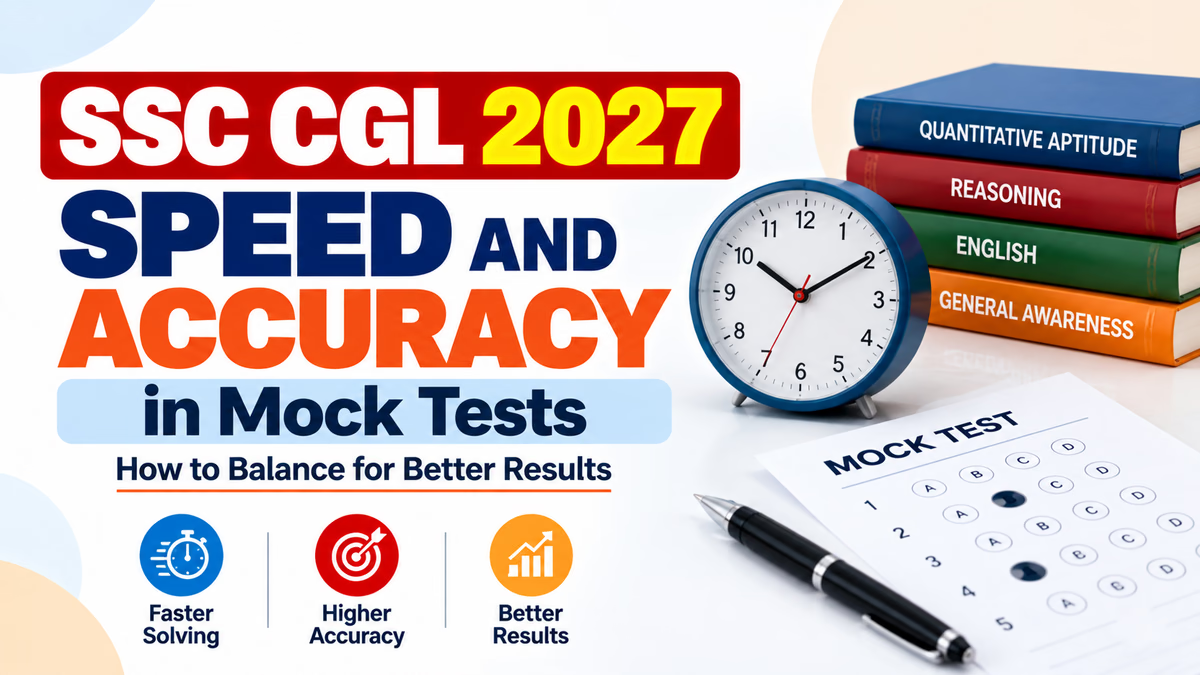
Preparing for a competitive examination requires more than knowing the correct answers. Candidates must also solve questions within the available time while avoiding unnecessary mistakes. Attempting questions too quickly can reduce accuracy, while spending too long on each problem may leave important questions unanswered.
Developing a balance between speed and accuracy requires regular practice, careful question selection and an understanding of personal strengths and weaknesses. By reviewing mock-test performance and improving solving methods, aspirants can develop a more effective examination strategy.
Speed refers to how efficiently you solve questions within a given period. Accuracy measures how many of your attempted questions are correct.
Both factors matter, but improving one should not unnecessarily damage the other. A candidate who attempts many questions with frequent mistakes may perform less effectively than someone who makes better decisions about which questions to answer.
Your objective should be to improve the quality of attempts while gradually becoming faster at familiar question types.
Before changing your strategy, understand how you currently perform. Attempt a practice test under timed conditions and record your attempts, correct answers, incorrect answers and total time.
| Performance Indicator | What It Reveals |
|---|---|
| Questions attempted | Your attempt volume during the test. |
| Correct answers | The number of accurate responses. |
| Incorrect answers | Potential conceptual, calculation or decision-making problems. |
| Time taken | How efficiently you used the available time. |
| Topic-wise performance | Subjects or question types that require more attention. |
Compare results across several reasonably similar tests instead of judging your ability from one attempt. Differences in difficulty can affect your score and should be considered during analysis.
Accuracy helps you understand how reliably you answer the questions you attempt.
Accuracy (%) = (Correct Answers ÷ Total Questions Attempted) × 100
For example, suppose you attempt 50 questions and answer 40 correctly.
Accuracy = (40 ÷ 50) × 100 = 80%
This means that 80% of your attempted questions were correct. Review the remaining incorrect responses to determine whether the cause was weak understanding, careless calculation, misreading or uncertain guessing.
Remember that accuracy alone does not determine your final score. The applicable marking scheme, including any negative marking, also affects the result.
One common problem during timed tests is spending too much time on a single difficult question. Effective question selection helps you use your time more productively.
During practice, learn to distinguish between questions you can solve immediately, questions that require additional thought and questions that are currently too time-consuming.
Do not skip a question simply because it looks unfamiliar. Read it carefully and decide whether you can solve it efficiently. With practice, this decision-making process becomes more consistent.
Speed should improve through familiarity, efficient methods and repeated practice rather than rushing through every question.
Select a small set of questions from one topic and solve them within a reasonable time limit. Review both the answers and the methods you used.
Where appropriate, practise alternative methods that reduce unnecessary calculations. However, make sure the method is valid and that you understand why it works.
Regular practice with fractions, percentages, squares, common values and other relevant calculations can reduce avoidable delays in mathematical questions.
Repeated exposure to different question formats helps you recognise common patterns and choose suitable methods more quickly.
Incorrect answers should be reviewed carefully. Increasing speed will not help much if the same errors continue to appear in later tests.
| Mistake | Possible Cause | Corrective Action |
|---|---|---|
| Calculation error | Rushing through arithmetic. | Check intermediate steps and practise calculations. |
| Wrong method | Concept not understood clearly. | Revise the concept and solve basic examples. |
| Misreading | Overlooking an important condition. | Identify what the question is asking before solving. |
| Uncertain answer | Insufficient reasoning or knowledge. | Review the concept and practise elimination where appropriate. |
| Excessive time | Inefficient method or poor question selection. | Compare solution methods and practise timed exercises. |
Maintain a short error log containing the question topic, mistake type and corrective action. Revisit recurring errors before attempting another mock test.
Mathematics requires a combination of conceptual understanding, calculation skills and method selection.
Reasoning performance often improves when candidates learn to recognise patterns and interpret conditions accurately.
English requires attention to meaning, grammar and context. Rushing through questions can cause candidates to overlook important words or sentence structures.
General Awareness questions may depend on recall and familiarity with the relevant syllabus. Candidates should avoid spending excessive time debating uncertain answers.
Mock tests are useful when you analyse their results and adjust your preparation accordingly. After each test, check whether you are solving familiar questions more efficiently without making additional mistakes.
Record the following information:
Compare these indicators across several tests. If your speed improves but accuracy falls considerably, review the causes before trying to increase your attempt count further.
The following is an illustrative routine that you can adapt to your preparation level and available study time.
| Activity | Suggested Time |
|---|---|
| Review formulas or key concepts | 5 minutes |
| Solve a short set of timed questions | 15 minutes |
| Check correct and incorrect answers | 10 minutes |
| Record mistakes and improvement targets | 5 minutes |
This 35-minute session is an example, not an official requirement. Adjust the number of questions and the duration according to the topic and your current ability.
Develop your approach gradually. Consistent practice and thoughtful review are more useful than making sudden changes based on a single test.
Q1. What does accuracy measure?
A. Total study hours
B. The proportion of attempted questions answered correctly
C. The number of chapters completed
D. The number of mock tests downloaded
Answer: B. Accuracy measures the percentage of attempted questions answered correctly.
Q2. A candidate attempts 40 questions and answers 30 correctly. What is the accuracy?
A. 65%
B. 70%
C. 75%
D. 80%
Answer: C. Accuracy = (30 ÷ 40) × 100 = 75%.
Q3. What should you do when a question consumes too much time?
A. Continue indefinitely
B. Consider moving forward and returning later if time permits
C. Stop the entire test
D. Select an answer without reading
Answer: B. Question selection helps protect time for other solvable questions.
Q4. How can calculation errors be reduced?
A. By avoiding all calculations
B. Through regular practice and checking intermediate steps
C. By ignoring incorrect answers
D. By rushing more quickly
Answer: B. Practice and careful checking can help reduce avoidable errors.
Q5. What should candidates review after a mock test?
A. Only the final score
B. Only the questions answered correctly
C. Accuracy, mistakes, time use and weak topics
D. Only the test duration
Answer: C. A broader review helps identify practical areas for improvement.
Q6. What is a sensible way to improve speed?
A. Skip concept learning
B. Practise efficient methods and familiar question types
C. Guess every answer
D. Ignore the marking scheme
Answer: B. Efficient methods and repeated practice can improve solving speed.
Q7. Should candidates attempt uncertain questions without considering the rules?
A. Yes, in every situation
B. No, the marking scheme and available information should guide the decision
C. Only at the beginning of the test
D. Only when the question looks difficult
Answer: B. The applicable marking scheme should inform decisions about uncertain answers.
Q8. What should you do if your speed improves but accuracy falls?
A. Ignore the change
B. Increase speed further immediately
C. Review the causes of errors and adjust your approach
D. Stop reviewing mock tests
Answer: C. Reviewing the errors helps identify whether rushing or another issue is affecting performance.
Q9. Why should results from multiple tests be compared?
A. To identify performance trends
B. To guarantee a particular rank
C. To avoid revising weak topics
D. To eliminate the need for practice
Answer: A. Multiple results provide a better indication of progress than a single attempt.
Q10. What is the main objective of balancing speed and accuracy?
A. Attempting every question regardless of risk
B. Solving questions efficiently while maintaining reliable answers
C. Finishing without checking any answers
D. Studying only one subject
Answer: B. The goal is to use time effectively without unnecessary mistakes.
Balancing speed and accuracy requires a combination of concept clarity, efficient problem-solving methods, sensible question selection and regular performance analysis. Candidates should focus on solving questions correctly before gradually improving their pace.
Use mock tests to identify recurring mistakes, practise the topics that need attention and compare results across multiple attempts. A consistent approach can help you make better use of examination time and develop a more reliable strategy.
Always follow the latest official SSC CGL notification for the applicable examination pattern, timing and marking scheme.
