.avif)


Download the App & Start Learning
- Expert Faculty Guidance
- Updated Study Material
- Mock Tests & Practice Quiz
- Live Doubt Solving Sessions
- Exam-Oriented Preparation
- Motivation & Success Strategy
Katara Academy

10/23/2026
Preparing for a competitive examination requires a balance between learning concepts, practising questions and evaluating performance. Revising everything repeatedly without a clear plan can consume valuable study time and make it difficult to identify which topics need attention.
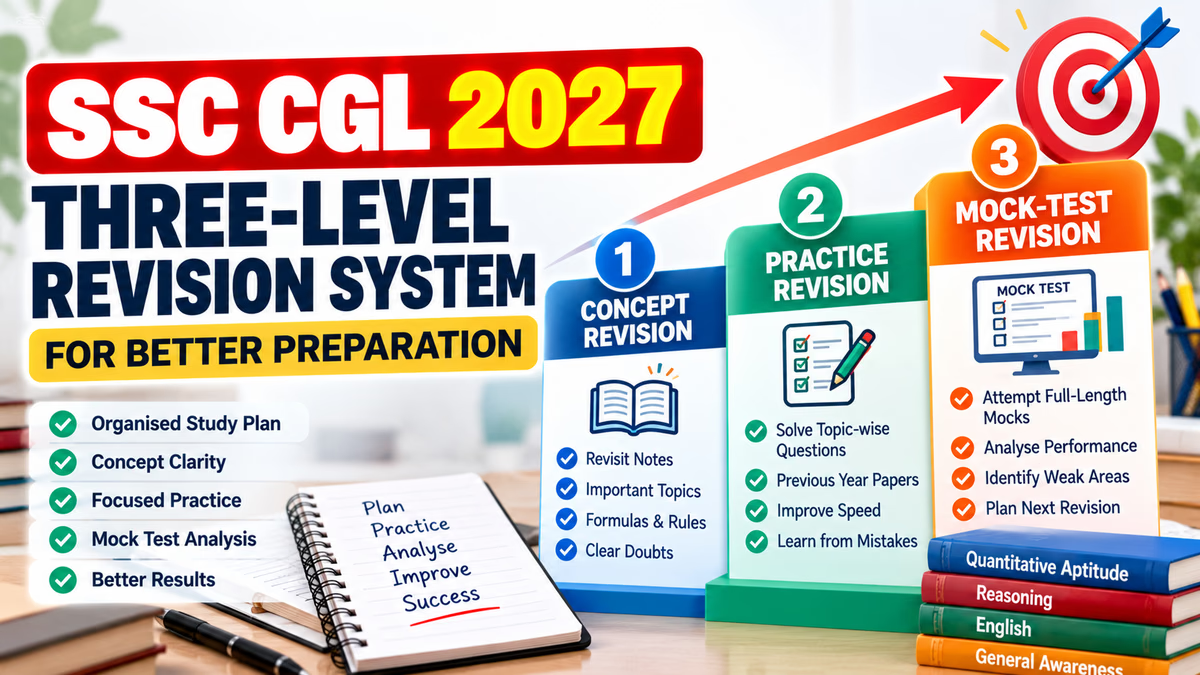
A three-level revision system gives candidates a structured way to organise their preparation. It combines concept review, question practice and performance-based revision so that aspirants can strengthen their understanding, correct mistakes and prepare more efficiently for the examination.
This method divides revision into three connected stages. Each stage has a different purpose, and the results of one stage help determine what to do next.
| Level | Main Purpose | Key Activity |
|---|---|---|
| Level 1: Concept Revision | Strengthen understanding of important topics. | Review notes, definitions, rules and formulas. |
| Level 2: Practice Revision | Apply concepts to different question types. | Solve topic-wise exercises and previous-year questions. |
| Level 3: Performance Revision | Identify weaknesses and improve exam strategy. | Review mock tests, analyse errors and revisit difficult topics. |
The three stages should work together rather than operate as separate activities. If a practice question exposes a conceptual gap, return to the first stage before attempting similar questions again.
The first stage focuses on understanding what you have already studied. Before attempting difficult questions, make sure you can recall the basic concepts, important rules and methods required for each topic.
For Quantitative Aptitude, this may involve revising formulas and mathematical relationships. In English, it could include grammar rules and vocabulary. Reasoning revision may focus on common patterns, while General Awareness requires reviewing important facts and concepts.
Avoid spending too much time rewriting notes you already understand. Focus on recalling information and resolving gaps in your knowledge.
If you are revising percentages, begin by understanding how a percentage represents a fraction of a quantity. Review percentage increase and decrease, and then check whether you can explain the basic method without referring to your textbook.
Knowing a concept does not automatically mean you can apply it correctly under examination conditions. The second stage converts theoretical understanding into practical problem-solving skills.
After reviewing a topic, attempt questions that test the same concept in different ways. Begin with straightforward exercises and gradually introduce questions that require multiple steps or careful reasoning.
Do not measure progress only by the number of questions completed. Consider whether you understand the methods, make fewer repeated mistakes and solve questions with appropriate accuracy.
After reviewing percentages, solve questions involving price changes, marks, population changes and other relevant applications. If you can solve basic examples but struggle with questions involving successive changes, revisit that specific concept and practise similar problems.
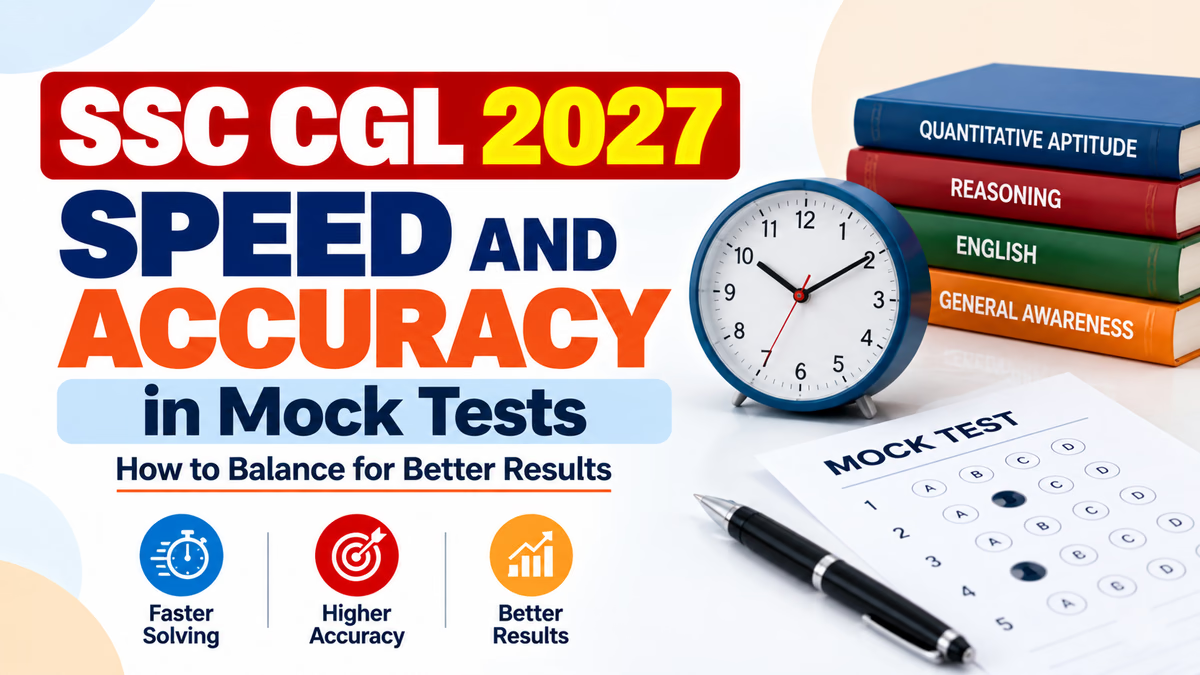
The third stage uses practice results to decide what deserves further attention. Sectional tests and full-length mock examinations can reveal weaknesses that may not be obvious during ordinary study sessions.
After a test, review more than the final score. Check which questions were incorrect, where you spent excessive time and whether mistakes occurred because of weak concepts, calculation errors or misreading.
Record important mistakes in an error log. For each entry, note the topic, reason for the error and the corrective action required. Use this record to decide which concepts and question types need another revision cycle.
Suppose you repeatedly make mistakes in profit and loss questions during mock tests. Review whether the problem involves the formula, the interpretation of the question or calculation accuracy. Return to the relevant concept, solve targeted questions and check your performance in a later test.
The main advantage of this system is that it creates a continuous learning cycle. Instead of following a fixed routine regardless of your results, you can adjust your next study session according to the difficulties you encounter.
This cycle can be repeated for individual topics across Quantitative Aptitude, Reasoning, English and General Awareness. The time spent at each stage should depend on your preparation level and the difficulty of the topic.
Prioritise topics according to the official syllabus and your actual performance rather than assuming that every topic requires equal revision time.
A weekly schedule helps you distribute study activities across the three stages. The following example can be adjusted according to your available time and syllabus coverage.
| Day | Suggested Activity |
|---|---|
| Monday | Review concepts and formulas from one weak topic. |
| Tuesday | Practise related questions and review incorrect answers. |
| Wednesday | Revise another subject and solve topic-wise exercises. |
| Thursday | Work on difficult topics identified during practice. |
| Friday | Attempt a sectional test and record performance. |
| Saturday | Analyse mistakes and revisit weak concepts. |
| Sunday | Review weekly progress and plan the next cycle. |
This is a suggested structure rather than a compulsory timetable. If you have limited time, prioritise the subjects and topics that need the most attention.
Keep your routine manageable and use evidence from your practice results to guide your next steps.
Q1. What is the main purpose of the first revision level?
A. Attempting only full-length tests
B. Strengthening understanding of concepts
C. Avoiding difficult topics
D. Memorising scores
Answer: B. The first stage focuses on understanding and recalling fundamental concepts.
Q2. What should candidates do after reviewing a topic?
A. Avoid solving questions
B. Move immediately to an unrelated subject
C. Apply the concepts through practice questions
D. Rewrite the entire textbook
Answer: C. Practice helps candidates apply what they have learned.
Q3. What is the main purpose of performance-based revision?
A. Ignoring incorrect answers
B. Identifying weaknesses and planning corrective action
C. Replacing concept study entirely
D. Increasing study hours without a plan
Answer: B. Reviewing performance helps identify areas that need further attention.
Q4. What should be recorded in an error log?
A. Only the final score
B. Only the examination date
C. The mistake, its cause and the corrective action
D. Unrelated study information
Answer: C. These details help candidates learn from repeated errors.
Q5. What should you do if a concept remains unclear during practice?
A. Continue guessing indefinitely
B. Return to the relevant concept and review it
C. Delete the topic from your notes
D. Stop revising the subject
Answer: B. Returning to the underlying concept helps address the source of the problem.
Q6. Why is active recall useful?
A. It tests whether information can be remembered without looking at notes
B. It eliminates the need to practise
C. It guarantees a particular score
D. It replaces the official syllabus
Answer: A. Active recall helps candidates assess what they can retrieve independently.
Q7. Should every topic receive exactly the same amount of revision time?
A. Yes, in every situation
B. No, time should reflect topic difficulty and individual performance
C. Only difficult topics should ever be studied
D. Only familiar topics should be revised
Answer: B. A flexible plan allows more attention to be given to areas that need it.
Q8. What is a useful step after a sectional test?
A. Ignore all mistakes
B. Analyse incorrect answers and time management
C. Delete the results
D. Repeat the same test without review
Answer: B. Test analysis helps determine what needs improvement.
Q9. What should happen when a previously difficult topic improves?
A. Stop monitoring it permanently
B. Never practise it again
C. Continue periodic review while focusing on remaining weaknesses
D. Remove all related notes
Answer: C. Periodic review helps maintain progress while allowing attention to shift to other areas.
Q10. Which sequence best describes the three-level method?
A. Guess, memorise, stop
B. Read, ignore, repeat
C. Understand, practise, evaluate
D. Test, skip, forget
Answer: C. The method moves from understanding to application and then performance evaluation.
A structured revision routine can make preparation more organised and purposeful. Begin by strengthening concepts, apply them through practice questions and use test results to identify what needs further attention.
The three-level method works best when it is repeated consistently and adapted to your progress. Rather than trying to revise everything in the same way, focus on understanding difficult concepts, correcting repeated mistakes and monitoring improvement over time.
For the latest syllabus, examination structure and marking rules, refer to the official SSC CGL notification applicable to your recruitment cycle.
